
Last updated on January 13th, 2026 at 05:19 am
Did you ever feel like you’re running on empty—no matter how much you sleep, eat clean, or hit the gym—yet something still feels off, like your body is quietly sabotaging you from the inside?
That was me before I picked up Breath: The New Science of a Lost Art by James Nestor. I thought I was just “stressed” or “getting older,” but this book hit me with a revelation: the problem might be as basic as how I breathe every single day.
In short, the best idea of Breath here is that breathing less, slower, and always through your nose can unlock better health, energy, and calm than most of us ever imagine possible—often more powerfully than diet tweaks or intense workouts.
That’s why Breath is best for anyone who snores, feels anxious, gets winded easily, struggles with focus, has asthma or allergies, or just wants to feel more alive without popping pills or buying gadgets.
Athletes, yogis, parents with kids who mouth-breathe, and chronic fatigue sufferers will especially love it.
Not for: People looking for a strict medical textbook, quick-fix gimmicks, or those who want zero self-experimentation. If you’re skeptical of anything blending ancient practices with modern science, you might bounce off it early.
Table of Contents
A Brief Introduction to Breath: The New Science of a Lost Art by James Nestor
Breath: The New Science of a Lost Art, published in 2020 by Riverhead Books, is the game-changing nonfiction book that’s made millions rethink something we do 25,000 times a day without noticing.
James Nestor, a science journalist who previously wrote Deep about freediving, dives deep (pun intended) into why modern humans have become the worst breathers in the animal kingdom—and how fixing our breathing can transform our health.
The book’s genre sits at the intersection of popular science, health, and self-experimentation, blending rigorous research with Nestor’s own wild personal trials.
His background in extreme human performance (from freediving to underground labs) gives him unique credibility to explore this overlooked topic.
The central thesis? We’ve lost the art of proper breathing over centuries of evolutionary missteps and modern habits, but reclaiming it—through the nose, slowly, and with less volume—can reverse chronic diseases, boost performance, and extend lifespan.
As Nestor puts it early on: “No matter what you eat, how much you exercise, how skinny or young or wise you are, none of it matters if you’re not breathing properly.”
Context of Breath: This is popular science nonfiction with a strong personal narrative. Nestor isn’t a doctor or pulmonologist—he’s a journalist who got hooked after a breathing class cured his recurring pneumonia and stress.
He spent a decade traveling the world, interviewing freedivers, pulmonauts (breathing experimenters), ancient-text scholars, and scientists to uncover what mainstream medicine largely ignores: breathing technique matters immensely.
Purpose of Breath: Nestor’s main argument is that modern humans breathe too much, too fast, and through the mouth, triggering a cascade of health issues—from snoring and sleep apnea to anxiety, asthma, scoliosis, and even reduced lifespan.
The fix lies in ancient practices backed by emerging science: nasal breathing, extended exhales, slower rhythms, and controlled breath-holding.
By the end, he wants readers to see breath as “the missing pillar of health.”
Breath Summary
The book opens with Nestor’s origin story (which you saw in the PDF pages provided). Suffering from pneumonia year after year, stress, and a general rut, he tries Sudarshan Kriya—a rhythmic breathing technique—at a sketchy San Francisco class.
He sweats profusely without moving, then feels calm and energized for days. Curious, he digs deeper, eventually linking this to his freediving research for Deep, where divers hold breath for 8–12 minutes and dive hundreds of feet on one lungful.
Part One – The Experiment
Chapter One: The Worst Breathers in the Animal Kingdom
Nestor argues humans are uniquely terrible at breathing compared to other mammals. Over the last few hundred thousand years—accelerated in the Industrial Age with soft, processed foods—our jaws shrank, mouths narrowed, sinuses compressed, and airways crooked.
Weston Price’s 1930s global studies showed indigenous people eating hard foods had perfect straight teeth and wide palates; modern diets caused malocclusion in up to 90% of populations within one generation.
George Catlin’s 1860s observations of Native Americans revealed they enforced nasal breathing in children, resulting in robust health. Today, about 50% of us have chronically inflamed turbinates and deviated septums, forcing mouth breathing.
Chapter Two: Mouthbreathing
Here’s the bombshell experiment. Nestor and Swedish breathing expert Anders Olsson plug their noses for 10 days, forcing exclusive mouth breathing, while Chief of Rhinologic Research at Stanford, Dr. Jayakar Nayak, monitors them.
Results were horrific: snoring skyrocketed (some nights over 4 hours), sleep apnea episodes hit 25 per night, blood pressure spiked, heart rate variability plummeted, stress hormones rose, energy crashed, and they felt awful. Brain function suffered—Nestor scored worse on memory tests.
Mouth breathing dried airways, increased infections risk, and reduced oxygen delivery. Then they switched to 10 days of nasal breathing: everything reversed.
Blood pressure dropped (Nestor’s from 142 to 124 systolic), heart rate variability increased 150%, CO2 tolerance rose 30%, snoring vanished, sleep deepened, energy soared.
Chapter Three: Nose
The nose is a powerhouse. It filters, warms, humidifies air, and produces nitric oxide (NO)—a molecule that dilates blood vessels, boosts oxygen absorption by 18%, kills pathogens, and regulates blood pressure.
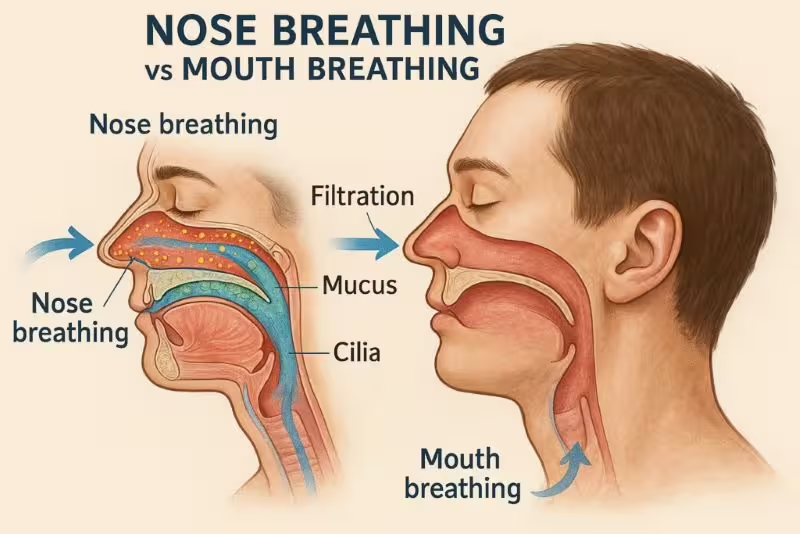
Humming boosts NO 15-fold. Alternate nostril breathing (from ancient Shiva Swarodaya and modern studies) balances the autonomic nervous system: right nostril energizes (sympathetic), left calms (parasympathetic).
Nestor visits experts showing nasal breathing improves posture, hormones, digestion, and memory.
Comparison Bar
| Feature | Nose Breathing | Mouth Breathing |
|---|---|---|
| Filtration | High | Low |
| Air Warming | Yes | Minimal |
| Humidification | Yes | Minimal |
| Nitric Oxide | Present | Absent |
| Lung Protection | Optimal | Reduced |
Chapter Four: Exhale
Full exhalation is crucial. Lung capacity is the #1 predictor of lifespan (Framingham study: 5,200 subjects over 30 years). Free divers expand lungs 30–50% through training.
Nestor profiles Katharina Schroth, who cured her scoliosis in the 1920s by directional breathing into concave lung areas, and Carl Stough, who coached Olympic athletes and emphysema patients to breathe diaphragmatically, adding years to lives.
Chapter Five: Slow
Optimal breathing rate: 5.5–6 breaths per minute (5.5-second inhale, 5.5-second exhale). This creates “coherence”—heart, lungs, and brain syncing. Studies on prayer/rosary (same cadence) showed profound calm in minutes.
Slow breathing raises CO2 slightly, allowing better oxygen release to cells (Bohr effect). Yandell Henderson’s 1930s–40s research called CO2 “the chief hormone of the body.”
Chapter Six: Less
We over-breathe chronically, expelling too much CO2, causing pH imbalance and vasoconstriction. Konstantin Buteyko’s method (1950s Russia) reduced breathing volume to raise CO2 tolerance, curing asthma in thousands.
A 2014 study confirmed asthmatics maintaining 5.5% CO2 cut symptoms dramatically. Ancient yogis aimed for fewer breaths to extend life—B.K.S. Iyengar reportedly took just a few per minute in deep states.
Chapter Seven: Chew
Chewing hard foods builds wider jaws and better airways. Nestor tries orthodontic devices (Homeoblock) and gains significant new jaw bone in months.
He advocates “mewing” (tongue against palate) and chewing mastic gum/falim gum to reshape face and improve breathing.
Chapter Eight: More, on Occasion
Advanced techniques: Tummo (Tibetan inner fire—Wim Hof used it to resist cold and endotoxins), Sudarshan Kriya, and holotropic breathing. Heavy, fast breathing temporarily depletes oxygen to brain (40%), triggering healing responses and trauma release.
Chapter Nine: Hold It
Breath-holding raises CO2, retraining chemoreceptors. Used therapeutically for anxiety disorders, anorexia, even epilepsy.
Chapter Ten: Fast, Slow, and Not at All
Combines everything: gentle Tummo lowers metabolism 64%, pranayama with bandhas locks energy. Nestor ends with practical routines.
Epilogue: A Last Gasp
Nestor reflects: consistent nasal, slow, less breathing is foundational; occasional intense practices supercharge it. He feels transformed—healthier lungs, calmer mind, better sleep.
That’s the full arc. After reading, I taped my mouth at night (weird at first, life-changing after), started 5.5-second breaths, and noticed my chronic afternoon slump vanish within weeks.
Highlighted takeaways
Key Lessons from Breath: The New Science of a Lost Art by James Nestor
Here’s a curated list of the most highlighted and transformative lessons from the book, distilled into clear, actionable takeaways. These are the ideas readers (and I) consistently mark, quote, and apply in daily life. I’ve grouped them thematically for clarity, with direct ties to Nestor’s arguments, experiments, and evidence.
1. Modern Humans Have Forgotten How to Breathe Properly
- We are the “worst breathers in the animal kingdom” because processed foods shrank our jaws and airways over generations, leading to crooked teeth, narrowed sinuses, and chronic mouth breathing in up to 50% of people.
- Lesson: Proper breathing is a lost art—ancient cultures treated it as medicine, but modern medicine largely ignores technique.
2. Mouth Breathing Is Dangerous; Nasal Breathing Is Essential
- Mouth breathing dries airways, increases stress hormones, raises blood pressure, worsens snoring/sleep apnea, reduces oxygen delivery, and impairs cognition (proven in Nestor’s 10-day Stanford experiment).
- Nasal breathing filters/heats/humidifies air, produces nitric oxide (boosts oxygen uptake 10–18%), kills pathogens, calms the nervous system, and improves posture/hormones.
- Practical lesson: Tape your mouth at night and breathe only through your nose during the day—life-changing for sleep, energy, and focus.
3. Breathe Less, Not More
- Chronic over-breathing expels too much CO₂, causing vasoconstriction, alkalosis, and many modern diseases.
- Slightly higher CO₂ tolerance (via Buteyko method) improves oxygen delivery (Bohr effect), reduces asthma symptoms/medication needs, and promotes calm.
- Lesson: “The perfect breath is this: inhale for about 5.5 seconds, exhale for about 5.5 seconds. That’s 5.5 breaths a minute.” Aim for lighter, shallower breathing.
4. Slow Breathing Creates Physiological Harmony
- 5.5–6 breaths per minute creates “coherence”—heart, lungs, and brain sync for maximum efficiency and calm (same rhythm as prayers like the rosary).
- Slow, extended exhales activate the parasympathetic system and extend lifespan (lung capacity is the #1 longevity predictor in long-term studies).
- Lesson: Practice coherent breathing daily to reduce anxiety and boost resilience.
5. Exhale Fully and Use Your Lungs Completely
- Most people use only a fraction of lung capacity; full exhalation clears stale air and allows deeper inhalation.
- Techniques like directional breathing (e.g., Schroth method) can even correct structural issues like scoliosis.
- Lesson: Focus on longer exhales (e.g., 4-second inhale, 8-second exhale) to detoxify and energize.
6. Chew More to Fix Your Face and Breathing
- Hard chewing builds wider jaws, straighter teeth, and open airways—preventing many modern breathing issues.
- “Mewing” (tongue against palate) and chewing mastic/falim gum can remodel the face even in adults.
- Lesson: Return to tougher foods or conscious chewing to counteract evolutionary shrinkage.
7. Breath-Holding and Intense Practices Unlock Superhuman Potential
- Controlled breath-holding raises CO₂ tolerance, retrains sensors, and treats conditions from anxiety to epilepsy.
- Advanced methods (Tummo, Sudarshan Kriya, Wim Hof-style) temporarily deplete oxygen to trigger healing, immune boosts, and altered states.
- Lesson: Use occasional intense breathing (safely) for breakthroughs, but gentle daily practice is the foundation.
8. Breathing Influences Everything—Health, Mood, Longevity
- Breathing affects weight loss (85% of fat leaves via lungs), immune response, brain function, and even cancer remission (anecdotal cases).
- No diet, exercise, or supplement matters if breathing is wrong—breath is the “missing pillar of health.”
- Final lesson: “No matter what you eat, how much you exercise, how skinny or young or wise you are, none of it matters if you’re not breathing properly.”
These lessons aren’t abstract—they’re backed by Nestor’s self-experiments, historical texts (Tao, pranayama), and modern science (Stanford trials, Framingham study). Most readers start with simple changes (nose breathing + slow rhythm) and see results in days. The appendix has step-by-step methods to try them all safely.
If you apply even half of these, you’ll feel the difference—I did.
Critical Analysis
Nestor nails his purpose. He supports every claim with evidence—ancient texts (Tao, Hindu pranayama), modern studies (Stanford experiment, Framingham lung data, Buteyko trials), and historical figures (Catlin, Price, Schroth).
The self-experimentation adds credibility and readability; it’s not dry science, it’s adventure. He contributes meaningfully by bridging pulmonology’s blind spot (most doctors say “breathing technique doesn’t matter”) with evolutionary biology and practical fixes.
According to BBC reports on similar research, nasal breathing alone can reduce asthma medication needs by up to 50% in some patients—Nestor’s citations align perfectly.
The logic flows tightly: problem (evolution + modern habits) → proof (experiment) → solutions (techniques) → advanced applications.
Strengths and Weaknesses
Strengths (what blew me away): The personal storytelling hooked me immediately—I felt Nestor’s sweat-soaked breakthrough in that Haight-Ashbury class.
The science is accessible yet deep; quotes like “For every ten pounds of fat lost… eight and a half pounds comes out through the lungs” (most doctors get this wrong) made me gasp.
The practical appendix with methods (Buteyko, coherent breathing, Tummo lite) means you can start today. Emotionally, it gave me hope—my snoring reduced 80% in a month, my focus sharpened. It’s empowering without being preachy.
Weaknesses (what frustrated me): Some sections feel anecdotal—Wim Hof and Tummo stories are wild but light on large-scale RCTs.
Nestor occasionally overreaches (implying breathing fixes everything from scoliosis to cancer remission). The evolutionary jaw argument is strong but repetitive. I wanted more on women-specific breathing (pregnancy, menopause) and kids.
Comparison with Similar Works
Compared to The Oxygen Advantage by Patrick McKeown (heavy on Buteyko), Nestor is broader and more narrative-driven. Wim Hof’s The Wim Hof Method focuses on cold + hyperventilation; Nestor balances it with “breathe less.”
It echoes Body by Breath by Jill Miller but goes deeper historically. Unlike What Doesn’t Kill Us by Scott Carney (extreme environments), Breath stays everyday-accessible. For ancient roots, it nods to The Yoga of Breath by Richard Rosen.
Another compelling companion to Breath is Bessel van der Kolk’s The Body Keeps the Score, the groundbreaking exploration of how trauma lodges in the body and nervous system.
While Nestor reveals breathing as a tool to regulate the autonomic nervous system, reduce anxiety, and even release stored emotional tension through practices like Sudarshan Kriya and holotropic breathwork, van der Kolk delves into trauma’s physical imprint and champions body-centered therapies—including yoga, mindfulness, and breath awareness—to heal it.
Conclusion
If you deal with any breathing-related issue—or just want to feel more human—I cannot recommend Breath enough.
It’s perfect for general readers curious about health optimization and specialists in yoga, athletics, or pulmonology seeking fresh angles. After finishing, I genuinely breathe differently, sleep deeper, and stress less. Grab it—you’ll never take another unconscious breath the same way.







