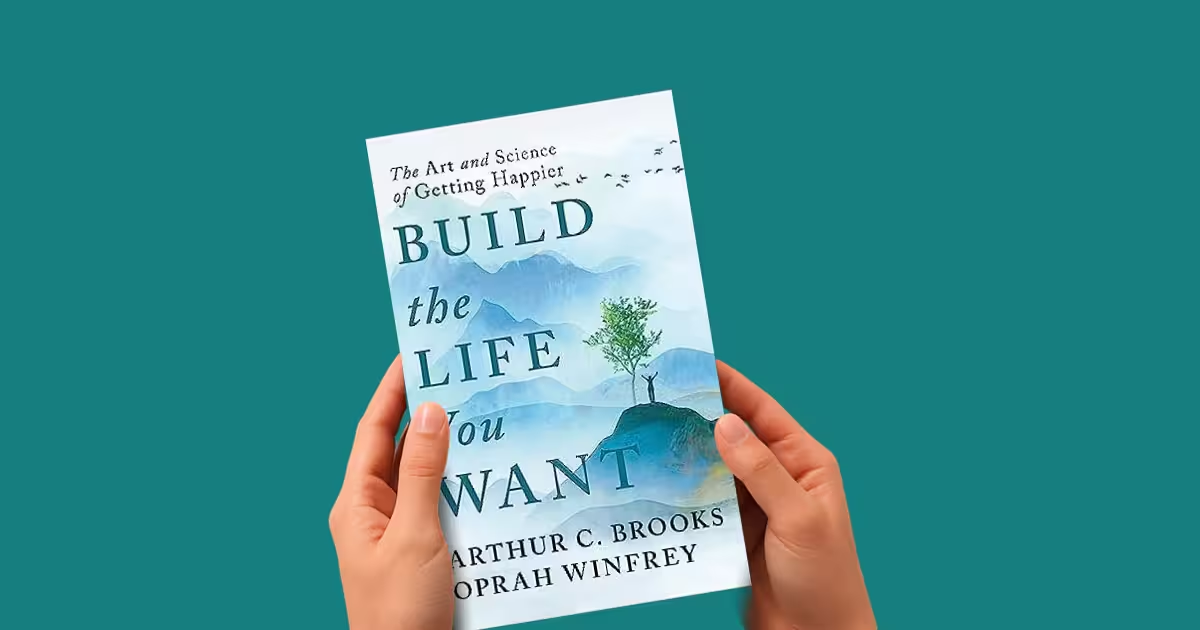
Ever wonder why you feel like true happiness is always a moving target you can never quite hit? Build the Life You Want by Arthur C. Brooks and Oprah Winfrey helps you how to obtain true happiness in your life.
Build the Life You Want says that you cannot achieve a permanent state of pure happiness, and that is actually the best news you will hear today. By understanding the “macronutrients” of happiness (enjoyment, satisfaction, and purpose) and accepting your natural negative emotions, you can take the wheel of your own life. Using metacognition, you can manage your reactions instead of letting your feelings drive your behavior. Stop waiting for your circumstances to improve and start building your life right now.
Build the Life You Want is best for anyone who feels stuck waiting for their life circumstances to improve before they can be happy. If you love deep, science-backed human psychology blended with practical self-management tools, you will benefit immensely.
Not for readers looking for a quick fix, toxic positivity, or a magic formula to completely eliminate pain from their lives. If you want a book that tells you just to “think positive,” you will bounce right off this one.
Table of Contents
1. Introduction
The book is Build the Life You Want: The Art and Science of Getting Happier by Arthur C. Brooks and Oprah Winfrey, published by Portfolio/Penguin in 2023.
Context:
Build the Life You Want is a non-fiction guide focused on psychology, self-realization, and emotional self-management. The book is about practical strategies for personal fulfillment.
Arthur C. Brooks is a Harvard University professor who teaches courses on happiness and writes a regular column for The Atlantic. Oprah Winfrey is a global media leader who spent twenty-five years hosting The Oprah Winfrey Show, where she witnessed every kind of human happiness and unhappiness imaginable.
Purpose:
The central thesis of the book is that happiness is not a destination, but a direction. You cannot find complete happiness on this side of heaven, but no matter where you are in life, you can all be happier.
You do not have to wait for your circumstances to change; you can manage your emotions and build a better life starting from the inside out.
2. Background
The book is born from a shared mission. Brooks transitioned his career at age fifty-five to write, speak, and teach about the science of happiness because it was naturally hard for him, and he wanted more of it.
Winfrey realized she had been discussing these exact concepts of purpose and meaning for decades on her show. They teamed up to democratize the amazing science of happiness for people in all walks of life.
3. Build the Life You Want Summary
To ensure you have all the necessary elements of the book right here, I am summarizing the argument point by point. Giving away the facts and preempting the thesis is essential for a deep understanding.
The Secret to Getting Happier
The journey begins with the story of Albina Quevedo, Brooks’s mother-in-law. Despite living through the brutal Spanish Civil War and being abandoned by her husband to raise three kids in poverty, she managed to become progressively happier over her life.
Albina’s secret was not natural optimism. At age forty-five, she realized she had been waiting for the outside world to change. She shifted her focus to the one person she could control: herself. She enrolled in college, became a teacher, and built a life on four pillars: family, friendship, work, and faith.
Happiness Is Not the Goal, and Unhappiness Is Not the Enemy
Most people hold two mistaken beliefs: they think they can be completely happy, and they believe their circumstances keep them stuck in unhappiness. The authors clarify that total happiness is impossible, and searching for it is like searching for El Dorado.
- Happiness is defined by three “macronutrients”: enjoyment, satisfaction, and purpose.
- Enjoyment is not just pleasure; it requires communion and consciousness.
- Satisfaction comes from accomplishing a goal through work and sacrifice, though it is temporary due to the “hedonic treadmill”.
- Purpose is the most important, and it almost always entails suffering.
Your Unique Mix of Happiness and Unhappiness
Positive and negative emotions are separable and can exist simultaneously. You can test your natural mix using the Positive and Negative Affect Schedule (PANAS) test. Depending on your scores, you fall into one of four categories:
- Mad Scientist: High positive, high negative.
- Judge: Low positive, low negative.
- Cheerleader: High positive, low negative.
- Poet: Low positive, high negative.
Every profile is a gift, and knowing yours helps you manage your natural tendencies.
Appreciating Bad Feelings
The human brain specifically reserves space to process negative emotions because they keep us alive. This negativity bias means we pay more attention to threats than treats. Regret, for instance, allows us to learn from past mistakes by imagining a different outcome. Without unhappiness, you would not survive, learn, or create.
The Power of Metacognition
Psychiatrist Viktor Frankl noted that we have the freedom to choose our attitude in any given set of circumstances. This is the essence of metacognition: experiencing your emotions consciously, separating them from your behavior, and refusing to be controlled by them.
- When a threat appears, your amygdala reacts in 0.074 seconds with fear.
- Metacognition moves the experience from the limbic system into your prefrontal cortex, the part of the brain that governs decision-making.
- Practicing metacognition involves observing your feelings without acting on them immediately. Counting to thirty before sending an angry email allows your prefrontal cortex to catch up.
Rewriting Your Past
Memories are not perfect video recordings; they are reconstructed each time you recall them. Since your current emotional state influences how you reconstruct a memory, you can consciously rewrite the story of your past. Journaling your positive memories and finding meaning in your painful experiences helps you interrupt negative feedback loops.
Choosing a Better Emotion
The authors use the example of caffeine. Caffeine works by plugging into adenosine receptors in the brain, blocking the chemical that makes you tired. In the same way, you can substitute a better emotion for a negative one. You do not have to accept the first emotion your brain produces.
3. Build the Life You Want Analysis
Build the Life You Want is a poignant, practical, and highly intelligent manual for modern living. Like the best psychological writing found in The Guardian or The New York Times, it strips away the magical thinking surrounding self-help.
The authors successfully support their arguments by blending neuroscience with human stories. By explaining the triune brain model and the role of the amygdala versus the prefrontal cortex, they give logical reasons for why we react the way we do.
I was particularly impressed by the explanation of the PANAS test and the four distinct emotional profiles. This framework alone contributes meaningfully to the field of personal development because it removes the guilt of not being a natural “Cheerleader”.
The book fulfills its stated purpose beautifully. It provides the exact tools needed to manage emotional weather rather than wishing for a different climate.
From a human perspective, reading this feels like sitting down with a very smart friend who finally explains why your brain tortures you, and then hands you the keys to fix it.
4. Strengths and Weaknesses
Strengths:
- The concept of the three macronutrients (enjoyment, satisfaction, purpose) is highly compelling. It perfectly explains why chasing empty pleasure leads nowhere.
- The book validates negative emotions. It makes it clear that feeling sad or angry does not mean you are failing at life.
- The writing is conversational and directly applicable. The practical exercises, like keeping a journal with a one-month and six-month follow-up for painful experiences, are highly innovative.
Weaknesses:
- Some readers might find the neurological explanations a bit dense, even though the authors try to simplify them.
- The concept of substituting emotions (like the caffeine metaphor) sounds slightly easier on paper than it is to practice in real life.
7. Comparison with Similar Other Works
Books like Man’s Search for Meaning by Viktor Frankl share the core message that purpose often entails suffering and that we choose our attitude in any circumstance.
However, Build the Life You Want takes these heavy philosophical concepts and pairs them with modern neuroscience and daily actionable steps. It is more clinical than The Secret and more warmly human than Thinking, Fast and Slow.
If Can’t Hurt Me will show you how to break free from physical and mental limits through sheer force, Build the Life You Want shows you how to do it through emotional intelligence and metacognition.
8. Conclusion
I highly recommend this book. Who will actually benefit? Anyone who feels chronically stressed, unhappy with their job, or trapped in a loop of waiting for the “right time” to be happy.
It is suitable for both general audiences looking for peace and specialists in digital content creation wanting a deeper understanding of human motivation.
You have everything you need right there within you today. Stop waiting.