
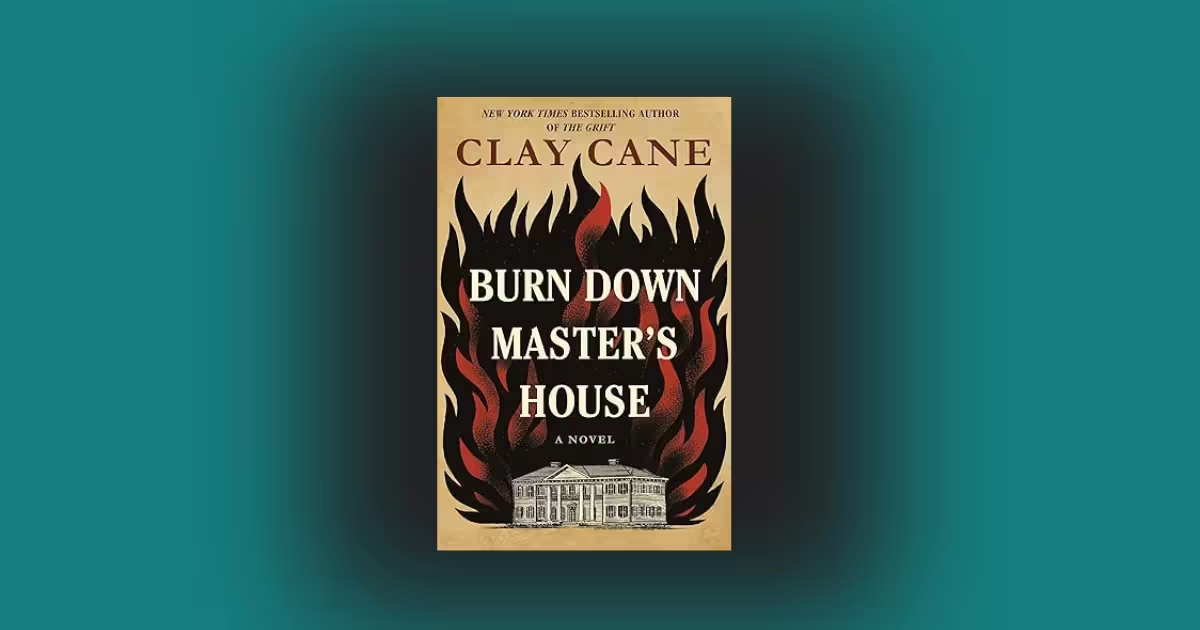
Ever feel like the history books handed you a sanitized script where the “good guys” were always white saviors and the enslaved were just silent victims waiting to be freed? Burn Down Master’s House is a scorching reclamation of agency that rewrites the narrative of American slavery, showing us that freedom wasn’t given by a proclamation—it was seized by poison, fire, and unyielding resistance.
Based on the real-life, often-erased stories of Charity Butler, who fought for her freedom in court against future abolitionist Thaddeus Stevens, and the chilling historical reality of Black slave owners like Nat Butler.
Burn Down Master’s House is best for readers who crave historical fiction that refuses to look away, fans of Django Unchained or The Birth of a Nation (2016), and anyone tired of the “white savior” trope.
Not for: Those seeking a comfortable, romanticized version of the Antebellum South or readers easily triggered by graphic depictions of torture and sexual violence.
Table of Contents
1. Introduction
Title: Burn Down Master’s House Author: Clay Cane
Publication Details: Published by Dafina (Kensington Publishing Corp.), January 27, 2026.
Clay Cane’s Burn Down Master’s House is not just a novel; it is a literary molotov cocktail thrown at the “Lost Cause” narrative. While many historical fictions tread lightly around the psychological complexities of slavery, Cane dives headfirst into the fire.
He constructs a narrative that is both a thriller and a historical corrective, ensuring that the names of the forgotten—Henri, Luke, Josephine, Charity—are etched into our collective memory, not as victims, but as warriors.
2. Background
The novel is set against the backdrop of the Antebellum South, spanning from the oppressive cotton fields of Virginia to the legal battlegrounds of Pennsylvania and the decaying plantations of South Carolina.
But the real context here is the erasure of Black resistance. As Cane notes in his introduction, misinformation is a tool of control. We often hear that slavery ended because of Abraham Lincoln or the “better angels” of the North.
This book argues that slavery ended because enslaved people made the institution untenable through sabotage, revolt, and creating a state of constant terror for their oppressors.
The narrative also bravely tackles the “third rail” of Black history: Black slave owners. By including a character based on historical figures like Nat Butler and William Ellison, Cane complicates the racial binary, showing how the institution of slavery was so pervasively evil it could corrupt even those who had once worn its chains.
3. Burn Down Master’s House Summary
Part I: The Fire of Goochland (Luke and Henri)
The story opens in the suffocating squalor of a cabin in Goochland, Virginia. Henri, a young man stolen from Africa who still remembers the smell of his village and the face of his mother, is ordered to breed with a woman named Suzie.
When Henri refuses—his body physically unable to perform the act of creating another slave for his master—he is punished not by the lash, but by being sold away to the notorious Magnolia Row plantation.
Magnolia Row is a place of psychological warfare run by the sadistic Montgomery Ragland and his vacuous, cruel wife, Mistress Kitty. Here, Henri meets Luke, a young man born on the plantation who serves as the personal valet (and victim) of Ragland’s obese, depraved son, Junior. Unlike Henri, Luke has never known freedom, but he possesses a quiet, simmering intelligence.
The two men form a bond that transcends friendship. In a world designed to strip them of humanity, they find love in the hidden corners of the plantation—by the riverbank, where they steal moments of intimacy that feel like “an act of God”. This love becomes their fuel.
The turning point comes when a fellow enslaved man, Solomon, attempts to escape and is recaptured. The Raglands torture Solomon in front of the entire plantation, blinding him in one eye with a drawing pin and severing his toe. This brutality radicalizes Luke and Henri.
They attempt their own escape, inspired by the spirit of Luke’s dying mother, Miss Emily, whom Luke mercy-kills to save her from Ragland’s cruelty.
Their escape fails. They are dragged back to Magnolia Row, where Ragland and Junior inflict horrific punishments—cutting off Luke’s ear and castrating Henri.
But instead of breaking them, the violence crystallizes their resolve. On their nineteenth birthday, they enact a plan of total annihilation. They break into the big house, slaughtering Junior with a broadax, killing Mistress Kitty, and blinding Ragland before killing him.
In the chaos, Henri is mortally wounded. As he dies in Luke’s arms, he gives a final command: “Burn it down, Luke”. Luke, aided by a house servant named Ruby and a young girl named Josephine, sets the entire plantation ablaze.
They watch the “master’s house” collapse, a symbol of their reclaiming of power. The legend of Magnolia Row spreads across the South, inspiring terror in white slaveholders and hope in the enslaved.
Part II: The Poison of the Baynards (Josephine)
Years later, the narrative shifts to Josephine, the little girl who watched Magnolia Row burn. Now eighteen, she is enslaved by the Baynard family—Lady Baynard and her drunkard husband, Lafayette. Josephine has learned well from Ruby and Luke: silence is a weapon.
The Baynards are grotesque figures of gluttony and abuse.
Lafayette sexually assaults Josephine, while Lady Baynard, aware of the abuse, punishes Josephine for it. After a brutal whipping, Josephine connects with the plantation’s matriarch, Old Mama Bess.
Bess reveals she has been hoarding arsenic (“bad medicine”) inside the kitchen clock for years, waiting for the “right one” to use it.
Josephine realizes she is that one. On a Sunday following Independence Day, she prepares a sumptuous feast for the Baynard family—roast pork, greens, and honey-drizzled cornbread—all laced with arsenic. She watches with cold detachment as the entire family, including the children who tormented her, convulse and die at the dinner table.
When the Baynards are dead, the other enslaved people enter the house, not to mourn, but to witness.
They drag the bodies to the center of the room, reclaiming the space. Josephine declares, “This house was built on our blood. Tonight, it burns with yours”. They flee into the night, eventually finding freedom in the North. Josephine raises a young boy named Larkin, teaching him the lessons of Magnolia Row: “Don’t let them take what they can’t touch”.
Part III: The Betrayal of Law (Charity)
The story moves to Charity, a woman enslaved in Maryland who is rented out to a white seamstress named Miss Clara. Clara is a complex figure—a Northern woman who married a Southern slaveholder and was left destitute. She relies on Charity’s labor but also forms a strange, uneven alliance with her, even teaching Charity to read using Jane Austen’s Sense and Sensibility.
During their travels to Gettysburg, Pennsylvania, Charity meets Larkin Butler—the boy Josephine raised, now a grown man and a free blacksmith.
They fall in love, and Larkin educates Charity on the “Gradual Abolition Act,” which states that any enslaved person residing in Pennsylvania for more than six months is free. Charity meticulously tracks her days. When she hits the six-month mark, she declares her freedom to Miss Clara and refuses to return to Maryland. Clara, in a moment of redemption, allows it.
Charity and Larkin build a beautiful life in Gettysburg, having two daughters, Harriet and Sophia. But their peace is shattered when Charity’s former owner, Norman Bruce, tracks her down. Bruce hires a powerful lawyer to argue for her return: Thaddeus Stevens.
This is the book’s most gut-wrenching twist. Thaddeus Stevens, historically known as a champion of abolition, here represents the slaveholder to advance his legal career. He argues that Charity’s residence wasn’t “continuous,” winning the case on a technicality. The court orders Charity and her daughters back into slavery. In the courtroom, Larkin rages at Stevens, calling his law “wicked”.
Back on the Bruce plantation, Charity falls into a catatonic state. Her daughters, however, carry the fire of their parents. When Norman Bruce attempts to rape Harriet in the blacksmith shed, the sisters fight back.
They beat him with hammers and burn him with a branding iron. Charity snaps out of her stupor, entering the shed to finish the job. They dismember Bruce and burn his remains in the forge.
Using a secret letter from Miss Clara, they escape to a safe house marked by a white chimney, finding true freedom at last.
Part IV: The Traitor (Nathaniel)
The final section introduces Nathaniel William, a Black man in Charleston, South Carolina, who bought his freedom and then became a slave owner himself.
Nathaniel is a monster of his own making, believing that owning slaves makes him equal to white men. He lures runaways to his plantation with promises of safety (“We family here”), only to sell them back to their masters for a profit.
As the Civil War nears its end, the social order crumbles. Nathaniel’s cruelty escalates as he realizes the white elite, represented by the sinister Minister Woodward, will never accept him. He is ostracized and indebted.
The reckoning arrives in the form of Black Union soldiers—specifically, Luke (from Part I) and Larkin (from Part III). They converge on Nathaniel’s plantation.
Solomon, the man blinded at Magnolia Row thirty years prior, is also there, enslaved by Nathaniel. The reunion between Luke and Solomon is heartbreaking and triumphant.
The soldiers and the enslaved put Nathaniel on trial. They nail him to the front door of his own big house—a crucifixion of the “master”. When Minister Woodward rides up to collect a debt, they ambush him, burying him alive in a grave filled with the bodies of the enslaved he helped oppress.
Luke, Solomon, and the others burn Nathaniel’s house to the ground, with Nathaniel still nailed to the door, alive. As the flames consume him, Luke declares that they must burn down every foundation of oppression, not just the house.
4. Burn Down Master’s House analysis
4.1. Burn Down Master’s House Characters
Luke & Henri: They are the heartbeat of the novel. Their romance challenges the historical erasure of queer love among the enslaved. Henri is the spark—the connection to African roots and uncompromised rebellion. Luke is the vessel who carries that fire forward. His transformation from a victim of sexual abuse to a Union soldier and executioner of justice is the novel’s most powerful arc.
Josephine: She represents the loss of innocence and the cold logic of survival. She weaponizes domesticity (cooking, cleaning) to destroy her oppressors. Her act of poisoning the Baynards is portrayed not as murder, but as a military strike.
Thaddeus Stevens: Cane boldly paints Stevens as a villain in Charity’s story. This complicates the narrative of the “white ally.” Stevens prioritizes legal ambition over human life, showing how systemic racism is upheld even by those who claim to oppose it.
Nathaniel William: A terrifyingly complex villain. He embodies the cycle of abuse—the oppressed becoming the oppressor to survive. He is a tragic figure who sold his soul for proximity to whiteness, only to find that whiteness never loved him back.
4.2. Burn Down Master’s House Themes and Symbolism
Fire: Fire is the central symbol of purification and justice. It destroys Magnolia Row, the Baynard family (internally via arsenic/fever), Norman Bruce (in the forge), and Nathaniel’s estate. It symbolizes that the old world cannot be reformed; it must be incinerated.
The “House”: The title refers to the physical plantation house, but also the “house” of American systemic racism. Burning it down means dismantling the entire structure, including the laws (Thaddeus Stevens) and the religion (Minister Woodward) that uphold it.
Complicity: The novel is brutal on complicity. Miss Clara, the white women who watch abuse happen, and the Black overseer Nathaniel are all held accountable. There are no innocent bystanders in a system of terror.
5. Evaluation
Strengths: Clay Cane’s prose is electric. He avoids the “torture porn” trap by focusing on the response to violence rather than just the violence itself. The choice to exclude the N-word forces the reader to focus on the actions and emotions rather than getting snagged on a slur. The weaving of real historical figures (Josephine, Charity) into a cohesive narrative is masterful.
Weaknesses: The pacing in the final section (Nathaniel) feels slightly rushed compared to the slow-burn tension of the first two parts. The convergence of all the characters (Luke finding Solomon and Larkin) relies on heavy coincidence, though it provides necessary emotional closure.
Impact: This book made me angry, then triumphant. It reframes American history not as a tragedy, but as a war that is still being fought. It forces you to question every “hero” you learned about in school.
Comparisons: It sits alongside The Confessions of Nat Turner (but with more agency for the Black characters) and The Prophets by Robert Jones Jr. (regarding queer love in slavery). It shares the visceral revenge energy of Tarantino’s Django Unchained but with far more historical weight and sorrow.
6. Personal Insight with Educational Relevance
The most chilling aspect of this book is its relevance to the modern “culture wars” over education. In the introduction, Cane references the banning of books and the rewriting of curriculum to suggest slavery had “benefits”. Burn Down Master’s House is the antidote to that poison.
The story of Thaddeus Stevens is particularly instructive. We often teach history in binaries: North vs. South, Abolitionist vs. Slaveholder.
Cane shows us the gray areas—how “allies” can weaponize the law against the vulnerable for their own gain. In a contemporary context, this mirrors debates about performative allyship and systemic inequality within legal structures.
The lesson here is that law is not synonymous with justice. Just as Charity shouted in the courtroom, laws can be “wicked,” and true justice often requires breaking them.
7. Burn Down Master’s House quotes
- “Slavery didn’t end because President Abraham Lincoln had a profound love for Black people… Slavery… began to die on paper because the enslaved people said ‘no more’ and the country had no choice.”
- “Don’t let them take what they can’t touch.”
- “This house was built on our blood. Tonight, it burns with yours.”
- “You cannot make a slave… It was built on the breaking of spirits… But no whip, no chain, no branding iron could turn a soul into property.”
- “If negroes wanted to be free, they would… There was no such thing as oppression. Just fools too sorry to lift their own heads out of the dirt.” (Nathaniel’s internalized racism)
8. Conclusion
Burn Down Master’s House is a literary sledgehammer. It is violent, uncomfortable, and absolutely necessary. Clay Cane has written a novel that refuses to beg for empathy; instead, it demands respect for the strategic, brutal, and loving resistance of the enslaved.
Recommendation: This is essential reading for anyone interested in American history, social justice, or powerful character-driven drama. If you loved The Underground Railroad by Colson Whitehead but wanted more fire and fury, pick this up immediately.
Final Reflection: The book challenges us to look at the “houses” we still live in today—structures of inequality built on old foundations—and asks if we have the courage to burn them down and start over.







