
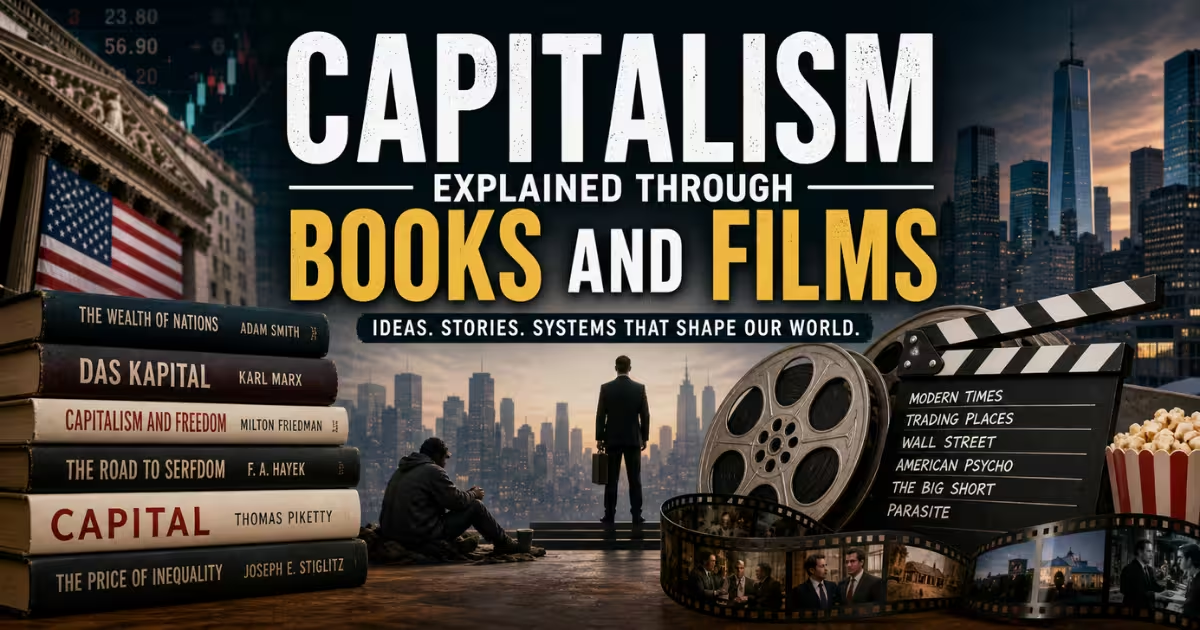
Capitalism is one of those words people use constantly, often angrily, sometimes proudly, and frequently without slowing down to define it. For some, capitalism means freedom: the right to own property, start a business, choose work, compete, invest, and improve one’s life. Here, capitalism explained through books and films
For others, capitalism means inequality, exploitation, burnout, consumerism, and a world where everything sacred eventually receives a price tag.
Both views are too simple on their own. Capitalism is not just a theory in economics textbooks.
It is also a lived atmosphere: the alarm clock before work, the stock ticker, the shopping mall, the factory floor, the gig app, the luxury apartment, the unpaid internship, the family business, the mortgage crisis, the dream of escape.
That is why the best way to understand capitalism may not be through economics alone, but through books and films on capitalism—through the arguments of writers and the images of cinema.
At its simplest, capitalism is usually described as an economic system where private actors own and control property, prices are shaped by supply and demand, and profit acts as a central motive.
The IMF’s explanation emphasizes private property, self-interest, competition, decentralized price-setting, freedom of choice, and a limited but necessary role for government as major pillars of capitalism.
But those pillars do not tell the whole story. Books explain the architecture. Films show what it feels like to live inside it.
Table of Contents
Why Books and Films Explain Capitalism So Well
Books are useful because capitalism is partly an argument about systems.
Adam Smith, Karl Marx, Friedrich Hayek, Milton Friedman, John Maynard Keynes, Thomas Piketty, Naomi Klein, and Joseph Stiglitz are not merely writing about money.
They are asking what kind of society emerges when markets, labor, property, capital, law, and ambition are organized in particular ways.
Films are useful because capitalism is also a drama.
It has winners and losers, symbols and rituals, temptations and humiliations. A book can explain wage labor; a film can show the body exhausted by the machine.
A book can explain inequality; a film can place one family in a semi-basement and another in a glass mansion. A book can explain speculation; a film can make a mortgage-backed security feel like a loaded gun.
This is where the phrase capitalism books films becomes more than a term. It names a method. To understand capitalism, read the theorists, then watch what artists do with their theories. The result is clearer, sharper, and harder to ignore.
Adam Smith: Capitalism as Order Without Central Command
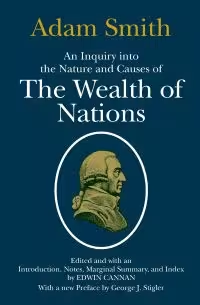
Any serious journey into capitalism begins with Adam Smith’s The Wealth of Nations. Published in 1776, the book helped lay the foundation for classical economics and modern market thought.
The Wealth of Nations is a work spanning political economy, moral philosophy, and social science, with a central argument that national wealth grows from productive labor, specialization, free markets, and limited government interference.
Smith is often caricatured as the prophet of greed, but that is a lazy reading.
He was not saying that selfishness magically turns into goodness.
He was arguing that under certain conditions—competition, justice, rules, trust, and restraint—self-interest can produce social benefits no single planner could design. The market, in this view, is a coordination mechanism. It allows millions of people, most of whom never meet, to exchange goods, services, skills, and information.
The film equivalent of Smith is not necessarily a single movie, but the marketplace itself, as cinema often shows it: busy streets, bargaining, risk, mobility, hustle.
The optimistic side of capitalism appears whenever a character builds something, escapes poverty, invents a product, or refuses to accept the place assigned to them.
Smith helps us see capitalism as energy: imperfect, morally dependent, but productive.
Karl Marx: Capitalism as Exploitation and Contradiction
If Smith explains capitalism from the perspective of coordination, Karl Marx explains it from the perspective of conflict.
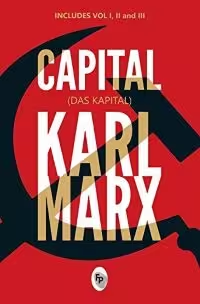
Das Kapital is not light reading, but it remains one of the most powerful critiques of capitalism ever written. Marx’s Capital is a foundational work in Marxian economics, political philosophy, and critical theory, calling it a forensic analysis of capitalism as a historical mode of production.
Marx’s central insight is that capitalism is not merely a marketplace of free exchange.
It is also a system of production where owners of capital control factories, tools, resources, and institutions, while workers sell their labor power to survive. In this arrangement, the worker may be formally free but economically pressured.
The wage contract looks voluntary, yet it takes place inside a world where not everyone owns productive property.
This is where films become essential. Charlie Chaplin’s Modern Times is one of the clearest cinematic images of industrial capitalism.
The Criterion Collection describes it as Chaplin’s last outing as the Little Tramp, placing him inside factory work and class struggle during the Great Depression.
In one unforgettable image, the worker is almost swallowed by the machine. That scene explains alienation better than a lecture. Marx gives us the concept; Chaplin gives us the body.
Milton Friedman and Hayek: Capitalism as Freedom
Capitalism is not only criticized in books. It is also defended with moral seriousness. Milton Friedman’s Capitalism and Freedom argues that economic freedom and political freedom are deeply connected.
First published in 1962, Capitalism and Freedom frames capitalism as a defense of human liberty and a warning against excessive state power.
Friedrich Hayek’s The Road to Serfdom makes a related but darker argument. Hayek warned that centralized economic planning, even when motivated by noble ideals, can concentrate power and erode individual liberty. It was a major twentieth-century defense of individual liberty, free markets, and skepticism toward collectivist planning.
These writers matter because they prevent the conversation from becoming one-sided.
Capitalism’s defenders do not merely say “greed is good.” The stronger defense says something subtler: dispersed economic power is safer than centralized political power.
A society where people can own, trade, invest, quit, start over, and challenge incumbents may protect pluralism better than a society where the state commands economic life.
Films often dramatize this argument through characters trying to escape control.
The small entrepreneur, the immigrant shopkeeper, the inventor, the independent farmer, and the rebellious worker all embody a capitalist promise: your future need not be assigned at birth.
The problem, of course, is that the promise is unevenly distributed.
Piketty and Stiglitz: Capitalism as Inequality Machine
The modern debate about capitalism often centers on inequality. Thomas Piketty’s Capital in the Twenty-First Century became famous for its argument that when returns on capital exceed economic growth over the long term, inherited wealth can become increasingly dominant.
Piketty’s core formula—r > g—as the engine of his warning about patrimonial capitalism and democratic risk.
Joseph Stiglitz’s The Price of Inequality approaches a similar problem from another angle. The book is a proven framework for thinking critically about modern capitalism and notes its argument that inequality is shaped by design rather than destiny.
Here, again, cinema becomes brutally effective.
Bong Joon-ho’s Parasite is not an economics lecture, but it may be one of the best modern films about class under capitalism. The film is a blend of black comedy, thriller, and social commentary that captures the divide between rich and poor through the story of the Kim family, who live in a cramped semi-basement and survive through temporary work.
The genius of Parasite is that it does not turn poverty into moral purity or wealth into cartoon evil.
It shows something more disturbing: class distance changes perception. The rich can be polite and still benefit from invisible labor. The poor can be clever and still remain trapped. The house itself becomes a map of capitalism: upstairs comfort, downstairs secrecy, underground survival.
Trading Places: Capitalism as Game
John Landis’s Trading Places is a comedy, but beneath the jokes is a savage lesson about class, speculation, and inherited power. Trading Places is a satire of capitalism and greed, noting that the Duke brothers use their wealth to manipulate human lives for sport.
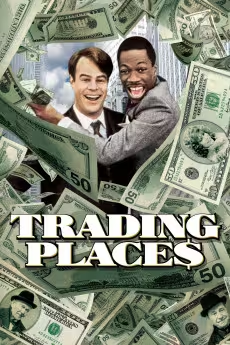
The film’s central experiment is simple: take a privileged commodities broker and a poor street hustler, switch their circumstances, and watch what happens.
The joke is funny because the system pretends to reward merit while quietly protecting status. The film asks whether success comes from talent, environment, networks, or rigged access. Its answer is not gentle.
In the language of capitalism books films, Trading Places is a bridge between Smith and Marx.
It accepts that markets reward intelligence and timing, but it also shows that markets are embedded in power. Information matters. Insider access matters. Social assumptions matter. The market is not a neutral machine floating above society.
It is played by people who already know the rules—and by people who discover the rules too late.
Wall Street and American Psycho: Capitalism as Performance
No discussion of capitalism in film can ignore the image of the ruthless financial man. Oliver Stone’s Wall Street gave popular culture Gordon Gekko, the corporate raider whose “greed” speech became more famous than the film’s warning.
The movie’s importance lies in its moral ambiguity: it intended to expose greed, yet some viewers found Gekko charismatic.
That misunderstanding is part of capitalism’s cultural power. Capitalism does not merely distribute goods; it manufactures desire. It turns wealth into style, confidence, vocabulary, posture, clothing, restaurants, business cards, apartments, and bodies.
This is why American Psycho remains such a sharp capitalist satire. Many viewers appreciate the film’s subversive take on capitalism and its exploration of psychopathic tendencies embedded within society.
Patrick Bateman is not frightening only because he is violent. He is frightening because he is empty in a socially approved way. He has the right job, suit, haircut, apartment, and reservations. His identity is assembled from brands. The horror is not that he stands outside consumer capitalism; the horror is that he represents its surface logic taken to a dead extreme.
In that world, being seen matters more than being human.
The Big Short: Capitalism as Abstraction
The 2008 financial crisis exposed a different problem: capitalism had become so abstract that even many insiders did not understand the risks being sold.
The Big Short, based on Michael Lewis’s book, dramatizes the housing bubble and the investors who bet against the mortgage market before the crash. The BFI identifies Adam McKay’s film as a 2015 U.S. production starring Christian Bale, Steve Carell, and Ryan Gosling, while IMDb summarizes the plot as investors betting against the U.S. mortgage market before the 2008 crisis and uncovering corruption in the process.
This is capitalism as spreadsheet tragedy. Nobody sees the whole system. Loans are packaged, sold, rated, insured, and resold. Responsibility dissolves into models and incentives.
The homeowner thinks locally; the banker thinks quarterly; the trader thinks probabilistically; the rating agency thinks commercially. Everyone has a reason. The disaster belongs to everyone and no one.
Books can explain derivatives, leverage, incentives, and moral hazard. Film can show the absurdity of experts using jargon to disguise ignorance.
The Big Short works because it understands that modern capitalism is not always visibly cruel. Sometimes it is cheerful, technical, legal, and catastrophically stupid.
The American Dream: Capitalism’s Promise and Trap
Capitalism survives partly because it attaches itself to hope.
The American Dream is one of its most powerful narratives: work hard, rise upward, own something, give your children more than you had. American Dream defines it in plain terms as a belief in opportunity, upward mobility, freedom, and equal dignity, while also noting that popular culture tests and complicates that promise.
This dream is not false simply because it is incomplete. Some people really do rise through markets.
Businesses are built, families are lifted, talents are rewarded, and poverty is escaped. But the dream becomes ideological when it ignores unequal starting points.
A child born into debt, bad schools, unstable housing, weak healthcare, and unsafe work is not running the same race as a child born into capital, networks, inheritance, and confidence.
That is why capitalism books films are so useful together. The books show the debate: freedom versus equality, markets versus planning, profit versus justice.
The films show the emotional cost: envy, aspiration, shame, imitation, exhaustion, and rage.
So, Is Capitalism Good or Bad?
The honest answer is that capitalism is neither a demon nor a saint.
It is a powerful social technology. It can generate innovation, abundance, mobility, and personal freedom. It can also generate inequality, monopoly, alienation, ecological damage, and moral emptiness. The same market that funds a new medicine can underpay the worker who packages it. The same competition that lowers prices can destroy small communities.
The same freedom that lets one person build a company can let another accumulate enough power to bend the rules.
The IMF notes that mixed capitalist economies predominate today, meaning most real-world economies combine markets with regulation, public goods, welfare systems, and state intervention.
That matters. The real debate is rarely capitalism versus no capitalism. It is usually about what kind of capitalism: democratic or oligarchic, competitive or monopolistic, humane or extractive, innovative or predatory, regulated or reckless.
Smith reminds us that markets need moral conditions. Marx reminds us to ask who owns and who works. Friedman and Hayek remind us that economic freedom can protect political freedom.
Piketty and Stiglitz remind us that wealth concentration can threaten democracy. Chaplin, Bong Joon-ho, Oliver Stone, Mary Harron, and Adam McKay remind us that systems become visible when we watch people live inside them.
Best Capitalism Books and Films to Start With
For readers building a capitalism books films list, start with contrasts rather than agreement. Read Adam Smith’s The Wealth of Nations beside Karl Marx’s Capital. Add Friedman’s Capitalism and Freedom and Hayek’s The Road to Serfdom for the classical liberal defense. Then read Piketty’s Capital in the Twenty-First Century or Stiglitz’s The Price of Inequality for modern inequality debates.
For films, begin with Modern Times for labor and industrialization, Trading Places for class and market games, Wall Street for financial ambition, American Psycho for consumer identity, The Big Short for systemic risk, and Parasite for class architecture. Watch them not as “anti-capitalist” or “pro-capitalist” propaganda, but as case studies.
Ask what each film thinks capitalism does to time, family, work, morality, language, space, and the body.
Conclusion: Capitalism Is Easier to See Through Stories
Capitalism is not just an economic system. It is a way of organizing desire, labor, property, risk, and hope.
It tells people they are free, then asks what they can afford. It rewards imagination, then monetizes attention. It breaks feudal hierarchies, then builds corporate ones. It creates abundance, then makes scarcity profitable. It gives people ladders, but not always floors.
That complexity is exactly why books and films matter. Economics gives us vocabulary; art gives us recognition. After reading Smith, you may see the market’s hidden coordination.
After reading Marx, you may notice the worker behind the commodity. After reading Friedman or Hayek, you may worry about state power. After reading Piketty or Stiglitz, you may worry about inherited capital and inequality.
After watching Parasite, Modern Times, Trading Places, American Psycho, or The Big Short, you may never again hear the word “capitalism” as a cold abstraction.
The best capitalism books and films do not hand us a slogan. They train us to see. And once we see capitalism clearly—as promise, machine, dream, gamble, comedy, horror, and everyday reality—we can finally argue about it honestly.
FAQs About Capitalism Books Films
1. What are the best books to understand capitalism?
Start with The Wealth of Nations by Adam Smith, Capital by Karl Marx, Capitalism and Freedom by Milton Friedman, The Road to Serfdom by Friedrich Hayek, Capital in the Twenty-First Century by Thomas Piketty, and The Price of Inequality by Joseph Stiglitz. Together, they cover markets, labor, freedom, planning, inequality, and democratic risk.
2. What films best explain capitalism?
Some of the best films for understanding capitalism are Modern Times, Trading Places, Wall Street, American Psycho, The Big Short, and Parasite. Each film shows a different face of capitalism: factory labor, class mobility, greed, consumer identity, financial abstraction, and inequality.
3. Why use books and films to explain capitalism?
Books explain capitalism’s theories and structures. Films show its emotional and social consequences. Reading and watching together gives a fuller understanding than either method alone.
4. Is capitalism only about greed?
No. Capitalism involves private property, markets, competition, profit, choice, and investment.
Greed can thrive within capitalism, but so can innovation, independence, cooperation, and upward mobility. The serious debate is about how capitalism should be structured, regulated, and morally limited.







