
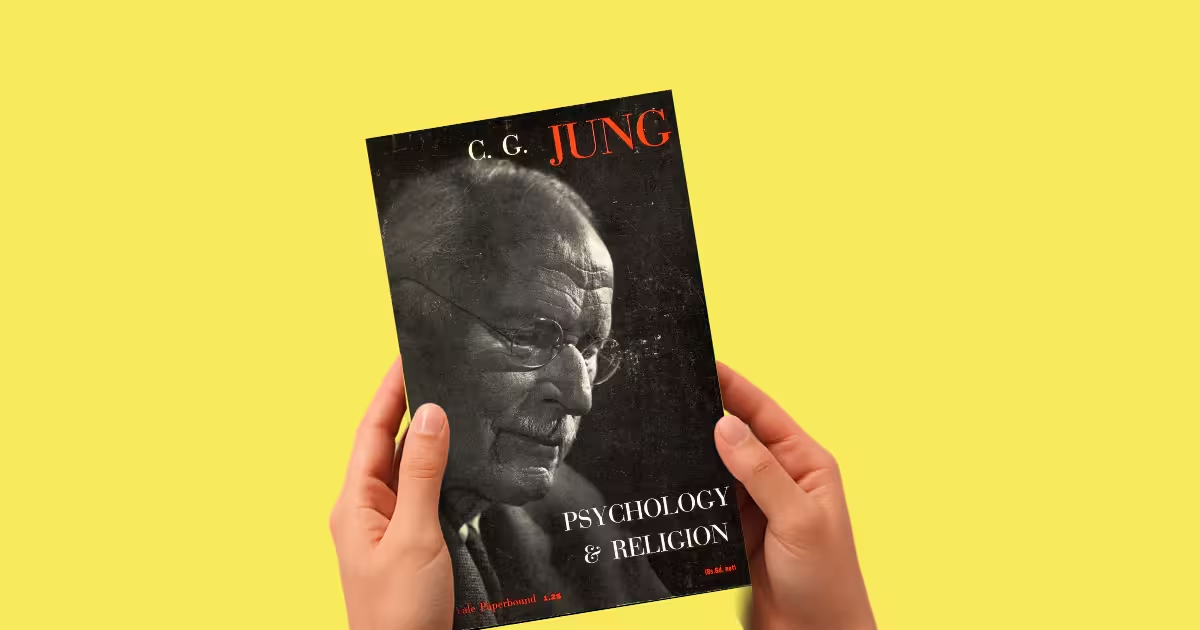
Do you really own your mind, or does something else live inside it, pulling the strings without your permission? That question haunted me through every page of Carl Gustav Jung’s Psychology and Religion. And honestly? The answer he gives is not comforting.
Table of Contents
Overview
This isn’t a book that tells you what to believe. Psychology and Religion forces you to ask why you believe anything at all, and whether you have any choice in the matter. Based on the Terry Lectures delivered at Yale University in 1937, Jung’s Psychology and Religion argues that religion is not merely a social construct or a neurotic symptom (as Freud suggested), but an authentic, spontaneous expression of the unconscious mind.
Jung demonstrates, through detailed analysis of his patients’ dreams, that the human psyche possesses what he calls an “authentic religious function”, a natural tendency to produce religious symbols and experiences independent of conscious belief or cultural conditioning.
Psychology and Religion is best for anyone who has ever felt that something more was happening beneath the surface of their thoughts. Psychotherapists, seekers, people in midlife crisis, students of psychology or religion, and anyone who has ever been unnerved by a dream that felt too meaningful.
Psychology and Religion is not for readers looking for quick answers, tidy conclusions, or a book that will tell them which religion is “correct.” If you prefer your psychology neatly categorized and your religion safely contained within church walls, this book will unsettle you.
What I Learned from Reading Psychology and Religion
Let me be honest: I picked up this book expecting a dry academic lecture. What I got was something closer to a psychological thriller.
Jung opens with a disarmingly simple question: what is religion, really? His answer comes from Rudolf Otto’s concept of the numinosum, a dynamic presence or effect “not caused by an arbitrary act of will. On the contrary, it seizes and controls the human subject, which is always rather its victim than its creator”. Religion, for Jung, is the careful observation of these numinous experiences.
It’s not about dogma or creed. It’s about what happens to you when something bigger than your conscious mind grabs hold.
And here’s where it gets interesting. Jung tells the story of a patient—an intellectual, a scientist, a Catholic by education but not by practice—who came to him with a severe neurosis. This man had no interest in religion. He was rational, skeptical, modern. But his unconscious mind had other plans.
Over the course of four hundred dreams, this patient’s unconscious produced a series of religious symbols so striking, so coherent, and so historically parallel to ancient mystical traditions that Jung couldn’t ignore them. The patient dreamed of a “universal Catholic church” with a sign that read: “This is the universal Catholic church. It is the church of the Lord.
All those who feel themselves to be instruments of the Lord may enter”. But the dream wasn’t a simple endorsement of Catholicism. It was a compromise, a cheap reconciliation between spirituality and worldliness that left the dreamer’s deeper self deeply dissatisfied.
A mysterious woman appears in the dream, nods in approval at first, then weeps and says: “Then there is nothing left at all” before vanishing. Jung identifies this figure as the anima, the feminine side of a man’s unconscious, the representative of everything the conscious mind has repressed.
Her disappearance signals that the dreamer’s conscious attempt to find religious comfort is missing something essential.
The Dream That Changed Everything
Later in the series, the patient dreams of a “house of inner composure or self-collection.” Burning candles are arranged in four pyramid-like points. An old man at the door explains: “When they leave they are pure.” Then a voice speaks:
“What thou art doing is dangerous. Religion is not a tax which thou payest in order to get rid of the woman’s image, for this image is indispensable. Woe to those who use religion as a substitute for the other side of the soul’s life. They are in error and they shall be cursed. Religion is no substitute, but it is the ultimate accomplishment added to every other activity of the soul. Out of the fulness of life thou shalt give birth to thy religion, only then shalt thou be blessed.”
This passage stopped me cold.
The voice isn’t telling the dreamer to be more religious. It’s telling him that using religion as an escape from his own psychological depths is a form of spiritual cowardice. Religion, properly understood, is not a substitute for living fully. It is the crown of a complete life, a life that includes both the light and the shadow, the conscious and the unconscious, the masculine and the feminine.
Jung’s interpretation is radical: the unconscious mind doesn’t just produce neurotic symptoms. It produces religious experiences. And these experiences are not pathologies to be cured, but messages to be understood. “Religious experience is absolute,” Jung writes. “It is indisputable. You can only say that you have never had such an experience, and your opponent will say: ‘Sorry, I have.’ And there your discussion will come to an end”.
The Mandala: A Symbol of Wholeness
The climax of Psychology and Religion, and of the patient’s dream series, is a vision of what Jung calls the “world clock.” The patient describes:
“There are a vertical and a horizontal circle with a center common to both. This is the world clock. It is carried by the black bird. The vertical circle is a blue disk with a white rim, divided into 4 X 8 = 32 partitions. A hand is rotating upon it. The horizontal circle consists of four colors. Four little men are standing upon the circle carrying pendula and the golden ring is laid around it.”
Jung identifies this as a mandala, a circular symbol that appears in religious traditions across the world, from Tibetan Buddhism to medieval Christianity. The mandala represents wholeness, unity, the reconciliation of opposites. In the patient’s vision, the center is empty.
There is no deity enthroned there. Instead, the symbol points to the self, the total personality, conscious and unconscious combined.
This was the turning point in the patient’s treatment. The vision produced what Jung calls “an impression of the most sublime harmony”. It was, in religious language, a conversion—not to any creed, but to a new relationship with his own psyche.
Why This Book Matters Right Now
Here’s the thing: Jung wrote these lectures in 1937, watching Europe slide toward catastrophe. He saw what happens when people lose their connection to the unconscious, when rationalism and technology replace religious experience, and when the repressed energies of the psyche erupt as collective madness.
“Look at all the incredible savagery going on in our so-called civilized world,” he writes. “All of which is derived from human beings and their mental condition”.
This isn’t ancient history. We’re living through the same dynamics today. Political tribalism, ideological extremism, the desperate search for meaning in consumerism or nationalism—these are all symptoms of what happens when the religious function of the psyche is denied or repressed. Jung’s argument is that the psyche will produce religious experiences, whether we like it or not. If we don’t integrate them consciously, they will possess us unconsciously.
The Shadow and the Self
One of the most powerful concepts in Psychology and Religion is the shadow, the part of ourselves we refuse to acknowledge. “Everyone carries a shadow,” Jung writes, “and the less it is embodied in the individual’s conscious life, the blacker and denser it is”.
The shadow isn’t evil; it’s just unacknowledged. It contains our primitive instincts, our repressed desires, our inferior qualities. And when we suppress it, it doesn’t disappear. It grows stronger and eventually erupts.
Jung’s patient had to learn to agree with his adversary, to make peace with the inferior, primitive, awkward parts of himself. This is the essence of psychological integration. It’s also, Jung argues, the essence of genuine religion. “Agree with thine adversary quickly, whilst thou art in the way with him,” Jung quotes from Matthew 5:25.
A Gnostic interpretation of this verse reads: “The adversary is the somatic man. As the living body is an indispensable part of the personality, the text, therefore, should be read: ‘Agree with thyself quickly, whilst thou art in the way with thyself’”.
This is not about moral perfection. It’s about wholeness. And wholeness, Jung insists, is the goal of both psychological health and religious life.
Strengths and Weaknesses
What works: Jung’s phenomenological approach is refreshing. He doesn’t try to prove or disprove God. He simply observes that people have religious experiences, and these experiences are real and meaningful regardless of their metaphysical status. His use of dream material is fascinating, and his willingness to take the unconscious seriously, to treat it as an autonomous intelligence rather than a garbage heap of repressed wishes, is genuinely revolutionary.
Psychology and Religion is also remarkably accessible for Jung. Unlike some of his denser works, these lectures were written for a general audience. The prose is clear, the arguments are structured, and the clinical examples are vivid.
What doesn’t: Jung’s reliance on a single case study (the four-hundred-dream patient) raises questions about generalizability. Can we really draw such sweeping conclusions from one person’s dreams? Jung would argue that he has observed similar patterns in many patients, but the book doesn’t present that broader evidence in detail.
Psychology and Religion also leaves some questions unanswered. If the unconscious produces religious symbols, how do we distinguish between genuine religious experience and pathological delusion? Jung acknowledges this problem but doesn’t fully resolve it.
He suggests that the effect of the experience, whether it leads to greater wholeness and integration, is the test. But this criterion is subjective and hard to apply consistently.
How Psychology and Religion Compares to Other Works
If you’ve read Freud’s The Future of an Illusion, you’ll recognize the debate immediately. Freud argued that religion is a neurotic illusion, a wish-fulfillment born of human helplessness. Jung rejects this outright. For Jung, the absence of religion, not its presence, is what creates neurosis.
Compared to William James’s The Varieties of Religious Experience, Jung is more clinical and less philosophical. James describes religious experiences from the outside; Jung analyzes them from the inside, as a practicing psychotherapist.
Compared to Rudolf Otto’s The Idea of the Holy, Jung is more psychological and less theological. Otto focuses on the numinosum as a quality of the divine; Jung focuses on the numinosum as a quality of psychic experience.
Should You Read This Book?
If you’ve ever felt that your dreams were trying to tell you something important, read this book. If you’ve ever wondered why religion persists despite centuries of scientific progress, read this book. If you’ve ever suspected that there’s more to your mind than your conscious thoughts, read this book.
Psychology and Religion won’t give you easy answers. It won’t tell you what to believe or which church to attend. But it will give you something more valuable: permission to take your own inner experience seriously. It will show you that the strange, unsettling, numinous experiences that sometimes break through your ordinary consciousness are not signs of madness.
They are signs of life.
As Jung writes in the final lines of Psychology and Religion: “Nobody can know what the ultimate things are. We must, therefore, take them as we experience them.
And if such experience helps to make your life healthier, more beautiful, more complete and more satisfactory to yourself and to those you love, you may safely say: ‘This was the grace of God’”.







