
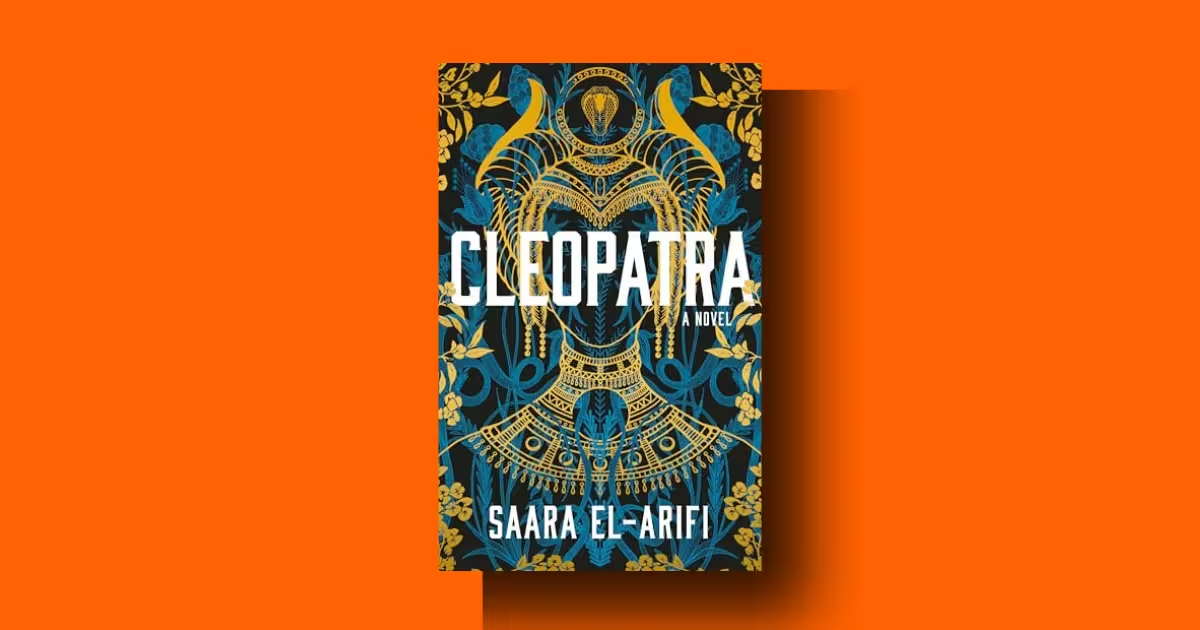
Do you ever wonder why history remembers Cleopatra as a seductive villain instead of the brilliant, devoted ruler and mother who fought tooth and nail for her people and children?
If that question has ever lingered in your mind while scrolling past another glamorous but shallow retelling, then Saara El-Arifi’s Cleopatra is the book you’ve been waiting for. I devoured its 352 pages in two breathless sittings, and it left me emotionally wrecked in the best possible way.
This is Cleopatra finally telling her own story. No more Roman propaganda painting her as a scheming whore or tragic lover. El-Arifi gives us the real woman—clever strategist, healing priestess marked by Isis, fiercely loving mother, and unapologetic ruler—who lived, loved, and died on her own terms, all wrapped in lush, sensuous prose with just enough divine fantasy to make the ancient world feel alive and magical.
The author’s note (pages 10–11) openly states this is “a true story. As true as any other biography of Cleopatra VII,” drawing from Plutarch, Cassius Dio, and modern scholarship while freely interpreting gaps and adding fantasy gifts from the gods (a curse from Ptolemy I’s desecration of tombs).
Cleopatra is best for readers who loved Madeline Miller’s Circe or The Song of Achilles (feminist myth retellings with emotional depth and sensuous writing), fans of lush historical epics like The Wolf Den trilogy or I, Cleopatra, anyone craving a “girl’s girl” reclaiming of a powerful woman, or those who enjoy light fantasy in historical settings (divine blessings/curse).
Not for: Strict history purists wanting zero invention, readers triggered by detailed parental grief/death scenes, or those who prefer fast-paced action over introspective, memoir-style narration from the afterlife.
I start reading Cleopatra expecting another glamorous tragedy. Instead, I got something far more intimate and defiant. As a reader who’s always felt the sting of how powerful women are reduced to their relationships with men, this book felt like justice.
El-Arifi doesn’t just humanize Cleopatra—she lets her speak directly to us across millennia, calling out the lies while owning her flaws, loves, and fierce maternal love.
Table of Contents
1. Introduction
Cleopatra: A Novel by Saara El-Arifi is the internationally bestselling author’s first foray into straight historical fiction after her acclaimed fantasy series The Ending Fire trilogy (The Final Strife, The Battle Drum, The Ending Fire) and The Faebound duology.
Published February 24, 2026, by Ballantine Books (an imprint of Penguin Random House) in the US and The Borough Press (HarperCollins) in the UK, it’s a gorgeous hardcover with designed endpapers, custom case stamp, interior illustrations by Sophie Dunster, and a striking cover by Sarah Foster.
El-Arifi, who holds a master’s in African studies focusing on Cleopatra’s myth and its impact on Black women, brings scholarly rigor and passionate reclamation to every page.
2. Background
Set against the final decades of Ptolemaic Egypt (51–30 BCE), the novel grapples with the real historical pressure of Rome’s expanding empire, the propaganda war waged by Octavian (later Augustus), and the scarcity of Cleopatra’s own voice—only one possible papyrus signature survives (“Ginestho [Let it be done]”).
El-Arifi explicitly addresses this in her author’s note: historians like Plutarch and Cassius Dio wrote centuries later, often relying on biased Roman sources shaped by propaganda.
She mixes verified events (the carpet scene, Alexandrian War, Donations of Alexandria, Battle of Actium) with imaginative gaps and a light fantasy layer: the Ptolemaic “divine gifts” are actually a curse from Ptolemy I’s tomb desecration, dooming each ruler to a god-tied downfall. It’s memory, not strict history—and that honesty makes it more powerful.
3. Cleopatra Summary
Prologue & Part One: The Witch (51 BCE onward)
“You know my name, but you do not know me.” The opening line hits like a slap. Cleopatra speaks from beyond death, mocking poets and bards who reduced her to “tainted crown” and “infinite variety.”
She is pharaoh once, wife twice, mother more than thrice—called Queen, lover, Mama by some; witch, villain, whore by others. The story is not how she died, but how she lived.
We open on the day she becomes Pharaoh. Eighteen-year-old Cleopatra sits on a lighthouse balcony with her beloved handmaiden/lover Charmion, playing senet and eating figs. Her father Ptolemy XII is dying; she knows the throne is hers but dreads it. She’s marked by Isis (a black throne sigil on her neck), but her power hasn’t awakened yet—unlike her siblings.
Arsinoe communes with birds via Thoth (her ibis Qar), a younger brother breathes underwater thanks to Sobek, and her executed older sister Berenice carried Apep’s chaos (blamed for crop failures). Cleopatra’s gift? Healing and eventual resurrection—but it’s revealed as the family curse.
Her father dies. She swims naked to the palace, asserts “Just Pharaoh” to servants, and claims the throne. Sibling rivalries explode: brother Ptolemy XIII and Arsinoe, backed by eunuch Pothinus, try to sideline her.
She meets Julius Caesar by being smuggled in a carpet into his chambers (the famous scene, but grounded and sensual here). They become lovers and political allies. Caesar helps her defeat her brother (who drowns trying to escape in heavy armor) and Arsinoe in the Alexandrian War.
The Great Library burns (devastating her). Caesarion (Ptolemy XV Caesar) is born in 47 BCE—Caesar weeps with joy, calling them his Venus and Cupid.
They travel to Rome. Cleopatra sees Caesar’s triumphs, including Arsinoe paraded (she begs mercy; Arsinoe is spared and sent to Ephesus). Caesar is assassinated in 44 BCE on the Ides of March. Cleopatra flees back to Egypt heartbroken.
Part Two: The Whore
Grief nearly breaks her, but Marcus Antonius (Antony) arrives. Their love is passionate, sun-like to Caesar’s rain-like affection. They have twins (Alexander Helios and Cleopatra Selene II) and later Ptolemy Philadelphus.
The Donations of Alexandria (34 BCE) grant territories to the children—Caesarion proclaimed Caesar’s heir in Rome. Antony’s Dionysian revelry and Cleopatra’s Isis devotion blend in grand pageantry, but Octavian uses it as propaganda: “the whore of the East” turning Antony against Rome.
War looms. At Actium (31 BCE), betrayal (Dellius defects), supply shortages, and omens doom them. Cleopatra orders a sacrificial breakout: thirty ships ram the blockade so the rest can escape. Thousands die. She sails home to Alexandria; Antony marches overland from Cyrene.
Part Three: The Villain & Ending (30 BCE)
Octavian’s fleet approaches. Cleopatra prepares her children’s escape via hidden cistern tunnels with Charmion. She writes a final letter to Antony on obsidian: “Marcus, I will see you again in the field of reeds. Our love is more than this life; it is blood, it is bone, it is breath.”
Antony, hearing a false report of her death, stabs himself. Dying, he’s carried to her temple. They share a final, blood-soaked goodbye. He dies in her arms.
Cleopatra and Charmion then poison themselves with wolfsbane-laced hairpins (not the asp of legend—Octavian later spins it that way). They die together beside Antony, holding hands, reciting their childhood prayer.
But here’s the gut-punch twist (revealed in Chapter 30, “A Beginning” and the Epilogue): Cleopatra’s “gift” from Isis is actually the family curse. She cannot stay dead.
She resurrects repeatedly, reliving variations of her death across millennia—watching her children die (Caesarion executed, Selene and Helios from illness, etc.), wandering as a commoner, dying by blade, fire, drowning, poison again and again, only to wake back in Isis’s crimson realm.
She lives many lives: scholar, traveler, lover under false names. She reads every book and play about herself and laughs/cries at the distortions. The curse ends only with her line; she is the last.
The final line: “I told you at the beginning, this is not the story of how I died. For death will forever evade me. No, this is the story of how I lived. And live still.”
The ending is devastatingly beautiful—immortality as punishment, motherhood as both salvation and eternal grief. El-Arifi doesn’t flinch from the cost of power.
4. Cleopatra Analysis
4.1. Cleopatra Characters
Cleopatra is magnificently complex: proud yet self-doubting, ruthless when needed (feeding an assassin to young asps in vengeance), but above all a mother whose every decision orbits protecting her children.
Her growth from insecure young pharaoh to weary but defiant queen is masterful. Caesar is intellectual, charismatic, and ultimately flawed (omitting Caesarion from his will). Antony is warm, passionate, Dionysian—his final self-stabbing scene destroyed me.
Charmion is the emotional core, the “other half” of Cleopatra’s soul; their love is tender, lifelong, and platonic-romantic in the most beautiful way. The children feel real—Caesarion noble, Selene fierce, the younger ones innocent. Even villains like Pothinus and Octavian have nuance; Octavian isn’t cartoon evil, just coldly ambitious.
4.2. Cleopatra Themes and Symbolism
Power vs. humanity, legacy vs. myth, motherhood as radical act, the male gaze distorting women’s stories. The divine “gifts” symbolize how power corrupts and isolates (the curse). Snakes/asp recur as symbols of both danger and protection (Cleopatra’s affinity with cobras).
The senet game frames fate vs. agency. The Epilogue’s resurrection curse powerfully explores immortality as torment—watching loved ones die forever. Religion blends Egyptian and Greek, showing cultural hybridity of Ptolemaic Egypt.
5. Evaluation
The Sense of an Ending by Julian Barnes is poignant; Cleopatra by Saara El-Arifi is groundbreaking and marvelous—an important, emotionally devastating reclamation that feels urgent in 2026.
I felt seen as a woman who has been reduced to relationships in my own life. El-Arifi’s prose is lush without being purple, the emotion raw and human. I laughed, gasped, sobbed, and closed it feeling changed.
Strengths/Positive Experiences:
- Vivid, sensory world-building—I could smell the Nile silt and taste the figs.
- Deep emotional truth in motherhood and female friendship (Cleopatra-Charmion is one of the best portrayals I’ve read).
- Perfect balance of history and invention; the fantasy curse elevates it without overwhelming.
- Voice—Cleopatra’s narration is witty, defiant, and intimate.
Weaknesses/Negative Experiences:
- Pacing drags slightly in the mid-war sections (Actium preparations), though the emotional payoff redeems it.
- Some invented elements (specific dialogues, the exact curse mechanics) may frustrate purists, though the author’s note prepares you.
- The repeated deaths in the epilogue, while thematically brilliant, border on repetitive for some readers.
Impact: Intellectually, it made me rethink how history is written by victors. Emotionally, it gutted me—I hugged my own children tighter that night. It resonated as a story about women refusing to let others define their worth.
Comparison with Similar Works:
Closer to Miller’s Circe (reclaiming a “villainess” with agency and sensuality) than Schiff’s straight biography Cleopatra: A Life. More emotionally raw than The Wolf Den trilogy, with a fantasy twist reminiscent of Kaikeyi by Vaishnavi Patel.
6. Personal Insight with Contemporary Educational Relevance (280 words)
The book’s most powerful theme—how powerful women are reduced to their sexuality and relationships while their intellect and motherhood are erased—feels painfully relevant in 2026.
Just last year, a Pew Research study (2025) found female world leaders are still 3x more likely to be described by appearance or family status in media than male counterparts. Cleopatra’s reclamation reminds us that history (and headlines) often rewrite ambitious women as “witches, whores, villains.”
El-Arifi’s curse motif brilliantly illustrates the eternal cost of power for women: you survive, but at what price? In an era of “girlboss” burnout and online pile-ons, Cleopatra’s eternal resurrection—watching her children die repeatedly—mirrors the mental load many mothers and leaders carry. Her line “I am abundant. You will never define me” is a rallying cry for anyone tired of being boxed in.
For educators: pair this with primary sources (Plutarch excerpts) and modern pieces on media bias (e.g., UN Women’s 2025 report on gender in politics). It sparks discussions on whose stories we tell and why.
This book doesn’t just entertain—it educates through empathy. In a world still struggling with powerful women, Cleopatra is essential reading.
7. Cleopatra Quotes
- Prologue: “You know my name, but you do not know me… I am Cleopatra. This is not the story of how I died. But how I lived.” (p. 12)
- Author’s Note: “This novel is not history, it is memory.” (p. 11)
- On power: “We are Egypt, and Egypt is us. Sometimes we must sacrifice what we hold dear. But Egypt must live. Always.” (echoed throughout, originally father’s words, p. 31)
- Final moments with Antony: “In blood, in bone, in breath—forever we are bound.” (p. 330)
- Epilogue reflection: “Witch. Whore. Villain. But I am also Cleopatra; the mother, the lover, the friend, and so much more. I am abundant. You will never define me…” (p. 339)
- On legacy: “Rome is not the world. Octavian’s empire will be lost in history. You are Egypt.” (p. 315)
8. Conclusion
Cleopatra by Saara El-Arifi is a triumph—lush, heartbreaking, defiant, and deeply human. It doesn’t just retell history; it corrects the record with love, rage, and exquisite prose. Overall impressions: 5/5 stars, one of my top reads of 2026 already. I’ll be pressing this into friends’ hands for years.
Recommendation: Essential for fans of feminist historical fiction, anyone who loves complex mothers in literature, or readers seeking a fresh take on ancient history with emotional punch.
If you want to feel seen as a woman who refuses to be reduced, read this. It’s significant because it reminds us that the most powerful act is telling our own stories—on our own terms.







