
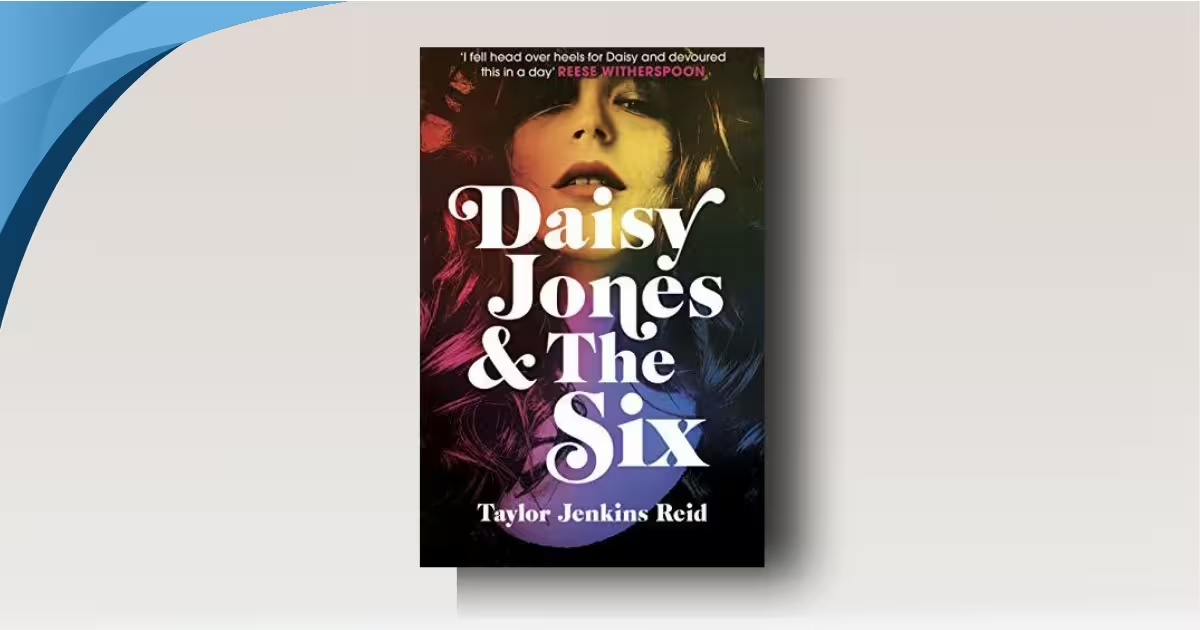
Do you ever wonder why some love stories feel like a song you can’t stop replaying—even when it hurts? Daisy Jones and The Six is one of those books: it teaches you how fame, addiction, and desire can turn talent into a wildfire and still leave something tender behind.
A fictional 1970s rock band tells the “real story” of their rise and collapse—until you realize the truth is stitched together from contradictions, cravings, and the parts people couldn’t admit out loud.
- Daisy Jones and The Six’s emotional pull lines up with research showing that literary fiction can improve “Theory of Mind”—our ability to understand other people’s feelings and perspectives (Kidd & Castano, Science, 2013).
- Its addiction/industry pressure themes reflect real-world concerns: a major UK report commissioned by Help Musicians UK set out to quantify mental-health issues in musicians.
- Another global report summarizes surveys where substantial shares of musicians report alcohol/substance-related harms.
Daisy Jones & The Six is best for:
- Readers who love messy genius: music, fame, heartbreak, ego, recovery
- Fans of “oral history” storytelling and multiple POV truth-games
- Anyone who wants a fast, bingeable novel that still hits emotionally
Not for:
- Readers who hate interview/transcript formats
- Anyone who needs a single “objective narrator” (this book refuses that comfort)
- People seeking a clean romance—this is desire + consequence, not just chemistry
Table of Contents
1. Introduction
Daisy Jones and The Six is a historical-fiction novel by Taylor Jenkins Reid, originally published in hardcover by Ballantine Books. Originally published in hardcover…by Ballantine Books” on March 5, 2019.
What makes it pop (and rank well in searches) is also what makes it addictive to read: it’s written like a rock documentary—a collage of interviews, memories, and curated receipts.
2. Background
The novel is steeped in the mythology of 1970s rock—the era of studio obsession, stadium tours, magazine canon-making, and band implosions that became legend. Pop culture has long been fascinated by that particular kind of collapse: not just “they broke up,” but they broke each other.
Reid has openly discussed (and journalists have deeply traced) how Fleetwood Mac’s lore—especially the charged creative tension around Rumours—helped inspire the emotional atmosphere, without the book being a direct retelling. (Vanity Fair)
And the novel itself frames its mission early with a line that functions like a thesis statement:
“The truth often lies, unclaimed, in the middle.”
That is basically the book’s engine: everybody is telling you their truth—and the “real” story lives in the overlap.
3. Daisy Jones and The Six summary
The structure: You’re reading a “compiled oral history” of a famous band—Daisy Jones and The Six—told decades later through interviews with the band members and their orbit.
The style is quick-cut: one person says a thing, another contradicts it, and your brain starts doing what fans do in real celebrity scandals—trying to figure out what really happened.
3.1 Billy Dunne, the band’s origin, and the first big fracture
The story’s backbone is Billy Dunne, ambitious, magnetic, and already flirting with self-destruction before he becomes famous. He starts playing music young, chasing that feeling of being chosen by the world.
He forms a band with his brother Graham, and eventually they become The Dunne Brothers. They’re talented, but what they really have is hunger.
Then Billy meets Camila—and Daisy Jones and The Six makes it clear she’s not a decorative “rock wife.” She’s the kind of person who sees the best in Billy while also being painfully aware of his worst instincts. Their relationship becomes the moral center of the band’s story: Billy loves her, and he also keeps trying to outrun himself.
As the band starts gaining traction, fame amplifies what already exists: temptation, ego, fear, craving. Billy spirals into addiction. Even before Daisy Jones and The Six fully reveals the shape of his relapse patterns, you can feel the slippery logic of someone who believes rules don’t apply to him when he’s chasing art.
They sign, they record, they tour. Success comes fast—fast enough that no one has time to grow up.
At some point, the band becomes The Six—Billy, Graham, Eddie (the quietly furious one), Warren (the steady one), Karen (the keyboardist with steel in her spine), and later a rotating cast of momentum and mess.
Billy’s addiction culminates in a crash that threatens everything: his marriage, his future, the band. He goes to rehab. He returns with a new identity he tries to wear like armor: sober leader, devoted husband, responsible frontman. But sobriety doesn’t delete desire—it just takes away the chemical excuse.
3.2 Daisy Jones arrives like a match near gasoline
Daisy Jones grows up in L.A. with beauty and neglect in equal measure. She is surrounded by people, and still alone. She’s drawn to music because music is the only thing that doesn’t lie to her—except, ironically, her whole life becomes an argument about truth.
Daisy is not interested in being a fantasy. She says it bluntly:
“I am not a muse.”
That line isn’t just empowerment; it’s also a warning. Daisy doesn’t want to be someone else’s inspiration. She wants authorship. Ownership. Control. And yet she’s vulnerable to the oldest trap in fame: confusing attention with love.
Daisy’s best friend Simone becomes essential here. Simone is her mirror and her anchor—someone who loves Daisy without needing to possess her. Their friendship is one of the book’s most human relationships: protective, messy, loyal, sometimes exhausted.
Daisy begins writing songs. She starts performing. She becomes a “thing” the industry can market—wild, luminous, dangerous. Men want to consume her. Women want to decode her. Daisy wants to be real, but her identity keeps getting remixed by other people.
3.3 The collision: Daisy joins The Six and “Aurora” begins
A producer—Teddy Price—becomes the adult in the room. He hears Daisy’s voice and sees the band’s potential, and he makes a decision that changes everything: he pushes Daisy and The Six into the same project.
Billy doesn’t want Daisy. Not because she isn’t talented—she’s too talented. Daisy threatens his control. She also threatens his sobriety, his marriage, his self-image.
But Teddy knows what the music world rewards: tension that sings. Daisy joins.
And immediately, the band’s center of gravity shifts. Billy and Daisy start writing together. Their songwriting partnership becomes intimate in a way that terrifies them both. It’s not necessarily physical—at least not in the clean, tabloid way people expect—but it’s emotional and creative, which can be even more destabilizing.
The album they create—Aurora—becomes a masterpiece in their universe. But it’s also a battlefield: every lyric is a negotiation, every harmony is a power struggle, every studio day is either magic or war.
Billy wants the songs to be honest, but not too honest. Daisy wants the songs to be naked. Billy wants to keep the marriage intact. Daisy wants Billy—partly as a person, partly as proof that she’s chosen.
And the band around them starts fracturing under the pressure:
- Eddie resents Billy’s leadership and his myth. Eddie wants credit, wants power, wants to stop being treated like an accessory.
- Graham falls for Karen, and their love becomes both beautiful and heartbreaking because it’s built on incompatibility: Graham wants family; Karen wants freedom and her own future.
- Warren tries to stay above the drama, but nobody stays clean in a band fire.
3.4 Daisy’s marriage, her unraveling, and the illusion of escape
Daisy, despite all her swagger, is lonely. She tries to patch the hole with substances and chaos. At one point she marries Nicky Fitzpatrick, a rock star who feels like an escape route. But it’s a mirage. Nicky doesn’t save her; he dulls her.
Daisy’s addiction deepens. The book refuses to glamorize it. Daisy’s “wildness” stops looking like glamour and starts looking like pain.
Simone keeps trying to pull Daisy back toward herself, toward survival. Teddy tries too, in his own way. But Daisy has to decide she wants to live.
3.5 The tour: when performance becomes the last mask
The band tours. They become huge. Their shows are myth-making machines. Onstage, Daisy and Billy are electricity. Offstage, they’re an exposed wire.
Billy is always negotiating with himself: he loves Camila, he loves his children, he loves sobriety—yet he is drawn to Daisy like gravity.
Camila, meanwhile, is not blind. She knows what’s happening, and her response is not what people expect from the cliché “wife” role. She makes choices that are painful, strategic, and deeply human—choices that say: I will not surrender my life to your chaos, but I also won’t pretend you’re not human.
The band reaches its apex: a massive show that becomes the famous last night. Everything collapses there.
3.6 The final show and the breakup
At the last concert, the tension reaches the point where it can’t be “managed” anymore. There is a moment where the music can’t cover the truth.
Billy and Daisy have a final confrontation (emotionally and creatively). And then Daisy does something that is both devastating and merciful: she chooses to end the fantasy before it destroys everyone.
The band breaks up. Not with a neat press-release reason, but with that classic real-life mess: too much love, too much ego, too much pain, too much history.
Afterward:
- Daisy eventually gets clean and builds a new life away from the constant performance of being Daisy Jones.
- Billy stays with Camila and lives into the life he once seemed incapable of protecting.
- The band members scatter into adulthood with scars and complicated nostalgia.
Then Daisy Jones and The Six reveals a final layer: who is compiling these interviews and why now? The “author” behind the oral history is Camila and Billy’s daughter, and the project is connected to Camila’s death. The Author’s Note makes that explicit:
“My mother, Camila Dunne, died…”
And the emotional gut-punch arrives in Camila’s final message—because even at the end, she refuses to let life be smaller than it could be. She asks (through her children) for Billy to reach back toward Daisy:
“tell him to call Daisy Jones.”
That ending reframes everything. Camila isn’t a victim of Daisy and Billy’s connection. She is the person who understood it most clearly—and still chose love, dignity, and truth over bitterness.
4. Daisy Jones & The Six Analysis
4.1 Daisy Jones and The Six Characters
Daisy Jones: the refusal to be “used up”
Daisy’s whole arc is a fight against being reduced—to a pretty face, to a vibe, to a man’s “inspiration.” The book hands you her manifesto early, and it stays true all the way to the breakup:
- “I am not a muse. I am the somebody.”
That line isn’t just empowerment; it’s defense. Daisy knows the industry’s appetite, and she also knows her own soft spots—loneliness, addiction, the ache to be chosen. So when Billy becomes the one person who can match her creatively, she mistakes creative recognition for emotional safety. That’s the tragedy: Daisy is strong enough to demand authorship, but not always strong enough to demand health.
Her clearest “good” desire is actually simple: she wants to be heard without being edited into something palatable. There’s a moment that captures her pure intention:
- “I wanted to sing songs from my heart right to the people in front of me.”
And yet Daisy is also honest (almost brutally) about the darker half of her drive:
- “I wanted to write songs and get high.”
So Daisy is never a saint, never a cautionary poster, never a manic-pixie fantasy. She’s a person with a gift—and a wound that keeps trying to steer her.
Billy Dunne: self-control as a religion (and a lie he keeps testing)
Billy’s character is built around control: control of the band, control of the sound, control of his image, control of himself. After rehab, he treats sobriety like a sacred duty—but the book makes it clear that sobriety doesn’t automatically resolve obsession.
Billy’s biggest contradiction is that he wants truth in art, but he’s terrified of truth in life. He can write a lyric that bleeds, then refuse to admit what it means when Daisy sings it back at him.
What keeps Billy sympathetic (even when he’s infuriating) is that he knows he’s dangerous. He’s aware of the edge—and he keeps walking up to it anyway.
Camila Dunne: the quiet power at the center
Camila is the character many readers expect to be sidelined—and instead she becomes the spine of the whole story. She’s not naive. She’s not blind. She’s simply unwilling to surrender her dignity.
One of the most emotionally loaded lines in the entire Daisy Jones and The Six arrives at the end, because it re-frames everything you thought the love triangle was:
- “tell him to call Daisy Jones.”
That’s Camila’s final authority move: she refuses to let jealousy define her legacy. She acknowledges that Daisy mattered—without giving Daisy the power to destroy her family. Whether a reader finds that saintly or heartbreaking, it’s unforgettable.
Karen & Graham: love isn’t always the same dream
Karen and Graham are what happens when two people adore each other but want futures that don’t fit in the same suitcase. Their relationship hits especially hard because it isn’t “toxic.” It’s just incompatible.
Karen’s defining statement is clean and absolute:
- “I never wanted children.”
That single sentence explains so much: her ambition, her fear of being trapped, her need to be seen as an artist—not as someone’s mother-shaped accessory.
Graham, meanwhile, wants warmth and family and steadiness. The tragedy isn’t that one of them is wrong. The tragedy is that they’re both honest—just honest too late.
Eddie (and the band as a machine that eats people)
Eddie is the resentful ghost in the band’s bloodstream. He’s the one who’s constantly measuring: credit, attention, authorship, power. His anger is ugly sometimes, but it also exposes how creative hierarchies form—and how quickly “team” becomes “leader vs. labor.”
And that loops back to the book’s thesis about storytelling itself:
- “The truth often lies, unclaimed, in the middle.”
Because Eddie’s version of events is rarely “the whole truth,” but it’s also rarely worthless. It’s one angle of a real machine grinding.
Simone & Teddy: the anchors
Simone is Daisy’s most meaningful relationship in Daisy Jones and The Six because it isn’t transactional. It’s care. It’s history. It’s someone who doesn’t need Daisy to perform.
Teddy is the grown-up who sees the bigger picture: he knows that talent is fragile, and that the industry will happily let artists die as long as the album sells. He’s the moral counterweight to the label’s appetite.
5. Daisy Jones & The Six Themes
1. Truth as a collage, not a confession
The oral-history structure is not a gimmick—it’s the theme. Everyone’s memory is biased, everyone’s ego edits, everyone protects their own version of themselves. That’s why the book can say, outright:
- “The truth often lies, unclaimed, in the middle.”
The “symbol” here is the form itself: the book looks like an interview transcript because fame often arrives to us as interviews, clips, quotes, PR narratives. We’re trained to build truth out of fragments.
2. Art as intimacy (and the danger of being understood)
Daisy and Billy don’t just harmonize musically—they penetrate each other psychologically. That kind of being-seen can feel like love even when it’s not sustainable.
The album Aurora becomes symbolic: dawn as creation, light as exposure, beauty as something that arrives and also burns.
3. Women vs. the industry’s “muse” mythology
Daisy’s refusal—“I am not a muse. I am the somebody.” —is the book’s sharpest critique. It names the most common trick the industry plays on talented women: you’re valuable, but only as a source of inspiration, not as a full author.
Karen’s storyline backs that up from another angle: what women have to surrender (or refuse to surrender) to keep their autonomy.
4. Addiction, performance, and the myth of control
Addiction appears as both substance and lifestyle—touring, adoration, chaos, permission. Daisy’s bluntness—“I wanted to write songs and get high.”—cuts through romanticizing. It’s not pretty. It’s a craving for silence inside the self.
5. Love as a choice, not a vibe
Camila’s ending message—“tell him to call Daisy Jones.” —turns love into something mature and brutal: not possession, but release.
6. Evaluation
6.1 Strengths (what works brilliantly)
- The format is addictive. The interview style creates momentum: you keep reading because every voice feels like a new clue.
- Character complexity. Daisy’s agency (“I am not a muse…” and Karen’s clarity (“I never wanted children.” keep the women from becoming props.
- Emotional realism. The book understands how people can be honest and still misleading—especially when fame is involved.
6.2 Weaknesses (what could’ve been stronger)
- Some arcs are necessarily compressed. The oral-history style jumps; a few relationships can feel “reported” rather than lived in-scene.
- The mythology sometimes outruns the intimacy. A handful of band dynamics (especially for secondary members) could feel thinner than Daisy/Billy/Camila.
6.3 Impact
This book hit me like a song that knows your secrets. Not because the plot is “relatable” in a literal way—most of us aren’t headlining stadiums—but because it nails the emotional mechanics: wanting someone, wanting to be chosen, wanting to be safe, and realizing those are not always the same thing.
And the ending—Camila’s request—doesn’t feel like a twist. It feels like the last note of a long chord resolving.
6.4 Comparison with similar works
1. Almost Famous (Film)
Like Cameron Crowe’s film, Daisy Jones & The Six captures the gritty, glamorous, and often destructive world of 1970s rock ’n’ roll. Both explore fan culture, creative collaboration, and the tension between artistic integrity and commercial success.
However, Reid’s novel delves deeper into the interior lives and contradictions of its characters through its oral history format.
2. The Seven Husbands of Evelyn Hugo (Taylor Jenkins Reid)
Reid employs a similar retrospective interview style in both books, unraveling the hidden truths behind public personas.
While Evelyn Hugo focuses on Old Hollywood and queer identity, Daisy Jones centers on music, addiction, and creative partnership. Both are deeply feminist works about women fighting for agency in male-dominated industries.
3. A Star Is Born (Film, multiple versions)
The dynamic between Daisy and Billy echoes the tragic arc of talented artists whose partnership is both creatively explosive and personally destructive.
Unlike A Star Is Born, however, Daisy Jones offers a more nuanced, dual-perspective narrative and a less conventionally tragic ending.
4. Just Kids by Patti Smith
While Just Kids is a memoir of artistic awakening in the New York punk scene, Daisy Jones mirrors its themes of creative symbiosis, love, and loss. Both works portray the raw, often painful process of becoming an artist, though Reid’s novel is fictional and more plot-driven.
5.5 Adaptation
What the adaptation is
Prime Video released Daisy Jones & The Six as a 10-episode musical drama miniseries in March 2023.
Key differences (book vs. series)
- The show shifts the book’s oral history into a more visual “documentary” framing.
- The series removes/merges at least one band member (often discussed as streamlining the cast), changing “The Six” dynamic.
- The adaptation also makes some romantic and conflict beats more explicit, including choices around Billy/Daisy/Camila that are subtler in the novel.
“Box office” / performance reality
Because it’s a streaming miniseries, there isn’t traditional public “box office” the way films have. Wikipedia notes a one-night U.S. theatrical screening for the first episode (for Prime members), but that’s not a standard box-office run.
Soundtrack performance (real-world metrics)
The fictional album Aurora was released in real life, and it charted:
- On the UK Official Charts, peak position 26 on the Official Albums Chart, with chart history details publicly listed.
- Entertainment Weekly reported notable chart milestones, including a No. 1 iTunes moment and strong Billboard-category outcomes (as described in their coverage).
6. Personal insight with contemporary educational relevance
Reading Daisy Jones and The Six in 2026, what stayed with me wasn’t just the romance or the rock-and-roll glitter—it was the way the book quietly teaches a modern lesson: creative success doesn’t immunize you against mental strain; it can magnify it.
Real research backs up how hard the music ecosystem can be on people’s minds.
A large UK study commissioned by Help Musicians UK and conducted with University of Westminster/MusicTank reported striking levels of anxiety and depression among music makers (the project describes surveying over 2,000 participants, with widely cited rates such as 71.1% reporting anxiety and 68.5% reporting depression).
Mainstream coverage of that same research emphasized how working conditions—instability, irregular hours, and pressure—can push mental health into crisis territory.
That’s why Daisy’s line—“I wanted to write songs and get high”—doesn’t read like “edge.” It reads like a coping mechanism that turns into a trap. And Billy’s obsession with control feels like what many high-achievers do today: they build a brand of discipline to keep chaos away, and then the brand starts suffocating them.
If you’re teaching or learning anything in 2026—media literacy, mental health, relationships, even business—this novel becomes a case study in how narratives are manufactured and how humans pay the bill. It’s not just “a book about a band.” It’s a lesson in boundaries, systems, and survival.
7. Daisy Jones and The Six Quotes
- Daisy on being her own person:
“I had absolutely no interest in being somebody else’s muse. I am not a muse. I am the somebody. End of fucking story.” - Billy on addiction and self-deception:
“You have these lines you won’t cross. But then you cross them. And suddenly you possess the very dangerous information that you can break the rule and the world won’t instantly come to an end.” - Daisy on her purpose:
“All I wanted to do was make something interesting and original and cool.” - Camila on love and pride:
“Love and pride don’t mix.” - Billy on fatherhood and shame:
*“I didn’t want my kid to have to look up and see this man, this drunken, strung-out, piece of shit and think, *This is my dad?” - Karen on soulmates:
“I don’t believe in soul mates anymore… but if I did, I’d believe your soul mate was somebody who had all the things you didn’t, that needed all the things you had.” - Daisy on creative partnership:
“It was like we all agreed not to discuss that Billy needed Teddy’s approval like a son needs his father’s.” - Billy on Daisy’s talent:
“Don’t ever doubt Daisy Jones.” - The truth of memory and perspective:
“The truth often lies, unclaimed, in the middle.” - Daisy on self-worth:
“I used to care when men called me difficult. I really did. Then I stopped. This way is better.” - Billy on art and feeling:
Teddy once told me, “What your sound is, is a feeling. That’s it. And that’s a world above everything else.” - Simone on Daisy’s essence:
“If the rest of the world was silver, Daisy was gold.” - Camila on faith in people:
“I think you have to have faith in people before they earn it. Otherwise it’s not faith, right?” - Daisy on connection through music:
“Music can dig, you know? It can take a shovel to your chest and just start digging until it hits something.” - Billy on his marriage:
“No crowd cheering, no magazine cover ever made me feel even remotely as important as Camila.”
8. Conclusion
After finishing Daisy Jones and The Six, I didn’t feel like I’d read a “fake band” story. I felt like I’d watched a documentary where everyone finally said the parts they’d been hiding from themselves.
The book’s significance is how it balances two truths at once: art can be transcendent, and artists can be disastrous—sometimes to themselves most of all. And it refuses simple villains.
Daisy isn’t a homewrecker cliché; she’s a woman demanding authorship. Billy isn’t a hero; he’s a man trying to outrun relapse and temptation with willpower alone.
Camila isn’t a passive wife; she’s the person who refuses to let the story shrink into bitterness.
Recommendation:
- If you like character-driven literary fiction, music novels, celebrity oral histories, or complicated love stories, this is absolutely for you.
- If you need a neat romance with clean moral lines, you may bounce—because this one lives in the gray.







