
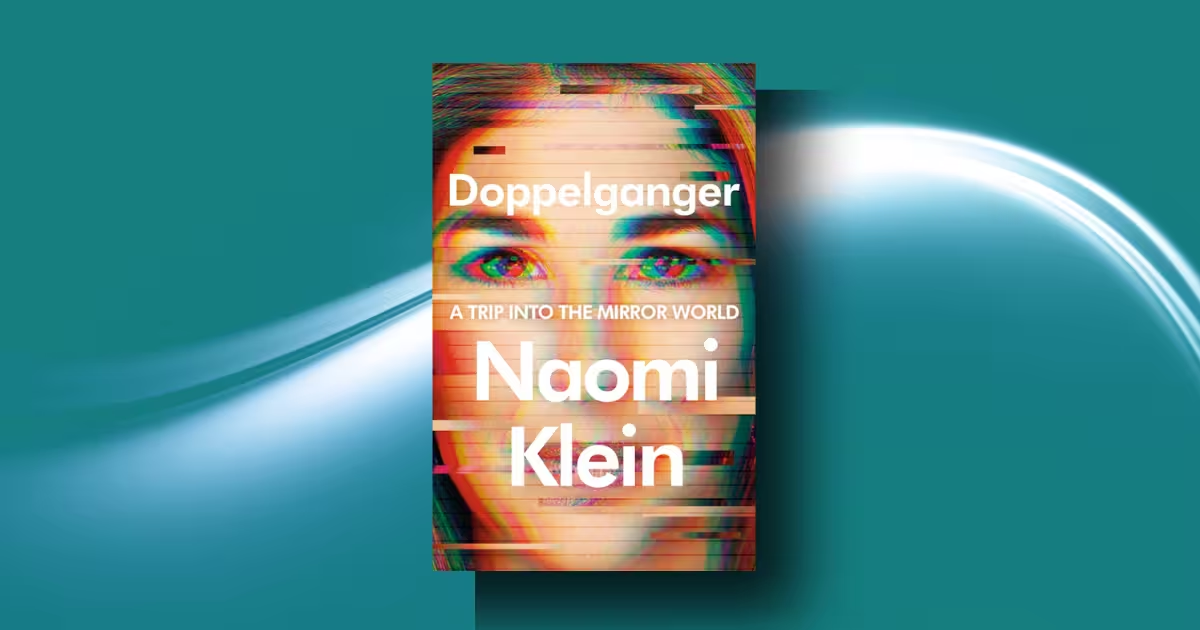
Does it ever feel like the world has split in two, and you’re not sure which side of the mirror you’re actually standing on? Doppelganger: A Trip into the Mirror World won’t just show you that fractured reality—it will give you the language and the spine to find your way back to something solid.
Doppelganger is best for anyone who has watched a friend or family member spiral down a conspiracy rabbit hole and wants to understand why. Readers who feel politically homeless in an era of rigid identity performances.
Those who appreciate a blend of deeply personal memoir with rigorous cultural and political analysis. If you’ve ever wondered how a 1990s feminist icon like Naomi Wolf could end up as a regular on Steve Bannon’s podcast, this book is your roadmap.
Not for readers seeking a straightforward, dispassionate political treatise. Those uncomfortable with an author who openly wrestles with her own complicity in the attention economy. People looking for a simple, binary narrative of good versus evil—Klein’s analysis is too nuanced for that.
Table of Contents
1. Introduction
Doppelganger: A Trip into the Mirror World is a 2023 non-fiction work by the award-winning Canadian journalist, activist, and professor Naomi Klein.
Published by Farrar, Straus and Giroux, the book debuted in September 2023 and quickly became a New York Times bestseller, a National Indie Bestseller, and was named Vulture’s #1 Book of the Year. It went on to win the prestigious Women’s Prize for Non-Fiction and was a finalist for the 2023 National Book Critics Circle Award. Klein, the author of seminal works like No Logo, The Shock Doctrine, and This Changes Everything, is one of the most trenchant social critics of our time.
This is not your typical political screed. Doppelganger is a dizzying hybrid of tragicomic memoir, chilling political reportage, and “cobweb-clearing analysis”.
The book was born out of a specific, surreal personal crisis: for over a decade, Naomi Klein has been chronically confused with another prominent feminist author, Naomi Wolf.
What began as a minor annoyance in a bathroom stall during the Occupy Wall Street protests in 2011 spiraled into an existential nightmare when Wolf, the author of The Beauty Myth, veered sharply into the world of right-wing conspiracy theories, becoming a darling of the anti-vaccine movement and a frequent guest on Steve Bannon’s War Room podcast.
Klein’s central argument of Doppelganger is that this personal case of mistaken identity is not merely a quirky anecdote but a powerful metaphor for our destabilized age.
She uses the figure of the doppelganger—the shadow self, the evil twin—to map what she calls the “Mirror World.”
This is a realm where real anxieties (about surveillance, corporate power, and government overreach) are twisted by conspiracy entrepreneurs into fantastical plots, where “the problem with democracy is not political elites everywhere who are beholden to the interests of corporations and financial markets, but a secret cabal of pedophiles planning to institute a world government”.
The book’s ultimate purpose is not just to diagnose the vertigo of our current moment but to find a way out—a path beyond despair and toward genuine solidarity.
2. Background
To fully grasp Doppelganger, you need to understand the two central figures it orbits.
The first is Naomi Klein herself. A third-generation leftist and a child of 1960s radicals, Klein built her career on meticulous investigations of corporate power and its ravages, from the branding strategies dissected in No Logo to the exploitation of crises detailed in The Shock Doctrine. She is, as she puts it, a writer of “Big Ideas About Serious Subjects”.
Her shadow, Naomi Wolf, was once a standard-bearer of 1990s third-wave feminism. Her 1990 book, The Beauty Myth, was hailed by Germaine Greer as “the most important feminist publication since The Female Eunuch”.
Wolf was the telegenic face of a new brand of feminism, one that sought power within existing elite structures rather than challenging them from the outside. She advised Al Gore’s 2000 presidential campaign and was a darling of the liberal establishment.
However, by the mid-2000s, something changed. Her work became increasingly erratic, filled with unsupported claims about Edward Snowden being a spy, ISIS beheadings being faked, and 5G networks possessing mystical calming properties.
This trajectory culminated in a public humiliation in 2019 when a BBC interviewer corrected a central, fatal error in her book Outrages live on air, leading to the book being pulped and her being dropped by her U.S. publisher.
The confusion between the two Naomis wasn’t just a case of similar names and big hair. As Klein writes, “We both write big-idea books (my No Logo, her Beauty Myth; my Shock Doctrine, her End of America…)” and “we both have brown hair that sometimes goes blond from over-highlighting”.
More importantly, their intellectual lanes began to blur as Wolf started writing about authoritarianism and states of emergency—territory Klein had staked out. It was as if Wolf had become “a parody of The Shock Doctrine, one with all facts and evidence carefully removed”.
3. Doppelganger Summary
Doppelganger is structured in four parts, moving from the personal to the political, and finally to the collective. Here is a comprehensive breakdown that will give you the book’s full intellectual payload.
Part One: Double Life (Performance)
Klein opens with the now-infamous bathroom incident at Occupy Wall Street in November 2011.
Overhearing two women complain that “Naomi Klein” didn’t understand the movement’s demands, she realizes they are talking about Naomi Wolf, who had been making a spectacle of herself, getting arrested in an evening gown while trying to dictate the protesters’ demands to them.
This is the first sign of a problem that would, over the next decade, become a daily avalanche of online confusion.
Klein uses this personal doppelganger trouble as a jumping-off point to explore the culture of personal branding. She reflects on her own discomfort with being turned into “the No Logo girl,” a brand she tried to kill by writing a book on a completely different topic (The Shock Doctrine).
She connects this to the broader societal pressure, especially on young people, to “relate to our self in the third person” and package their very traumas into “consumable commodities” for college admissions essays. As Klein’s students tell her, the process involves “packaging up your trauma into a consumable commodity”.
She also delves into the digital avatars we all create online—our “digital golems,” cobbled together from data trails we leave behind, which are “not made by us. It is made by exterior perceptions, interpretations, and predictions about us”.
The constant pressure to perform an idealized version of ourselves creates an internal doppelganger, a partitioned self. This, she argues, is a dangerous form of avoidance.
Part Two: Mirror World (Projection)
This is where the book shifts from memoir to political and cultural analysis. Klein begins to track Wolf’s descent into the “Mirror World,” a place where “whatever one says and believes, the other seems obliged to say and believe the exact opposite”.
Enter Covid, the Threat Multiplier: The pandemic supercharged Wolf’s trajectory.
No longer hopping from one conspiracy to another, she became a key node in anti-vaccine and anti-lockdown networks, claiming that vaccine passports were “slavery forever” and that vaccinated people were “biohazards” whose feces needed to be separated from sewage systems.
Klein notes with horror that Wolf’s Twitter following nearly doubled, and her website traffic skyrocketed from a mere 851 unique visits to over 100,000 in a single month after she started appearing on Bannon’s podcast.
The Real Fear Beneath the Fantasy: Klein makes a crucial, nuanced point. While Wolf’s claims about vaccine apps being a “CCP-style social credit score system” were “essentially fantasy,” they resonated because they tapped into very real, latent fears about surveillance capitalism. As Klein writes, “The words she was saying were essentially fantasy. But emotionally, to the many people now listening to her, they clearly felt true”.
She argues that progressives have largely ceded the ground on digital privacy and corporate surveillance, leaving a vacuum that figures like Wolf and Bannon were all too happy to fill.
The Alliance with Steve Bannon: Klein dedicates a significant portion of the book to understanding Wolf’s unlikely partnership with Steve Bannon, the former Trump strategist and host of the War Room podcast.
She describes Bannon’s project as building “MAGA Plus”—a supersized coalition that brings together traditional Trump voters with disaffected liberals, “Warrior Moms,” and wellness influencers who feel betrayed by the mainstream.
Bannon, she observes, is a master of identifying issues the left has neglected and then reflecting them back as warped, mirror-world versions. He rails against Big Pharma and Big Tech using rhetoric that “sounds like Noam Chomsky.
Or Chris Smalls… Or, for that matter, me”. Yet, his solutions are always about buying his own currency (FJB coins) or disaster-ready meals, not systemic change.
The Far Right Meets the Far-Out: Klein explores the convergence of the far-right with the “far-out”—the world of wellness influencers, yoga moms, and alternative health gurus. She traces how the “conspirituality” movement, fueled by a hyper-individualistic focus on bodily purity and optimization, became a vector for Covid denialism and anti-vaccine sentiment.
Figures like Christiane Northrup and Glowing Mama, who once focused on “vibrant health” and fitness, pivoted to spreading misinformation.
Klein chillingly recounts a canvassing experience where a yoga woman in British Columbia told her husband, Avi Lewis, that immunocompromised people “should die” rather than inconvenience her with vaccine mandates.
This, she argues, is the logic of “deaths pulled from the future”—a mindset that welcomes the culling of those deemed weak or “suboptimal”.
Autism and the Anti-Vax Prequel: A deeply personal and powerful chapter connects the modern anti-vaccine movement to its earlier incarnation: the vaccine-autism myth. Klein shares her own experiences as the parent of a neurodivergent child, navigating a world of “strange magical cures” and parents who treat their child’s diagnosis as a catastrophe, a “changeling” who replaced their “real” child.
She connects this to the legacy of Hans Asperger in Nazi Vienna, where children were sorted into those “worthy of life” and those who were not. This chapter provides a haunting historical lineage for the “pureblood” rhetoric of today’s anti-vax wellness influencers.
Part Three: Shadow Lands (Partition)
Here, Klein broadens her scope to examine the collective “Shadow Lands” upon which our modern world is built.
Calm, Conspiracy… Capitalism: Klein contrasts her own method of “pattern recognition”—seeking a calming, systemic analysis of power—with Wolf’s method, which is designed to induce panic and a state of “terrified” shock. She writes, “Calm is not a replacement for righteous rage… But calm is the precondition for focus, for the capacity to prioritize”.
She argues that Wolf, lacking a critique of capitalism, defaults to seeing power as residing in a cabal of evil individuals (Fauci, Gates, Soros) rather than in a system. This is the “socialism of fools”.
No Way Out but Back: Klein analyzes the two trucker convoys in Canada. The first, in June 2021, was a “We Stand in Solidarity” convoy honoring the Indigenous children whose unmarked graves had been discovered at a former residential school.
The second, the “Freedom Convoy” of February 2022, was a raucous, conspiracy-fueled occupation of Ottawa.
Klein sees the second convoy as a “white-lash”—an angry reassertion of innocence and a refusal to confront the uncomfortable truths of colonialism and genocide that the first convoy had acknowledged.
The Nazi in the Mirror: In one of the book’s most bracing sections, Klein draws on the work of Raoul Peck and Sven Lindqvist to argue that the Holocaust was not an aberration but an intensified, compacted expression of the same violent colonial ideology that ravaged the Americas and Africa.
She quotes Aimé Césaire’s chilling observation that Europeans tolerated “Nazism before it was inflicted on them” and that Hitler was their “demon,” their shadow.
The Unshakable Ethnic Double: Klein confronts her own Jewish identity and the “ethnic double” she and Wolf share. She asks whether the confusion between them is, at its root, a form of anti-Semitism, a refusal to distinguish between two “striving Jewesses”.
She then turns to the ultimate doppelganger state, Israel-Palestine, a place “where everything is doubled”. She describes Zionism as a project that created a “doppelganger of the forms of chauvinistic European nationalisms” and a “doppelganger of the colonial project”.
She movingly recounts a trip to Gaza where, after the 2009 attacks, an Israeli commander named “Erez from Erez” tried to gaslight her and her husband into believing their only safety lay in the Israeli military, despite their support for Palestinian rights.
Part Four: Facing the Real (Integration)
Having mapped the Mirror World in all its complexity, Klein searches for a way out. The path, she suggests, lies in “unselfing.”
She writes, “The climate crisis can be understood as a surplus of heat-trapping gases in the atmosphere; it can also be understood as a surplus of self”.
The solution is not more individual optimization but a turn toward collective action and a softening of the boundaries between ourselves and others. She finds hope in the memory of Red Vienna, the 1920s socialist experiment that built “children palaces” in order to “tear down prison walls”.
She points to the power of collective organizing, where people discover they are “not merely individuals, with the limited power of their individual selves, but that they belong to a class”.
Ultimately, Klein argues that the only way to combat the vertigo of the Mirror World is to stop running from our “second body”—the one entangled in the wars, extinctions, and exploitations that make our lives possible—and instead turn toward it, and toward each other.
4. Critical Analysis
Doppelganger: A Trip into the Mirror World is, in my opinion, the most essential, clarifying, and strangely comforting political book I have read in a decade.
It is a masterpiece of intellectual synthesis that manages to be both deadly serious about the forces threatening democracy and life on earth, while also being surprisingly funny and deeply human.
Klein’s argument is sprawling, but it holds together because of the power of her central metaphor. The figure of the doppelganger allows her to weave together seemingly disparate threads—personal branding, digital avatars, conspiracy theories, the rise of diagonalism, the history of eugenics, and the Israeli-Palestinian conflict—into a coherent and devastating diagnosis of our times.
She doesn’t just describe the symptoms of our collective vertigo; she names the underlying disease: a crisis of the self, amplified and exploited by a predatory capitalist system.
She is most effective when she demonstrates how the Mirror World operates by pipikism, a term she borrows from Philip Roth’s Operation Shylock, which she defines as “the antitragic force that inconsequentializes everything—farcicalizes everything, trivializes everything, superficializes everything”.
She shows how figures like Wolf and Bannon take serious concepts like “othering,” “fake news,” and “fascism” and render them absurd through overuse and misapplication, leaving us speechless and unable to name the real threats we face.
Crucially, Klein does not exempt herself or her own political tribe from her critique.
She is honest about her own complicity in the attention economy, her initial reluctance to critique tech company overreach during the pandemic for fear of being associated with Wolf’s conspiracies, and the ways in which left-wing movements have ceded ground by prioritizing individual brand-building over coalition-building.
This self-reflexivity is what elevates the book from a simple polemic to a work of genuine moral and intellectual inquiry.
The book fulfills its stated purpose brilliantly. It does not offer easy answers, but it provides an invaluable framework for understanding why everything feels so uncanny and unmoored. As Michelle Goldberg wrote in The New York Times, it’s hard to think of another text that “better captures the berserk period we’re living through”.
5. Strengths and Weaknesses
Strengths
Intellectual Breadth and Synthesis: Klein’s ability to connect the collapse of the Outrages book to the rise of diagonalism, or to link the vaccine-autism myth to Nazi child psychiatry, is breathtaking. The book is a masterclass in connecting the dots across history, politics, and culture.
The Central Metaphor: The doppelganger is not a gimmick. It is a brilliantly chosen analytical tool that unlocks insight after insight, from the digital avatars we perform online to the “fascist clown state” that is the ever-present shadow of liberal democracy.
Narrative Voice and Humor: Klein’s prose is “tight and urgent, almost breathless,” as Kirkus Reviews noted, and she masterfully blends the absurdity of her situation with the gravity of the subject matter. The scene where she gets a call from a Kuwaiti official who only returned her call because he thought she was Naomi Campbell is pure gold.
Uncompromising Honesty: The chapters on Israel-Palestine and on her own Jewish identity are some of the most difficult and courageous in the book. She navigates this minefield with a rare combination of moral clarity and personal vulnerability, refusing to offer easy platitudes.
A Path Forward: Unlike many books that diagnose our political sickness, Doppelganger ends on a note of cautious, hard-won hope. Its call for “unselfing” and its reclamation of forgotten models like Red Vienna offer a tangible, if daunting, alternative to despair.
Weaknesses
Density and Length: The book’s greatest strength is also its potential weakness for some readers. It is dense with ideas and names (Asperger, Césaire, Lindqvist, Arendt, etc.). At times, the sheer volume of information can feel overwhelming, and a reader might get lost in the “cobwebs” before the “clearing” part of the analysis arrives.
Asymmetry of the Personal: While the book is framed as a memoir about Klein’s doppelganger, it is, understandably, a very one-sided story. We get little to no insight into Naomi Wolf’s own perspective, motivations, or internal life. Klein’s analysis of Wolf is largely based on her public output and actions.
This is a necessary limitation, but it does mean the book is more of an “auto-doppelganger-graphy” than a true dual biography.
The “What Now?” Question: As some reviewers have noted, while the final section on “Facing the Real” is inspiring, the actionable steps for building a new solidarity-based politics on a mass scale remain somewhat vague. The power of the analysis highlights just how difficult that work will be.
6. Comparison with Similar Other Works
Doppelganger occupies a unique space, but it can be compared to several other important works.
Philip Roth’s Operation Shylock: This is the most direct literary antecedent, and Klein explicitly engages with it throughout the book. Both works use the doppelganger conceit to explore questions of identity, Zionism, and the line between sanity and madness.
Where Roth’s novel is a work of slippery fiction, Klein’s is a work of non-fiction that grapples with a reality that has become “Rothian.”
Sven Lindqvist’s “Exterminate All the Brutes”: Klein draws heavily on Lindqvist’s thesis about the colonial roots of the Holocaust. Like Lindqvist, she traces the continuities of genocidal logic across time and space, refusing to treat the Nazi genocide as a singular, inexplicable event.
Other Works on Conspiracy Culture: Books like Anna Merlan’s Republic of Lies or the podcast Conspirituality (which Klein credits as a key source) cover similar ground on the convergence of wellness and far-right conspiracy theories.
Klein’s unique contribution is to connect this phenomenon so intimately to the crises of personal branding, digital identity, and the failure of the left.
Her Own Oeuvre: Doppelganger is a fascinating evolution of Klein’s earlier work. It takes the core concern of The Shock Doctrine—how states of crisis scramble our collective synapses—and applies it to a more intimate, personal, and digitally-mediated kind of shock: the shock of being confused with your own evil twin.
7. Conclusion
Recommendation
Doppelganger: A Trip into the Mirror World is an essential, urgent read for anyone trying to make sense of our politically surreal and psychologically destabilizing moment.
It is not a book for specialists alone; it is for every person who has lost a loved one down a rabbit hole, for every activist who feels their language has been hijacked by bad actors, and for every citizen who senses that the world has become unmoored but lacks the vocabulary to describe it.
As Klein writes, “The point of this mapping is not to stay trapped inside the house of mirrors, but to do what I sense many of us long to do: escape its mind-bending confines and find our way toward some kind of collective power and purpose”.
This book is the best map we have. It won’t show you a simple, straight road out, but it will help you get your bearings in the bewildering, mirrored landscape we now all inhabit. It is a gift of clarity in a time of profound confusion.







