
Last updated on November 6th, 2026 at 11:41 am
Why do so many of us feel simultaneously seduced and suffocated by the ubiquitous logos plastered across our cities, screens, and clothing? No Logo will show you how to break free from the invisible web of branding that dictates modern consumerism.
No Logo is good read for digital marketers, culture jammers, political science students, and anyone seeking a comprehensive understanding of globalization and corporate accountability.
Not for those looking for a light, uncritical celebration of free-market capitalism.
Table of Contents
1. Introduction
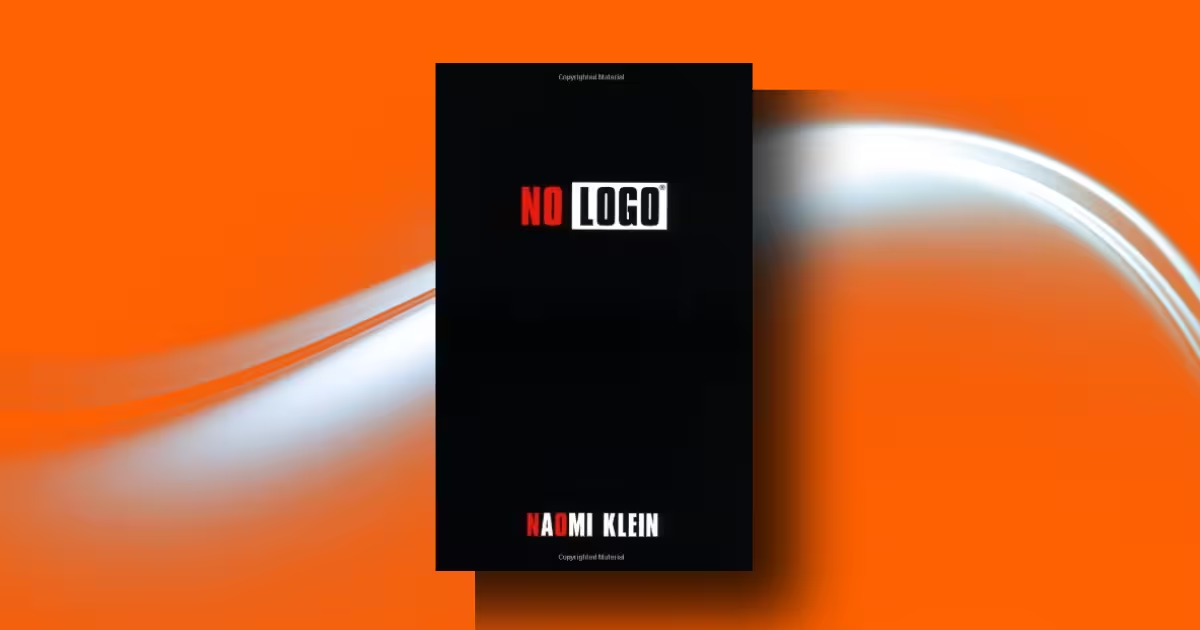
No Logo: Taking Aim at the Brand Bullies (10th Anniversary Edition) is an international bestseller by Naomi Klein.
Published by Picador, the book emerged as a defining text of the anti-corporate globalization movement. Naomi Klein is an award-winning journalist, author, and filmmaker who has written for The Nation and The Guardian.
The 10th-anniversary edition includes a new introduction by the author reflecting on the evolution of branding, including the “rebranding” of America under the Obama administration.
The central thesis of No Logo is that as more people discover the hidden, unbranded points of origin of brand-name goods (such as abusive sweatshops and degraded environments), their outrage will fuel a vast political movement targeting transnational corporations.
Klein argues that the astronomical growth of multinational corporations is rooted in a single idea: successful corporations must primarily produce brands, not products.
This shift has led to an assault on public space, consumer choice, and stable employment.
2. No Logo Summary
This definitive summary breaks down Klein’s exhaustive analysis into its four core components: No Space, No Choice, No Jobs, and No Logo.
Part I: No Space (The Surrender of Culture to Marketing)
The Birth of the Brand: In the machine age, mass production flooded the market with uniform goods. To create image-based differences, corporations bestowed names and personas (like Aunt Jemima or Quaker Oats) on generic products.
By the 1940s, agencies realized that a brand wasn’t just a mascot, but a “corporate consciousness”.
Marlboro Friday and the Brand Crisis: On April 2, 1993, Philip Morris slashed the price of Marlboro cigarettes by 20 percent to compete with bargain brands, causing Wall Street to panic and declare the “death of the brand”.
However, companies like Nike, Starbucks, and The Body Shop thrived during this period by integrating branding into the very fabric of their businesses, proving that brands were not dead, but transitioning into lifestyle concepts.
The Hollow Corporation: Companies shifted to a model where the ostensible product was mere filler for the real production: the brand. Phil Knight declared Nike a “sports company,” not a shoe manufacturer.
This led to the “hollow corporation,” which outsources manufacturing to contractors and focuses entirely on corporate mythology and marketing.
Branding the Culture: Logos expanded from hidden tags to massive chest emblems, turning consumers into walking billboards (e.g., Tommy Hilfiger). Brands began “culture-vulturing,” co-opting youth trends, indie culture, and irony. Nike utilized “bro-ing”—taking prototypes to inner-city neighborhoods to siphon “cool” from black urban youth.
Ads in Schools: Facing budget cuts, schools allowed corporations to brand their environments. Channel One broadcast mandatory commercials in classrooms, while fast-food chains like Pizza Hut and Taco Bell set up kiosks in cafeterias.
Part II: No Choice (Franchises and Synergy)
The Retail Clones: Klein contrasts the deep-discount “big-box” stores (Wal-Mart) with “clustering” lifestyle chains (Starbucks). Starbucks achieves market dominance through “cannibalization,” saturating an area with stores to drive out independent competitors, even if it means reducing sales at their own individual outlets.
Corporate Censorship: Mega-retailers dictate cultural production. Wal-Mart and Blockbuster refuse to carry CDs or movies that violate their “family” values, forcing artists (like Nirvana) to alter album art or change lyrics to access these massive distribution channels.
Synergy and Mergers: Conglomerates like Disney and Viacom seek to create “branded loops” where content is cross-promoted across owned networks, theme parks, and retail stores.
This consolidation severely limits consumer choice and can lead to internal censorship, such as ABC News allegedly softening a critical report on Disney.
Copyright Bullying: Corporations fiercely protect their brand identities using trademark and libel laws, suing artists, musicians, and independent businesses that attempt to parody or critique the brand’s cultural dominance.
Part III: No Jobs (The Discarded Factory)
Export Processing Zones (EPZs): As brands divested from manufacturing, production shifted to EPZs in the developing world, such as the Cavite zone in the Philippines. These zones act as tax-free, deregulated “labor warehouses” where multinational contractors assemble goods.
Labor Abuses: EPZ workers are predominantly young female migrants working under extreme conditions: forced overtime, poverty wages, and aggressive anti-union intimidation.
Multinationals exploit a system of subcontracting to distance themselves from these abuses. Pregnancy tests are routinely used to screen out mothers, creating a workforce of childless women.
The Temp Economy: In the West, job security is also vanishing. The service sector relies on part-time “McJobs” to suppress wages and benefits. Even profitable tech giants like Microsoft rely heavily on “permatemps” to maintain a flexible, disposable workforce while protecting the stock options of a core elite.
Part IV: No Logo (The Anti-Corporate Resistance)
Culture Jamming: Activists use “adbusting” to alter billboards and subvert corporate messaging, using the brand’s own momentum against it (e.g., changing Joe Camel to “Joe Chemo”).
Reclaim the Streets (RTS): Movements in the U.K. and globally stage spontaneous, illegal street parties to reclaim public space from car culture and corporate privatization.
The Brand Boomerang: Activists use the prominence of the logo to expose corporate abuses. The National Labor Committee targets high-profile brands (like Disney and Kathie Lee Gifford) to highlight sweatshop conditions. The McLibel Trial in the U.K. turned a McDonald’s libel suit into a massive public relations disaster for the fast-food giant.
Local Foreign Policy: Students and local governments use “selective purchasing agreements” to boycott companies doing business in dictatorships like Burma (Myanmar) or Nigeria, leveraging institutional buying power to force corporate withdrawals.
3. Critical Analysis
No Logo stands as a monumental piece of investigative journalism and cultural critique.
Klein masterfully links seemingly disparate phenomena—from the rise of Tommy Hilfiger’s hip-hop marketing to the suppression of labor rights in the Cavite Export Processing Zone—into a cohesive narrative about the mechanics of modern capitalism.
The author supports her arguments with an overwhelming amount of evidence, transitioning seamlessly from Wall Street ad expenditure data to firsthand accounts of sweatshop workers in Indonesia and the Philippines.
By treating corporate history as a sociological text, Klein fulfills her stated purpose: she effectively maps the architecture of the anti-corporate globalization movement, proving that the obsession with “branding” inherently creates the conditions for its own backlash.
For platforms focused on deep, systematic cultural and digital analysis, such as sopranu.com, this text serves as a foundational blueprint for understanding how corporate narratives are constructed and ultimately dismantled.
4. Strengths and Weaknesses
Strengths:
Thematic Synthesis: The book’s greatest strength is its ability to connect First World consumer culture with Third World labor realities.
Klein’s documentation of how corporations extract “cool” from marginalized urban youth while simultaneously moving manufacturing jobs out of those very cities is profound.
Prescient Analysis: Klein’s examination of the “hollow corporation” perfectly predicts the modern gig economy and the increasing reliance on subcontracted labor.
Weaknesses:
Dated Cultural References: Readers approaching the text today may find the heavy reliance on 1990s cultural touchstones (e.g., the grunge movement, early MTV, and AOL) slightly anachronistic, though the underlying economic principles remain highly relevant.
Limitations of Brand-Based Politics: As Klein herself notes, targeting highly visible brands (like Nike or Shell) can inadvertently let unbranded, business-to-business resource extractors off the hook, creating a “warped hierarchy of oppression” where abuses are ignored if a famous logo isn’t attached.
5. Comparison With Similar Works
No Logo is frequently compared to Marx’s Das Kapital for the modern anti-corporate movement. It shares thematic DNA with Thomas Frank’s The Conquest of Cool, which also explores how advertising co-opts counterculture.
However, Klein’s work is uniquely comprehensive in its global scope, bridging the gap between media studies and international labor economics.
6. Conclusion
No Logo is an essential, groundbreaking read for anyone interested in economics, marketing, sociology, or activism.
It is highly recommended for digital entrepreneurs, marketers, and SEO specialists who need to understand the mechanics of brand-building and the ethical responsibilities that accompany global corporate power.
It is accessible enough for a general audience but meticulously researched enough to satisfy academic specialists.
Related reading: The Network Society Is Here, And It’s Reshaping Everything You Do







