

Do you ever feel like you’re running faster just to stay in the same place, not just in your personal life, but as a society? Like we’re trapped on a treadmill that keeps speeding up, and no one dares to ask whether we could simply step off?
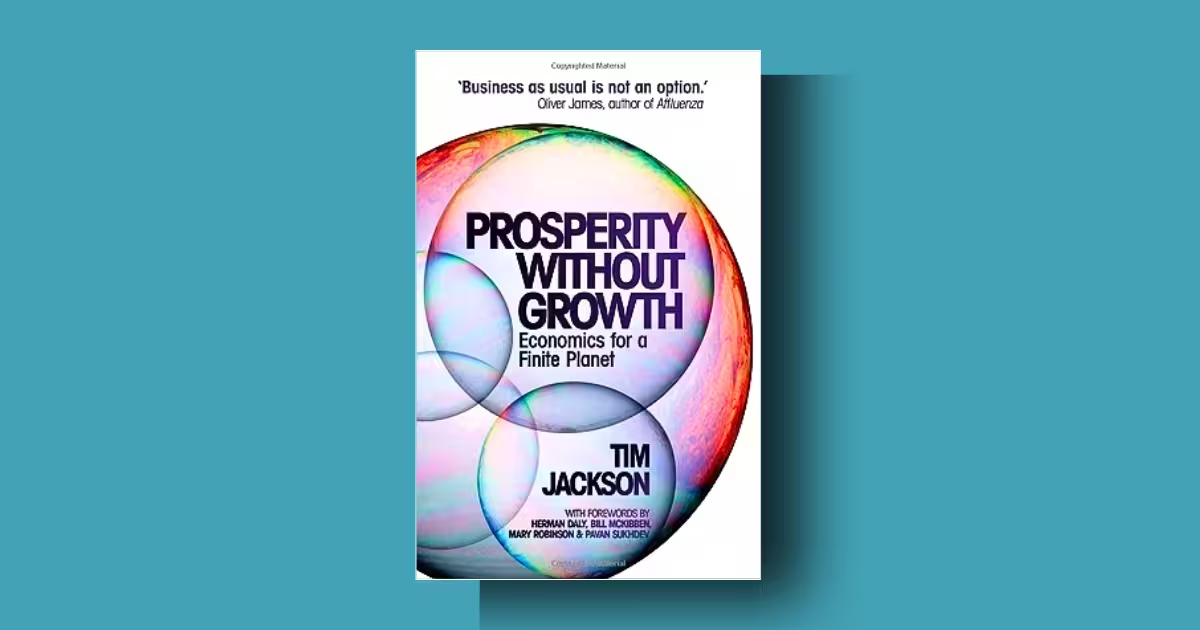
That’s exactly the question Tim Jackson poses in his landmark book, Prosperity Without Growth: Foundations for the Economy of Tomorrow. And his answer might just unsettle everything you thought you knew about economics, progress, and what it means to live well.
Overview
Prosperity Without Growth isn’t another doom-and-gloom environmental book. It’s a meticulously researched, deeply human, and surprisingly hopeful exploration of one question: What if endless economic growth isn’t the answer, and never was?
Jackson, a Professor of Sustainable Development at the University of Surrey and Director of the Centre for the Understanding of Sustainable Prosperity (CUSP), served as Economics Commissioner for the UK’s Sustainable Development Commission from 2004 to 2011.
His work culminated in a 2009 report that became this book, which was later named a Financial Times “Book of the Year” in 2010 and UnHerd’s economics book of the decade in 2019.
The book challenges the sacred cow of modern economics: GDP growth. It argues that our obsession with expanding the economic pie is not only ecologically unsustainable but also socially destructive. And it offers a vision of how we might build an economy that serves human flourishing rather than the other way around.
Who Will Actually Love Prosperity Without Growth, And Who Should Bounce
Read Prosperity Without Growth if:
- You’ve ever suspected that “growth at all costs” is a dangerous delusion.
- You care about climate change but are tired of hearing that technology will magically fix everything.
- You want to understand why politicians keep chasing GDP even when it clearly isn’t making people happier.
- You’re open to questioning deeply held assumptions about work, consumption, and what prosperity really means.
- You enjoy books that combine rigorous economics with philosophy, psychology, and a genuine concern for human well-being.
Skip Prosperity Without Growth if:
- You’re looking for a step-by-step policy manual with easy answers (Jackson is honest about the complexity of the transition).
- You believe that technological innovation alone will solve our environmental problems.
- You’re not ready to question whether endless growth is possible or desirable.
- You prefer books that reinforce what you already believe rather than challenge it.
Table of Contents
1. Introduction
Title and Author Information
Title: Prosperity Without Growth: Foundations for the Economy of Tomorrow (Second Edition, 2017)
Author: Tim Jackson
Publication Details: First published in 2009 by Earthscan as Prosperity Without Growth: Economics for a Finite Planet. A substantially revised and expanded second edition was published in January 2017 by Routledge.
The book has been translated into 17 foreign languages and has become a foundational text of the post-growth and degrowth movements.
Context
Prosperity Without Growth emerged from a specific historical moment: the 2008 financial crisis, which exposed the fragility of an economic system built on ever-expanding debt and consumption.
But its arguments have only grown more urgent in the years since, as climate breakdown accelerates, inequality widens, and political instability deepens.
The book sits at the intersection of ecological economics, political economy, and social psychology. It draws on decades of research into sustainable development, consumer behavior, and macroeconomic theory.
Jackson’s background is unusually broad: he holds degrees in mathematics, philosophy, and physics, and he’s also an award-winning playwright with numerous BBC radio credits. This unusual combination gives the book a rare blend of analytical rigor and narrative flair.
Purpose
The central thesis of Prosperity Without Growth is stark and uncompromising:
“Questioning growth is deemed to be the act of lunatics, idealists and revolutionaries. But question it we must.”
Jackson’s purpose is to demonstrate that continued economic growth in wealthy nations is both ecologically impossible and socially unnecessary, and that we urgently need to imagine and build an economy that can deliver prosperity without expansion.
As he puts it in the book’s core argument:
“There is as yet no credible, socially just, ecologically sustainable scenario of continually growing incomes for a world of nine billion people.”
2. Background
To understand why Prosperity Without Growth matters, you need to understand the context in which it was written.
For most of the post-war period, economic growth was seen as the primary goal of economic policy. Governments measured success by GDP, and political careers rose and fell on growth figures. The assumption was simple: growth creates jobs, growth reduces poverty, growth makes everyone better off.
But by the early 2000s, cracks were showing. Inequality was rising even in growing economies. Environmental degradation was accelerating. And the 2008 financial crisis revealed that the financial system, which was supposed to channel savings into productive investment, had instead become a machine for generating debt and speculation.
Jackson was uniquely positioned to challenge the growth orthodoxy. As Economics Commissioner for the UK’s Sustainable Development Commission (SDC), he was tasked with advising the government on how to reconcile economic prosperity with environmental sustainability. His 2009 report, “Prosperity Without Growth? The Transition to a Sustainable Economy,” was the culmination of three years of research involving 40 commissioners and several hundred advisers.
The report caused a stir. It was the first time a government-affiliated economist had openly questioned the growth imperative. But Jackson wasn’t content to leave it as a policy document.
He expanded it into a book that reached a wider audience, and in doing so, he became a leading voice in the emerging post-growth movement.
3. Prosperity Without Growth Summary
Let me walk you through what I learned from this book. I want you to understand it as thoroughly as if you’d read it yourself.
Chapter 1: The Limits to Growth
Jackson begins by laying out the ecological reality we face. He draws on the planetary boundaries framework (which you might recognize from Kate Raworth’s Doughnut Economics) to show that we’re already exceeding safe limits on climate change, biodiversity loss, and nitrogen and phosphorus cycles.
The numbers are sobering. Global GDP has grown more than fivefold since 1950, but this growth has come at a staggering ecological cost. Greenhouse gas emissions continue to rise, biodiversity is collapsing, and resource extraction is accelerating.
Jackson’s point isn’t that growth is always bad, it’s that endless growth on a finite planet is a logical impossibility. As he puts it:
“The idea of a non-growing economy may be an anathema to an economist. But the idea of a continually growing economy is an anathema to an ecologist.”
Chapter 2: Prosperity Lost
This chapter explores what we’ve actually gained from decades of growth. The answer, Jackson argues, is less than we think.
Yes, average incomes have risen. But so have rates of depression, anxiety, and social isolation. Consumerism hasn’t made us happier, it’s made us more anxious, more indebted, and more disconnected from each other.
Jackson draws on the work of psychologists like Tim Kasser and Richard Ryan, who have shown that materialistic values are associated with lower well-being, higher anxiety, and more depression. We’ve been chasing growth, but we’ve been losing the things that actually matter: relationships, community, meaning, and purpose.
Chapter 3: Redefining Prosperity
If growth isn’t the answer, what is? Jackson proposes a different vision of prosperity: one based on human flourishing rather than material accumulation.
This isn’t just wishful thinking. Jackson draws on a rich tradition of philosophical and psychological research that identifies the key ingredients of a good life: social connections, meaningful work, creative expression, and a sense of purpose.
He quotes Adam Smith (yes, the same Adam Smith who’s often invoked as the patron saint of free markets) to argue that poverty isn’t just about material deprivation, it’s about the inability to participate fully in society:
“Following Adam Smith, Jackson understands poverty not primarily as material deprivation but rather as the inability ‘to appear in public without shame.’”
Chapter 4: The Dilemma of Growth
This is the heart of the book. Jackson lays out what he calls the “dilemma of growth”: growth is ecologically unsustainable, but degrowth (economic contraction) is socially unstable.
“Jackson describes here more clearly than in the first version the dilemma of growth, namely that growth is not sustainable while ‘degrowth’ is unstable.”
Why is degrowth unstable? Because our economies, financial systems, and social institutions are all built on the assumption of growth. If growth stops, unemployment rises, public finances deteriorate, and social tensions escalate.
But continuing to pursue growth is equally dangerous. The ecological damage is already severe, and it’s getting worse.
So what’s the way out? Jackson argues that we need to transform the structure of the economy, not just slow it down, but change what it produces, how it produces it, and who benefits.
Chapter 5: The Myth of Decoupling
This is one of the most important chapters in the book, and one of the most controversial.
The idea of “decoupling” is central to green growth thinking. The argument goes like this: we can continue growing the economy while reducing its environmental impact, by using resources more efficiently and shifting to cleaner technologies.
Jackson subjects this idea to rigorous scrutiny. He shows that while relative decoupling (using fewer resources per unit of GDP) has happened in some cases, absolute decoupling (reducing total resource use while GDP grows) is nowhere near the scale needed.
“Jackson argues compellingly that such ‘decoupling’ is a myth.”
The evidence is stark: despite decades of efficiency improvements, global resource use and carbon emissions continue to rise. We’re getting more efficient, but we’re also consuming more.
Jackson doesn’t deny that efficiency improvements are valuable, he just argues that they can’t deliver the scale of change we need, fast enough, on their own.
Chapter 6: The “Iron Cage” of Consumerism
Why do we keep consuming more, even when it doesn’t make us happier? Jackson turns to sociology and psychology for answers.
He draws on the work of Thorstein Veblen, who coined the term “conspicuous consumption” to describe how people use goods to signal status. He also references the “Diderot effect”, the tendency for one new purchase to trigger a cascade of others as we try to maintain consistency in our lifestyle.
But the deeper issue, Jackson argues, is that consumerism has become a kind of prison. We’re trapped in a system that constantly tells us that happiness lies in the next purchase, and we believe it, because the alternative (questioning the whole system) feels too overwhelming.
“Consumerism promotes the illusion that needs can be satisfied primarily through the acquisition of goods.”
Jackson doesn’t blame individuals for this. He recognizes that consumerism is a structural phenomenon, driven by advertising, social norms, and the economic imperative to keep the growth machine running.
Chapter 7: Flourishing, Within Limits
If consumerism is the problem, what’s the alternative? Jackson sketches a vision of flourishing within limits, a life of meaning, connection, and creativity that doesn’t depend on endless material accumulation.
He draws on the Aristotelian tradition of eudaimonia (human flourishing), which emphasizes the importance of virtue, community, and purpose. He also references modern positive psychology, which has identified similar factors: autonomy, competence, relatedness, and meaning.
Jackson argues that these sources of well-being don’t require endless growth. In fact, they often thrive when we step off the consumer treadmill and invest in relationships, skills, and communities instead.
Chapter 8: Foundations for the Economy of Tomorrow
This is where Jackson moves from critique to construction. What would a post-growth economy actually look like?
He identifies several key pillars:
- A different kind of enterprise: businesses that prioritize social and environmental goals alongside profit.
- A different kind of work: shorter working hours, more meaningful jobs, and a fairer distribution of labor.
- A different kind of investment: public and private investment in social and ecological goods, rather than speculative financial assets.
- A different kind of money: reforming the financial system to serve the real economy, rather than the other way around.
Jackson doesn’t pretend to have all the answers, but he provides a clear framework for thinking about the transition.
Chapter 9: Towards a “Post-Growth” Macroeconomics
This chapter tackles the technical challenge: can we design macroeconomic policies that work without growth?
Jackson argues that we can. He draws on Keynesian economics, which emphasizes the role of government in managing demand, and proposes a “Green New Deal” approach: massive public investment in renewable energy, energy efficiency, and social infrastructure.
But he also recognizes that we need to go beyond Keynesianism. Traditional Keynesian policies assume growth will eventually return, they’re about managing the cycle, not breaking the addiction. A genuinely post-growth macroeconomics would need to operate differently: stabilizing the economy at a sustainable scale, rather than trying to expand it.
Chapter 10: The Progressive State
What role should government play in the transition? Jackson argues for a progressive state that actively shapes the economy rather than just reacting to market forces.
This means:
- Regulating finance to prevent speculation and ensure investment in productive activities.
- Investing in public goods like education, health, and infrastructure.
- Redistributing income and wealth to reduce inequality and ensure everyone can participate in society.
- Supporting innovation in sustainable technologies and business models.
Jackson is careful to distinguish this from the old command-and-control socialism. He’s not arguing for state ownership of everything, he’s arguing for democratic governance of the economy, with a clear focus on human and ecological well-being.
Chapter 11: A Lasting Prosperity
The final chapter returns to the big picture: what does prosperity really mean, and how can we achieve it?
Jackson’s answer is both simple and profound: prosperity is the ability to flourish as human beings, within the ecological limits of a finite planet.
“Prosperity consists in our ability to flourish as human beings , within the ecological limits of a finite planet.”
This isn’t a retreat to some pre-industrial pastoral fantasy. Jackson is clear that we need to use technology, innovation, and human creativity to build a better world. But he insists that we need to use these tools in service of human flourishing, not endless accumulation.
4. Analysis
My Opinion / Commentary
Prosperity Without Growth is one of the most important books I’ve read in the past decade. It’s not an easy read, it challenges deeply held assumptions about progress, success, and the very nature of the good life. But it’s a necessary read, especially for anyone who cares about the future of our planet and our species.
What struck me most is Jackson’s honesty. He doesn’t pretend that the transition to a post-growth economy will be easy. He acknowledges the political, economic, and psychological barriers. But he also refuses to accept that we have no choice but to continue on our current path. As he writes:
“Questioning growth is deemed to be the act of lunatics, idealists and revolutionaries. But question it we must.”
The book is beautifully written, clear, accessible, and often moving. Jackson’s background as a playwright shows in his ability to tell a story and connect with readers on an emotional level.
Does Jackson Support His Arguments?
Yes, and thoroughly. The book is meticulously researched, drawing on decades of academic work in ecological economics, psychology, sociology, and political science. Jackson provides extensive references and data to back up his claims.
The strongest evidence comes from the failure of decoupling, the fact that despite decades of efficiency improvements, we haven’t been able to reduce total resource use and emissions. This is a powerful empirical argument against green growth optimism.
Does the Book Fulfill Its Purpose?
Yes, but with some caveats. Jackson’s goal is to question the growth imperative and sketch a vision of an alternative. He succeeds admirably at both.
However, the book is stronger on critique than on detailed prescription. Jackson provides a framework for thinking about the transition, but he doesn’t offer a step-by-step policy blueprint.
This is intentional, he recognizes that the specifics will vary by country and context, but it may leave some readers wanting more.
5. Strengths and Weaknesses
Strengths
Intellectual Rigor: Jackson doesn’t rely on slogans or rhetoric. He engages seriously with economic theory, data, and evidence. This makes his arguments harder to dismiss.
Human Focus: Unlike many environmental books, Prosperity Without Growth is fundamentally about human well-being. Jackson argues that the growth economy isn’t just ecologically destructive, it’s also making us less happy, more anxious, and more disconnected.
Accessible Writing: Despite the complexity of the subject, Jackson writes clearly and engagingly. He uses stories, examples, and analogies to make his points understandable.
Honest About Difficulties: Jackson doesn’t pretend the transition will be easy. He acknowledges the political, economic, and psychological barriers, and he doesn’t offer easy answers.
The “Dilemma of Growth”: The recognition that growth is unsustainable but degrowth is unstable is a crucial insight. It forces us to think about transformation, not just expansion or contraction.
Weaknesses
Lack of Detailed Policy Proposals: Critics have noted that Jackson doesn’t provide a detailed roadmap for the transition. This is partly intentional, but it may frustrate readers looking for practical guidance.
Political Naivety: Some critics have argued that Jackson underestimates the political barriers to change. As one Treasury official reportedly asked him: “What would it be like for Treasury officials to turn up at G7 meetings knowing that the UK’s GDP had slipped down the rankings?” Jackson admits he was “dumbstruck” by this question.
Decoupling Debate: Some economists argue that Jackson is too pessimistic about decoupling. They point to falling emissions in some countries as evidence that absolute decoupling is possible. Jackson’s response is that the reductions aren’t happening fast enough, and they’re often achieved by offshoring emissions to other countries.
Unanswered Questions: The book raises many important questions without fully answering them. How do we manage the transition without causing social collapse? How do we build political support for radical change? How do we ensure a just transition that doesn’t leave the poorest behind?
6. Comparison with Similar Works
Doughnut Economics (2017) by Kate Raworth
Raworth’s book is often mentioned alongside Jackson’s, and for good reason. Both challenge the growth orthodoxy and propose alternative frameworks. But there are important differences.
Raworth’s “Doughnut” framework is more visual and intuitive: it’s about staying within planetary boundaries while meeting social needs. Jackson’s book is more focused on the economic mechanisms that drive growth and the structural changes needed to escape them.
Raworth is more optimistic about the possibility of transformation; Jackson is more focused on the barriers and difficulties.
Steady-State Economics (1977) by Herman Daly
Daly is the godfather of ecological economics and a major influence on Jackson. His concept of a “steady-state economy” (one that doesn’t grow) is a direct precursor to Jackson’s post-growth vision.
But Daly’s work is more abstract and theoretical. Jackson’s book is more accessible and more focused on the human and social dimensions of the transition.
Managing Without Growth (2008) by Peter Victor
Victor’s book uses computer modeling to explore what a no-growth economy might look like. It’s more technical than Jackson’s, but it reaches similar conclusions: that it’s possible to have full employment, reduced inequality, and environmental sustainability without growth.
Jackson is more focused on the social and psychological barriers to change, while Victor focuses on the macroeconomic feasibility.
Farewell to Growth (2009) by Serge Latouche
Latouche is a leading figure in the “degrowth” movement, which emphasizes the need for deliberate reduction in production and consumption.
Jackson is more cautious about degrowth, recognizing that economic contraction can be socially destabilizing. He prefers the term “post-growth” and focuses on transformation rather than simple reduction.
7. Conclusion
Final Verdict
Prosperity Without Growth is an outstanding book, one that deserves to be read widely and taken seriously. It’s not a comfortable read, but it’s an essential one.
Jackson has done something remarkable: he’s taken a deeply unfashionable idea (that we need to stop growing) and made it not just plausible but compelling. He’s shown that the growth economy isn’t just ecologically unsustainable, it’s also making us less happy, more anxious, and more disconnected.
Recommendation
I recommend this book to:
- Students and academics in economics, environmental studies, and political science.
- Policy-makers and activists who are looking for a coherent critique of the growth paradigm.
- Anyone who has ever felt that there must be more to life than working, consuming, and chasing the next promotion.
- Readers of Kate Raworth, Herman Daly, or Naomi Klein who want to go deeper into the economics of the transition.
I would not recommend this book to:
- Those looking for easy answers or a simple policy manual.
- Those who are deeply committed to the green growth narrative and unwilling to question it.
- Those who prefer books that reinforce their existing beliefs rather than challenging them.
Closing Thought
Jackson ends the book with a powerful call to action:
“Fulfilling that vision is simply the most urgent task of our times.”
He’s right. The growth economy is taking us to the brink of ecological and social collapse. We need to imagine and build something better, and soon.
Prosperity Without Growth is an essential guide to that task. It won’t give you all the answers, but it will help you ask the right questions. And in a world that’s desperately short of wisdom, that’s no small thing.
Related Books, Films, and Articles
Books
- Kate Raworth, Doughnut Economics: Seven Ways to Think Like a 21st-Century Economist (2017)
- Herman Daly, Steady-State Economics (1977)
- Peter Victor, Managing Without Growth: Slower by Design, Not Disaster (2008)
- Serge Latouche, Farewell to Growth (2009)
- Naomi Klein, This Changes Everything: Capitalism vs. The Climate (2014)
- Jason Hickel, Less Is More: How Degrowth Will Save the World (2020)
Films
- The Story of Stuff (2007), a short animated film about consumerism and the linear economy
- An Inconvenient Truth (2006), Al Gore’s documentary on climate change
- The Corporation (2003), a documentary about the rise of the corporate form and its social and environmental impacts
Articles
- “Beyond green growth: why we need a world without economic growth”, The Guardian, April 2010
- “Post Growth by Tim Jackson review, life after capitalism”, The Guardian, May 2021
- “Rio+20: Tim Jackson on how fear led world leaders to betray green economy”, The Guardian, June 2012