
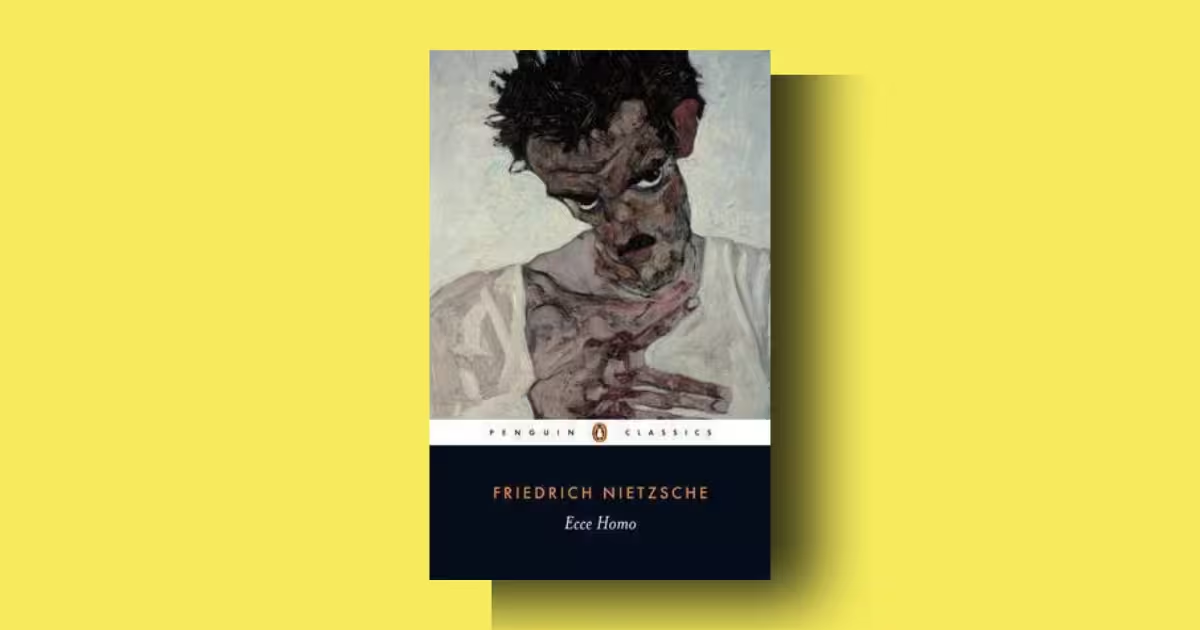
Why does Friedrich Nietzsche, on the verge of madness, write Ecce Homo calling himself divine, and why should you read it?
Overview
Ecce Homo is Friedrich Nietzsche’s final original work, written in a frenzy of creative energy during the autumn of 1888, just weeks before his catastrophic mental collapse in January 1889. The title, Latin for “Behold the Man,” is a direct echo of Pontius Pilate’s words as he presented the scourged Jesus to the mob. But Nietzsche isn’t presenting a beaten prophet.
He’s presenting himself as the first immoralist, the destroyer of morality, the man who will split history in two.
Ecce Homo is structured around four chapters with absurdly immodest titles: “Why I Am So Wise,” “Why I Am So Clever,” “Why I Write Such Good Books,” and “Why I Am a Destiny.” Nietzsche reviews his own life and his previous works, offering commentary that ranges from the laughably self-aggrandizing to the genuinely profound. He claims to be “by far the most terrifying human being there has ever been” and declares: “I am not a man, I am dynamite”.
But here’s the thing: Ecce Homo isn’t really an autobiography in any conventional sense. It deliberately withholds basic biographical facts (Nietzsche never even tells us when he was born). Instead, it’s a philosophical performance—a self-creation, a work of literary art that uses the genre of autobiography to demonstrate what it means to become what you are.
Key stats to know:
- Written in just three weeks (15 October – 4 November 1888)
- Published posthumously in 1908, eight years after Nietzsche’s death
- Nietzsche was 44 when he wrote it; he would be declared insane within three months
- The book was suppressed by his sister Elisabeth for twenty years
Reader recommendation
Ecce Homo is best for:
- Readers already familiar with Nietzsche’s major works (Thus Spoke Zarathustra, Beyond Good and Evil, On the Genealogy of Morals) who want to see how he understood his own project
- Anyone interested in philosophical autobiography as a literary genre
- Readers who appreciate satire, irony, and intellectual provocation
- Those curious about the relationship between philosophy and mental illness
Ecce Homo is not recommended to:
- Beginners to Nietzsche—this book assumes you know his ideas and will make little sense without context
- Readers seeking a straightforward, factual biography
- Anyone easily offended by extreme self-praise, misogyny, or anti-German sentiment
- Those who prefer their philosophy modest and academically restrained
Table of Contents
1. Introduction
Book: Ecce Homo: How To Become What You Are (original German: Ecce homo: Wie man wird, was man ist)
Author: Friedrich Nietzsche (1844–1900)
Publication Details: Written in 1888, first published posthumously in 1908. The Oxford World’s Classics edition (2007) is translated and edited by Duncan Large, who provides extensive explanatory notes and a substantial introduction.
Author’s Credentials: Nietzsche was a German philosopher, classical philologist, and cultural critic who fundamentally reshaped Western philosophy. By the time he wrote Ecce Homo, he had already produced a body of work that included The Birth of Tragedy, Thus Spoke Zarathustra, Beyond Good and Evil, and On the Genealogy of Morals.
He had been a professor of classical philology at the University of Basel at the astonishing age of 24, though illness forced him to resign in 1879. His influence on existentialism, postmodernism, psychology, and literature is immeasurable—Sigmund Freud, for instance, agreed that Nietzsche had achieved a “degree of introspection [that] had never been achieved by anyone”.
Context of Ecce Homo
The book is about Nietzsche’s attempt to present himself to an audience he knew had largely ignored him. As he writes in the Foreword: “People ought really to know already: for I have not failed to ‘bear witness’ to myself… I am living on my own credit; perhaps it is merely a prejudice that I am alive at all?”.
Ecce Homo was written as a kind of “stock-taking exercise” before the monumental work Nietzsche was planning: the Revaluation of All Values. He saw it as a preliminary explanation of who he was so that readers of his magnum opus would not misunderstand him. In fact, the book is more of an annunciation than a valediction, Nietzsche genuinely believed he was about to shake the world to its foundations.
Purpose of Ecce Homo
The central thesis of Ecce Homo is contained in its subtitle: “How To Become What You Are.” This isn’t a self-help manual. It’s a demonstration that the self is not something you are but something you achieve—through struggle, through incorporation of what is alien, through what Nietzsche calls amor fati: the love of fate.
“My formula for human greatness is amor fati: not wanting anything to be different, not forwards, not backwards, not for all eternity. Not just enduring what is necessary, still less concealing it, all idealism is hypocrisy in the face of what is necessary, but loving it…”
The book argues that Nietzsche himself is the supreme example of this self-becoming. He presents himself as the “first immoralist,” the man who has overcome Christian morality and its life-denying values, and who therefore stands as a destiny for humanity.
2. Background
To understand Ecce Homo, you need to understand the circumstances of its composition.
In 1888, Nietzsche was living in Turin, Italy, in a state of extraordinary productivity. Within a single year, he had completed The Wagner Case, Twilight of the Idols, The Antichrist, and Ecce Homo itself. He was also amassing notes for his projected magnum opus, The Will to Power (later reconceived as Revaluation of All Values).
But Nietzsche was also a profoundly ill man. He had suffered from debilitating migraines, eye problems, and digestive issues for most of his adult life. In 1879, at the age of 35, he had been forced to resign his professorship due to his health.
By 1888, he was living as a wanderer, moving between Sils-Maria in Switzerland, Nice in France, and Turin in Italy, searching for climates that wouldn’t exacerbate his condition.
The book was begun on Nietzsche’s 44th birthday, 15 October 1888, as a “birthday present to himself”. He wrote the majority of it in just three weeks. By January 1889, he had suffered his famous breakdown in Turin—the moment when he allegedly embraced a horse that was being whipped, then collapsed. He spent the remaining eleven years of his life in a state of mental darkness, cared for by his mother and then his sister Elisabeth.
This context has haunted the reception of Ecce Homo. For decades, readers have asked: Is this the work of a madman? The book’s extreme claims- Nietzsche calls himself “divine,” claims to be “the first decent human being,” and declares that “the truth speaks from me”—have been read as symptoms of incipient psychosis.
However, scholars have increasingly pushed back against this reading. As Nicholas D. More argues in Nietzsche’s Last Laugh, Ecce Homo is better understood as a masterful work of satire. Its “exceedingly bombastic claims” can be explained by Nietzsche’s incorporation of traditional elements of Judeo-Christian apocalyptic narratives. The book is no more a work of “madness” than the Book of Revelation.
3. Ecce Homo Summary
Let me walk you through what I actually learned from reading Ecce Homo, and trust me, it’s a lot more than I expected from a book that’s barely 150 pages.
The Foreword: Setting the Stage
Nietzsche opens with a declaration that is both humble and utterly arrogant:
“In view of the fact that I will shortly have to confront humanity with the heaviest demand ever made of it, it seems to me essential to say who I am.”
He complains that he hasn’t been heard, that people don’t even know he exists. But then he immediately pivots to the substance of the book: he is “definitely no bogeyman, no moral monster,” but rather a “disciple of the philosopher Dionysus” who “would prefer to be a satyr rather than a saint”.
He attacks idealism directly: “Reality has been robbed of its value, its sense, its truthfulness insofar as an ideal world was faked up”. The “real world” versus the “apparent world”?
No, it’s the fake world versus reality.
Chapter 1: Why I Am So Wise
This chapter is where Nietzsche introduces his concept of decadence, a term he borrowed from the French writer Paul Bourget. Nietzsche argues that he is both a decadent and its opposite:
“I am a décadent and the opposite of one… As summa summarum I was healthy, as nook, as speciality I was décadent.”
He claims that his long period of illness was actually a gift—it taught him to “discover life anew” and to turn his “will to health, to life, into my philosophy”. This is where we get one of Nietzsche’s most famous lines:
“What does not kill him makes him stronger.”
Then things get… strange. Nietzsche discusses his genealogy (in the literal sense of his family tree). He insists he is a “Polish nobleman pur sang” (pure blood) with “not a drop of bad blood… least of all German blood”. This is a family legend that has since been disproved, but Nietzsche uses it to distance himself from his German heritage.
He attacks his mother and sister with shocking venom, calling them canaille (riff-raff) and claiming that “to think of myself as related to such canaille would be a blasphemy against my divinity”. This paragraph was actually suppressed by his sister Elisabeth and only restored to the text in 1969.
Nietzsche also introduces his concept of Russian fatalism—the idea of not reacting at all when circumstances become unbearable:
“Not taking, taking on, taking in anything at all any more—no longer reacting at all…”
He contrasts this with the destructive emotions of resentment and revenge, which he sees as the hallmarks of weakness.
Chapter 2: Why I Am So Clever
This is the most practical and, dare I say it, helpful chapter of the book. Nietzsche talks about:
Nutrition: He argues that the question of what to eat is more important than any theological question. “God is a rough-and-ready answer,” he says. He criticizes German cooking (soup before the meal, overcooked meat), prefers Piedmontese cuisine, and advocates for drinking water over alcohol.
Climate: Nietzsche insists that genius depends on “dry air” and “clear skies”. He lists Paris, Provence, Florence, Jerusalem, and Athens as places where intelligence flourishes. He blames his own early struggles on living in the wrong climates—Naumburg, Schulpforta, Leipzig, Basel were all “hapless haunts for my physiology”.
Relaxation: Nietzsche reveals that he barely reads—and when he does, it’s mostly French authors. “I believe only in French education,” he says, dismissing German education as a “misunderstanding”. He praises Stendhal, Heine, and Shakespeare (though he weirdly argues that Bacon wrote Shakespeare’s plays).
His relationship with Wagner: Nietzsche calls Wagner “the greatest benefactor of my life”, even though he had broken with him years earlier. He says: “What makes us related, the fact that we have suffered more profoundly… will for ever reconcile our names”.
Music: Nietzsche reveals his musical tastes—he loves Chopin, Rossini, and something called “the music of my Venetian maestro Pietro Gasti” (a humorous reference to his friend Peter Gast). He says: “Whenever I look for another word for music, I always find only the word ‘Venice’”.
But the heart of this chapter is Nietzsche’s explanation of how to become what you are:
“Becoming what you are presupposes that you have not the slightest inkling what you are… forgetting yourself, misunderstanding yourself, belittling, constricting, mediocritizing yourself becomes good sense itself.”
This is a profound and counterintuitive idea: you can’t force yourself to become who you are. You have to let it happen organically, trusting that your instincts will guide you toward your task.
Chapter 3: Why I Write Such Good Books
This is the longest chapter, and it’s essentially Nietzsche’s commentary on his own body of work. He reviews each of his major books:
On The Birth of Tragedy (1872): Nietzsche claims it was misunderstood as a work of Wagnerian propaganda. He says its true innovation was the “understanding of the Dionysian phenomenon” and the “understanding of Socratism: Socrates recognized for the first time as the instrument of Greek dissolution, as a typical décadent”.
On the Untimely Meditations (1873–6): Nietzsche describes these as “thoroughly warlike” attacks on German education, modern science, and the “historical sense” which he called a “typical sign of decay”.
On Human, All Too Human (1878): He calls this “the monument to a crisis”—his break with Wagner and his liberation from idealism. “The name Voltaire on a work of mine—that really was progress,” he says.
On Daybreak (1881): Nietzsche describes this as the beginning of his “campaign against morality”.
On The Gay Science (1882): He praises it as a “yes-saying book, profound but bright and generous”.
On Thus Spoke Zarathustra (1883–5): Nietzsche goes into rhapsodies. He calls it “the greatest gift” ever given to humanity. He describes the inspiration behind it:
“A rapture whose immense tension is released from time to time in a flood of tears… a depth of happiness where the most painful and sinister things act not as opposites but as determined, as induced, as a necessary colour within such a surfeit of light”.
On Beyond Good and Evil (1886): He calls it “a critique of modernity” and a “school for the gentilhomme”.
On On the Genealogy of Morals (1887): He describes it as the “first psychology of the priest”.
On Twilight of the Idols (1888): He calls it “cheerful and fateful in tone, a demon that laughs”.
On The Wagner Case (1888): He describes it as an attack on “the German nation”.
Chapter 4: Why I Am a Destiny
This is the most explosive chapter. Nietzsche opens with the famous line:
“I am not a man, I am dynamite.”
He claims that “some day my name will be linked to the memory of something monstrous”. He presents himself as “the man of impending disaster” who will bring about “wars such as there have never yet been on earth”.
He explains what he means by “immoralist”:
“My term ‘immoralist’ incorporates two denials. On the one hand I am denying a type of human being who has hitherto been considered the highest type—the good, the benevolent, the beneficent; on the other hand I am denying a kind of morality that has achieved validity and predominance as morality in itself—décadence morality, or to put it more concretely, Christian morality.”
He attacks Christianity with extraordinary vehemence:
“Christian morality—the most malignant form of the will to falsehood, the true Circe of humanity: the thing that ruined it.”
The book ends with a stark contrast:
“Dionysus against the crucified one…”
4. Ecce Homo Analysis
What I Found Compelling
Let me be honest: reading Ecce Homo is a disorienting experience. You’re never quite sure whether to laugh, be offended, or take notes. But that’s precisely the point.
Nietzsche is playing a game with us. He knows he’s being outrageous. He’s deliberately provoking us. As Nicholas D. More argues, the book is a satire—and once you see it that way, everything clicks into place.
The book’s immodesty is strategic. Nietzsche is demonstrating what it means to say “yes” to yourself absolutely. He’s showing us what amor fati looks like in practice. He’s not asking us to imitate him; he’s asking us to learn from his example and become ourselves.
I also found Nietzsche’s discussion of health and illness genuinely illuminating. His insistence that “what does not kill him makes him stronger” isn’t just a platitude—it’s rooted in his own experience of turning debilitating illness into philosophical insight. He writes:
“Looking from the perspective of the sick towards healthier concepts and values, and conversely looking down from the fullness and self-assuredness of rich life into the secret workings of the décadence instinct—this is what I practised longest, this was my true experience”.
This is a profound insight about the relationship between suffering and knowledge. Nietzsche isn’t romanticizing illness; he’s arguing that if you have the strength to overcome it, illness can teach you things that health cannot.
What I Found Problematic
There’s no getting around it: Ecce Homo contains some deeply unpleasant material.
The misogyny is relentless. Nietzsche claims that “woman is unutterably more wicked than man, and cleverer”, that “goodness in a woman is already a form of degeneration”, and that “the struggle for equal rights is even a symptom of illness”. He writes: “Did anyone hear my answer to the question of how you cure—‘redeem’—a woman? You get her pregnant”.
This is indefensible, and it’s a stain on the book.
The anti-Semitism is present, though less explicit than in some of Nietzsche’s other late works. He complains about “anti-Semites” among Wagner’s followers, but his own comments about Jews are complex and often contradictory.
The anti-German sentiment is so extreme it becomes comical. Nietzsche claims that “everywhere Germany extends it ruins culture” and that Germans are “canaille—oh! they are so good-natured”. He calls the German spirit “my bad air” and says he has “difficulty breathing when near the uncleanliness in psychologicis become instinct which a German’s every word, every expression betrays”.
And then there’s the sheer egomania. Nietzsche claims to be “by far the most terrifying human being there has ever been” , to have “the highest sensitivity for all the signs of healthy instincts”, and to be “the first decent human being”. It’s exhausting.
The Satirical Reading
The scholar Nicholas D. More has argued persuasively that Ecce Homo is a satire. This makes sense of the book’s excesses. Nietzsche is mocking the genre of autobiography, parodying the self-important philosopher, and lampooning the very idea of a “great man” writing about his own greatness.
More argues that satire enables Nietzsche to “belittle bad philosophy by comic means, attempt reconciliation with his painful past, review and unify his disparate works, insulate himself with humor from the danger of ‘looking into abysses’, and establish wisdom as a special kind of ‘good taste’”.
If we read Ecce Homo as satire, then its outrageous claims aren’t symptoms of madness, they’re deliberate exaggerations designed to provoke and instruct. Nietzsche is showing us what happens when someone takes themselves too seriously (and inviting us not to make the same mistake).
5. Strengths and Weaknesses
Strengths
Unforgettable prose. Nietzsche is one of the great stylists in the German language, and Ecce Homo showcases his talents: aphoristic, rhythmic, and full of memorable one-liners.
A unique window into Nietzsche’s self-understanding. Whatever you think of the book, it gives you direct access to how Nietzsche saw himself and his work at the end of his active career.
The concept of amor fati. Nietzsche’s “love of fate” is one of the most powerful ethical ideas in Western philosophy. Learning to affirm everything that happens to you—even the suffering—is a genuinely transformative ideal.
The critique of Christian morality. Nietzsche’s argument that Christian values are life-denying and decadent is provocative and worth engaging with, even if you ultimately reject it.
The literary artistry. The book is a performance, and it’s a brilliant one. Nietzsche is playing with genre, with expectation, with the very idea of what a philosophical text can be.
Weaknesses
The misogyny. It’s not just offensive—it’s philosophically shallow. Nietzsche’s comments on women are reductive and unworthy of his best thinking.
The egomania. Even if you accept the satirical reading, the book’s relentless self-praise is wearing.
The anti-German sentiment. It’s sometimes funny, but it’s also tedious. Nietzsche’s contempt for everything German becomes a tic.
It’s not for beginners. You need to have read Nietzsche’s other works to understand what he’s talking about. As a standalone text, Ecce Homo is nearly incomprehensible.
The shadow of madness. However you interpret the book, it’s impossible to read it without knowing what happened next. That knowledge colors everything.
6. Comparison with Similar Works
Confessions by Saint Augustine
Augustine’s Confessions is the foundational text of Western autobiography. Like Nietzsche, Augustine tells the story of his life as a spiritual journey. But where Augustine confesses his sins and seeks redemption through God, Nietzsche confesses his virtues and seeks affirmation through himself. The contrast couldn’t be starker.
Memoirs of a Dutiful Daughter by Simone de Beauvoir
Beauvoir’s autobiography is a classic of philosophical self-examination. Like Nietzsche, she reflects on how she became who she is, but with a feminist consciousness that Nietzsche entirely lacked. Reading them side by side shows how much the autobiographical genre depends on the author’s assumptions about what matters in a life.
My Life by Richard Wagner
Nietzsche knew Wagner’s autobiography intimately (he had supervised its proofing). Wagner’s self-aggrandizing memoir is a clear model for Ecce Homo. But where Wagner is relentlessly serious about his own greatness, Nietzsche is, at least sometimes, laughing at himself.
The Life of Henry Brulard by Stendhal
Stendhal’s autobiography is a model of the ironic, self-aware memoir. Nietzsche admired Stendhal enormously, and Ecce Homo shares Stendhal’s playfulness and his willingness to mock the genre even as he uses it.
7. Ecce Homo Quotes
1. “I am not a man, I am dynamite.”
Full Passage: “I know my lot. Some day my name will be linked to the memory of something monstrous, of a crisis as yet unprecedented on earth, the most profound collision of consciences, a decision conjured up against everything hitherto believed, demanded, hallowed. I am not a man, I am dynamite.”
Context: This appears in the final chapter, “Why I Am a Destiny” (section 1). Nietzsche is announcing his role as the destroyer of old values and the usherer of a new era.
Significance: This is arguably the single most famous line from the book. It encapsulates Nietzsche’s self-conception as a force of nature, a world-historical figure whose ideas will shatter established morality. The metaphor of dynamite, a recent invention at the time (patented by Alfred Nobel in 1867), is deliberately chosen to convey both destructive power and the potential for clearing the ground for something new.
It’s cited constantly in discussions of Nietzsche’s late style, his megalomania (or strategic self-presentation), and his influence on 20th-century thought.
2. “What does not kill him makes him stronger.”
Full Passage: “He guesses correctly what will heal harm, he exploits strokes of bad luck to his advantage; what does not kill him makes him stronger.”
Context: This appears in the first chapter, “Why I Am So Wise” (section 2). Nietzsche is describing the traits of someone who has “turned out well.”
Significance: This is Nietzsche’s most widely quoted aphorism from Ecce Homo, so ubiquitous that many people don’t realize it originates here. It has become a cultural cliché for resilience, but its Nietzschean meaning is more specific: suffering, illness, and hardship are not just obstacles to be endured but opportunities for growth and self-overcoming.
For Nietzsche, the strong person doesn’t merely survive adversity, they metabolize it and become stronger because of it.
3. The Amor Fati Passage
Full Passage: “My formula for human greatness is amor fati: not wanting anything to be different, not forwards, not backwards, not for all eternity. Not just enduring what is necessary, still less concealing it, all idealism is hypocrisy in the face of what is necessary, but loving it…”
Context: This appears in “Why I Am So Clever” (section 10).
Significance: This is one of the most frequently cited passages in all of Nietzsche’s work. Amor fati (Latin for “love of fate”) is the cornerstone of his ethical vision. The passage is quoted in countless self-help books, philosophical works, and discussions of Stoicism (though Nietzsche’s version is more radical than the Stoics’). The Wikipedia article on amor fati prominently features this exact quote, and it appears on virtually every list of Nietzsche quotes.
4. “Some are born posthumously.”
Full Passage: “I myself am not yet timely; some are born posthumously.”
Context: This appears in “Why I Write Such Good Books” (section 1).
Significance: A favorite line for readers and scholars alike. Nietzsche is acknowledging that his work hasn’t found its audience yet, but he’s confident it will, eventually. The line is often quoted to describe thinkers who were ahead of their time or only appreciated after death. It’s become a kind of motto for misunderstood genius.
5. “How much truth does a spirit endure, how much truth does it dare?”
Full Passage: “How much truth can a spirit stand, how much truth does it dare?, for me that became more and more the real measure of value.”
Context: This appears in the Foreword (section 3).
Significance: This encapsulates Nietzsche’s philosophical method: truth is not an abstract good but something that must be measured against one’s capacity to bear it. The weak need illusions; the strong can face reality. It’s frequently quoted in discussions of Nietzsche’s “perspectivism” and his critique of idealism.
6. “I am a disciple of the philosopher Dionysus… I would prefer to be a satyr rather than a saint.”
Full Passage: “I am a disciple of the philosopher Dionysus; I would prefer to be a satyr rather than a saint.”
Context: This appears in the Foreword (section 2).
Significance: This line establishes the book’s anti-Christian, pagan sensibility. Dionysus represents life-affirmation, ecstasy, and the embrace of primal instincts, while the “saint” represents Christian otherworldliness and self-denial. It’s frequently cited to illustrate Nietzsche’s rejection of Christian morality and his alignment with pre-Socratic, pagan values.
7. “Resentment, born of weakness, harms no one more than the weak person himself.”
Full Passage: “Resentment, born of weakness, harms no one more than the weak person himself.”
Context: This appears in “Why I Am So Wise” (section 6).
Significance: This line distills Nietzsche’s critique of ressentiment (a concept he developed more fully in On the Genealogy of Morals). It’s widely quoted in psychology, self-help, and philosophy to describe the self-destructive nature of holding grudges. The line is often cited alongside his warning that “nothing on earth consumes a man more quickly than the passion of resentment”.
8. “One must pay dearly for immortality; one has to die several times while still alive.”
Full Passage: “One must pay dearly for immortality; one has to die several times while still alive.“
Context: This appears in “Why I Write Such Good Books” (section 5), discussing the aftermath of writing Thus Spoke Zarathustra.
Significance: Nietzsche is describing the cost of greatness: the isolation, the suffering, the “death” of one’s former self. It’s frequently quoted in discussions of artistic sacrifice and the price of legacy.
9. “Sit as little as possible; do not believe any idea that was not born in the open air and of free movement.”
Full Passage: “Sit as little as possible; do not believe any idea that was not born in the open air and of free movement, in which the muscles do not also revel. All prejudices emanate from the bowels. Sitting still, the real sin against the holy ghost.“
Context: This appears in “Why I Am So Clever” (section 1).
Significance: A favorite among readers who appreciate Nietzsche’s embodied philosophy. He’s insisting that thinking is a physical activity, not a disembodied exercise. The line “sitting still is the real sin against the holy ghost” is often quoted to mock sedentary intellectualism. It’s also a good example of Nietzsche’s humor and his critique of academic philosophy.
10. “To become what one is, one must not have the faintest idea what one is.”
Full Passage: “Becoming what you are presupposes that you have not the slightest inkling what you are… forgetting yourself, misunderstanding yourself, belittling, constricting, mediocritizing yourself becomes good sense itself.”
Context: This appears in “Why I Am So Clever” (section 9).
Significance: This is the central paradox of the book’s subtitle. Nietzsche argues that self-knowledge isn’t the starting point for self-development, it’s the result. If you try to consciously shape yourself according to a preconceived plan, you’ll only constrain yourself. Instead, you must trust your instincts and let your “task” emerge organically.
11. “I am the first immoralist.”
Full Passage: “I am the first immoralist.”
Context: This appears in “Why I Write Such Good Books” (section 6).
Significance: Nietzsche repeatedly claims this title throughout the book (at least four times). It’s his way of announcing that he stands outside the Christian moral tradition and is creating a new value system. The line is cited in almost every discussion of Nietzsche’s ethics.
12. “Dionysus against the crucified one.”
Full Passage: “Dionysus against the crucified one…”
Context: This is the final line of the book.
Significance: The book ends with this stark opposition: pagan life-affirmation versus Christian self-denial. It’s one of the most quoted closing lines in philosophy, encapsulating Nietzsche’s entire project in a single phrase.
8. Conclusion
So who should read Ecce Homo?
If you’re new to Nietzsche, don’t start here. The book assumes you know his major ideas and will leave you confused if you don’t.
If you’re already familiar with Nietzsche’s work, read it. Ecce Homo is the capstone of his career, the place where he pulls together all his major themes and presents them as a unified vision. It’s also one of the most entertaining philosophy books ever written, if you have the stomach for its provocations.
If you’re interested in autobiography as a literary genre, read it. Ecce Homo is a masterclass in how to write about yourself without being boring or sentimental.
If you’re easily offended, maybe give it a miss. Nietzsche doesn’t pull his punches, and some of his punches land on targets that don’t deserve them.
Ultimately, Ecce Homo is a book about self-overcoming, the process of becoming who you truly are by affirming everything that has happened to you, even the suffering. It’s an uncomfortable read, but it’s also a genuinely inspiring one.
Nietzsche shows us what it looks like to say “yes” to life absolutely, without reservation, without regret.
“My formula for human greatness is amor fati: not wanting anything to be different, not forwards, not backwards, not for all eternity.”
That’s a hard ideal to live up to. But reading Ecce Homo might just give you the courage to try.







