Did you know that the small rash a father cannot see under his daughter’s Halloween face paint, in one quiet scene of this novel, is the exact warning sign the NHS still begs every parent in Britain to check with the side of a glass? That one true, unglamorous detail is why I sat with this book for three straight evenings and came out the other side changed.
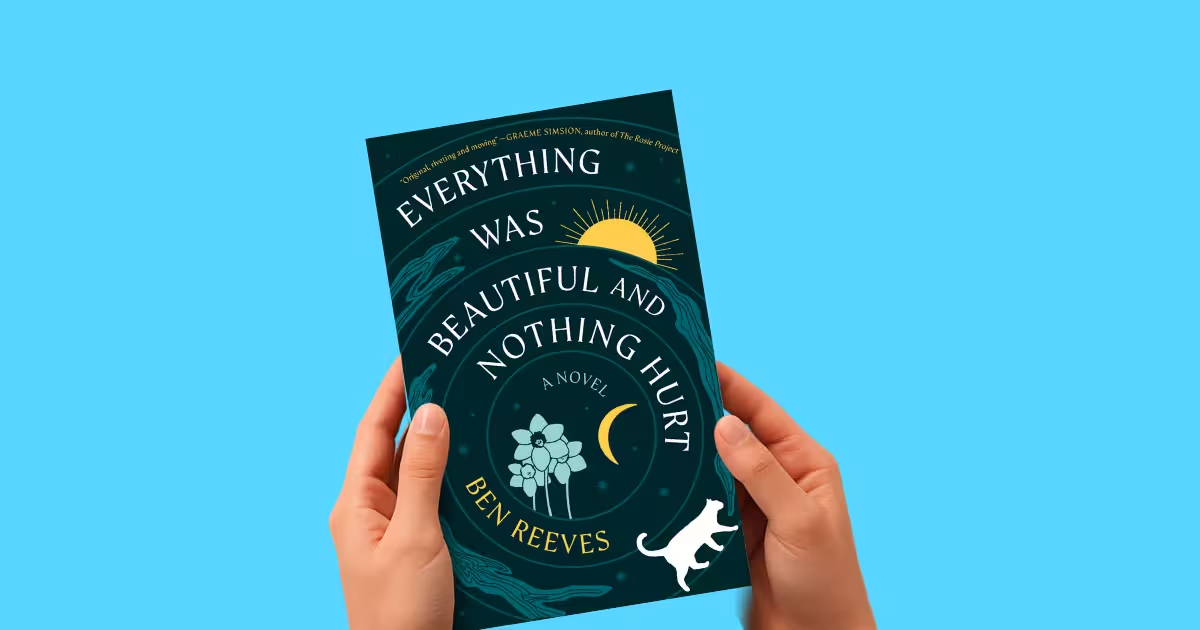
Everything Was Beautiful and Nothing Hurt is Ben Reeves’ debut novel, narrated by Death himself, a quiet man named Travis who restores old photographs between house calls. He falls for a midwife named Dalia and her eight-year-old daughter Layla, who live across the hall, and the rest of the book is about what happens to a professionally detached witness of death when he finally has something to lose.
Best idea in a sentence: Death isn’t the villain of this story, time is, and every chapter is really Ben Reeves asking what you would do with twenty more minutes.
Everything Was Beautiful and Nothing Hurt is best for readers who loved the quiet devastation of A Man Called Ove, anyone who has grieved and wants a book that doesn’t rush them through it, parents who want a gentle but genuinely useful reminder about childhood illness, and readers who prefer mood and voice over plot mechanics.
Not for: thriller readers who need momentum and stakes, anyone in the middle of acute grief over a child (this book sits directly on that wound), readers who need speech marks and a linear timeline, and anyone who wants their magical realism explained with rules and a rulebook.
Table of Contents
1. Introduction
Everything Was Beautiful and Nothing Hurt is the debut novel from British author Ben Reeves, published by Atlantic Books in the UK on 2 July 2026 and by Avid Reader Press, an imprint of Simon & Schuster, in the US on 7 July 2026.
Not a hooded figure with a scythe. A young man in a grey jumper with holes in his socks, who calls himself Travis, keeps a stray cat he never asked for, and mends other people’s photographs at a folding table because he doesn’t know what else to do with his hands between visits.
The premise sounds like it could go either way, cute or unbearable, and I went in braced for both. What I got instead was something closer to being handed a stethoscope and told to listen to a town breathe.
2. Background
Reeves didn’t arrive from a creative writing pipeline.
He lives in Peterborough with his wife and two children, paints and makes music on the side, and works as a web designer for a book printing company, which is either irony or destiny depending on how you like your author bios.
An early draft of this novel won the international Bath Novel Award in 2024, a prize specifically built to find unpublished manuscripts and get them in front of agents, and that win is the reason we’re reading a finished book today instead of a forgotten Word document.
The title is lifted, deliberately, from Kurt Vonnegut’s Slaughterhouse-Five, where a version of the afterlife is described in a way that has stuck in readers’ heads for over fifty years.
Reeves keeps the phrase in the past tense on purpose. It’s a line you can only say looking backward, half comfort and half concession, and that doubleness runs through the whole book: nothing here is simply sad or simply hopeful, it’s both, often in the same paragraph.
3. Everything Was Beautiful and Nothing Hurt Summary
The book opens with a car crash. A silver car rolls five times at a crossroads near a kebab shop, and the world, quite literally, slows to a crawl around it. This is our first meeting with the narrator: he walks through the frozen scene, past paramedics caught mid-stride, to the driver, twenty-nine-year-old Samuel Preston, who was planning to propose to his pregnant girlfriend that New Year’s Day.
Travis kneels in the wreckage, holds Samuel’s head in his lap, and talks him through his final eight seconds with the kind of tenderness you don’t expect from Death. Samuel’s chapter closes the way every death in this book closes, with a small stamp: Samuel Preston, 29 years, 5 months, 4 days.
From there the novel settles into its real shape, a mosaic of short, titled chapters, each one a full and specific life given to us right before Travis takes it. We meet John Lamb, an 81-year-old widowed poet who greets every stranger in town with the same cheerful “g’morning, g’morning” just to prove to himself he isn’t a ghost yet, and who finally asks Travis to read him one more poem before he lets go.
We meet an unnamed very old woman (later, much later, revealed to matter more than she first seems) who begs Travis on every single birthday to finally take her, only to be told, again and again, that it isn’t yet her day.
We meet Meera Gupta, dying of breast cancer in a hospice she has decorated herself, who gives Travis a small printed cloth and tells him, gently, that he should find someone, before she dies with what looks like a smile, thinking that everything is beautiful and nothing hurts, the exact line the title borrows.
We meet Dan Harper, a hoarder who tidies his flat for the first time in years on the day he learns it’s his last, and Mike Rudd, a man who abused his own daughters for years and who dies choking on a Marmite sandwich while Travis simply watches, refusing to grant him the absolution of a reaction. None of these people know each other.
What they share is Travis, and the unnamed grey English town that “thought itself a city,” with its industrial estate, its canal choked with shopping trolleys, its allotments and closed-down pubs.
Scattered between these named chapters are shorter, unnamed interludes that widen the book’s lens past its human cast entirely. A five-month-old baby, Noah Finch, dies quietly in his cot while Travis sits beside him and recites a bedtime story no one else will ever hear. A man in his thirties steps in front of a train at a busy station, and Reeves lingers not on the impact but on the fifteen strangers who witnessed it and spend weeks afterward puzzling over why they feel almost nothing.
A mother deer leads her fawn away from a combine harvester she mistakes for a monster, only to watch an older stag gore the fawn to death the moment they reach the safety of a new patch of woodland. None of these threads connect to Layla or Dalia directly.
They exist to make the point, quietly and without commentary, that the same rules apply to a hamster, a mayfly, a deer and a person, and that Travis’s job has never once taken a day off for any of them.
Between house calls, Travis restores old photographs for the living and the dying, a task he treats with something close to reverence, easing water-damaged faces back from the edge of disappearing. His own flat is nearly empty, just a folding table, deionized water, a scalpel and glue.
Then a stray white cat climbs through his bedroom window, and hunting for cat food sends him across the hall to a flat belonging to Dalia, a midwife, and her seven-year-old daughter Layla.
Layla is instantly, stubbornly curious about the quiet man across the hall. She invites him to her eighth birthday party by sliding a hand-drawn card under his door; he tells her, as gently as he can manage, never to knock on his door again, and she runs off in tears calling him strange to her mother. It’s the first sign of a rule Travis is trying, and failing, to keep.
Dalia herself is stretched thin: a single mother juggling Layla, her toddler Neda (from a brief relationship with a man named Solomon), night shifts at the hospital, and an ex, Nick, Layla’s father, who is fighting his own alcoholism. Dalia’s brother, we later learn during a rainy afternoon at their shared allotment, died a few years back in a car crash near a kebab shop at twenty-nine. It’s Samuel Preston, the young man from the opening chapter, and neither Dalia nor the reader is told this connects Travis to her past; it simply sits there, one more of the small, unremarked coincidences that make this town feel lived-in rather than plotted.
Slowly, and against his own better judgment, Travis becomes part of Layla and Dalia’s life. He babysits when Dalia gets called into work. He helps bury Layla’s dead hamster, Roly, in his allotment plot rather than let him go in the bin.
He paints fake scars on Layla for a school Halloween disco while Dalia paints her skin a sickly zombie teal, and for one evening the three of them feel, unmistakably, like a family. That same night, Layla gets a headache and comes home early from the disco, and Dalia puts her straight to bed in her make-up, planning to wash it off in the morning.
The next morning, giving Layla a bath, Dalia notices a rash under the fading zombie paint. It doesn’t fade under a gentle press. It’s bacterial meningitis, and by the time they reach the hospital it has already moved fast.
Layla is placed in intensive care, and what follows is one of the harder stretches of contemporary fiction I’ve sat through this year: Dalia in the waiting room insisting she should have known, Nick arriving too late and drunk, a nurse’s checklist of vitals sliding downward, and Layla, briefly conscious, asking Travis directly whether he ever actually cared about her, or was just there to collect her.
He tells her the meningitis is killing her, not him, and that he does care, though maybe not in the way she’d hoped to hear.
She dies at eight years, six months and thirteen days old.
What follows Layla’s death is not tidy grief. Dalia goes numb before she cries, functions in ten-minute delayed instructions to her own body (go to the bathroom, take off your clothes), and eventually pulls Travis into a strange, desperate, grief-fuelled physical relationship that neither of them can name honestly. When Travis, clumsily, suggests she might want to “move on” after cleaning out Layla’s room, Dalia turns on him completely and tells him to leave her alone for good, and he does.
Some unspecified time later, Dalia drives two hundred miles retracing every home she’s ever lived in, ending on a quiet rural road at dusk. She rigs a hose from the exhaust into the car and starts the engine.
Travis is in the passenger seat the whole time, and for the first and only time in the novel he breaks his own rule of never trying to change anyone’s fate: he begs her, by name, over and over, not to do it. The chapter ends there, mid-plea, and the book cuts instead to a run of mayfly nymphs waiting at the bottom of a pond for a “Special Day” they don’t understand yet, an image that turns out to be doing a lot of quiet work.
The next time we see Dalia, decades have clearly passed. It is her ninetieth birthday.
Her grandson Mason has to talk her into getting dressed; she tells him flatly that she’s tired of clinging to life “like a barnacle” and just wants to leave with dignity. Her family arrives anyway, cake and all, and right as she’s asking them to stop the fuss, her granddaughter Cara walks in with her fiancé, who is holding a newborn. They’ve named the baby Layla.
That night, alone in her room, Travis is waiting for her again, wearing “a new face, new skin, a new name,” and she knows him anyway, because, as the book reminds us twice, everyone knows him, at the end. They dance, wordlessly, and she thanks him for making her wait all those years. She dies peacefully as Dalia Willard, ninety years old exactly.
The book closes with two short, formally distinct pieces. “A Dance of Mayflies” completes the earlier nymph passage: the mayflies finally get their wings, realise this single day is the only day they get, and choose to spend it dancing anyway, their brief lives braided into flashes of human birth, marriage, illness and joy happening at the same instant elsewhere in the world.
Then, in “A Twenty-Minute Gift,” the narration steps fully outside the story and addresses you, the reader, directly: imagining you are on your own deathbed, Travis offers you twenty minutes to go back to right now and do one small, precious thing before your nineteen minutes run out.
It’s a device Reeves plants once, quietly, mid-book, when Dalia holds her two daughters on the sofa and calls it “this twenty-minute gift,” long before he repurposes the phrase to close the entire novel out.
4. Everything Was Beautiful and Nothing Hurt Analysis
4.1 Everything Was Beautiful and Nothing Hurt Characters
Travis (Death). Reeves’ central choice is to make Death young, plain-looking, a little awkward, and genuinely uncertain of himself, rather than mythic. He has rules he sticks to almost religiously: never judge, never bargain, never try to change a fate, no matter how much a dying abuser or a suicidal mother might beg or provoke him.
What makes him work as a character, rather than a device, is how visibly that neutrality costs him once Layla and Dalia enter his life. He admits, watching Layla cry over a buried hamster, that “this little family have sunk their roots into my skin,” and later, in the car with Dalia’s life ebbing away, he breaks his own oldest rule and pleads with her by name.
Reeves never explains the mechanics of how Travis’s job works, no manual, no boss, no other Deaths mentioned, and that omission is either a strength or a frustration depending on what kind of reader you are (more on that below).
Dalia. A midwife who spends her working days pulling new lives into the world while Travis spends his easing them out, and the novel lets that mirroring sit quietly rather than hammering it into a thesis statement.
Her arc is the book’s real spine: overwhelmed single mother, tentative new intimacy with the strange man across the hall, catastrophic loss, a period of genuinely upsetting numbness and self-destructive drift, a suicide attempt Travis cannot talk her out of directly, survival (never explicitly narrated, only implied by the decades that follow), and finally a long, full, ordinary life that produces grandchildren and a great-granddaughter she gets to hold before she dies. She is never sanitised.
Her worst moment, cruelly telling Travis to leave her alone after he fumbles the words “move on,” is left to sting rather than being smoothed over.
Layla. An eight-year-old defined by specificity rather than sweetness: she is obsessed with narwhals and terrified of clowns, keeps a hidden drawer of photographs she takes and then cuts into confetti, and argues that “a brick isn’t boring” if you look at it long enough, which becomes the book’s clearest statement of its own values.
Her death is not softened by any last-minute miracle, and her final conversation with Travis, asking him bluntly whether he ever cared about her, is one of the most quietly brutal exchanges in contemporary fiction I’ve read this year.
Nick. Layla’s father, a recovering alcoholic trying, with visible effort, to earn back his daughter’s trust through AA-style meetings that involve painting and knot-tying.
His grief at the hospital is loud where Dalia’s is silent, guilt-soaked where hers is numb, and Reeves uses the contrast to show that there is no single correct shape for a parent’s grief.
Neda and the next generation. Dalia’s younger daughter with Solomon survives into the novel’s final pages as an adult with children of her own, including Cara, whose baby is named Layla in the closing scene. It’s a quiet way of arguing that a family line can carry a name forward without pretending to replace what was lost.
The vignette figures. John Lamb, Meera Gupta, Dan Harper, Mike Rudd, Wendy Lowe and Enid Speck (a couple who hid their fifty-year relationship from their own families until their final years together), and strongman-turned-old-man Keith Rotherham all exist to widen the book’s frame past its central family, and to prove Travis treats a child abuser’s last sandwich with the same unblinking attention as a poet’s final stanza.
4.2 Everything Was Beautiful and Nothing Hurt Themes and Symbolism
Mayflies and the elasticity of time. The mayfly life cycle, one day of flight after months underwater, is the book’s central image, introduced right as Dalia’s fate is left hanging and paid off in the closing chapter.
It’s the clearest possible metaphor for a novel obsessed with how differently time behaves depending on where you’re standing in your own life, a point Dalia makes explicitly earlier when she does the maths on how fast her daughters are aging away from her.
Detachment as a survival mechanism, not the absence of love. Travis’s professional neutrality reads, deliberately, like compassion fatigue in caregiving work: the same flattening that hospice nurses, midwives and long-serving doctors describe when the alternative is falling apart daily.
Dalia’s own dissociation during a difficult birth, where the room reduces to shapes and colours until she can breathe again, mirrors his condition exactly, reinforcing the parallel between the two professions that usher people across life’s opposite doors.
The sacredness of the ordinary. Reeves keeps returning to bricks, weeds, Marmite sandwiches, holey socks and cat biscuits as sites of real meaning, arguing through Layla’s own words that attention itself is a form of love.
The book’s most memorable images are almost never dramatic; they are a boiled egg for breakfast, a photograph of a stranger’s twin boys on quad bikes, a woman dipping a custard cream she never liked.
Photographs as resistance to disappearing. Travis’s day job, restoring faded and torn photographs, is a literal, hands-on version of what the whole narrative structure is trying to do for its dying characters: hold a face still long enough that it doesn’t slip away undocumented.
The hidden rash as a symbol of mortality wearing a costume. Layla’s meningitis rash, disguised under a night of Halloween face paint she refuses to wash off because she loves how it looks, is the book’s sharpest piece of symbolism and its most quietly devastating plot mechanism at once: the thing that could have saved her was hidden by the very festivity meant to make her happy.
5. Everything Was Beautiful and Nothing Hurt Evaluation
Everything Was Beautiful and Nothing Hurt is the rare debut that earns almost every tear it goes looking for. Reading the Layla hospital chapters back to back felt less like reading fiction and more like being handed someone else’s actual worst night.
Strengths. The sentence-level writing is genuinely controlled: Reeves, who paints and makes music on the side, builds scenes the way a musician builds a bar, one small sensory detail layered on the next, the woody chew of an apple pip, the smell of a bracelet a dying man holds to his lips.
Layla in particular is written without a shred of movie-child cuteness, which makes her loss land harder than a more sentimental version of the same scene ever could.
The structural choice to keep Travis mostly silent in scenes he doesn’t narrate, present but wordless, is a genuinely clever way of making Death felt rather than performed.
Weaknesses. The vignette structure is the book’s strength and its cost at the same time. Read in long sittings, as I did, the accumulation of deaths starts to numb rather than deepen somewhere past the halfway mark, and a handful of the secondary chapters (the office manager desperate for a toilet break, the line managers in the signal box coffee room) repeat a note the book has already sounded more powerfully elsewhere.
Reeves also declines to explain any mechanics of how Travis’s role actually works, no hierarchy, no rules beyond his own conscience, which some readers will find refreshingly restrained and others will find frustratingly vague.
The prose drops quotation marks entirely in favour of dashes and context, a stylistic choice that some readers found disorienting enough to nearly cost the book a star in early reviews I came across, even when they ultimately still loved it.
Impact and controversy. Early reader reaction has split, sometimes sharply, between five-star declarations that this is one of the best books of the decade and pointed one- and two-star reviews accusing the prose of reaching for profundity it hasn’t quite earned, occasionally naming specific crude asides (a stray vulgar joke dropped into an otherwise tender scene) as tonal missteps that yank readers straight out of the mood. Both reactions are, in my view, responding to the same real feature of the book: it refuses a single, consistent register, mixing the sacred and the crude in the same breath the way actual grief tends to.
Comparison with similar works. The most obvious comparison, Markus Zusak’s The Book Thief, shares the exact premise of Death as narrator, though Zusak’s Death is older, wearier and working through the specific horror of the Holocaust, where Reeves’ Travis is younger, more porous, and working through the specific horror of an ordinary town.
Matt Haig’s The Midnight Library and The Humans both share Reeves’ interest in an outsider learning what makes human life worth staying for. Fredrik Backman’s A Man Called Ove is the clearest tonal cousin for readers who want grief wrapped in gruff, unexpected community, and Shelby Van Pelt’s Remarkably Bright Creatures shares its interest in loneliness, aging and found family.
Readers drawn to the chorus-of-the-dying structure might also look at George Saunders’ Lincoln in the Bardo, and anyone who wants the same uncanny, gentle strangeness in a different key should try Susanna Clarke’s Piranesi.
6. Personal insight with contemporary educational relevance.
The detail that stayed with me longest wasn’t Travis at all, it was the rash under the face paint. The NHS and the UK Health Security Agency still run active public campaigns around exactly this scenario: a meningitis rash that starts as small red pinpricks, doesn’t fade when you press a clear glass against it, and can be genuinely hard to spot under makeup, dark clothing or simply a child’s own skin tone.
UK data shows that routine infant vaccination has already cut childhood bacterial meningitis rates by more than half, to under 1 in 10,000 children a year, which is real progress, but early symptoms still mimic flu closely enough that parents are told, repeatedly, not to wait for a rash to appear before seeking help.
Five things this novel argues, and that I’d stand behind independently of it: first, trust the feeling that something is wrong over a tidy checklist of symptoms, because Dalia’s instinct arrived before her checklist did.
Second, grief has no required order, numbness is not the same as not caring, and Dalia’s frozen ten-minute-delayed mornings are more medically honest than a tidy crying scene would have been.
Third, sustained attention is itself a form of love, which is the entire philosophical weight Layla puts on a single brick. Fourth, professional detachment in caregiving work, whether it’s a midwife’s or an oncology nurse’s, is a survival adaptation, not evidence of not caring, something worth remembering next time a tired doctor seems short with you.
Fifth, a family line can carry someone’s name forward, as Cara’s daughter does with Layla’s, without pretending grief was ever resolved rather than simply carried.
7. Everything Was Beautiful and Nothing Hurt Quotes
A few lines that stopped me mid-page (paraphrased context added for anyone who hasn’t read the surrounding scene):
- On the moment Travis realises he has become attached to Layla and Dalia despite every rule he’s kept for centuries: “Day by day, this little family have sunk their roots into my skin.”
- Layla’s entire personal philosophy, delivered to Travis on her sofa: “a brick isn’t boring” if you actually look at it.
- Meera Gupta’s final thought before she dies, which gives the novel its title: she looks as though “everything is beautiful and nothing hurts.”
- Travis’s answer when Mike Rudd, dying and full of self-loathing, demands to know if Death has judged him: “I’m not here to decide what you do or don’t deserve.”
- The line that closes both Samuel Preston’s death and, decades later, Dalia’s: “everyone knows, at the end.”
- The book’s closing address to the reader, reframing a single ordinary domestic moment as “this twenty-minute gift,” used first for a mother watching her daughters on the sofa and then for you, the reader, on the final page.
8. Conclusion
Everything Was Beautiful and Nothing Hurt is not a comfortable read, and I don’t think it wants to be one. It asks you to sit with a child’s death from an illness that hides under Halloween make-up, with a mother’s numbness before her tears, with a suicide attempt Death himself cannot talk her out of, and it refuses, almost stubbornly, to tidy any of it into a neat lesson.
What it offers instead is attention: to bricks, to Marmite sandwiches, to a very old woman’s rummy hand, to twenty minutes you didn’t know you’d remember. I’d recommend it firmly to readers of Zusak, Haig and Backman, to anyone who has lost someone and wants a book that doesn’t rush them past it, and, quietly, to any parent who needs one more reason to trust their gut over a symptom checklist.
I would not recommend it, at least not yet, to anyone currently in the rawest weeks of losing a child, because this book does not look away from that particular room, and it shouldn’t have to for everyone else’s sake, but you deserve to choose that for yourself.
A note on this review: passages quoted above are brief excerpts used for critical commentary and discussion under standard review practice. For the complete text, please support Ben Reeves and his publishers by purchasing a copy through Atlantic Books, Avid Reader Press/Simon & Schuster, or your preferred bookseller.
If any part of this review touched on grief, loss of a child, or suicide in a way that’s sitting heavily with you right now, that’s worth taking seriously, and reaching out to a counsellor, doctor, or a helpline in your country is a reasonable next step, not an overreaction.