
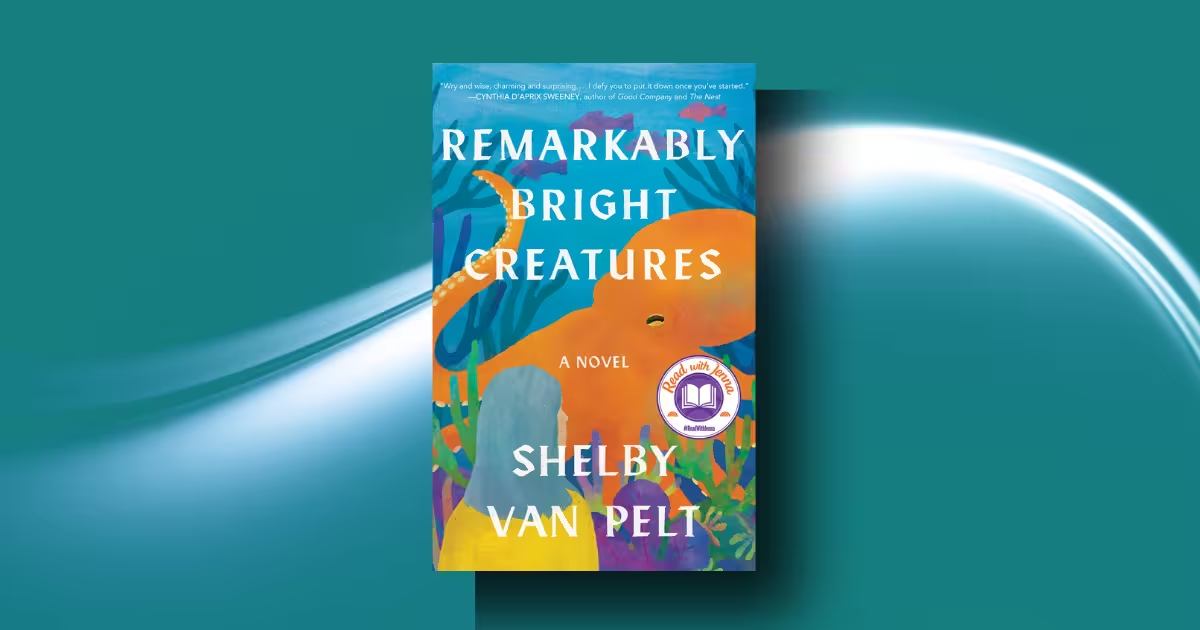

Did you ever think a creature with three hearts and nine brains could teach a human how to heal a single broken one? Remarkably Bright Creaturesl is a luminous exploration of how an unlikely bond between a grieving widow and a captive giant Pacific octopus unearths a decades-old mystery, proving that we are never as alone as we feel.
Remarkably Bright Creatures is for readers who cherish character-driven “up-lit” like A Man Called Ove, fans of magical realism (without the magic), and anyone who has ever suspected that animals understand us far better than we understand them.
Not for for the readers who are looking for a fast-paced thriller or readers who find anthropomorphized perspectives (even one as cynical and brilliant as Marcellus) too whimsical for their taste.
Table of Contents
1. Introduction
Shelby Van Pelt’s debut novel, Remarkably Bright Creatures (published May 2022 by Ecco/HarperCollins), arrived as a breath of fresh air in the contemporary fiction landscape.
Set in the misty, fictional town of Sowell Bay, Washington, the story weaves together the lives of Tova Sullivan, a stoic woman in her seventies, and Marcellus, a Giant Pacific Octopus residing at the local aquarium.
It is a story of quiet resilience, the weight of secrets, and the surprising ways the universe conspires to bring us home.
2. Background
While the book is contemporary fiction, its soul is rooted in the very real, staggering intelligence of the Enteroctopus dofleini.
Giant Pacific Octopuses are known to possess about 500 million neurons—comparable to a dog—with two-thirds of those neurons located in their arms rather than their heads.
This biological reality serves as the “historical” or scientific context for the character of Marcellus. Van Pelt’s inspiration reportedly stemmed from a video of an octopus escaping its enclosure, a feat Marcellus mirrors throughout the book to satisfy his “predilection to depart the building”.
3. Remarkably Bright Creatures Summary
Part I (The Setup and the Search)
Tova Sullivan is a woman of ritual. At seventy, she is the oldest employee at the Sowell Bay Aquarium, where she works the night shift as a cleaner.
For Tova, cleaning isn’t just a job; it’s a way to keep moving so she doesn’t have to breathe in the suffocating stillness of her own grief.
She lost her husband, Will, to illness, but the wound that never truly healed was the disappearance of her eighteen-year-old son, Erik, thirty years ago. Erik’s boat was found abandoned in the Sound, and the world assumed suicide or accident.
Tova, in her quiet, Swedish way, has simply lived with the “what ifs” ever since.
The story shifts to Marcellus, the aquarium’s star octopus, who narrates his own chapters with a dry, superior wit. Marcellus is nearing the end of his four-year lifespan—what he calls his “captivity”. He is bored, lonely, and remarkably observant. “Humans,” he notes, “for the most part, you are dull and blundering”.
Marcellus spends his nights sneaking out of his tank to scavenge for “the sublime texture of fresh oyster” or “tasty morsels” left behind by humans, including a stash of “falsehood cookies”.
Their lives collide one night when Tova finds Marcellus tangled in power cords in the break room, pale and gasping for air.
Instead of calling for help or being afraid, Tova gently untangles him. “I won’t hurt you, dear,” she murmurs. In that moment, a bond is formed.
Marcellus, who usually views humans as “dull,” recognizes in Tova a kindred spirit. He begins to interact with her, even “winding two of its tentacles around her wrist” in a way that makes her feel seen.
Meanwhile, in California, we meet Cameron Cassmore. At thirty, Cameron is the definition of a “fuck-up.”
He can’t hold a job, he lives in his aunt’s garage, and he feels abandoned by the mother who left him when he was a child.
When he finds a class ring and an old photo in his mother’s belongings, he becomes convinced that his father is Simon Brinks, a wealthy real estate mogul in Sowell Bay. Driven by a desperate need for a payday (and perhaps an identity), Cameron heads north to confront the man he thinks is his father.
Cameron ends up in Sowell Bay and, through a series of “physics-based” accidents and a recommendation from the local grocer Ethan Mack, takes over Tova’s cleaning duties when she injures her ankle.
Cameron is clumsy and lacks Tova’s reverence for the sea creatures, but he eventually meets Marcellus. Marcellus, however, has already found something. During one of his nightly excursions, he scavenged a class ring and a driver’s license that Cameron had lost.
Marcellus, with his nine brains, begins to connect the dots that the humans are too “blundering” to see: the connection between Tova’s lost son, Erik, and this new, lost young man, Cameron.
Part II (The Reveal and the Release)
As the story progresses, the parallel lives of Tova and Cameron begin to knit together, mediated by the silent, eight-armed genius of Marcellus. Cameron’s search for his father, Simon Brinks, reaches a climax when he finally confronts the man.
However, the confrontation is a disaster. Simon is not the wealthy, regretful father Cameron imagined; he is a man who barely remembers Cameron’s mother, Daphne, and has no interest in being a father. Cameron is left shattered, realizing his entire journey to Sowell Bay was built on a misinterpretation of a class ring.
Here, the narrative shifts into high gear. Marcellus, who has “stolen” a set of keys and a ring from the humans, realizes something they haven’t.
He recognizes the insignia on the ring—it belongs to the same high school Erik Sullivan attended. More importantly, Marcellus has seen the physical resemblance between the photo of Erik in Tova’s house and the young, clumsy Cameron.
In a pivotal scene, Marcellus manages to drop the ring where Tova can find it.
When Tova sees the ring, she recognizes it instantly as Erik’s.
But how did it get from the bottom of the sea to the aquarium? She begins to piece together the truth: Cameron isn’t just a drifter; he is the son of Daphne, the girl Erik was secretly seeing before he died. Cameron is Tova’s grandson.
The ending is a masterclass in emotional payoff. Tova discovers that Erik didn’t commit suicide.
He had been out on the water that night to meet Daphne, but a freak accident—likely involving the very boat he was so proud of—took his life. Daphne, young and terrified, fled the town, unaware of how to tell the stoic Sullivans she was carrying their grandchild.
The resolution of the human plot coincides with the end of Marcellus’s life. Knowing his “1,300+ days of captivity” are ending, Tova realizes she cannot let her friend die in a tank. In a daring, late-night sequence, she helps Marcellus return to the Sound. As he slips into the dark water, there is a profound sense of closure.
Tova doesn’t move into the retirement home in isolation; instead, she and Cameron form a new, unconventional family unit. The “remnants” of their broken lives are gathered to build something whole.
Ending Explained: The mystery isn’t just “who is Cameron’s father,” but “how do we move past the ghosts of the past?” By the final chapter, Tova has found her “why” to keep living, and Cameron has found the roots he never knew he needed.
4. Remarkably Bright Creatures Analysis
4.1. Remarkably Bright Creatures Characters
Tova Sullivan: The emotional anchor of the novel. Tova’s development is a journey from “forced independence” to “vulnerability.” At the start, she is preparing to sell her family home and move into Charter Village, a retirement community, because she doesn’t want to be a “liability”.
Her complexity lies in her stoicism; she doesn’t perform her grief, she mops it away. Her relationship with Marcellus is the first time she allows herself to “communicate” with the insentient to process her plan to move.
Marcellus: More than just a narrator, Marcellus is the story’s “God in the machine” (or “God in the tank”). He is cynical but deeply empathetic.
His motivation is a mix of intellectual curiosity and a final desire for agency before his “160 days” are up. His relationship with Tova is a true friendship of equals—two “remarkably bright creatures” who understand that “nothing stays sunk forever”.
Cameron Cassmore: Initially frustrating, Cameron’s development is the most traditional. He starts the novel looking for a “payout” from Simon Brinks, whom he believes is his father.
However, his interaction with Tova and his time in Sowell Bay force him to grow up. He is the “sucker for injured creatures,” a trait he shares with Tova, though he doesn’t know it yet.
Ethan Mack: The owner of the local grocery store and a man who has been quietly in love with Tova for years.
He represents the possibility of a “second act” in life. His motivation is simple: he wants to protect Tova, even if it means checking on her hatchback to make sure she made it home safe.
4.2. Remarkably Bright Creatures Themes and Symbolism
The Weight of Unspoken Grief: The novel posits that grief is not a mountain to be climbed but a sea to be navigated. Tova’s Swedish stoicism (“Uff da”) is her shield, but it’s also her prison.
Intelligence and Perception: Marcellus symbolizes the idea that intelligence doesn’t always look human. His “nine brains” allow him to see connections that human emotion obscures.
Connectivity: The “Silver-Dollar Scar” on Cameron’s hand and the physical traits he shares with Tova symbolize the biological and emotional threads that bind us across generations, even when we are unaware of them.
The Sea as a Vault: The Puget Sound acts as a character itself—a place that keeps secrets (Erik’s death) but eventually gives them back (the ring).
5. Evaluation
Remarkably Bright Creatures is a luminous, groundbreaking achievement in contemporary fiction. It manages to be “poignant” without being saccharine, a rare feat in the “up-lit” genre.
Strengths
The Voice of Marcellus: Van Pelt’s decision to give the octopus a POV is a stroke of genius. His dry, misanthropic wit provides a necessary counterpoint to the heavy emotional weight of Tova’s chapters.
Pacing: The way the three disparate plot lines (Tova, Cameron, Marcellus) converge is mathematically satisfying.
Weaknesses
Cameron’s Initial Likability: Some readers may find Cameron’s early chapters frustrating, as his “blundering” nature borders on the repetitive before his character arc truly begins.
Impact
The book left me with a profound sense of the “smallness” of our human worries and the “vastness” of our capacity to love. It’s a reminder that we are all, in our own way, “remarkably bright” if we only choose to see one another.
Comparison
It sits comfortably between the wry humor of Fredrik Backman’s A Man Called Ove and the deep, naturalistic empathy of Delia Owens’ Where the Crawdads Sing.
6. Personal Insight: The Epidemic of Loneliness
There is a contemporary educational relevance to Tova’s story that mirrors a growing global crisis. According to the U.S. Surgeon General’s 2023 Advisory, about 50% of U.S. adults report experiencing measurable levels of social isolation. In the elderly population, this “loneliness epidemic” is as lethal as smoking 15 cigarettes a day.
Tova’s ritualistic cleaning and her plan to move into “Charter Village” reflect the real-world trend of “aging in place” versus the fear of becoming a burden. The book serves as a social commentary on how we treat our seniors.
Tova’s salvation doesn’t come from a government program, but from an intergenerational connection (Cameron) and an inter-species one (Marcellus). It highlights the educational need for community-based support systems that recognize the “value” of the elderly beyond their physical utility.
7. Remarkably Bright Creatures Quotes
“I am a remarkably bright creature. I know what I know.” (Marcellus, establishing his intellectual dominance).
“Humans. For the most part, you are dull and blundering.”
“Nothing stays sunk forever.” (The central thesis of the book).
“Tova Sullivan is a woman of secrets. She carries them like stones in her pockets.”
“Sometimes, the things we lose are just waiting for us to be ready to find them again.”
8. Conclusion
Shelby Van Pelt has crafted a story that is as much about the mysteries of the deep as it is about the mysteries of the heart. Remarkably Bright Creatures is a mandatory read for anyone who has ever felt like an outsider or struggled with the “what ifs” of their past. It is a significant work because it challenges our definition of “intelligence” and “family.”
Recommendation: Highly recommended for book clubs, lovers of contemporary fiction, and anyone who needs a reminder that hope can be found in the most unlikely of places—even in the arms of an octopus.