
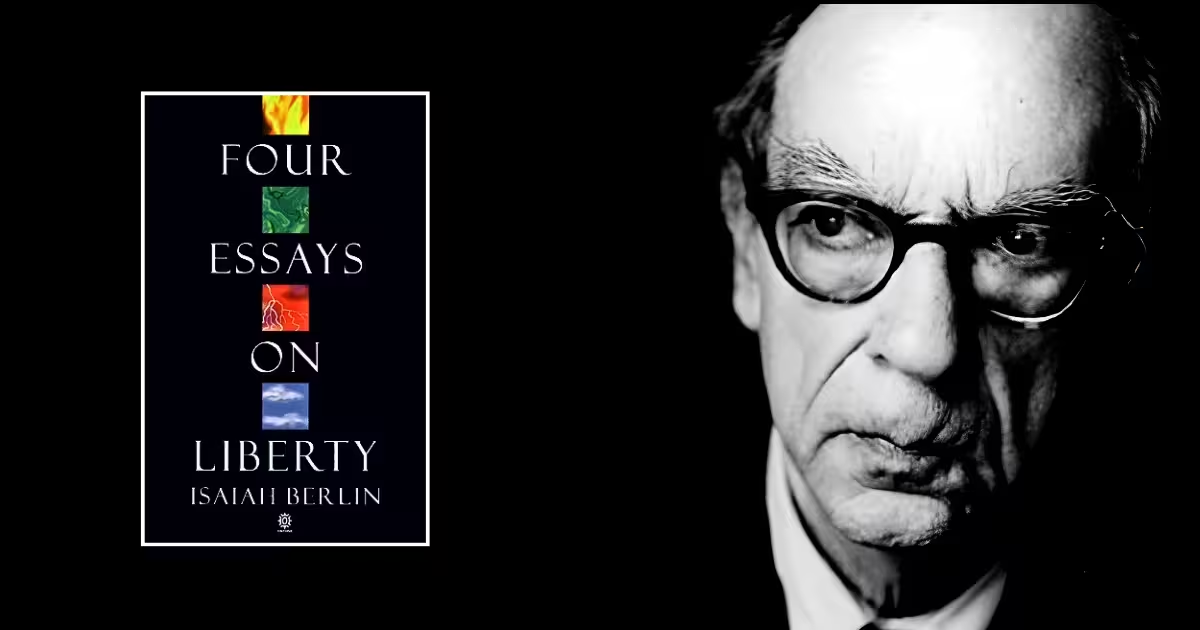
Ever wonder why you feel free to choose your career, your partner, your beliefs—yet somehow sense invisible strings pulling you toward conformity, obligation, and decisions that don’t quite feel like your own? What if the very concept of “freedom” you’ve been taught is actually a trap—one that has been used to justify oppression, tyranny, and the erasure of everything that makes you uniquely you?
Isaiah Berlin’s Four Essays on Liberty doesn’t just ask these questions—it forces you to confront them with the kind of intellectual brutality that leaves you breathless and transformed.
Table of Contents
Overview
Four Essays on Liberty (1969) is Isaiah Berlin’s masterwork on political philosophy—a collection of five essays (later expanded to Liberty in 2002) that fundamentally reshaped how the modern world understands freedom.
Berlin draws a devastatingly clear distinction between negative liberty (freedom from interference) and positive liberty (freedom to be one’s own master)—and then shows how the latter, when twisted by ideologues, becomes the intellectual justification for totalitarianism.
The book is not a comfortable read; it’s a philosophical hand-grenade that explodes comforting assumptions about democracy, determinism, and human nature. Berlin writes with dazzling erudition and moral urgency, arguing that monism—the belief that all good things can be harmonized into one perfect system—is the most dangerous idea in human history.
Preferred readers
Best for: Philosophy students, political science junkies, anyone who’s ever felt uneasy about “the greater good” arguments, readers who want to understand why totalitarianism isn’t just evil but intellectually bankrupt, and people who suspect that freedom means more than just “doing what you want.”
Not for: Readers seeking light beach reading or simple answers—Berlin doesn’t offer comfort, he offers clarity. If you’re allergic to dense philosophical prose or hate having your assumptions dismantled, this book will exhaust you.
Also not for those who believe in absolute, unchanging moral truths—Berlin will show you why that belief is historically dangerous.
Introduction
Title: Liberty (incorporating Four Essays on Liberty)
Author: Sir Isaiah Berlin (1909–1997)
Editor: Henry Hardy
Publication: Originally published as Four Essays on Liberty in 1969 by Oxford University Press; expanded edition Liberty published in 2002.
Isaiah Berlin was one of the most brilliant and influential political philosophers of the twentieth century. Born in Riga, Latvia (then part of the Russian Empire), he immigrated to England in 1921 at age eleven, speaking virtually no English.
He became Chichele Professor of Social and Political Theory at Oxford (1957–1967) and founding President of Wolfson College. His intellectual range was staggering—he wrote with equal authority on Russian thinkers, the Enlightenment, Romanticism, and the history of ideas.
But it was Four Essays on Liberty that cemented his reputation as the century’s most eloquent defender of liberal pluralism.
Context: What This Book Is About
Four Essays on Liberty is not a dry academic treatise—it’s a passionate, urgent intervention in the great ideological battles of the twentieth century. Berlin wrote these essays during the Cold War, when the world was divided between liberal democracies and totalitarian regimes, each claiming to represent “true freedom.” The book is his attempt to cut through the propaganda and show that these two visions of freedom are not just different—they are fundamentally incompatible.
The book brings together five essays:
✅ “Political Ideas in the Twentieth Century” (1950) – A diagnosis of the intellectual origins of totalitarianism.
✅ “Historical Inevitability” (1954) – A takedown of determinism and its corrosive effects on human responsibility.
✅ “Two Concepts of Liberty” (1958) – The centerpiece, distinguishing negative and positive liberty.
✅ “John Stuart Mill and the Ends of Life” (1959) – A defense of Mill’s liberalism against its critics.
✅ “From Hope and Fear Set Free” (1964) – An exploration of whether knowledge always liberates.
The expanded Liberty edition (2002) adds further essays, including “The Birth of Greek Individualism” and “Final Retrospect,” along with autobiographical appendices that reveal the personal experiences that shaped Berlin’s thinking.
Purpose: Berlin’s Central Thesis
Berlin’s primary argument is devastatingly simple yet world-changing: there is no single, harmonious solution to human problems. The belief that all good things—freedom, equality, justice, happiness—can be reconciled into one perfect system is not just naive; it’s the intellectual foundation of tyranny.
“One belief, more than any other, is responsible for the slaughter of individuals on the altars of the great historical ideals—justice or progress or the happiness of future generations, or the sacred mission or emancipation of a nation or race or class, or even liberty itself… This is the belief that somewhere, in the past or in the future, in divine revelation or in the mind of an individual thinker, in the pronouncements of history or science, or in the simple heart of an uncorrupted good man, there is a final solution.”
Berlin argues that value pluralism—the recognition that human ends are many, incommensurable, and often in conflict—is the only honest foundation for a free society. To pretend otherwise is to prepare the ground for the Gulag, the concentration camp, and the Grand Inquisitor.
Background: The Making of a Masterpiece
The story of how Four Essays on Liberty came to be published is almost as fascinating as the book itself. Henry Hardy, Berlin’s editor, recounts the “tortuous and tortured route” by which the book finally appeared.
Berlin was notoriously slow—”his output is very small and his performance is worse than his promise,” his publisher lamented. The book was first discussed in 1953, but it took sixteen years to finally appear. Berlin kept promising an introduction, then delaying, then rewriting. He asked for comments from friends like Stuart Hampshire and Herbert Hart.
He made extensive corrections even after the book had been typeset—on a Monophoto machine where “every correction involves a delicate operation not unlike that for the removal of a cataract from a human eye”.
The fifth essay, “From Hope and Fear Set Free,” was almost excluded because it was “too late” to include—Berlin had to beg his publisher, and a treaty was struck to add it in a future edition.
This chaotic genesis reveals something important about Berlin: he was a perfectionist who cared deeply about every word, every argument. He wrote to his publisher:
“I have looked through ‘Historical Inevitability’ again, and I find that there are all kinds of things wrong with it, and I should certainly be ashamed if it appeared in an unaltered form… I would rather nothing were published at all, and that these essays continued to dwell in their present decent obscurity.”
This is not the voice of an academic seeking fame—it’s the voice of a man who understood that ideas have consequences, sometimes deadly ones.
Four Essays on Liberty Summary
Essay 1: “Political Ideas in the Twentieth Century” – The Birth of Totalitarianism
Berlin opens with a sweeping diagnosis of how the twentieth century became the bloodiest in human history. He identifies a crucial shift: in the nineteenth century, even the most bitter ideological opponents believed that problems had solutions—that reason, education, and progress could eventually resolve human conflicts.
But something changed. The twentieth century witnessed the rise of a new attitude:
“For the first time it was now conceived that the most effective way of dealing with questions… was not by employing the tools of reason… but by obliterating the questions themselves. And this method consists not in removing them by rational means… but in so treating the questioner that problems which appeared at once overwhelmingly important and utterly insoluble vanish from the questioner’s consciousness like evil dreams.”
This is the intellectual core of totalitarianism: not just suppressing dissent, but destroying the capacity to dissent. Berlin traces this to the fusion of two apparently opposite traditions—the scientific rationalism of the Enlightenment and the irrationalism of Romanticism. The result was a worldview in which human beings are treated as raw material to be molded by experts who claim to know “what history requires.”
“The technical disciplines which direct natural forces and adjust men to the new order must take primacy over humane pursuits—philosophical, historical, artistic.”
This essay is Berlin’s warning: when we stop asking fundamental questions about how to live, we don’t achieve peace—we achieve the peace of the graveyard.
Essay 2: “Historical Inevitability” – The Denial of Human Responsibility
This essay, originally the first Auguste Comte Memorial Lecture at the London School of Economics in 1953, is Berlin’s attack on determinism—the belief that everything that happens is caused by forces beyond human control.
Berlin doesn’t claim to refute determinism; he makes a more subtle and powerful argument. He points out that even if determinism were true, we don’t actually live as if it were. Our entire moral vocabulary—praise, blame, responsibility, guilt, justice—presupposes that people could have chosen otherwise.
“If determinism is true, the concept of merit or desert, as these are usually understood, has no application. If all things and events and persons are determined, then praise and blame do indeed become purely pedagogical devices—hortatory and ministry.”
Berlin is scathing about what he calls “soft determinism”—the attempt to reconcile determinism with moral responsibility by saying that our choices are “self-determined” even if they’re caused. He quotes Kant’s dismissal of this as a “miserable subterfuge” and William James’s label of “a quagmire of evasion”.
The essay is also a devastating critique of historians like E.H. Carr who try to explain away individual responsibility by invoking “impersonal forces.” Berlin writes:
“To frighten human beings by suggesting to them that they are in the grip of impersonal forces over which they have little or no control is to breed myths… It is to invent entities, to propagate faith in unalterable patterns of events for which the empirical evidence is, to say the least, insufficient.
Berlin’s point is not that individuals are completely free—obviously we’re constrained by circumstances. But unless there is some area of genuine choice, the very concept of human action becomes meaningless. And if that concept becomes meaningless, so does morality, justice, and democracy.
Essay 3: “Two Concepts of Liberty” – The Masterpiece
This is the essay that made Berlin famous—and it remains one of the most influential pieces of political philosophy ever written. Berlin’s distinction between negative and positive liberty is now taught in every university course on political theory.
Negative liberty is freedom from interference. Berlin defines it as:
“The area within which a man can act unobstructed by others. If I am prevented by others from doing what I could otherwise do, I am to that degree unfree.”
This is the freedom of classical liberalism: the right to be left alone, to pursue your own goals without being coerced by the state, the church, or your neighbors. It’s the freedom that Mill defended in On Liberty—the freedom to think, speak, and live as you choose, as long as you don’t harm others.
Positive liberty is freedom to—the freedom to be one’s own master. Berlin explains:
“I wish my life and decisions to depend on myself, not on external forces of whatever kind. I wish to be the instrument of my own, not of other men’s, acts of will. I wish to be a subject, not an object.”
This sounds innocent enough—who wouldn’t want to be self-determining? But Berlin shows how this concept has been hijacked throughout history. The logic goes like this: I have a “true” self (rational, virtuous, enlightened) and a “false” self (driven by base desires, ignorance, passion). If I’m ruled by my false self, I’m not truly free—I’m a slave to my passions.
Therefore, someone else (a wise ruler, a party, a state) can force me to obey my “true” self, even against my conscious wishes. And this, they claim, is not coercion—it’s liberation.
“This monstrous impersonation, which consists in equating what X would choose if he were something he is not, or at least not yet, with what X actually seeks and chooses, is at the heart of all political theories of self-realisation.”
Berlin traces this perversion from Plato and the Stoics through Rousseau, Kant, Hegel, and Marx, all the way to the totalitarian regimes of the twentieth century. The rhetoric of “true freedom” has been used to justify the Gulag, the concentration camp, and the Inquisition.
“To compel men to adopt the right form of government, to impose Right on them by force, is not only the right, but the sacred duty of every man who has both the insight and the power to do so.”
Berlin is careful to say that positive liberty isn’t inherently evil—self-government and participation in democratic life are genuine human goods. But when positive liberty is combined with monism—the belief that there is only one correct way to live—it becomes a recipe for tyranny.
The essay concludes with a powerful defense of pluralism:
“Pluralism, with the measure of ‘negative’ liberty that it entails, seems to me a truer and more humane ideal than the goals of those who seek in the great disciplined, authoritarian structures the ideal of ‘positive’ self-mastery… It is truer, because it does, at least, recognise the fact that human goals are many, not all of them commensurable, and in perpetual rivalry with one another.”
Essay 4: “John Stuart Mill and the Ends of Life” – Defending the Liberal Tradition
In this essay, Berlin defends J.S. Mill against his critics and argues that Mill’s genius lay not in his utilitarianism but in his insistence on human variety. Berlin shows that Mill, despite his official commitment to Benthamite utilitarianism, actually believed something much deeper:
“In the last analysis, all appearances to the contrary, this is what Mill seems to me to have cared about most of all… the glories of individual freedom, or denounces whatever seeks to curtail or extinguish it.”
Berlin argues that Mill’s importance lies in his recognition that human beings are not machines that can be programmed for happiness. We are creatures who need to choose, to experiment, to make mistakes. Mill’s famous “experiments in living” are not just a means to happiness—they are the essence of what it means to be human.
“He believes that it is neither rational thought, nor domination over nature, but freedom to choose and to experiment that distinguishes men from the rest of nature.”
Berlin also shows how Mill anticipated the dangers of mass society and conformism:
“The disease of Victorian England was claustrophobia—there was a sense of suffocation… The mass neurosis of our age is agoraphobia; men are terrified of disintegration and of too little direction.”
This is a prophetic insight. Mill feared the tyranny of the majority; we fear the chaos of too much freedom. Both fears are valid—and both require constant vigilance.
Essay 5: “From Hope and Fear Set Free” – The Limits of Knowledge
The final essay asks a deceptively simple question: Does knowledge always liberate? The classical answer, from Plato to the Enlightenment, is yes—truth sets us free. But Berlin is skeptical.
“Is it inconceivable that the growth of knowledge will tend more and more successfully to establish the determinist thesis as an empirical truth… Would such a consummation extend the area of freedom? In what sense? Would it not rather render this notion, for want of a contrasting one, altogether otiose?”
Berlin argues that knowledge can liberate in some ways while enslaving in others. If I discover that I’m doomed to die of a disease, that knowledge may help me plan my life—but it may also destroy my capacity for hope, imagination, and creative action. Ignorance, in some cases, is a condition of freedom.
“If I am a poet, may it not be that some forms of knowledge will curtail my powers and thereby my liberty too?”
This isn’t an argument for obscurantism—Berlin is too much a child of the Enlightenment for that. But it’s a warning against the naive belief that more knowledge always means more freedom. Sometimes, knowledge closes doors. Sometimes, the best path is not the one we know best.
Four Essays on Liberty Analysis
What Makes Four Essays on Liberty Extraordinary
Reading Four Essays on Liberty is like watching a master surgeon dissect a living organism. Berlin’s prose is luminous, his arguments razor-sharp, his erudition staggering. He moves effortlessly from ancient Greek philosophy to twentieth-century totalitarianism, from Kant to Marx, from Mill to Dostoevsky—and he never loses the thread.
But what makes the book truly remarkable is its moral seriousness. Berlin isn’t just making an academic argument; he’s fighting for something he believes in with every fiber of his being. The book is animated by a passionate hatred of cruelty, oppression, and the arrogance of those who claim to know “the truth” about how others should live.
This passion comes from personal experience. Berlin witnessed the Russian Revolution as a child—he saw a policeman loyal to the Tsar being dragged off by a lynch mob to his death. He saw how ideology could turn ordinary people into murderers. He saw how the rhetoric of “freedom” could justify the most hideous oppression.
“Berlin always ascribed his lifelong horror of violence, especially when ideologically inspired, to an episode he witnessed at the age of seven during the February Revolution in Petrograd in 1917: while out walking he watched a policeman loyal to the Tsar, white-faced with terror, being dragged off by a lynch mob to his death.”
This is not abstract philosophy—it’s the lived experience of a man who saw what happens when ideals become idols.
The Four Essays on Liberty‘s lasting Relevance
In an age of identity politics, culture wars, and resurgent authoritarianism, Berlin’s arguments are more relevant than ever. The belief that there is one correct way to live—whether dictated by religion, nation, race, or ideology—is still the most dangerous idea in the world. And the rhetoric of “positive liberty” is still used to justify coercion, censorship, and the suppression of dissent.
Consider: when someone says “you’re not really free unless you think like us,” they’re invoking Berlin’s nightmare. When a government claims to be “liberating” its citizens by forcing them to comply with its vision of the good life, they’re using the logic that Berlin identified as the path to tyranny.
Berlin’s pluralism offers an alternative: the recognition that human beings are different, that they want different things, that their values conflict, and that this conflict is not a problem to be solved but a condition to be endured.
This is a hard truth—it means we can’t have everything, that we must make painful choices, that there is no final solution. But it’s also a liberating truth: it means we don’t have to pretend that our way is the only way.
What the Book Doesn’t Do
It’s important to note what Berlin doesn’t argue. He doesn’t say that negative liberty is always good or that positive liberty is always bad. He doesn’t say that all values are equally valid—he explicitly rejects relativism. He doesn’t say that we should never coerce anyone for any reason—he acknowledges that coercion is sometimes necessary to prevent greater evils
What he does say is that we should be honest about what we’re doing. If we’re curtailing someone’s freedom, we should admit it—not pretend we’re “liberating” them. If we’re making a choice between incompatible values, we should acknowledge the sacrifice—not pretend there’s a harmonious solution that avoids all conflict.
“If the claims of two (or more than two) types of liberty prove incompatible in a particular case, and if this is an instance of the clash of values at once absolute and incommensurable, it is better to face this intellectually uncomfortable fact than to ignore it… or, what is worse still, suppress one of the competing values altogether by pretending that it is identical with its rival.”
Strengths and Weaknesses
Strengths
1. Conceptual Clarity: Berlin’s distinction between negative and positive liberty has become a foundational concept in political philosophy. It’s not just a distinction—it’s a diagnostic tool that helps us see through the rhetoric of oppression.
2. Historical Depth: Berlin’s knowledge of intellectual history is breathtaking. He shows how ideas that seem abstract and academic have concrete, often deadly, consequences. This is philosophy with its hands dirty.
3. Moral Courage: Berlin doesn’t hedge. He takes sides—against determinism, against monism, against totalitarianism in all its forms. He does this with intellectual honesty, acknowledging the complexity of the issues while refusing to abandon his principles.
4. Prophetic Insight: Berlin foresaw many of the challenges we face today—the rise of identity politics, the danger of moral absolutism, the erosion of individual liberty in the name of collective goods.
5. Beautiful Prose: Berlin is one of the great stylists of twentieth-century philosophy. His writing is clear, elegant, and often moving. He makes complex ideas accessible without dumbing them down.
Weaknesses
1. The Problem of Relativism: Critics like Leo Strauss have argued that Berlin’s pluralism leads inevitably to relativism—the view that all values are equally valid, which makes moral judgement impossible. Berlin denied this, but his response is not always convincing.
He argues that there are “universal” values—a minimum set of moral principles that all human beings share—but he never adequately explains what these are or how we can know them.
2. The Ambiguity of Negative Liberty: Gerald MacCallum argued that the distinction between negative and positive liberty is flawed because all liberty is triadic—freedom from something to do something. Berlin’s response was that the distinction is still useful as a heuristic, but MacCallum’s point has force.
3. The Limits of Pluralism: If values are truly incommensurable, how do we make decisions? Berlin says we must choose, but he doesn’t provide any criteria for making those choices. This leaves his philosophy open to the charge that it’s ultimately arbitrary.
4. Historical Oversimplification: Some historians have argued that Berlin’s reading of intellectual history is too neat—that he draws too sharp a line between the Enlightenment and Romanticism, between positive and negative liberty.
5. The Problem of Action: Berlin is a powerful critic of totalitarianism, but he’s less good at telling us what to do. He’s a diagnostician, not a doctor. His philosophy provides a framework for understanding the dangers of monism, but it doesn’t offer much guidance for navigating the messy reality of political life.
Comparison with Similar Works
On Liberty by John Stuart Mill
Mill’s classic is the foundational text of negative liberty. Berlin’s essay on Mill is a loving tribute, but Berlin goes beyond Mill in several ways.
Mill assumed that the conflict between individual liberty and social order could be resolved by a clear distinction between “self-regarding” and “other-regarding” actions. Berlin shows that this distinction is impossible to maintain—everything we do affects others in some way.
Mill also believed that freedom was a means to truth and happiness; Berlin argues that freedom is an end in itself, valuable even when it leads to error and unhappiness.
The Open Society and Its Enemies by Karl Popper
Popper and Berlin share a common enemy—the belief in historical inevitability and the idea that there is one correct way to organize society. But Popper’s focus is on methodological issues—how we can know things, how we can avoid error.
Berlin’s focus is on value—what makes life worth living. Popper is a critic of historicism; Berlin is a defender of pluralism. Both are essential reading for anyone who wants to understand the intellectual foundations of liberalism.
The Origins of Totalitarianism by Hannah Arendt
Arendt and Berlin both saw totalitarianism as something new in human history—not just a more extreme version of old-fashioned tyranny, but a fundamentally different form of government that aims to destroy human spontaneity and choice.
But Arendt focuses on the social and economic conditions that made totalitarianism possible; Berlin focuses on the ideas that justified it. Both are necessary for a full understanding of the phenomenon.
A Theory of Justice by John Rawls
Rawls and Berlin represent two different traditions within liberalism. Rawls is a constructivist—he thinks we can derive principles of justice from a hypothetical social contract.
Berlin is a pluralist—he thinks there’s no single set of principles that can resolve all conflicts. Rawls offers a blueprint for a just society; Berlin offers a warning against the hubris of anyone who thinks they have such a blueprint. They complement each other.
Conclusion
Four Essays on Liberty is essential reading for anyone who cares about freedom—which should be everyone. It’s particularly valuable for:
- Students of philosophy, politics, and history who want to understand the intellectual foundations of liberalism.
- Citizens who want to think clearly about the great political issues of our time.
- Activists who want to defend liberty without falling into the trap of dogmatism.
- Anyone who’s ever felt uneasy about the claim that “the greater good” justifies sacrificing individual rights.
Final Verdict
Four Essays on Liberty is one of the most important books of the twentieth century—and it remains urgently relevant in the twenty-first. Berlin’s defense of pluralism, his critique of monism, his distinction between negative and positive liberty—these are not just academic concepts.
They are tools for understanding the world and for resisting the forces that would destroy human freedom.
The book is not an easy read. Berlin’s prose is dense, his arguments complex, his references obscure. But the effort is worth it. Reading Berlin is like having a conversation with one of the most brilliant and humane minds of the modern era. He challenges you, provokes you, and ultimately convinces you that freedom is not just a political ideal—it’s a moral necessity.
As Berlin himself wrote:
“The essence of liberty has always lain in the ability to choose as you wish to choose, because you wish so to choose, uncoerced, unbribed, not swallowed up in some vast system; and in the right to resist, to be unpopular, to stand up for your convictions merely because they are your convictions. That is true freedom, and without it there is neither freedom of any kind, nor even the illusion of it.”
That is the message of this book. And it’s a message we desperately need to hear.political philosophy







