
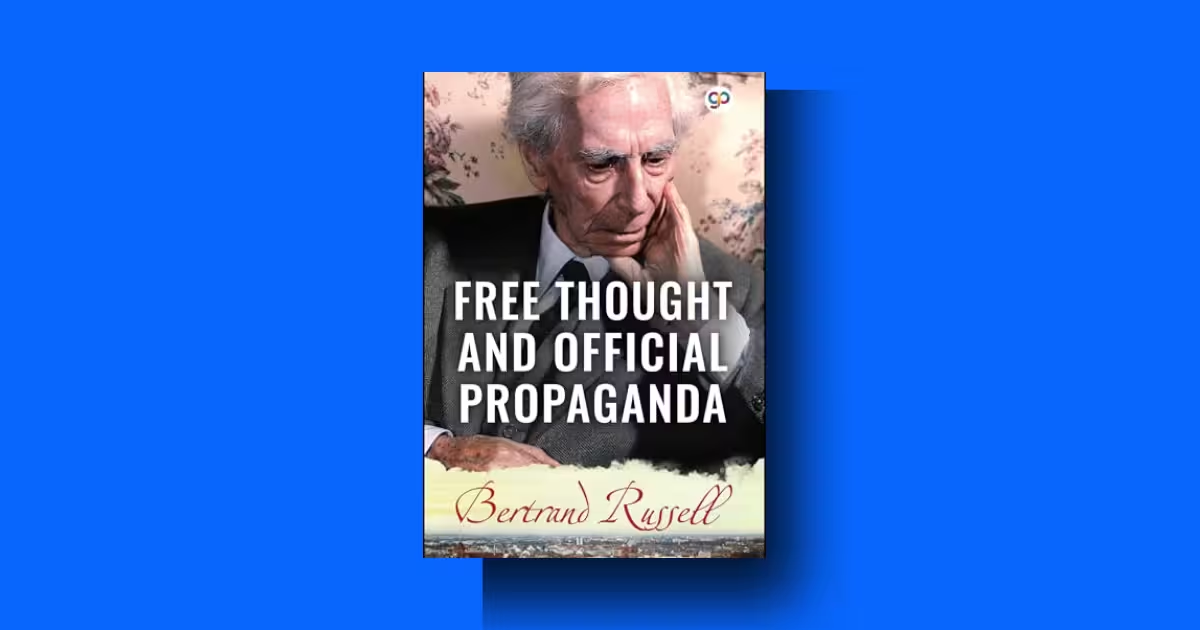
Do you actually think for yourself, or has someone else been doing the thinking for you your entire life?
That uncomfortable question sits at the heart of Bertrand Russell’s Free Thought and Official Propaganda—a slender speech turned book that punches far above its weight. Delivered on March 24, 1922, at South Place Institute as the Conway Memorial Lecture, this 100-plus-year-old essay reads less like a historical artifact and more like a dispatch from our own time.
Russell, the Welsh-born British philosopher, mathematician, and logician who would go on to win the Nobel Prize in Literature in 1950, wasn’t interested in polite academic abstractions. He was interested in why intelligent people believe stupid things—and who benefits when they do.
Overview
Free Thought and Official Propaganda argues that genuine freedom of thought requires far more than the absence of legal penalties.
Russell contends that three modern forces—state-controlled education, systematic propaganda, and economic pressure—have created a world where independent thinking is actively punished while conformity is rewarded.
The essay is built around Russell’s personal experiences: his father’s will being overturned by courts to force a Christian upbringing on young Bertrand, his 1910 rejection as a Liberal Party parliamentary candidate because he admitted he was agnostic, and his denial of a Fellowship at Trinity College, Cambridge, due to his “anti-clerical” views.
Russell’s central prescription is the “scientific temper”—a skeptical, evidence-based approach to all beliefs, not just scientific ones. He argues that rational doubt, not blind certainty, is the only path to a humane society.
Reader preference
Free Thought and Official Propaganda is best for:
- Readers who suspect they’re being manipulated by media, government, or corporate interests
- Anyone who’s ever felt that education taught them what to think rather than how to think
- Philosophy newcomers looking for an accessible entry point to Russell’s thought
- Citizens concerned about censorship, “cancel culture,” or ideological purity tests in any form
- Educators and parents who want to understand how teaching can either liberate or imprison young minds
Free Thought and Official Propaganda is not preferable for:
- Readers seeking a comprehensive philosophical treatise—this is a 30-page lecture, not a systematic work
- Those who prefer their political commentary neutral and dispassionate—Russell is unapologetically opinionated
- Anyone offended by frank atheism—Russell makes no secret of his belief that “every kind of religious belief will die out”
- Readers looking for practical solutions rather than diagnosis—Russell is better at identifying problems than solving them
Table of Contents
Background
To understand Free Thought and Official Propaganda, you need to understand where Russell was coming from—and what the world looked like in 1922.
Russell was born in 1872 into British aristocracy. By the time of this lecture, he was already a towering intellectual figure, having co-authored Principia Mathematica with Alfred North Whitehead and established himself as one of the leading philosophers of his generation.
But he was also a man who had lived through the First World War—a conflict that had shattered the optimistic rationalism of the previous century and revealed how easily entire populations could be mobilized for mass destruction.
The war had a profound effect on Russell. He was a passionate pacifist, and his opposition to the war cost him his Fellowship at Trinity College, Cambridge. This personal experience of institutional punishment for dissenting opinion runs through every page of this lecture.
The lecture was delivered in honor of Moncure Conway (1832-1907), an American abolitionist and freethinker who had devoted his life to “freedom of thought and freedom of the individual”.
Russell was speaking to an audience that already shared his basic commitments—but he wasn’t there to preach to the choir. He was there to warn them that the freedoms Conway had fought for were in danger of being lost.
Free Thought and Official Propaganda Summary
Russell begins by distinguishing between two meanings of “free thought.” In its narrower sense, it means rejecting religious dogma—being an atheist, agnostic, or freethinker in the traditional sense. Russell himself fits this description; he hopes “that every kind of religious belief will die out”.
But Russell is far more concerned with the wider sense of free thought: freedom from external compulsion of any kind, whether legal, economic, or social. This is the heart of his argument.
The Three Obstacles to Free Thought
Russell identifies three major obstacles to genuine freedom of thought:
1. Legal Penalties
The most obvious form of thought control is legal punishment for holding or expressing certain opinions. Russell notes that “no great country has yet reached” the level of allowing complete freedom of expression.
He points out that in England, blasphemy laws still made it illegal to express disbelief in Christianity (though not enforced against the wealthy).
In America, immigrants had to swear they weren’t anarchists or polygamists. In Japan, it was illegal to deny the Mikado’s divinity.
Russell’s insight here is that legal penalties are almost always justified by the majority’s conviction that the persecuted opinions are “monstrous and immoral”.
But this, he argues, is “exactly the same view as that which made possible the tortures of the Inquisition”. The majority always believes its own persecution is justified; the problem is that the majority is often wrong.
2. Economic Pressure
This is where Russell’s argument becomes genuinely prophetic. He observes that “thought is not free if the profession of certain opinions makes it impossible to earn a living”. In modern societies, economic pressure has largely replaced legal persecution as the primary means of enforcing conformity.
Russell illustrates this with three personal examples.
First, his father’s will appointed freethinking guardians for young Bertrand, but the courts overrode this and had him educated as a Christian.
Second, in 1910, when Russell was being considered as a Liberal Party parliamentary candidate, he admitted he was agnostic when questioned by a party caucus. When asked if he’d be willing to attend church occasionally, he said no. He was promptly rejected.
Third, when he was offered a lectureship at Trinity College, Cambridge, he was not made a Fellow—a position with tenure and a voice in college governance—because the clerical faction didn’t want to add to the “anti-clerical vote”.
Russell’s point is brutal and direct: “The habit of considering a man’s religious, moral, and political opinions before appointing him to a post or giving him a job is the modern form of persecution, and it is likely to become quite as efficient as the Inquisition ever was”.
He warns that as industrial monopolies grow and the number of possible employers shrinks, this form of persecution will only intensify. “If, in practice, certain opinions lead a man to starve, it is poor comfort to him to know that his opinions are not punishable by law”.
3. Distortion of Evidence
The third obstacle is perhaps the most insidious: the systematic presentation of only one side of every controversy. Russell observes that “thought is not free if all the arguments on one side of a controversy are perpetually presented as attractively as possible, while the arguments on the other side can only be discovered by diligent search”.
This is the domain of propaganda, and Russell saw it as the great danger of the modern age.
He traces the art of propaganda directly to advertising: “The art of propaganda, as practiced by modern politicians and governments, is derived from the art of advertisement”.
He gives the example that if he simply said “I am the most modest man alive” once, he’d be laughed at; but if he could afford to put that message on every bus and billboard, people would eventually believe it.
Education as the Chief Obstacle
Russell reserves some of his harshest criticism for education systems. He argues that “education has become one of the chief obstacles to intelligence and freedom of thought”.
Why? Because modern education, particularly state-controlled education, aims not to teach students how to think but to fill them with approved opinions.
Russell writes that “the officials in charge of education desire the young to become educated” only in the sense of acquiring information—not intelligence. “Their problem is to impart information without imparting intelligence”.
Russell illustrates this with a devastating example from the State of New York, where a law decreed that school licenses would be denied to any school teaching “the doctrine that organized Governments shall be overthrown by force, violence, or unlawful means”.
As the New Republic pointed out at the time, this would have made it illegal during the War to teach that the Kaiser’s government should be overthrown. Another law required teachers to be “loyal and obedient to the Government” and refused certificates to anyone who had advocated “a form of government other than the Government of this State or of the United States”.
Russell’s conclusion is withering: “According to the law of the State of New York, Christ and George Washington were too degraded morally to be fit for the education of the young”.
If Christ came to New York and said “Suffer the little children to come unto me,” the school board president would reply that Christ advocated “the kingdom of heaven” whereas “this country, thank God, is a republic”.
The Scientific Temper as Salvation
So what’s the solution? Russell proposes what he calls the “scientific temper”—an attitude of critical skepticism applied to all beliefs, not just scientific ones.
“The scientific temper,” Russell writes, “is capable of regenerating mankind and providing an issue for all our troubles”. This isn’t about knowing scientific facts; it’s about adopting the scientific attitude: tentativeness, openness to evidence, willingness to revise beliefs in light of new information.
Russell contrasts this with the dogmatic certainty that characterizes politics and religion. “In religion and politics,” he observes, “though there is as yet nothing approaching scientific knowledge, everybody considers it de rigueur to have a dogmatic opinion”. The result is persecution, war, and intellectual stagnation.
He offers Einstein’s theory of relativity as a model. When Einstein’s predictions were verified by the 1919 eclipse expedition, physicists around the world accepted the theory—but none of them, “least of all Einstein himself,” claimed to have said the last word. They understood that their theories would be modified in turn, just as they had modified Newton’s.
What would have happened, Russell asks, if Einstein had advanced something equally new in religion or politics? English people would have found “elements of Prussianism” in his theory; anti-Semites would have called it a “Zionist plot”; nationalists would have dismissed it as “lily-livered pacifism”. “Ultimately the truth or falsehood of his doctrine would be decided on the battlefield, without the collection of any fresh evidence”.
The Two Simple Principles
Russell concludes with two simple principles that, if adopted, would solve most social problems:
✅ “Education should have for one of its aims to teach people only to believe propositions when there is some reason to think that they are true”.
✅ “Jobs should be given solely for fitness to do the work”.
These principles seem almost absurdly obvious—which is precisely Russell’s point. They are obvious, yet they are systematically violated. And they will continue to be violated until public opinion demands otherwise.
Free Thought and Official Propaganda Analysis
Reading Free Thought and Official Propaganda in 2026 is an uncanny experience. So much of what Russell describes feels like it could have been written yesterday.
What he gets right:
Russell’s analysis of economic pressure as a form of persecution has proven remarkably prescient.
In an era of at-will employment, social media background checks, and ideological litmus tests for jobs ranging from university professor to social media moderator, his warning that “the habit of considering a man’s religious, moral, and political opinions before appointing him to a post” is “the modern form of persecution” feels almost too accurate.
His critique of education as indoctrination rather than liberation has been borne out by decades of research showing that schools often teach conformity rather than critical thinking.
The “teaching to the test” mentality that dominates modern education is exactly what Russell warned against: imparting information without imparting intelligence.
His analysis of propaganda as a form of advertising is now almost too obvious to state—but in 1922, it was a genuinely novel insight. Today, we live in a world where political campaigns are run by the same people who sell soap, and where the lines between news, entertainment, and propaganda have blurred to the point of invisibility.
Perhaps most importantly, Russell’s call for a “scientific temper”—a skeptical, evidence-based approach to all beliefs—has never been more urgent. In an age of social media echo chambers, algorithmic radicalization, and widespread misinformation, the ability to weigh evidence and resist dogmatic certainty is not just a luxury; it’s a survival skill.
What he misses:
Russell’s faith in the “scientific temper” as a solution to political and religious conflict is, to put it mildly, optimistic. He seems to believe that if people were simply taught to think critically, they would naturally abandon dogmatic beliefs and embrace rational skepticism.
This ignores the powerful psychological and social forces that make people cling to beliefs even in the face of contrary evidence.
Russell also underestimates the extent to which science itself can become a dogma. The history of the 20th century is full of examples of scientific racism, eugenics, and other forms of pseudo-scientific ideology being used to justify persecution.
The “scientific temper” is not immune to corruption; it requires constant vigilance, just like any other form of thought.
Finally, Russell’s proposal for education reform—teaching students to read newspapers skeptically, to compare biased accounts, to recognize propaganda—is sensible but inadequate.
He doesn’t address the structural issues that make propaganda so effective: the concentration of media ownership, the economics of attention, the psychology of identity-protective cognition. These are problems that cannot be solved by education alone.
Strengths and Weaknesses
Strengths:
Clarity and accessibility: Russell writes with the precision of a logician and the elegance of a literary stylist. This is philosophy that anyone can understand.
Personal authenticity: Russell’s willingness to use his own experiences—his father’s overturned will, his failed political candidacy, his denial of a Fellowship—gives the essay a concrete, lived reality that abstract arguments lack.
Prophetic insight: The essay’s diagnosis of economic pressure as a form of persecution, its critique of state-controlled education, and its analysis of propaganda as advertising all feel remarkably contemporary.
Moral seriousness: Russell genuinely cares about freedom of thought, and his passion is infectious. He’s not just making an argument; he’s issuing a warning.
Weaknesses:
Limited scope: This is a lecture, not a book. At around 30 pages, it can only sketch its arguments, not develop them fully.
Naive optimism: Russell’s belief that the “scientific temper” can solve humanity’s problems seems, in retrospect, overly optimistic. Critical thinking is necessary but not sufficient for a just society.
Eurocentrism: Russell’s examples are almost entirely drawn from Western Europe and America. He treats China as an exception to the rule of propaganda, but doesn’t seriously engage with non-Western traditions of thought.
Lack of practical solutions: Russell is excellent at diagnosing problems but offers few concrete proposals for solving them. He ends with a call for “enlightened public opinion” without explaining how such opinion might be created.
Comparison with Similar Works
Free Thought and Official Propaganda sits alongside several other important works on propaganda and intellectual freedom:
George Orwell’s Nineteen Eighty-Four (1949): Orwell’s dystopian novel explores many of the same themes as Russell’s essay—the manipulation of language, the control of history, the destruction of independent thought.
But where Russell offers analysis, Orwell offers nightmare. Russell’s essay is the diagnosis; Orwell’s novel is the prognosis.
Walter Lippmann’s Public Opinion (1922): Published the same year as Russell’s lecture, Lippmann’s book examines how propaganda shapes public opinion in democratic societies.
Lippmann is more systematic and less openly political than Russell, but both writers share a deep skepticism about the public’s ability to think for itself.
Noam Chomsky’s Manufacturing Consent (1988): Chomsky’s analysis of how media shapes public opinion in the service of elite interests is a direct descendant of Russell’s arguments.
Chomsky is more radical in his politics and more detailed in his analysis, but the core insight—that propaganda works through economic pressure and distortion of evidence—is the same.
John Stuart Mill’s On Liberty (1859): Mill’s classic defense of freedom of expression is the intellectual ancestor of Russell’s essay. But where Mill argues from first principles about the nature of liberty, Russell argues from concrete observations about how liberty is actually undermined.
Conclusion:
Should you read Free Thought and Official Propaganda?
Free Thought and Official Propaganda is not a perfect work, but it is an essential one. It’s the kind of essay that should be required reading in every high school and university—not because it contains all the answers, but because it asks all the right questions.
Russell’s central argument in Free Thought and Official Propaganda is that freedom of thought requires more than the absence of legal penalties; that it requires economic security, intellectual independence, and a culture of skepticism—is as relevant today as it was in 1922.
In an age of algorithmic echo chambers, corporate media consolidation, and political polarization, his warning that “the evils of the world are due to moral defects quite as much as to lack of intelligence” is a necessary corrective to those who believe that more information alone will save us.
Russell’s call for a “scientific temper” is not a call for scientism—the belief that science can answer all questions.
It’s a call for intellectual humility: the willingness to admit that we might be wrong, the openness to evidence, the rejection of dogmatic certainty. These are not just philosophical virtues; they are political necessities.
Free Thought and Official Propaganda‘s greatest strength is its relentless honesty. Russell doesn’t pretend that freedom of thought is easy or natural. He doesn’t pretend that the forces arrayed against it are weak or easily overcome.
He tells the truth: that propaganda, economic pressure, and bad education are powerful enemies, and that defeating them requires sustained effort from all of us.
Is Free Thought and Official Propaganda a perfect book? No. Is it a necessary book? Absolutely. In a world where more and more people seem to believe that the truth is whatever their tribe tells them it is, Russell’s voice—clear, skeptical, unafraid—is more valuable than ever.
For further exploration: If this essay resonates with you, consider reading Russell’s Why I Am Not a Christian (1927) for his fuller thoughts on religion, or In Praise of Idleness (1935) for his broader social critique.







