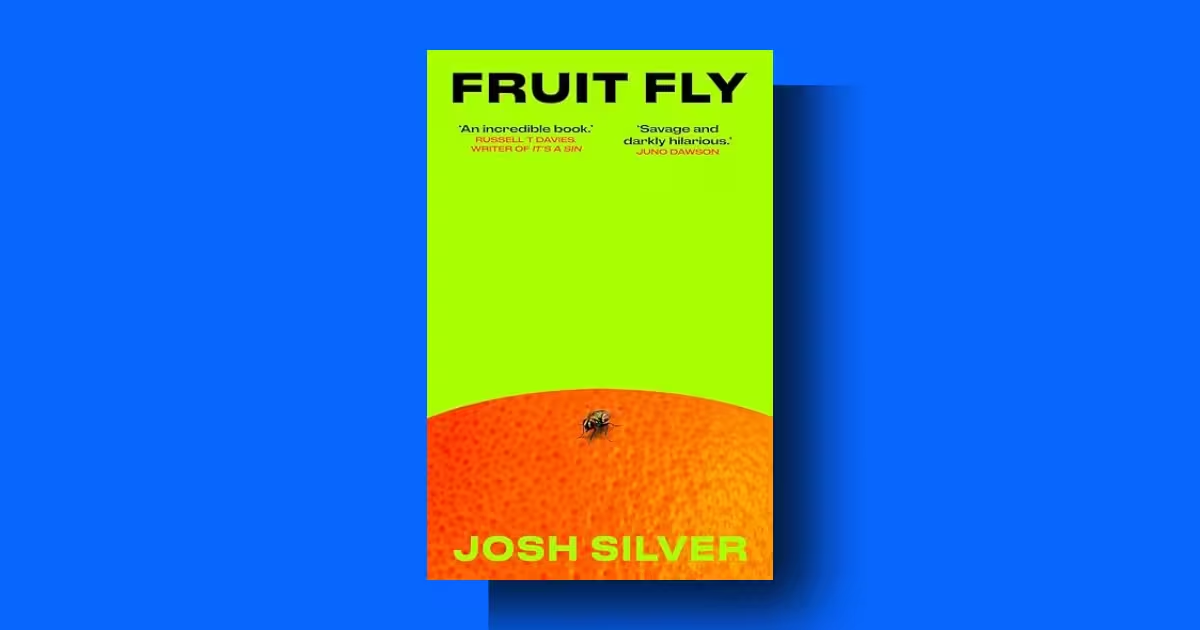

Fruit Fly by Josh Silver is the sharp, darkly funny literary thriller that turned a washed-up novelist’s desperation into one of 2026’s most talked-about books, blending satire of the publishing machine with raw queer survival stories in a way that leaves you both laughing and unsettled.
Snapshot
Fruit Fly is for readers who loved the moral mess of Yellowface or the unfiltered queer grit of Trainspotting and A Little Life, but want something faster, funnier, and more contemporary. You’ll stick around if you can handle unlikeable protagonists who both exploit and need each other, graphic addiction scenes, and a satire that refuses neat redemption.
You’ll bounce if you need clear heroes, clean language, or a tidy moral lesson. Mallory’s “go gay, go sad, go dark” Reddit rabbit hole and Leo’s poetry under the bridge are the exact moments that make the book stick.
Table of Contents
1. Introduction
Fruit Fly is Josh Silver’s adult debut, published in the UK by Magpie (an imprint of Oneworld) on 23 April 2026 and in the US by Crooked Lane Books on 4 August 2026. Silver, previously known for YA titles including HappyHead and Traumaland, worked as an actor and later as a mental health nurse. T
he novel runs roughly 384–416 pages depending on edition and quickly became a Top Ten Sunday Times bestseller.
2. Background
Silver has spoken openly about his own experiences with addiction and recovery, which feed the authenticity of Leo’s chapters without turning the book into memoir.
The story sits inside a post-2020 literary climate obsessed with “own voices,” trauma as currency, and the publishing industry’s hunger for the next authentic hit. It arrives after years of debates sparked by books like Yellowface, when questions of who gets to tell which stories feel sharper than ever.
3. Fruit Fly Summary
Mallory Maddox once published a successful debut, Shallow Embers, seven years earlier. It earned her a Sunday Times bestseller tag, a New York Times review that called her “unhinged bravery,” and a comparison to Virginia Woolf.
Since then: agent dropped, second book pulled, TV adaptation gone, writer’s block absolute. She lives in a carefully curated Crouch End house with her husband Ronan, a rising Netflix commissioning editor. They throw parties for the same “wannabe Bloomsbury set” who still quote Woolf while eating Tesco hummus.
Mallory hides in the bathroom playing Candy Crush, staring at her own unread early edition of Mrs Dalloway and the copy of her book she sometimes wants to spit on.
One Friday night, after Ronan’s speech and too much whiskey, she googles how to write a bestseller again. A Reddit post lands: underrepresented voices, cosy crime, sexy dragons, and the gold dust—“gay is in. Go gay. It’s cool now. It sells. However… the perfect blend is gay AND sad.” She downloads Grindr.
Leo is twenty-something, sleeping under bridges, scoring from a dealer called Brick, writing poetry under the handle @Alias22. He trades sex for drugs, drifts between chemsex parties, hostels, and the occasional NA meeting. His chapters open in short, jagged lines: “Three days no sleep / Smack’s sweet.” He is sharp, manipulative when he needs to be, and exhausted.
Their paths cross. Mallory, posing partly as a therapist (she has a short online counselling diploma and three clients), starts meeting Leo. She takes notes.
She renames him Liam. She begins a manuscript called Slay. The early chapters get her a buzzy editor’s attention and a six-figure interest. Meanwhile her marriage frays. Ronan wants a child; she does not. She hides cash from a client, follows Leo, sits in meetings under a false name (“Mandy”), and keeps extracting stories.
Leo is not passive. He steals, lies, tests her, turns up at her house bleeding and high, demands money, and eventually finds the manuscript. Confrontations escalate.
A man known as Mo ends up in the canal. Leo’s family appears in brief, painful scenes. Mallory’s mother arrives. The house becomes a pressure cooker. Ronan discovers pieces of the secret. The book deal solidifies.
In the later sections the timeline jumps. Slay is published or heading to publication. Mallory has the success she wanted. Leo is still alive, still writing, and the final movement turns the appropriation back on itself: the story she took becomes material he can use.
The last pages leave certain events deliberately ambiguous, exactly what happened in the kitchen that night, the precise fate of some secondary characters, while making clear that neither person walked away clean.
4. Fruit Fly Analysis
4.1 Characters
Mallory is the engine. She is vain, dishonest, and desperate, yet Silver makes her loneliness and creative starvation feel real. Her internal monologues about mirrors, Jäger, and the “modern-day Virginia Woolf” quote on her book cover are both comic and painful.
Leo is harder to pin down because he keeps performing for survival. He is funny, cruel, poetic, and repeatedly failed by systems that claim to help. Their relationship is transactional on both sides: she needs his trauma, he needs her money and temporary safety. Ronan is the polished villain of domestic life—handsome, successful, quietly controlling. Secondary figures (Joanie, Brick, Kerry the nurse, Mo) feel sharp and specific rather than decorative.
4.2 Themes and Symbolism
The central question is ownership of story. Mallory’s “go gay go sad go dark” moment is the book’s thesis in miniature: the market rewards certain kinds of pain when packaged correctly.
Chemsex, Grindr, and the bridge under which Leo sleeps function as literal and symbolic spaces of both connection and extraction. The title itself—Fruit Fly, short-lived, drawn to decay—lands on both characters. Silver keeps the satire tight; he never lets the reader settle into comfortable judgment of either Mallory or Leo.
5. Evaluation
Fruit Fly is a savage, propulsive, and unexpectedly tender novel that I finished in two sittings and immediately wanted to talk about with anyone who would listen.
5.1 Strengths
The alternating voices work. Leo’s poems and short chapters cut against Mallory’s longer, more performative sections. The humour is black and precise. The publishing satire never feels abstract because it is rooted in specific, embarrassing human need.
5.2 Weaknesses
The final quarter moves fast and leaves a few plot threads more suggestive than resolved. Some readers may find the tonal shifts (comedy into genuine threat) jarring.
5.3 Impact
It made me uncomfortable in the useful way: I kept catching myself rooting for Mallory’s success while knowing exactly what it cost. The book stays with you because neither character is allowed a simple redemption.
5.4 Comparison
Closest in spirit to Yellowface for the appropriation engine, Trainspotting for the addiction texture, and Detransition, Baby for the messy queer-straight dynamics. It feels more thriller-paced than any of them.
6. Personal insight with contemporary educational relevance
The most urgent thread for me is how easily trauma becomes content. In 2026 we still watch real pain packaged for algorithms, book deals, and awards lists.
UK data from the Office for National Statistics and various homelessness charities continue to show elevated rates of substance use and mental-health crisis among young LGBTQ+ people, especially those who have experienced family rejection or housing instability. Silver’s background as a mental-health nurse gives the addiction and recovery scenes a grounded weight that pure research rarely achieves.
Five concrete lessons the book left me with:
- “Authenticity” is often just the market’s current preferred flavour of suffering.
- Helping someone and extracting from them can look identical from the outside.
- Creative block is real; the solutions people invent under pressure are rarely pure.
- Queer stories told by outsiders are not automatically invalid, but the power dynamics matter and should be named.
- Recovery is not a clean narrative arc, and neither is literary success.
These feel useful beyond the page when conversations about representation and “own voices” keep circling the same questions without looking at the economic incentives underneath.
7. Fruit Fly Quotes
From Mallory’s early spiral: “I, too, am a piece of exploding computerised fruit… Here one moment, only to be pulverised into a spray of sweet nothing the very next.”
The Reddit gold-dust advice that starts everything: “gay is in. Go gay. It’s cool now. It sells. However – here is the gold dust – the perfect blend is gay AND sad. You nail that, you’re minted.”
Leo’s opening: “Three days no sleep / Smack’s sweet. / The aftertaste / I will push away / As long as I am able.”
Later, when the manuscript is confronted: the tension between “Leo” and the fictional “Liam” becomes the novel’s sharpest knife.
8. Conclusion
Fruit Fly is messy, funny, nasty, and strangely compassionate. It does not let anyone off the hook, including the reader who enjoys the spectacle. I recommend it strongly to anyone who likes literary fiction that moves like a thriller, queer stories that refuse sanitisation, and satires that still have a beating heart.
It is already one of the books of 2026 for a reason.