
I walked into Gregg Araki’s I Want Your Sex expecting pure provocation. What I got was something far more interesting: a wickedly funny, surprisingly tender, and deeply cynical film about sex, art, and the messy business of being young in 2026. Araki, the 66-year-old godfather of New Queer Cinema, has returned after a decade-long absence from feature filmmaking with what might be his most accessible work y, and also one of his most misunderstood.
I Want Your Sex premiered at the Sundance Film Festival on January 23, 2026, and was released by Magnolia Pictures in the United States on July 31, 2026. The film stars Olivia Wilde as Erika Tracy, a renowned contemporary artist, and Cooper Hoffman as Elliot, her 23-year-old assistant turned sexual muse. It is an erotic comedy thriller that blends crime procedural elements with a savage parody of both contemporary art and BDSM sexual practices.
Here is the thing: this movie is not for everyone. But for those who click with Araki’s sensibilities, it is a blast. I want to break down everything about this film—the plot, the performances, the themes, the reception, and why I believe it is destined for cult status.
Table of Contents
Summary
I Want Your Sex is a 2026 erotic comedy thriller directed by Gregg Araki and co-written with Karley Sciortino. It stars Olivia Wilde and Cooper Hoffman in a BDSM-inflected relationship set against the Los Angeles art world.
The film premiered at Sundance to strong critical reviews (89-91% on Rotten Tomatoes) but flopped at the box office, earning just over $2.1 million worldwide against an estimated $10 million budget. Despite its commercial failure, the film is a smart, funny, and provocative satire about generational attitudes toward sex, consent, and artistic exploitation.
Recommended for fans of Araki’s previous work, erotic thrillers, and art-world satires. Not recommended for viewers uncomfortable with explicit BDSM content or those seeking a conventional romance.
Background
To understand I Want Your Sex, you need to understand Gregg Araki. He is a leading figure of the New Queer Cinema movement of the early 1990s, known for innovative, eye-opening, and at times controversial films aimed primarily at queer audiences.
His Teen Apocalypse trilogy—Totally F*ed Up (1993), The Doom Generation (1995), and Nowhere (1997), captured contemporary teen angst in all its chaotic glory without fear or filter. These films were acts of rebellion in their dogged exploration of sexuality, drugs, and coming of age at the turn of the 21st century.
Araki’s films come peppered with beautiful people, bold fashion statements, tongue-in-cheek humour, and overt pop culture references. Yet behind it all there is a strong personal and political conviction, as he responds to homophobia or confronts backward attitudes. His radical films speak to the outsider spirit, rejecting heterosexuality as the norm.
So when Araki announced he was making a film called I Want Your Sex with Olivia Wilde and Cooper Hoffman, the film community paid attention. This was his first feature since 2014’s White Bird in a Blizzard. The screenplay, co-written with Karley Sciortino (the voice behind Vogue.com’s Breathless column and Viceland’s Slutever), originally centered on a young woman and her older male boss.
But after revisiting the script years later, Araki and Sciortino reversed the characters’ genders, resulting in the relationship between the older Erika and younger Elliot. Araki flipped the gender roles of I Want Your Sex following the #MeToo movement.
That decision alone tells you something about the film’s ambitions. This is not just a kinky romp. It is a deliberate reworking of power dynamics, a film that asks uncomfortable questions about who gets to be the predator and who gets to be the prey.
I Want Your Sex 2026 Plot Summary
I am going to walk you through the entire film because I believe understanding the narrative architecture helps you appreciate what Araki is doing. If you want to go in blind, skip to the next section.
The film opens with a flash-forward: at the luxurious home of renowned contemporary artist Erika Tracy, her 23-year-old lover Elliot finds her floating naked and unconscious in the pool. He fails to resuscitate her and calls 911, but her body has disappeared by the time authorities arrive.
We then cut to “nine-and-a-half weeks earlier,” a clear homage to 9 1/2 Weeks. Elliot is a struggling, unemployed young man living with his best friend Apple. He lands a job as an assistant in Erika’s studio, where he befriends fellow assistant Zap as they help produce Erika’s avant-garde, sexually explicit artwork. Elliot’s girlfriend Minerva is uninterested in sex, and he begins to fantasize about Erika.
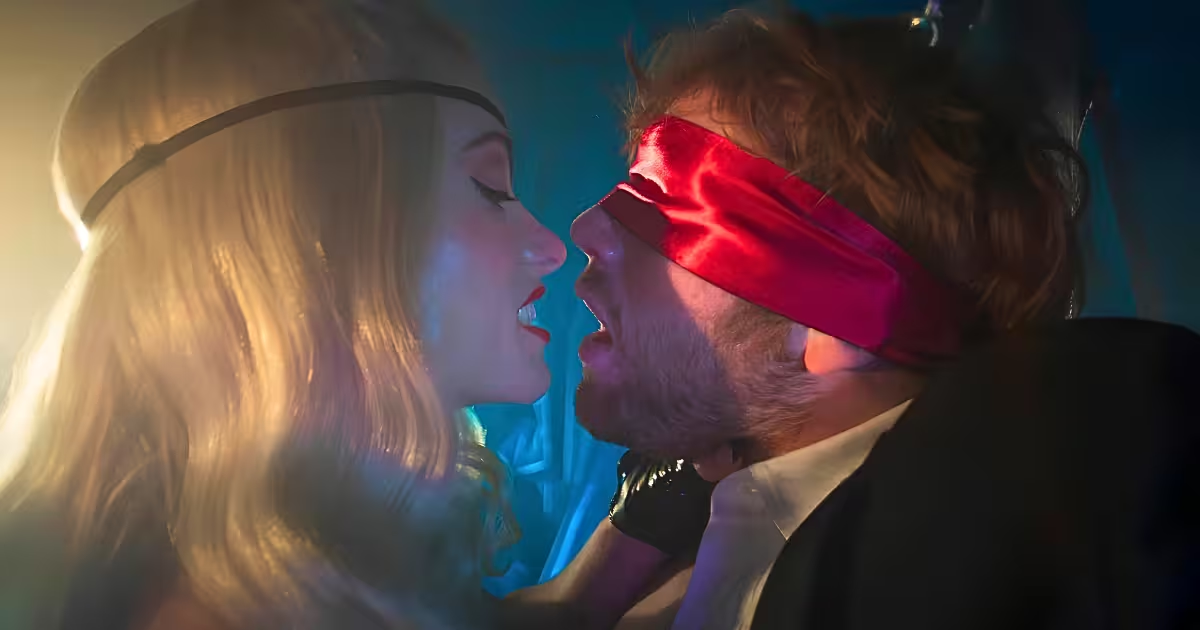
After Elliot’s first week, Erika calls him to her office and initiates a sexual relationship, instructing him to crawl to her to show his submission. Their BDSM dynamic deepens as the dominant Erika takes control of the submissive Elliot, despite warnings from Erika’s business manager Vikktor.
Erika sends Elliot to her visiting French friend Yvette to have sex with her as a “birthday present,” but Yvette rejects him for his overly facile attitude toward eroticism and sex. Overwhelmed by his feelings for Erika, Elliot breaks up with Minerva, who reacts with indifference.
As Erika prepares for a major art show, she instructs Elliot to bring an additional partner to her house that night for a threesome, and he invites Apple. Ignoring Elliot’s discomfort, Erika handcuffs him in the corner while she seduces Apple. As he continually demands to be unbound, an exasperated Erika reluctantly uncuffs him and instructs Apple to penetrate him with a strap-on. Elliot adamantly refuses, leading a distraught Apple to tearfully question why he deems her an unfit sexual partner. They go home early.
Drunkenly seeking closure with Minerva, Elliot goes to her place and finds her with another man. Hurt and embarrassed, Apple asks Elliot to move out. He moves in with Zap, with whom he works the opening of Erika’s exhibition. There, Erika tries to reignite their relationship. Elliot complies until he sees videos of their sexual encounters on display. He angrily confronts Erika, who pretends to not know him and has him ejected from the gallery.
The show is a critical and commercial failure, while news of Elliot’s fight with Erika spreads online, further harming her reputation. Later, a drunk and unstable Erika summons Elliot to her home and gives him champagne, becoming physically aggressive as he rejects her advances. Elliot passes out and awakens to find Erika naked and unconscious in the pool.
Police detectives question him about their relationship and suggest that he murdered her, but ultimately release him due to lack of a body and evidence. Erika then visits Elliot at Zap’s apartment, where she explains that she and Vikktor manipulated Elliot into making a scene at the gallery, then drugged his champagne to allow her to fake her own death. In the wake of her disappearance, the exhibition sold out, financially rescuing the studio.
Elliot is furious, but Erika urges him to use the scandal to boost his own career. Two years later, Elliot is a successful podcaster and interviews Erika, who has written a book about the hoax. She leaves with her new sub, promising to stay in touch.
Another two years later, Elliot and Erika are seen getting married. After they kiss at the altar, Elliot watches in horror as Erika’s face melts, revealing the marriage to be a shared nightmare they respectively wake up from in separate beds.
Critical Analysis: What Works and What Doesn’t
The Art-World Satire Is Sharp and Cruel
Araki and Sciortino have crafted a genuinely funny and biting satire of the contemporary art world. Erika Tracy is a composite of every provocative female artist you have ever read about—a bit Marina Abramović, a bit Tracey Emin, with the commercial instincts of Jeff Koons. Her studio is described in the film as a “hipster sweatshop” where interns chew gum to stick onto a painted vagina on canvas.
The art in I Want Your Sex is absurd, but not condescending. Araki clearly has affection for the art world even as he skewers its pretensions.
The film’s central joke is that Erika’s most successful artwork is not her explicit paintings or her BDSM performances, but her own fake death. The exhibition sells out only after she disappears. That is a savage indictment of how the art market rewards scandal over substance.
The BDSM Relationship Is More Than Shock Value
Initially, it may seem that the BDSM elements are there purely for titillation. But Araki is after something deeper. The film interrogates how we distinguish between kink and exploitation, performance and authenticity, generational attitudes toward desire and consent.
Erika pushes her sub past his comfort zone with a “try-it-you’ll-love-it” casualness. Elliot is incompatible with his girlfriend and bottling up things he had been unable to articulate or recognize on his own, so it is easy for him to surrender to being paddled and penetrated, to the latex mask on his face and the scissors tracing patterns on his chest, even as his boss demands ever more trust and vulnerability.
The power dynamic is not simply dominant/submissive.
As Olivia Wilde noted, “the Elliot-Erika relationship had to be so much more than just, you know, dom-sub. There had to be something that made you actually weirdly, in a teeny tiny way, root for them, and to feel that they had actual chemistry and kind of love each other”.
The Crime Procedural Frame Is Underdeveloped
Where the film stumbles, in my view, is in its crime procedural elements. The police interrogation scenes, while well-acted by Margaret Cho and Johnny Knoxville, feel somewhat tacked on. The mystery of Erika’s disappearance is resolved in a way that is clever but emotionally unsatisfying. The film’s final act, which jumps forward two years and then another two years to a shared nightmare of marriage, is ambitious but feels rushed.
Araki shot the film with the fewest days he has ever had on any movie, including his micro-budget early work. He says, “I love to work that way. I get bored easily, and I feel like the actors get bored, and they get cold. I personally think as a director that [moving fast] really helps the performances”. That energy is present in the film, but sometimes it feels like the narrative could have used a bit more breathing room.
Acting Performances: Wilde and Hoffman Are Magnetic
Olivia Wilde as Erika Tracy
Olivia Wilde delivers what I consider the best performance of her career. She is deliciously magnetic and sexy as Erika, commanding the screen with a performance that is by turns vulnerable, cruel, and desperately needy. Erika is compulsive and in need of adoration, she becomes visibly aroused when Elliot writes a press release that is worshipful even by PR standards.
Wilde told Entertainment Weekly that she felt immediate chemistry with Cooper Hoffman: “The second I met Cooper, I was like, ‘Oh, I love you'”. That chemistry translates directly to the screen. Their scenes together crackle with tension, and you genuinely believe that these two people are drawn to each other despite, or perhaps because of, the toxic power dynamics at play.
Cooper Hoffman as Elliot
Cooper Hoffman, son of the late Philip Seymour Hoffman, continues to impress. He delivers a wonderfully comedic and suitably frustrating performance as Elliot, a naïve young man drowning in a pool of twentysomething confusion. Hoffman was only 20 when he auditioned for the role, but Araki noted that he had “a lot of gravitas” and “really commanded the room”.
What I appreciate most about Hoffman’s performance is how he makes Elliot sympathetic even when he is being insufferable. This is a young man who is desperate to belong, to find approval. In Erika, he sees an outlet for his innermost desires, but it also mostly seems like he just wants someone to make him feel special. Hoffman captures that desperate neediness without ever letting it become pathetic.
Supporting Cast
The supporting cast is uniformly strong. Chase Sui Wonders as Apple, Elliot’s best friend and roommate, brings genuine emotional weight to a role that could have been purely comedic. Her tearful question about why Elliot deems her an unfit sexual partner is one of the film’s most affecting moments.
Mason Gooding as Zap, Daveed Diggs as the menacing business manager Vikktor, and Roxane Mesquida as the French friend Yvette all make strong impressions. Charli XCX, in an undisclosed role that turns out to be Minerva, Elliot’s disinterested girlfriend, is perfectly cast. her blank indifference is both funny and cutting. Margaret Cho and Johnny Knoxville as the detectives provide some of the film’s best deadpan humour.
I Want Your Sex Themes and Messages
Generational Attitudes Toward Desire
A major trait of I Want Your Sex is its exploration of generational attitudes toward sex. Araki has described the film as a “sex-positive love letter to Gen Z”. He has expressed frustration that younger generations seem to be having less sex than previous ones. “The highs and lows of it are kind of what life’s all about,” he told Attitude magazine.
Elliot represents a generation that is anxious, over-informed, and paradoxically less sexually adventurous than its elders. He is in a sexless relationship. He is confused about his desires. When Erika introduces him to BDSM, he is both thrilled and terrified. Araki is asking: What happens when a generation raised on pornography and consent education encounters actual, messy, complicated desire?
The Exploitation of Youth
Traditionally, films about age-gap relationships have featured older men and younger women. Araki reverses this dynamic, but he does not simply swap the genders and call it a day. He interrogates the very concept of exploitation.
Is Erika exploiting Elliot? Is Elliot exploiting Erika’s fame and connections? Is Vikktor exploiting both of them? The film refuses to give easy answers. As noted in the art-world satire, the film “deals in questions of power, consent and liberation”.
The Performance of Authenticity
Perhaps the most interesting theme is the film’s meditation on authenticity. Erika’s art is all about provocation and authenticity, she makes sexually explicit work that is meant to shock and liberate. Yet her entire career is built on performance. She performs her sexuality. She performs her death. She even performs her marriage in the film’s final nightmare sequence.
Elliot, in contrast, is genuinely naïve. He does not know how to perform. That is both his charm and his vulnerability. Araki seems to be suggesting that in a world saturated with irony and self-awareness, genuine naïveté becomes almost revolutionary.
Comparison to Araki’s Previous Work and Similar Films
How It Fits in the Araki Filmography
I Want Your Sex is unmistakably an Araki film. The Pop Art colour palette, the shoegaze-influenced soundtrack (James Clements provides the score), the Los Angeles setting, the beautiful people making terrible decisions. all of this will be familiar to fans of his work.
Yet it is also something new. RogerEbert.com called it “Araki’s most commercial film, and maybe his straightest”. That is not entirely accurate, the film is still stuffed to the gills with leather, whips, and whimsy. But it is more accessible than The Doom Generation or Nowhere. The narrative is more linear. The satire is broader.
Fans of Araki’s earlier work will recognize the DNA. The film’s opening is a gender-flipped homage to Sunset Boulevard, just as The Doom Generation was a road trip to hell. The film’s interest in the consequences of sexual liberation echoes The Living End and Totally F*ed Up. But the tone is lighter, more playful. Araki is 66 now. He has mellowed, but only slightly.
Comparisons to Other Erotic Thrillers
I Want Your Sex invites comparison to 9 1/2 Weeks, Basic Instinct, and Secretary. But it is funnier than all of them. It has more in common with The Player or Swimming with Sharks, films about the entertainment industry that use dark comedy to explore power dynamics.
The film also recalls The Square, Ruben Östlund’s satire of the contemporary art world. Both films are interested in the absurdity of modern art and the pretensions of the people who make and consume it. But Araki is less didactic than Östlund. He is more interested in the messy human beings behind the art.
Audience Appeal and Reception
Critical Reception
I Want Your Sex received strong reviews from critics. On Rotten Tomatoes, the film holds an 89-91% Fresh rating based on over 100 reviews. The critics’ consensus, as reported by Rotten Tomatoes, calls it “One of indie stalwart Gregg Araki’s most accessible works yet, this bawdy dramedy leverages…”.
Clint Worthington of RogerEbert.com gave the film 3 out of 4 stars, noting that the humour largely holds up. The AV Club gave it a B+, calling it “a blast, demonstrating that at 66, Araki has lost none of his youthful…”. The New Yorker and the Los Angeles Times also praised the film. The Guardian was more mixed, giving it 2 out of 5 stars.
Notably, Rotten Tomatoes describes the film as a potential cult classic: “with a 91% Rotten Tomatoes score, a cult classic could emerge here”.
Box Office Performance
Here is where the story gets less happy. I Want Your Sex was a commercial disappointment. The film grossed $634,877 in its opening weekend and went on to earn $1,484,433 domestically and $673,075 internationally, for a worldwide total of $2,157,508. Against an estimated $10 million budget, that is a significant loss.
The film opened against Spider-Man: Brand New Day, which dominated the box office. Olivia Wilde’s previous film, The Invite, had performed better, and some analysts speculated that the explicit BDSM content limited the film’s appeal to mainstream audiences.
Awards
As of this writing, I Want Your Sex has not won any major awards. It premiered at Sundance but did not win the Grand Jury Prize. It screened at the Miami Film Festival, the Indianapolis Film Festival, the Sydney Film Festival, and had its UK premiere at the Edinburgh International Film Festival. Whether it will find awards recognition in the coming months remains to be seen, but its strong critical reception suggests it could be a factor in independent film awards.
Personal Insight: What This Film Says About Us Today
I have been thinking about I Want Your Sex for days since I saw it, and the thing that keeps coming back to me is how perfectly it captures a specific cultural moment.
We are living in an era of what Araki calls “Zoomer Puritanism”. Young people are having less sex than any generation in recent history. Dating apps have gamified romance. Consent education has made us more aware of power dynamics but also more anxious about desire. Pornography is ubiquitous but intimacy is scarce.
Elliot represents this generation perfectly. He is passive, confused, and desperate for someone to tell him what to want. Erika, for all her flaws, offers him something valuable: an invitation to stop thinking and start feeling. Their BDSM relationship is not just about sex. It is about surrender, about letting go of control, about trusting someone else to guide you.
But Araki is too smart to present this as a simple solution. Erika is also manipulative, narcissistic, and ultimately willing to sacrifice Elliot for her own career. The film’s final twist—that their marriage is a shared nightmare—suggests that genuine connection between these two people is impossible. They are too different, too damaged, too trapped in their respective performances.
So what is the lesson? I think Araki is saying that we need to take sex seriously again. Not solemnly, but seriously. The highs and lows of it are what life is all about. We have spent so much time teaching young people how to be safe and respectful that we have forgotten to teach them how to be passionate and vulnerable. I Want Your Sex is a reminder that desire is messy, complicated, and sometimes dangerous—and that is exactly what makes it worth pursuing.
I Want Your Sex Quotes
“Don’t worry, you’ll like it.” — The film’s tagline, which appears on the theatrical poster.
“I’m a slave to this vagina.” — Elliot, describing his feelings about Erika’s artwork (and, by extension, Erika herself).
“I wish more people made movies like you. You just said, ‘Let’s do it. Let’s get cool people together to tell a story.’ And it doesn’t have to be a whole thing. It doesn’t have to feel like it’s a corporate project. It just comes from the heart.” — Olivia Wilde, speaking about Gregg Araki at the Sundance premiere.
“We were doing like, hardcore sex scenes on day one and day two, and people just had to jump right in. So, I bow down to you.” — Gregg Araki, introducing the film at Sundance.
“The second I met Cooper, I was like, ‘Oh, I love you.'” — Olivia Wilde, on her chemistry with Cooper Hoffman.
Pros and Cons
| Pros | Cons |
|---|---|
| Olivia Wilde’s best performance to date | Crime procedural elements feel underdeveloped |
| Cooper Hoffman’s charming, frustrating, and sympathetic lead | Final act feels rushed |
| Sharp satire of the contemporary art world | Commercial failure may limit its cultural impact |
| Thoughtful exploration of consent, power, and generational attitudes toward sex | Explicit BDSM content will alienate some viewers |
| Strong supporting cast (Chase Sui Wonders, Daveed Diggs, Charli XCX) | Pacing drags in the middle section |
| Araki’s signature visual style and pop-art colour palette | The ending’s dream-within-a-dream twist may frustrate some |
| Genuinely funny and genuinely sexy | Not as emotionally resonant as Mysterious Skin |
Conclusion
I Want Your Sex is not a perfect film. The crime procedural elements feel tacked on. The final act is rushed. It flopped at the box office, earning just over $2 million against a $10 million budget. But it is also one of the most interesting, provocative, and genuinely enjoyable films of 2026.
If you are a fan of Gregg Araki’s previous work, you will find plenty to love here. If you enjoy erotic thrillers that are more interested in character than plot, you will find plenty to admire. If you are interested in films that grapple seriously with questions of consent, power, and desire, you will find plenty to think about.
But if you are uncomfortable with explicit BDSM content, or if you are looking for a conventional romance, this is not the film for you. This is a film about messy people making messy choices. It does not offer easy answers. It does not even offer likable characters. What it offers is a provocative, funny, and sometimes disturbing meditation on what it means to desire someone—and to be desired in return.
I am recommending I Want Your Sex to fans of indie cinema, erotic thrillers, and art-world satires. It is not for everyone. But for those who click with it, it will linger long after the credits roll. At 66, Gregg Araki is still indie film’s youthful rebel, and I Want Your Sex is proof that he has not lost his edge.
Recommended Audiences
Who will love this film:
- Fans of Gregg Araki’s previous work (The Doom Generation, Nowhere, Mysterious Skin)
- Viewers who enjoy erotic thrillers with a darkly comic edge
- Anyone interested in art-world satires (The Square, The Player)
- Fans of Olivia Wilde and Cooper Hoffman
- People who appreciate films that explore BDSM and kink thoughtfully rather than exploitatively
- Gen Z viewers curious about how older generations view their attitudes toward sex
Who should skip this film:
- Viewers uncomfortable with explicit sexual content and BDSM imagery
- Anyone seeking a conventional romance or a straightforward crime procedural
- People who prefer films with clear moral lessons and likable protagonists
- Casual moviegoers looking for light entertainment