
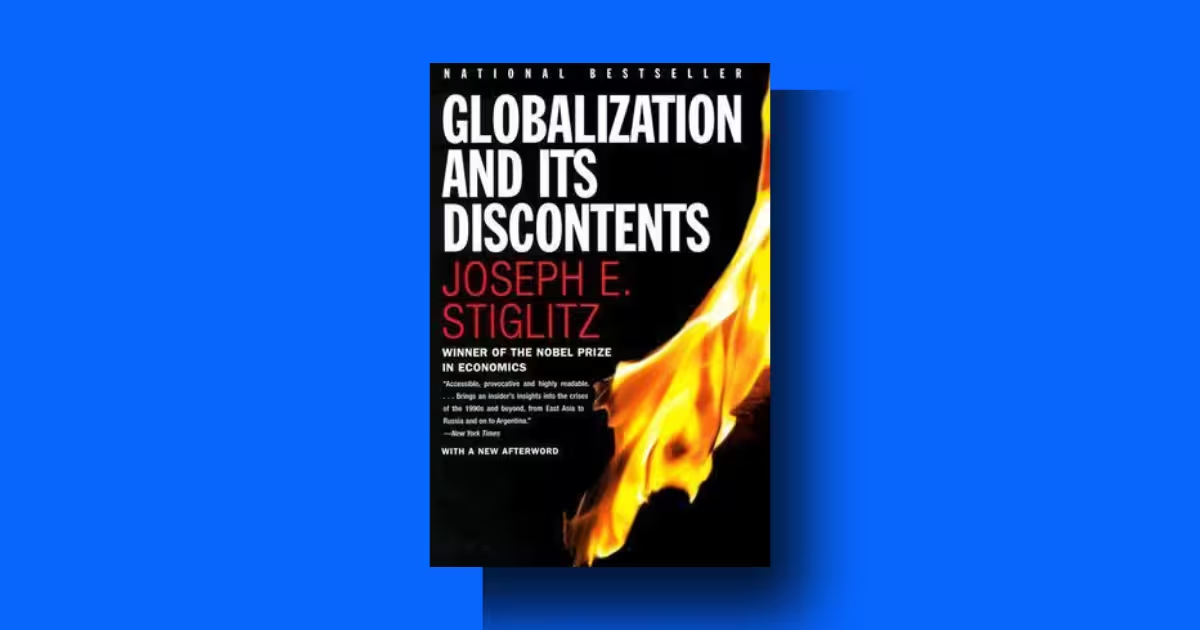
Did you ever wonder why a country can do everything the IMF tells it to do, cut its budget, sell off its state companies, open its markets overnight, and still end up poorer than when it started? I used to think that was just bad luck or bad local leadership. Then I read Joseph Stiglitz’s Globalization and Its Discontents, and I haven’t read an economics book the same way since.
Overview
Globalization and Its Discontents is Joseph Stiglitz’s 2002 account of what he saw from inside the White House and the World Bank during the 1990s: the East Asian financial crisis, Russia’s collapse into “crony capitalism” after communism, and the everyday operations of the International Monetary Fund. His argument, in short, is that globalization is not the villain.
Mismanagement is. The IMF, the World Bank, and the US Treasury pushed a rigid package of policies, rapid trade liberalization, rapid capital account opening, privatization, and austerity, onto countries that were not ready for them, with almost no regard for sequencing, local conditions, or democratic input.
The result, in country after country, was not the promised growth but deeper recessions, wrecked middle classes, and a justified backlash. This isn’t a neutral textbook. It’s a personal, sometimes angry, always well-documented case for the prosecution, written by a Nobel Prize winning economist who had a front row seat.
Reader recommendation
Globalization and Its Discontents is recommended for readers who want to understand why the IMF and World Bank are so distrusted in the developing world, why the 1997 Asian crisis and Russia’s collapse happened, and why terms like “Washington Consensus” still surface in today’s trade and debt arguments. Good for students of economics, international relations, or public policy.
Globalization and Its Discontents is not for readers wanting a balanced, two-sided textbook. Stiglitz is arguing a case, not moderating a debate, and says so openly. Pair it with a rebuttal like Bhagwati’s if you want the other side. Also not ideal for light reading; it’s dense with policy detail and a few sections drag.
Table of Contents
Introduction
Globalization and Its Discontents was written by Joseph E. Stiglitz and first published in June 2002 by W. W. Norton and Company, running 304 pages. Stiglitz is not an outside critic taking potshots from a university office.
He served on President Bill Clinton’s Council of Economic Advisers starting in 1993 and chaired it from 1995 to 1997, then moved across the street, in his own words, to become chief economist and senior vice president of the World Bank from 1997 to 2000.
A year after leaving the Bank, in 2001, he was awarded the Nobel Memorial Prize in Economic Sciences, shared with George Akerlof and Michael Spence, for his work on markets with asymmetric information. That detail matters more than it sounds like it should, because the whole argument of this book rests on it, as I’ll get to shortly.
The book’s genre is part memoir, part policy critique, part economic history. Its central claim, stated plainly in the preface and repeated throughout, is that globalization itself is neither good nor bad. It’s a tool.
What determines whether it helps or harms is how it’s managed, and Stiglitz argues that for two decades it was managed badly, in the interests of Wall Street and Washington rather than the people it was supposed to help.
Background
To understand why Globalization and Its Discontents landed the way it did in 2002, it helps to remember the moment.
The world had just watched the WTO protests in Seattle in 1999 and the G8 protests in Genoa in 2001. The Asian financial crisis was still a fresh wound, and Argentina had collapsed into economic and social chaos only months before the book’s publication.
Readers were primed for an insider account, and Stiglitz, who had just left the World Bank under pressure (a fact he alludes to but doesn’t dwell on), delivered exactly that. He wasn’t a protester with a placard. He was the man who used to sit across the table from finance ministers, and now he was telling readers what happened in that room.
Globalization and Its Discontents Summary
The Promise, and the Capture, of Global Institutions
Stiglitz opens by walking through how the IMF, the World Bank, and what eventually became the WTO were built at Bretton Woods in 1944, largely on Keynesian assumptions about the need for government to smooth out market failures and keep economies near full employment.
He traces how, over the following decades, that founding philosophy was replaced by a very different one, the “Washington Consensus,” a package of free market prescriptions that congealed among the IMF, the World Bank, and the US Treasury during the 1980s.
It was originally designed to fix specific problems in Latin America and then applied, largely unchanged, to every developing country and every post-communist economy, regardless of how different their circumstances were.
He is specific about why he thinks this happened.
The IMF’s leadership has, by informal custom, always gone to a European, the World Bank’s to an American, chosen behind closed doors with no requirement of development experience. Its senior staff cycle in and out of Wall Street.
He names Robert Rubin, Treasury Secretary through much of the period the book covers, who came from Goldman Sachs and returned to Citigroup, and Stan Fischer, the IMF’s number two, who moved directly to Citigroup after leaving the Fund. Stiglitz’s point isn’t that these are corrupt individuals. It’s that an institution staffed and led this way will, unsurprisingly, see the world through a financial community’s eyes rather than a factory worker’s or a farmer’s.
Ethiopia, and What “Conditionality” Actually Looks Like
One of the most affecting stories in Globalization and Its Discontents is Stiglitz’s account of visiting Ethiopia in March 1997, barely a month into his World Bank job.
Ethiopia’s per capita income at the time was around 110 dollars a year, and the country had endured droughts and famines that had killed roughly two million people. Its prime minister, Meles Zenawi, a former guerrilla leader who had studied economics precisely so he could rebuild his country’s economy, had actually run a fiscally responsible government with an approved budget.
Yet the IMF suspended its program anyway, largely over the government’s decision to draw down part of its own accumulated reserves rather than immediately liberalize its financial sector on the Fund’s preferred timetable. Aid from other donors, tied to IMF approval, dried up as a result. Stiglitz uses this to make a bigger point.
The conditions the IMF attaches to its loans are often not really about sound economics at all.
They’re about ideology and control, and the people who pay the price aren’t the officials arguing in Washington, but villagers who lose fuel subsidies, school fees, or health clinics.
The East Asia Crisis
This is Globalization and Its Discontents‘s centerpiece, and probably its strongest section. When the Thai baht collapsed on July 2, 1997, after a decade of trading steadily near 25 to the dollar, few people, including the IMF, saw it coming. The Fund had been forecasting strong regional growth right up until the crisis hit. The currency panic spread rapidly to Malaysia, Indonesia, South Korea, and the Philippines.
Stiglitz’s argument is not simply that the IMF failed to prevent the crisis. It’s that the IMF’s own core prescription, rapid, unregulated capital account liberalization, was a major cause of it in the first place, because it let hot money flow in and then flee out of economies whose banking systems were not remotely equipped to handle it.
He compares small developing economies to small boats pushed out into a rough sea before the holes in their hulls have been patched.
Worse, once the crisis hit, the IMF prescribed the opposite of what most economists would now recommend for a demand-driven downturn: high interest rates and tight fiscal policy, textbook responses to inflation that instead deepened the recessions in Thailand, Indonesia, and South Korea.
The bailout packages were enormous by the standards of the time, around 55 billion dollars for South Korea, 33 billion for Indonesia, and 17 billion for Thailand, and much of that money, Stiglitz argues, ended up protecting Western creditors rather than the citizens of the countries in crisis.
He includes the now-famous 1998 photograph of IMF managing director Michel Camdessus standing with arms crossed over a seated, visibly humbled President Suharto of Indonesia as he signed the Fund’s letter of intent, an image Stiglitz says reads, to much of the developing world, as an uncomfortable echo of colonial surrender ceremonies.
What makes this section land is Stiglitz’s contrast with what he calls the East Asia Miracle: decades of extraordinary, broadly shared growth achieved not through the Washington Consensus playbook but through government-directed industrial policy, gradual and sequenced trade liberalization, high savings, and heavy public investment in education, precisely the toolkit the Washington Consensus told developing countries to avoid.
Who Lost Russia
The chapter on Russia’s transition from communism is, in some ways, an even harsher indictment. Stiglitz walks through how Western advisers, many trained in the same “shock therapy” school, pushed for rapid, simultaneous price liberalization, privatization, and macroeconomic stabilization, with little attention to the legal and institutional scaffolding, courts, banking regulation, competition law, that market economies actually depend on.
The result, he argues, was not a market economy but a system of what he bluntly calls crony and mafia capitalism, in which a small group of oligarchs captured state assets through rigged privatization schemes while ordinary Russians saw their savings wiped out, their life expectancy fall, and their middle class effectively erased.
He contrasts this directly with China and Poland, which took a more gradual, sequenced path and avoided Russia’s implosion.
When the ruble finally devalued in 1998, after the IMF had spent billions defending an overvalued currency, the inflation the Fund had feared never really materialized, and the devaluation actually helped kick off Russia’s recovery.
Unfair Trade, Better Roads, and the IMF’s Incoherence
The middle chapters turn to trade policy and to the IMF’s internal logic. Stiglitz is blunt about the hypocrisy he witnessed firsthand.
The same rich countries that insisted developing nations tear down their tariffs kept billions of dollars in agricultural subsidies for their own farmers and pushed hard for global steel and aluminum cartels whenever their own industries felt threatened, while resisting liberalization in the service sectors, like construction and maritime shipping, where developing countries actually had an edge.
He also picks apart what he sees as the IMF’s incoherent theory of financial contagion and bankruptcy. If a highly leveraged firm borrows and loses money, that’s normally the lender’s problem to absorb, not a reason for taxpayers to bail out Western banks.
Yet the Fund’s programs, Stiglitz argues, repeatedly did just that, creating a textbook moral hazard problem where creditors had less reason to be careful because they expected a bailout, exactly what he says happened in the run-up to Russia’s 1998 default.
The Way Ahead
Stiglitz closes with a reform agenda rather than a call to abandon globalization altogether, which he explicitly rejects as neither feasible nor desirable.
He wants IMF “conditionality” replaced with “selectivity,” giving aid based on a country’s actual track record instead of a long checklist of politically loaded demands.
He supports large-scale debt forgiveness, crediting the Jubilee 2000 movement for building the moral and political case, and proposes new financing tools like issuing additional Special Drawing Rights to fund development without relying on the whims of rich-country budgets.
On trade, he pushes for the Doha “development round,” launched in November 2001, to actually deliver on its name, and flags the tension in intellectual property rules between rewarding pharmaceutical innovation and denying life-saving medicines, like HIV treatment, to the poor. He ends on a phrase that has stuck with the book’s legacy ever since: the goal is “globalization with a human face.”
Globalization and Its Discontents Analysis
My honest reaction is that Globalization and Its Discontents is one of the few books by a Nobel laureate that reads like a confession as much as a critique, and that combination is what gives it its force.
What sets it apart from a typical “IMF bad” polemic is the theoretical spine underneath it. Stiglitz won his Nobel for showing how markets behave when information is imperfect and asymmetric, when buyers and sellers, lenders and borrowers, don’t know the same things.
In Globalization and Its Discontents he applies that exact insight to the Washington Consensus itself.
The free market ideal, the idea that Adam Smith’s invisible hand steers markets to efficient outcomes on its own, only holds under narrow conditions that Stiglitz’s own academic work helped identify, and developing countries, with weak courts, thin capital markets, and incomplete information, are precisely where those conditions fail hardest. So when he argues that rapid liberalization backfired, he isn’t just recounting bad memories.
He’s applying the very theory that won him his prize.
Does he support the argument with evidence? Largely yes. He backs the narrative with real figures: Ethiopia’s per capita income, the specific size of the East Asian bailout packages, poverty headcounts from World Bank data showing that by 1998 close to 2.8 billion people were living on less than two dollars a day, and repeated country-by-country comparisons, Russia against China and Poland, Malaysia’s capital controls against the rest of the region’s approach.
Does it fulfill its purpose? For a general audience trying to understand why the IMF is so widely distrusted, absolutely.
It reshaped mainstream debate about development policy in a way few books by an economist manage, and its core diagnosis, that one-size-fits-all liberalization without attention to sequencing and institutions is dangerous, has aged into something close to conventional wisdom, even among IMF staff.
Strengths and Weaknesses
What I found genuinely compelling is the access.
You don’t often get a Nobel Prize winning economist telling you, in plain language, what actually happens behind the closed doors of a G7 finance ministers’ meeting, or why a photograph of a bureaucrat with crossed arms became a symbol of humiliation across the developing world. The Ethiopia chapter, in particular, stayed with me longer than any spreadsheet of GDP figures could have.
The weaknesses are real too, and worth being upfront about. Globalization and Its Discontents can feel repetitive.
The same underlying complaint, that the IMF favors financial interests over the people it claims to help, gets restated across several chapters in slightly different clothing, and more than one reader over the years has made exactly that complaint on sites like Goodreads. It’s also very much a case for the prosecution rather than a balanced hearing, and Stiglitz says as much himself.
The sharpest public pushback came from Kenneth Rogoff, the IMF’s own chief economist at the time, who published a scathing open letter to Stiglitz in 2002 dismissing his prescriptions, in Rogoff’s words, as “at best highly controversial, at worst, snake oil,” and accusing him of being certain of his own rightness to a fault.
Reasonable people still disagree about how much of that fight was substance and how much was wounded institutional pride, but it’s a genuine part of this book’s story, and any fair review has to mention it.
Comparison With Similar Works
If you want the other side of this argument stated by an equally credentialed economist, Jagdish Bhagwati’s In Defense of Globalization is the natural companion, a direct rebuttal that argues trade liberalization has lifted more people out of poverty than Stiglitz gives it credit for.
If you want a more radical version of Stiglitz’s critique, Naomi Klein’s The Shock Doctrine pushes the same who-benefits question much further, arguing that crises are sometimes deliberately exploited to push through unpopular free market policies.
Ha-Joon Chang’s Bad Samaritans and Kicking Away the Ladder make a historical case that mirrors Stiglitz’s sequencing argument almost exactly, showing that today’s rich countries protected their own industries on the way up before demanding developing nations do the opposite.
Dani Rodrik’s The Globalization Paradox covers similar academic ground with a bit more technical distance. And if you want Stiglitz’s own updated thinking, he returned to this exact territory with Globalization and Its Discontents Revisited in 2017 and Making Globalization Work in 2006.
Why Globalization and Its Discontents Still Matters Today
I’ll be honest, I didn’t expect a 2002 book to feel this current. As of March 2026, roughly 75 of 119 low- and middle-income countries tracked by the IMF and credit agencies are in or at high risk of debt distress, and global public debt has climbed past 100 trillion dollars.
At the IMF and World Bank’s own Spring Meetings this year, civil society groups and Global South finance officials were using language that could have come straight out of Stiglitz’s chapters, warning that austerity-focused lending risks deepening debt crises rather than resolving them, and describing the international financial architecture as tilted against developing nations.
Meanwhile, on the trade side, 2026 has brought a fresh round of American tariffs on dozens of trading partners and open talk of a fragmenting, de-globalizing world order, a very different flavor of discontent than the one Stiglitz described, but proof that the argument at the heart of this book, that the rules of the global economy are written by the powerful and felt most sharply by everyone else, hasn’t gone away.
If anything, it has just changed which countries are doing the complaining.
Conclusion
I’d recommend Globalization and Its Discontents to anyone who wants to understand the last quarter-century of arguments over trade, debt, and development, not because it’s the last word, but because it’s the account that set the terms of the debate everyone else has been responding to since.
It suits general readers who like their economics told through real people and real consequences rather than equations, and it rewards students and policy professionals who want the why behind terms like Washington Consensus and structural adjustment that still get thrown around in 2026’s headlines.
If you want a fully balanced, view-from-nowhere account, pair it with Bhagwati. But if you want to understand why so much of the world still doesn’t trust the institutions that run the global economy, start here.
Frequently Asked Questions
What is Globalization and Its Discontents about?
It’s Joseph Stiglitz’s 2002 firsthand account of how IMF and World Bank policy, built around rapid trade and capital market liberalization, privatization, and austerity, worsened crises in East Asia and Russia’s transition from communism instead of preventing them.
What is Stiglitz’s main argument in Globalization and Its Discontents?
That globalization itself is neither good nor bad. The harm comes from how it’s managed, specifically from international institutions applying one-size-fits-all free market policies without regard to a country’s readiness, sequencing, or democratic input.
What is the Washington Consensus?
A set of free market policy prescriptions, including trade liberalization, privatization, and fiscal austerity, that congealed among the IMF, World Bank, and US Treasury in the 1980s, originally aimed at Latin America’s problems and later applied broadly across the developing world.
Is Globalization and Its Discontents still relevant in 2026?
Yes. Debt distress across dozens of developing economies, ongoing IMF and World Bank reform debates, and a fresh wave of tariff-driven trade tension in 2026 echo the same power imbalances Stiglitz described more than two decades ago.
What did Kenneth Rogoff say about Globalization and Its Discontents?
Rogoff, then the IMF’s chief economist, published a public open letter in 2002 dismissing Stiglitz’s prescriptions in strikingly harsh terms, criticizing his tone and certainty more than rebutting each claim point by point. See the Strengths and Weaknesses section above for the exact wording.







