
Goldfinger 1964 review: what makes this Sean Connery classic still so influential, and could Goldfinger’s famous Fort Knox plan actually have worked? This review breaks down the plot, iconic Bond moments, the science behind the dirty-bomb scheme, and the surprising economic logic hidden beneath the film’s outrageous villain plan.

Does the greatest James Bond film still hold up, and would its famous Fort Knox scheme actually have worked? Sixty-two years after Guy Hamilton’s Goldfinger opened in London, most reviews still grade it on gadgets, one-liners, and the gold-painted corpse on the hotel bed. Those are fair things to grade.
But the film also hides a question that almost nobody asks: what if Auric Goldfinger was right about gold, and only wrong about the physics?
This review answers both questions. It covers the plot, the craft, and the legacy, and then runs Operation Grand Slam through a basic physics and economics check using the historical record of the 1960s gold market. The answer is stranger than the film. The bomb would have failed, but the price rise Goldfinger wanted arrived within sixteen years, with no nerve gas required.
Snapshot
Goldfinger (1964) is the third Eon Productions James Bond film, directed by Guy Hamilton, starring Sean Connery, Gert Fröbe, and Honor Blackman. It runs 110 minutes.
It built the Bond formula that every later entry copies: a pre-credits action scene, the Q-branch gadget briefing, the tricked-out Aston Martin DB5, a memorable henchman, and a pop-star title song.
It won the Academy Award for Best Sound Effects, the first Oscar for a Bond film, and holds a 99% score on Rotten Tomatoes, the highest in the series.
The unique angle: Goldfinger’s plan to irradiate Fort Knox would not have kept the gold “untouchable” for decades. The main radioactive gold isotope a nuclear blast creates has a half-life of under three days. Yet his economic bet was sound. The $35-an-ounce gold peg collapsed between 1968 and 1971, and gold reached $850 by January 1980, more than twenty times the 1964 price.
Verdict: 9/10. A near-perfect entertainment whose villain understood money better than the screenwriters understood atoms.
Table of Contents
Audience suggestion
Best for:
- Viewers new to James Bond who want the single film that defines the character on screen
- Readers interested in the history of money, the gold standard, and Cold War anxieties
- Film students studying production design (Ken Adam’s Fort Knox set) and title-sequence craft
- Anyone who enjoys a tightly plotted 1960s thriller with a sense of humour
Not for:
- Viewers who cannot tolerate the dated sexual politics of the 1960s; the barn scene between Bond and Pussy Galore has aged badly and is uncomfortable to watch today
- Those who want grounded, Daniel Craig-style realism
- Anyone expecting the plot to respect physics or chemistry
Goldfinger (1964) at a Glance
| Detail | Information |
|---|---|
| Director | Guy Hamilton |
| Producers | Harry Saltzman, Albert R. Broccoli |
| Screenplay | Richard Maibaum, Paul Dehn |
| Based on | Goldfinger (1959) by Ian Fleming |
| Cast | Sean Connery, Gert Fröbe, Honor Blackman, Shirley Eaton, Tania Mallet, Harold Sakata |
| Music | John Barry; title song sung by Shirley Bassey |
| Production design | Ken Adam |
| UK release | 17 September 1964 (London premiere) |
| US release | 22 December 1964 |
| Running time | 110 minutes |
| Budget | About $3 million |
| Box office | About $125 million worldwide (including reissues) |
| Major award | Academy Award, Best Sound Effects (Norman Wanstall) |
Goldfinger 1964 Review and Plot Summary
The Miami Card Table
The film opens with a stand-alone mission. Bond, in a wetsuit, sabotages a drug-smuggling operation in Latin America, then peels off the wetsuit to reveal a white dinner jacket underneath. A would-be assassin ambushes him in a hotel room, and Bond kills the man by knocking an electric heater into his bath. The sequence has no link to the story that follows, and that is the point: it tells the audience who Bond is before the title song begins.
After the credits, Bond is relaxing at a luxury hotel in Miami Beach. Felix Leiter of the CIA arrives with orders from M. Bond is to observe a bullion dealer named Auric Goldfinger, who is staying at the same hotel. Goldfinger is playing high-stakes gin rummy by the pool with a wealthy mark named Simmons, and he never seems to lose.
Bond finds out why. In a hotel suite overlooking the pool, Goldfinger’s employee Jill Masterson watches Simmons’s cards through binoculars and reads them to Goldfinger through a radio receiver disguised as a hearing aid. Bond interrupts Jill, takes the microphone, and forces Goldfinger to start losing, threatening to expose him to the police if he does not. It is the first of several games in the film that Goldfinger rigs and Bond turns against him.
Bond spends the evening with Jill. While he is fetching champagne, someone knocks him unconscious from behind. When he wakes, Jill is lying dead on the bed, her entire body covered in gold paint. Bond later tells M she died of “skin suffocation,” a medical idea the film invented but which many viewers took as fact for decades.
London, Golf, and a Bar of Nazi Gold
Back in London, M reprimands Bond and explains why the Bank of England cares about Goldfinger. The Bank suspects him of smuggling gold across borders to profit from price differences between countries. Over dinner, a Bank official named Colonel Smithers explains how the scheme works and hands Bond a bar of gold recovered from Nazi Germany to use as bait.
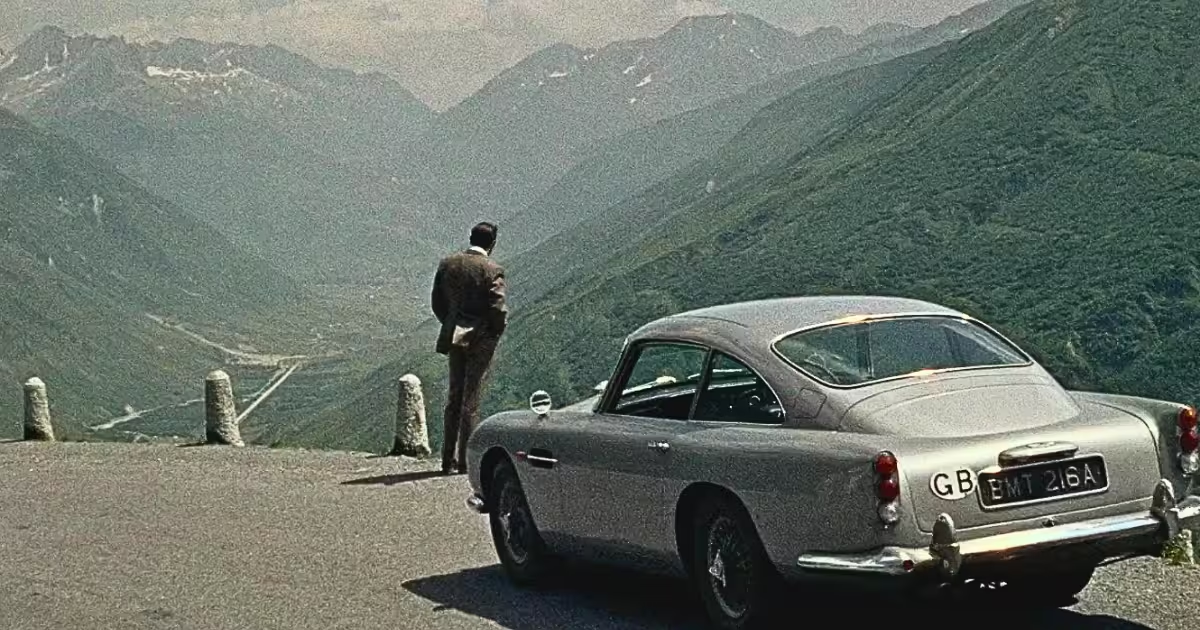
Q then briefs Bond on his new company car, a silver Aston Martin DB5. It comes with a revolving number plate, machine guns behind the indicator lights, an oil-slick sprayer, a smoke screen, tyre-shredding hubcaps, a tracking system, and a passenger ejector seat hidden under a button in the gear stick. The scene establishes the gentle friction between Bond and Q that would run through the series for decades.
Bond engineers a golf match with Goldfinger at a country club in Kent, wagering the Nazi gold bar. Goldfinger cheats, and his caddy, the mute Korean manservant Oddjob, drops a replacement ball when Goldfinger loses his own. Bond notices, and on the final hole he quietly swaps Goldfinger’s ball for one of a different number. Goldfinger plays the wrong ball, breaks the rules, and loses the match. As a warning, Oddjob decapitates a statue with his steel-rimmed bowler hat, and Bond learns what the hat can do.
The Swiss Refinery
Bond plants a homing device in Goldfinger’s Rolls-Royce Phantom III and follows it across the Channel and into Switzerland. On a mountain road, a young woman in a Ford Mustang tries to shoot Goldfinger with a rifle and misses. Bond disables her car with the DB5’s tyre shredders and learns she is Tilly Masterson, Jill’s sister, who is hunting Goldfinger for revenge.
At night, Bond sneaks into Goldfinger’s refinery. He discovers how the smuggling works: the bodywork of the Rolls-Royce is made of gold, which is melted down and recast once the car crosses a border. He also overhears Goldfinger mention “Operation Grand Slam” to a Chinese nuclear specialist named Mr. Ling.
Bond runs into Tilly again at the perimeter fence, and she trips an alarm. In the chase that follows, Bond uses the smoke screen, the oil slick, and finally the ejector seat, but Oddjob kills Tilly with his hat and Bond crashes the Aston Martin while trying to evade pursuers. He is captured.
The Laser Table
What follows is the most quoted scene in the series. Bond wakes up strapped to a table of solid gold. Above him, an industrial laser begins to cut through the metal, the beam creeping between his legs. Bond asks whether Goldfinger expects him to talk. Goldfinger’s reply is the most famous villain line in the franchise: “No, Mr. Bond, I expect you to die!”
Bond saves himself with a bluff. He tells Goldfinger that MI6 already knows about Operation Grand Slam and that another agent will simply take his place if he dies. Goldfinger cannot be certain Bond is lying, so he switches off the laser and decides Bond is more useful alive.
Pussy Galore and the Kentucky Stud Farm
Bond is sedated and wakes aboard Goldfinger’s private jet, flown by his personal pilot, Pussy Galore. She takes him to Goldfinger’s stud farm near Lexington, Kentucky, where he is held prisoner. Bond escapes his cell for a short time and hides beneath a scale model of Fort Knox to watch Goldfinger address a meeting of American Mafia bosses who have supplied him with men and materials for Operation Grand Slam.
Goldfinger lays out a plan that sounds like a robbery: gas the troops guarding Fort Knox, break into the vault, and take the gold. One gangster, Mr. Solo, refuses to take part and demands immediate payment in gold. Goldfinger agrees, and Oddjob drives Solo to the airport. On the way, Oddjob shoots him, and the car, with Solo inside, is crushed into a cube at a scrapyard. Goldfinger then kills the rest of the mobsters with nerve gas.
The Real Plan
Bond, recaptured, confronts Goldfinger over a drink. He points out that the robbery makes no sense. Fort Knox holds about $15 billion of gold, which Bond estimates would take 60 men twelve days to carry out, while the U.S. Army would arrive within hours.
Goldfinger agrees. He never intended to steal the gold. Mr. Ling has provided a small nuclear device, which Goldfinger describes as “particularly dirty,” containing cobalt and iodine. Detonated inside the vault, it will make the entire U.S. gold reserve radioactive and, Goldfinger claims, unusable for 58 years.
Gold becomes scarcer, the value of Goldfinger’s own hoard rises about tenfold, and China gains from the chaos this causes in the Western economy. The robbery was only ever a cover story for the Mafia.
Operation Grand Slam
Pussy Galore’s Flying Circus, a team of female pilots, flies over Fort Knox spraying what everyone believes is a nerve agent called Delta-9. The soldiers on the ground collapse. Goldfinger’s private army, disguised in military uniforms, blasts its way into the depository. Bond, handcuffed to the bomb inside the vault, watches the timer start counting down.
The twist is that the soldiers are only pretending. In the barn at the stud farm, Bond had won Pussy Galore over to his side, and she alerted the authorities and swapped the nerve gas for a harmless substance. The U.S. Army launches a counterattack.
Inside the vault, Goldfinger kills Ling and escapes. Bond, still handcuffed, fights Oddjob among the stacked gold bars. Oddjob throws his hat, which gets stuck between the bars of a gate. When he reaches for it, Bond touches a severed electrical cable to the metal and electrocutes him. Bond then tries and fails to disarm the bomb. An American specialist arrives and switches it off with the counter reading 007, seven seconds from detonation.
The Final Flight
Bond is invited to lunch at the White House and boards a jet to Washington. Goldfinger, in a stolen uniform, has hijacked the aircraft and forced Pussy into the cockpit. He and Bond struggle over a gold pistol, a shot shatters a window, and the explosive decompression sucks Goldfinger out of the plane.
The aircraft goes down. Bond and Pussy parachute safely into the countryside, where, true to form, Bond ignores the rescue helicopter.
Would Goldfinger‘s Fort Knox Plan Actually Work?
This is the question the film raises and never answers. Screenwriter Richard Maibaum had already fixed the biggest flaw in Ian Fleming’s 1959 novel, in which Goldfinger tries to physically steal the gold.
The film has Bond point out the impossible logistics, then replaces the heist with a radiological plan that sounded plausible in 1964. So does the new plan survive a check against physics, economics, and history?
The Physics: 58 Years Is Wrong by Several Orders of Magnitude
Natural gold consists of a single stable isotope, gold-197. When it absorbs a neutron, as it would near a nuclear detonation, it becomes gold-198. Gold-198 is radioactive, but its half-life is about 2.7 days, after which it decays into stable mercury-198. After ten half-lives, roughly four weeks, its radioactivity drops to about one thousandth of its starting level.
That is why the Foundation for Economic Education’s Nicholas Anthony concluded in 2018 that the Fort Knox gold would have been safe to handle within about a month. It also exposes an overstatement often repeated online: that the gold would “turn into mercury.” Only a small fraction of atoms would ever be activated, so the bars would remain overwhelmingly gold.
The cobalt in Goldfinger’s “dirty” device is a different matter. Cobalt-60 has a half-life of about 5.3 years, so cobalt contamination spread over the vault would be a serious, long-term hazard.
But contamination sits on and in surfaces; it does not change what gold is. Gold can be melted, refined, and recast, which is exactly what Goldfinger’s own Swiss refinery does in the film.
A costly clean-up, yes. Fifty-eight years of untouchable gold, no. The film never explains where the 58-year figure comes from, and I could not find a verified source that does.
A final physics problem sits at the heart of the plot. A nuclear detonation inside the vault would not gently irradiate the gold. It would destroy the depository and scatter much of the metal, which makes the “clean” scarcity Goldfinger wanted even less predictable.
Physics verdict: the plan fails.
The Economics: Goldfinger Understood Gold Better Than the Script Did
Here the film is more interesting than most reviewers notice. In 1964, the world ran on the Bretton Woods system. The U.S. dollar was pegged to gold at $35 per troy ounce, and foreign central banks could exchange dollars for American gold at that price. American citizens themselves were not allowed to hold gold bullion. Gold was not a free commodity; it was a fixed anchor of the global money system.
Goldfinger’s plan targets that anchor.
If most of America’s gold suddenly became unusable, the United States could not credibly promise to swap dollars for gold at $35. The peg would come under enormous pressure, the free-market price in London would jump, and anyone already holding a private hoard, like Goldfinger, would profit.
Two published critiques push back. Simon Bytheway, writing for CoinsWeekly, argues that the fixed official price makes the scheme illogical. Nicholas Anthony at FEE argues that higher prices would draw new supply from mines and jewellery, and that banks could keep using irradiated gold as a reserve, since it never has to leave the vault. Both arguments have real weight, especially for the long run.
But the historical record suggests Goldfinger’s core intuition was right, because the peg was already fragile before any villain touched it:
- In October 1960, panic buying pushed the London gold price above $40 per ounce during the U.S. presidential election campaign.
- In November 1961, the United States and seven European central banks formed the London Gold Pool to defend the $35 price by selling gold into the market together. The U.S. supplied half of the pool’s gold.
- By 1965, the pool was struggling. France withdrew in 1967, and the London gold market was shut on 15 March 1968, ending the arrangement.
- On 15 August 1971, President Richard Nixon closed the “gold window,” ending the conversion of dollars into gold for foreign governments.
- Gold reached $850 per ounce in January 1980, more than twenty-four times the 1964 price.
In other words, Goldfinger’s promised tenfold gain did arrive. It simply came from deficits, inflation, and the slow unravelling of Bretton Woods rather than from a Chinese bomb.
The film was released at the exact midpoint of the Gold Pool’s life, when the pressure on the $35 price was a live story in the financial press. Whether or not the screenwriters intended it, Goldfinger’s plan reads today as an exaggerated version of a real anxiety: that the dollar’s gold backing was thinner than it looked.
Economics verdict: the premise holds; only the method is fantasy.
The Postscript Nobody Expected
The story of Fort Knox did not end in 1964. The U.S. Mint says the depository holds about 147.3 million troy ounces of gold, roughly 56% of the Treasury’s total gold stock, according to a September 2025 Congressional Research Service report. Official visits are rare. The Mint records a September 1974 tour for journalists and members of Congress, arranged after rumours that the gold had vanished.
Those rumours never fully died. In February 2025, President Donald Trump said his administration would check that the gold was still there, and Elon Musk publicly raised the same question, while the Treasury said the gold was accounted for (reported by CNBC, CBS News, and ABC News).
By January 2026, gold had surged past $5,000 an ounce, according to CNBC. Sixty years on, the public imagination still pictures Fort Knox the way Ken Adam drew it: a gold cathedral that might, somehow, be empty or cursed.
Goldfinger Analysis: Why Goldfinger Became the Bond Blueprint
The Formula Is Born
Dr. No (1962) introduced Bond and From Russia with Love (1963) proved he could carry a serious spy thriller, but Goldfinger set the template.
Guy Hamilton, in the first of his four Bond films, pushed the series toward wit, spectacle, and gadgetry. Paul Dehn suggested a pre-credits sequence unconnected to the plot; Hamilton leaned into Q’s lab; the DB5 became a character in its own right. Almost every later Bond film, including parodies such as Austin Powers, borrows this structure.
Ken Adam’s Imaginary Fort Knox
The production was refused permission to film inside the real depository. Production designer Ken Adam flew over the site and drove around its perimeter, then imagined the interior as a towering cathedral of stacked gold.
Wikipedia’s account of the production, citing Adam’s comments to The Guardian, says he wanted to show gold stacked high as if reaching heaven. The set was so convincing that Pinewood Studios posted a round-the-clock guard to protect the prop bars.
In reality, gold would never be stacked that high because the weight would crush the lower layers, but Adam was designing for awe, not accuracy. It works.
The Villain: Greed Without Ideology
Gert Fröbe’s Goldfinger is not a SPECTRE agent, a Soviet assassin, or a would-be world ruler. He loves gold for its own sake. That makes him a purer villain than most in the series and ties him to a very old story: King Midas, whose touch turns everything, including the people he loves, into gold. Jill Masterson’s gold-painted corpse is Midas made literal. Goldfinger cannot enjoy wealth; he can only hoard it.
Fröbe spoke little English and delivered his lines phonetically and too slowly, so his voice was dubbed by the actor Michael Collins. The match is so good that most viewers never notice. The American Film Institute later ranked Auric Goldfinger among its 50 greatest screen villains.
Oddjob and the Silent Henchman
Harold Sakata, an Olympic silver medallist in weightlifting, turned Oddjob into the model for every oversized, near-wordless henchman who followed, from Jaws to Mr. Hinx. He never speaks a full line.
His menace comes from economy of movement, a smile, and that hat. According to production accounts, Sakata was burned during the electrocution scene and kept holding on until Hamilton called cut.
Pussy Galore: A Character Caught Between Two Eras
Honor Blackman was cast because of her judo skills as Cathy Gale in the television series The Avengers, and the script was rewritten to make Pussy Galore a judo expert.
She is a skilled pilot, runs her own flying team, and is initially immune to Bond’s charm. In that sense she is one of the most capable women in early Bond films. But her turn to Bond’s side happens after a scene in a barn that reads, by today’s standards, as coercion. The film undercuts her independence at the exact moment it needs her to act.
This is the single biggest reason the film has aged unevenly, and it should be named plainly rather than excused as “of its time.”
Sound and Music
Norman Wanstall’s Oscar-winning sound effects, from the hum of the laser to the crack of Oddjob’s hat, gave the film a physical punch. John Barry’s score, built around brass and the rising three-note motif of the title song, became the Bond sound.
Shirley Bassey’s “Goldfinger,” with lyrics by Leslie Bricusse and Anthony Newley, reached No. 8 on the Billboard Hot 100, and the soundtrack album hit No. 1 on the Billboard 200. From this point on, the Bond title song became an event.
Strengths and Weaknesses
Strengths
Tight structure. Each act moves to a new location with a clear goal: Miami, London, Switzerland, Kentucky, Fort Knox.
An unforgettable villain and henchman pairing. Fröbe and Sakata set the standard.
Production design. Ken Adam’s Fort Knox and the laser room remain among the most influential sets in British cinema.
Connery at his peak. He plays Bond as relaxed, amused, and dangerous in the same breath.
A smarter plan than it seems. Operation Grand Slam taps a real pressure point in the 1960s money system.
Critical standing. It holds a 99% Rotten Tomatoes score, and Roger Ebert called it his favourite Bond film.
Weaknesses
Bond is oddly passive. He spends much of the second half as a prisoner, and the U.S. Army and Pussy Galore do most of the work that stops the bomb.
Dated sexual politics. The barn scene and several throwaway lines are uncomfortable today.
Pseudo-science. “Skin suffocation” and the 58-year radiation claim are pure invention.
Ethnic stereotyping. The portrayal of the Chinese scientist Ling and the use of Oddjob as a mute servant rely on the lazy Cold War shorthand of the era.
How Goldfinger Compares to Other Bond Films and Classic Cinema
Compared with Dr. No, Goldfinger is louder, funnier, and far more confident about its own formula. Compared with From Russia with Love, it trades Cold War tension for spectacle, and fans still argue over which is the better film. Later entries such as Skyfall (2012) openly salute it by bringing the DB5 back, and Quantum of Solace (2008) echoes Jill Masterson’s death with a woman covered in crude oil.
If you want to see how Goldfinger‘s women compare with those in later Bond films, our overview of Bond girls from Ursula Andress to Léa Seydoux traces the shift across six decades. For the lines that made the series famous, including Goldfinger’s laser-table threat, see our compilation of James Bond film quotes from 1962 to 2021.
The film’s Cold War nuclear anxieties also connect it to a very different kind of cinema. Our review of Oppenheimer (2023) looks at the real science that made Goldfinger’s “dirty” bomb thinkable. And for where Goldfinger sits among the films that shaped popular cinema, see our list of the 25 best iconic films of all time.
Personal Reflection: What Goldfinger Teaches About Wealth
Watching Goldfinger again with its history in mind, I keep returning to one image, and it is not the laser or the Aston Martin. It is Goldfinger standing in his refinery, gazing at gold being poured. He does not look happy. He looks hungry. The film never shows him spending money on pleasure. He does not relax, travel for fun, or share. His entire life is about accumulating more of a metal that he will never use.
That is what makes him the most modern of the early Bond villains. Blofeld wants power, Dr. No wants revenge on the world that rejected him, but Goldfinger wants a number to go up.
He cheats at cards for money he does not need. He cheats at golf over a single bar of gold. He is willing to kill his own employee, murder a room full of allies, and set off a nuclear device in the American heartland so that the value of his pile grows tenfold. His greed is not a means to anything. It is the goal.
There is something uncomfortably familiar in that. We live in an age of fortunes measured in numbers too large to spend, where wealth often functions less as a tool than as a scoreboard.
Goldfinger belongs to that scoreboard mentality, sixty years early. The King Midas story warned that a person who turns everything into gold ends up unable to eat, drink, or embrace anyone. Jill Masterson on the hotel bed is that warning made visual: the woman who helped Goldfinger win becomes, in the end, just another gold object he owns.
What surprised me most in researching this piece was how close the film came to economic reality. I expected to write that Goldfinger’s plan was nonsense from start to finish.
The physics is nonsense. But the idea that the Western monetary system was nervously guarding its gold, and that a shock to that gold could send prices soaring, was not a fantasy at all. The London Gold Pool was fighting that battle in the very years the film was made, and it lost. When gold later climbed to $850 an ounce, a villain who had quietly bought in 1964 would have multiplied his fortune many times over without ever hiring Pussy Galore.
I find that a sobering thought. Films like Goldfinger teach us to imagine catastrophe as a single dramatic event: a bomb, a heist, a ticking clock that stops at 007. Real economic upheavals rarely look like that.
They arrive through slow pressures such as deficits, inflation, and broken promises about what money is worth. There is no James Bond to handcuff himself to those forces and stop the countdown.
I also think the film is more honest than it knows about its hero. Bond spends a large part of Goldfinger tied up, drugged, or locked in a cell. Pussy Galore’s decision to call the authorities and the U.S. Army’s counterattack save Fort Knox as much as Bond’s fists do. For all the gadgets and swagger, the world is saved because someone on the inside changes sides and ordinary institutions respond. That may be the quietest and truest lesson in the whole film.
None of this makes Goldfinger less fun. It remains a masterclass in pace, design, music, and charisma. But watching it with the history of gold in mind turns a glossy 1960s adventure into something more lasting: a portrait of greed, and a reminder that the fear behind Goldfinger’s plan was real, even if his bomb was not.
Conclusion: Is Goldfinger (1964) Worth Watching Today?
Yes. Goldfinger is the Bond film that created Bond as a cultural phenomenon, and it remains one of the most tightly built entertainments of the 1960s. Its flaws are real, especially its treatment of women and its casual stereotypes, but its craft is still easy to admire six decades later.
The film also rewards a second look. Operation Grand Slam is scientifically impossible, yet economically prophetic. The gold would not have been radioactive for 58 years, but the world’s faith in the $35 ounce did not survive the decade that followed. Goldfinger lost the battle with Bond and, in a sense, won his argument with history.
Rating: 9/10
FAQs About Goldfinger (1964)
What was Goldfinger’s plan at Fort Knox?
Goldfinger planned to detonate a small “dirty” nuclear device inside the U.S. Bullion Depository at Fort Knox. The aim was to make America’s gold radioactive and unusable, which he believed would raise the value of his own gold roughly tenfold. The robbery he described to the Mafia was only a cover story.
Would Goldfinger’s plan have worked in real life?
Not as described. The main radioactive isotope created in gold, gold-198, has a half-life of about 2.7 days, so the gold would not stay dangerous for 58 years. Cobalt contamination would last longer, but gold can be melted and refined. The economic logic, however, reflected real pressure on the $35 gold peg in the 1960s.
What happened to the price of gold after Goldfinger?
The official price stayed at $35 per ounce until the London Gold Pool collapsed in March 1968. President Nixon ended dollar-gold convertibility in August 1971, and gold reached $850 per ounce in January 1980. In January 2026, gold passed $5,000 an ounce, according to CNBC.
Can gold paint really kill you, as in Goldfinger?
No. “Skin suffocation” is fiction. Humans breathe through their lungs, not their skin. The idea became a widespread myth after the film, and the TV series MythBusters later tested the scene.
Who dubbed Goldfinger’s voice?
German actor Gert Fröbe’s lines were dubbed by the actor Michael Collins, because Fröbe spoke limited English and delivered his dialogue too slowly.
Did Goldfinger win an Oscar?
Yes. Norman Wanstall won the Academy Award for Best Sound Effects, making Goldfinger the first James Bond film to win an Oscar.
Was Goldfinger filmed inside Fort Knox?
No. Filming inside the depository was not permitted. Ken Adam designed the vault interior from his imagination and built it at Pinewood Studios in England. Some second-unit footage was shot in Kentucky.
Is Goldfinger the best James Bond film?
Many critics consider it so. It holds the highest Rotten Tomatoes score in the series (99%), Roger Ebert named it his favourite Bond film, and the critic John Brosnan wrote that it “represents the peak of the series.”
How is the Goldfinger film different from the novel?
In Ian Fleming’s 1959 novel, Goldfinger plans to steal the gold from Fort Knox and threatens Bond with a circular saw. The film changes the plan to nuclear contamination, replaces the saw with a laser, and turns Pussy Galore into a judo-trained pilot.