
Last updated on March 13th, 2026 at 10:55 am
Do you ever get that sickening feeling in the pit of your stomach that you’ve been sold a bill of goods? That the lifetime you’ve spent trying to be agreeable, helpful, and “good” has actually left you hollow, angry, and fundamentally unseen? Good Woman: A Reckoning is the book that finally gives you permission to stop begging for a seat at a table that was never designed to hold you and, instead, teaches you how to burn the whole damn thing down.
Good Woman is best for women, especially those in their “thunderous middle years” (30s to 50s), who are waking up to the fact that their compliance with social norms—being the peacekeeper, the dieter, the silent partner—has cost them their sanity and their sense of self.
It is a must-read for mothers of daughters who want to break the cycle of body-loathing and people-pleasing.
It is also essential for anyone interested in the intersection of race, gender, and body politics, specifically the unique position of Black women and mixed-race women in America.
Not for you if you are looking for light, beach-read fluff, this isn’t it. If you are deeply uncomfortable with unflinching critiques of patriarchy, white supremacy, or organized religion (specifically the concept of “God the Father”), you will likely find this book confrontational.
And if you believe that “not all men” is a sufficient response to systemic misogyny, Nolan’s laser-focused prose will probably feel like an attack rather than an education.
Table of Contents
Introduction
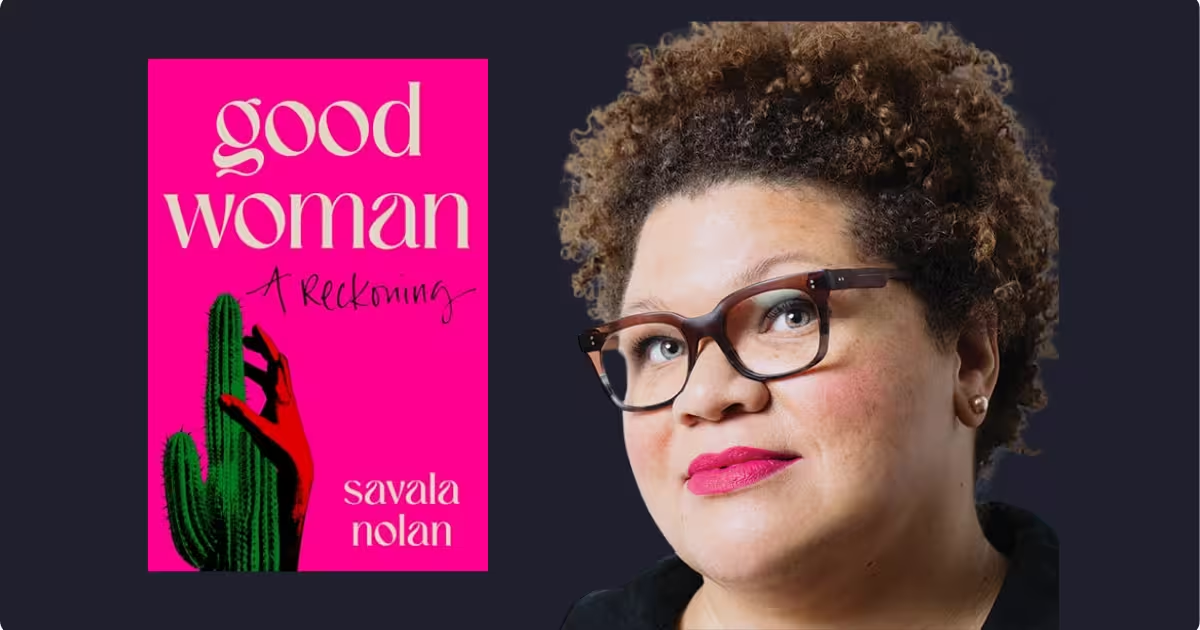
Good Woman: A Reckoning is the forthcoming (March 3, 2026) collection of essays by Savala Nolan, a writer and the Executive Director of the Thelton E. Henderson Center for Social Justice at UC Berkeley School of Law.
Following up on her acclaimed debut, Don’t Let It Get You Down, Nolan—described by Roxane Gay as “vibrant and thoughtful”—delivers a “stone cold, knock-out punch” of a book that blends memoir, cultural criticism, and historical reportage.
Across 240 pages and twelve essays, Nolan’s central thesis is an urgent and radical refusal: she refuses to be good.
She argues that the cultural conditioning of “goodness” for women—defined by agreeability, silence, and self-abnegation—is a “snake oil” that protects no one and actually prevents women from achieving true self-possession and freedom.
Background
To understand the weight of Good Woman, you have to understand the woman holding the pen. Savala Nolan isn’t just an essayist; she is a legal mind who clerked for the Sixth Circuit and worked in the Obama White House.
She is a mixed-race woman (Black, white, and Mexican) who grew up ping-ponging between elite private schools and generational poverty, a woman whose body has been both “fat and thin” under the cruel dictates of diet culture.
This is her second “reckoning.” Her first book established her as a vital voice on race and the body, but in this follow-up, she widens the aperture. She is not just recounting microaggressions; she is dissecting the very architecture of womanhood.
The book arrives at a time when the conservative tilt of national politics and the “GLP-1 gold rush” (Ozempic, etc.) are creating a fresh wave of anti-fat bias, making Nolan’s message of radical body neutrality more urgent than ever.
Good Woman Summary (Essays)
The book is structured like a spiral rather than a straight line, moving from the personal to the political and back again, weaving history through the present.
Part I: Refusal & The Divine (The Thesis)
The book opens with the gut-punch of an essay titled “Refusal.” Nolan doesn’t just state her case; she screams it from the page. “I refuse to be good,” she writes. “This is a matter of survival, not inclination or mood”.
She dissects the “thing”—that unnamed, omnipresent pressure of patriarchy that silences women and compresses them into domestic and sexual service. She follows this with “Mothers Superior,” a breathtaking theological argument where she rejects “God the Father.”
She observes that the fathers she knows leave, are emotionally absent, and fail at caretaking, whereas mothers embody the “limitless, steadfast always” of divine love. She posits that if God exists, God acts like a mother, not a father, and that motherhood is the only human behavior that mirrors the divine.
Part II: Race, Violence & The Gaze (The Body in Public)
In essays like “Wyoming” and “Which Men,” Nolan explores the terror and confusion of being a Black female body in a white supremacist world.
In “Wyoming,” she recounts a dinner where a man calls her a “porch monkey” while her white fiancé—focused on safety—ushers her out of the restaurant without confrontation. She explores the devastating emotional fallout: her desire for him to fight, the feeling of being unseen, and the complicated relationship between protection and patriarchal possession.
In “Which Men,” she dives into the statistics of sexual assault, noting that while 90% of perpetrators are men, the lines are blurred by language and conditioning.
She cites the 60% of female students who experience “unacknowledged rape,” unable to name their trauma because “a lifetime of living in sexism blocks us”.
Part III: The Recent Unpleasantness & Witness (History)
Nolan challenges the concept of linear time.
She argues that America’s racist past is not distant but breathes right next to us. She introduces Matilda McCrear, the last known survivor of the Middle Passage, who was kidnapped from West Africa in 1860 and lived until 1940—overlapping with the lives of people alive today.
Nolan then takes us on a harrowing pilgrimage to Virginia. She visits Monticello, where she stands in Sally Hemings’s 10×12 foot, windowless room and weeps, wiping her tears on the wall as an offering.
She then trespasses onto the land her own white ancestors used to enslave people, burying a letter of atonement in the dirt and—in a moment of raw, defiant catharsis—urinating on the ground to “desecrate” the memory of her slaveholding ancestors.
Part IV: Hunger & The Body (The Internal War)
In “Enfant Terrible,” Nolan traces her lifelong war with food.
She reveals that by the age of three, she had already internalized a “problem with food” and put herself on a starvation diet. She describes the generational curse of dieting with her mother, the ShapeDown program, and the college years where she subsisted on aerosol whipped cream.
This section is brutally honest about how fatness is equated with “badness” and how the quest for thinness is really a quest to be “good.” She pivots to “Lest We Die of Hunger,” where she compares the public shaming of Nicki Minaj’s Anaconda album cover to the universal acclaim of Picasso’s Les Demoiselles d‘Avignon, exposing the racist and misogynistic double standard regarding who is allowed to be hungry, sexual, and creative.
Part V: The Made World & Advice (Reconstruction)
The final sections are about building a new way of living. “The Made World” catalogs how everything—from car crash dummies to office temperatures to Siri’s inability to find abortion providers—is designed for the “Reference Man” (white, 154 lbs, Western European). “Good Advice” offers counter-intuitive wisdom on sex, money, and chivalry.
She concludes with “Girl/Woman/Other,” a meditation on aging, motherhood, and the desire to exist beyond categories, to be “invisible to men” and “beyond judgment”/
Good Woman Critical Analysis
Good Woman: A Reckoning is nothing short of a masterpiece of the contemporary essay form. It is outstanding in its intellectual range and groundbreaking in its emotional honesty. Nolan has achieved something rare: she has written a book that functions as both a scalpel and a warm embrace.
Her evaluation of content is flawless. She supports her arguments with a dizzying array of evidence: legal definitions of sexual battery in California and Italy (noting that her own assault in Italy would legally qualify), RAINN statistics showing that 1 in 6 American women have been victims of rape, and historical deeds from her family’s slave-holding past.
She effectively fulfills her stated purpose—to prove that “goodness” is a lie.
In “Which Men,” she cites a University of North Dakota study where 31.7% of men said they would “force a woman to have sexual intercourse,” compared to only 13.6% who said they would “rape” a woman, brilliantly highlighting how language shields male violence.
If there is a minor shortcoming, it is that the intensity of the prose can be almost overwhelming.
Reading Good Woman is like holding a live wire; there is very little narrative relief. Some readers might wish for a slightly longer “cool down” period in the final essay to process the emotional carnage of the previous 200 pages, though others will argue that this unrelenting pressure is precisely the point.
Strengths and Weaknesses
My Positive Experience:
What I found most compelling was Nolan’s theological argument in “Mothers Superior.” It is so simple yet so profound.
The idea that calling God “Father” is a “suspension of all lived experience” because fathers, as a cohort, are unreliable, while mothers perform the actual “godlike” work of creation and care, felt like a spiritual revelation.
Her connection of this to a specific, intimate moment—touching her newborn daughter’s head with a smear of her own menstrual blood—is one of the most tender and powerful images I have ever read.
Another strength is her ability to hold contradiction.
In “Wyoming,” she admits she wanted her fiancé to fight, even though she knows it was the safer choice to leave. She owns that “primitive” desire for male protection without apologizing for it, and then uses that desire to dissect the entire construct of femininity.
My Negative Experience:
If I have to identify a weakness, it would be in the density of the “history” sections.
While the story of Matilda McCrear is essential and needs to be shouted from the rooftops, the genealogical details of Jefferson’s family and the specific legalities of coverture, while fascinating, sometimes slow the momentum of the memoir.
However, this is a minor critique; for readers who love detail, this will be a strength.
Comparison with Similar Works
Good Woman sits on the shelf alongside the greats of feminist and Black feminist literature, yet it carves out its own unique space.
Good Woman vs. Rebecca Solnit (The Mother of All Questions): Both writers excel at the “essay as argument,” but Nolan is more visceral, more willing to put her body on the line. Where Solnit is elegant, Nolan is volcanic.
Good Woman vs. Roxane Gay (Hunger, Bad Feminist): Fans of Gay will love Nolan. They share a similar wit and an unflinching look at the body.
However, Nolan’s background in law gives her essays a sharper legal and historical edge, particularly in sections like “The Made World” where she deconstructs the legal fiction of the “reasonable man.”
Good Woman vs. Brittney Cooper (Eloquent Rage): Cooper (who blurbed this book) writes about the power of collective rage. Nolan takes that rage and applies it to the most intimate spaces—her bedroom, her marriage, her mother-daughter relationship. It’s rage applied to the domestic sphere.
Conclusion
Who should read this book? You should read this book if you are a woman who has ever felt exhausted by the mere act of existing. You should read it if you are a mother terrified of passing your own body issues down to your daughter. You should read it if you have ever looked at a history book and felt that the past is not actually past.
Good Woman: A Reckoning is not just a book; it is a manual for survival. It is suitable for general audiences with a strong stomach for truth, and it is essential reading for specialists in gender studies, critical race theory, and American history. By the time you close the cover, you will understand why Nolan dedicates this book “For daughters, especially mine”.
It is a gift to the future, wrapped in the fire of the present.