
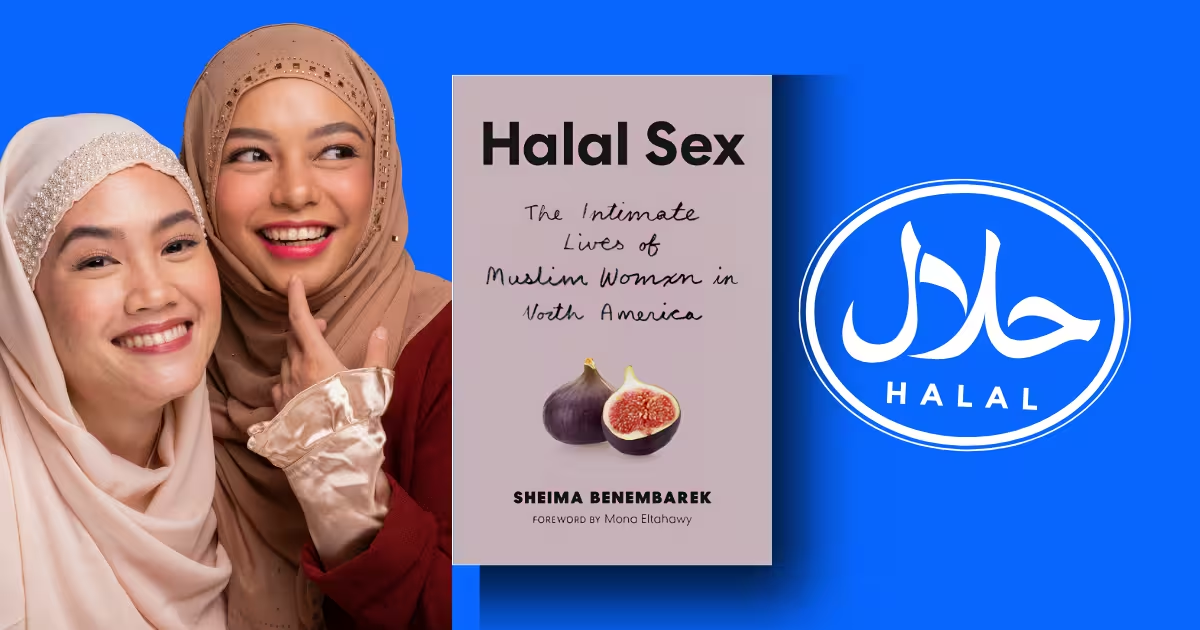

Halal Sex: The Intimate Lives of Muslim Women in North America by Sheima Benembarek is the book that finally breaks the silence. Published by Viking Canada in 2023, it follows six Muslims across Canada and the U.S. as they fight for sexual freedom without losing their faith. You will see yourself in these pages, or you will see someone you love.
Table of Contents
Brief Summary
Halal Sex: The Intimate Lives of Muslim Women in North America by Sheima Benembarek, published by Viking Canada in March 2023, is a work of narrative nonfiction that profiles six Muslim women and one nonbinary person across Canada and the United States.
Through more than 40 interviews conducted over four years, Benembarek explores how these individuals negotiate the tension between conservative Islamic teachings and their own sexual desires, orientations, and identities.
The book’s central argument is that consensual sex between adults is halal sex, and that the Muslim patriarchy, not Islam itself, has controlled women’s bodies for millennia. It combines memoir, journalism, and cultural criticism to dismantle shame, silence, and sexual illiteracy in Muslim communities.
Reader Recommendation
Who will love this book: Muslim women and gender-expansive Muslims who have ever felt alone in their struggle to reconcile faith and desire.
Anyone raised in a conservative religious household who was taught that their body was a problem to be solved. Readers of narrative nonfiction who appreciate immersive, character-driven journalism in the vein of Three Women by Lisa Taddeo. Allies who want to understand the internal diversity of Muslim communities beyond the hijab debate. Who might bounce: Readers seeking a straightforward theological treatise on Islamic jurisprudence and sexuality.
Those who prefer academic distance over intimate, first-person storytelling. Individuals who are not open to critiques of patriarchal interpretations of Islam.
Introduction
Halal Sex: The Intimate Lives of Muslim Women in North America is not a sex manual. It is a collection of lives. Published by Viking Canada, an imprint of Penguin Random House Canada, in March 2023, the book is the debut of Moroccan Canadian journalist Sheima Benembarek, who has held editorial roles at Toronto Life, The Walrus, and Broadview.
Benembarek identifies as Muslim and grew up in Morocco and Saudi Arabia before moving to Montreal at eighteen. Her background gives her privileged access to a community that is often suspicious of outsiders, and she uses that access with remarkable care.
The book’s central thesis is deceptively simple: all consensual sex between adults is halal sex. In Islam, the term halal refers to what is permissible. Traditional jurisprudence confines sexual activity to heterosexual marriage. Benembarek rejects that narrowing. “As a social construct in Islam, marriage enables heterosexual couples alone to freely participate in and enjoy sexual activity known as halal sex,” she writes. “I believe all consensual sex between adults is halal sex.” This is not a theological argument. It is a moral one, grounded in the lived experiences of the people she profiles.
The purpose of Halal Sex is to make public what has been kept private for too long. “In the Muslim community at large, the ummah, we don’t talk openly about sex enough,” Benembarek notes. “Halal Sex is meant to make public this unnecessarily hushed conversation, to help ease the burden of aloneness.” The book is an act of solidarity, a map out of isolation.
Background
Sheima Benembarek’s path to writing Halal Sex began with her own confusion. She lost her virginity at seventeen in Morocco, after calling her religious mother for permission.
She became pregnant a few years later while studying in Montreal and chose to have an abortion. When she later told her mother about it, the response was blunt: “Oh, no. You killed a soul.” Those words stung, but they also clarified something for Benembarek.
The shame she carried was not from God. It was from a community that had taught her that her body was a secret garden to be guarded, not a source of pleasure to be explored.
When she began her MFA in Creative Nonfiction at the University of King’s College, she initially planned to write a book that paired interviews with research and analysis. But she changed her mind. “I realized that writing in that way wasn’t going to be as accessible as I wanted the book to be,” she told the university.
Under the guidance of her mentor, Ayelet Tsabari, she wove in fictional elements—scene-setting, narrative arc—so that each profile reads like a short story. The result is a book that feels less like a sociological study and more like sitting across from someone who is finally telling you the truth.
Halal Sex Summary
Halal Sex profiles six individuals across six chapters, each a self-contained portrait. The book opens with Hind, a thirty-year-old Salafi niqabi living in British Columbia.
Hind wears the niqab by choice. She is also a survivor of emotional abuse, a divorced mother, a kink enthusiast, and a co-wife in a polygynous religious marriage that is illegal under Canadian law. She met her second husband, Faisal, through his first wife, Emma, an American convert. The three of them moved in together, and for a time, the arrangement worked.
Hind got to explore BDSM—light flogging, restraints, role play—with a partner who respected her desires. But the boundaries between the two wives blurred. Emma kissed Hind one day. Hind was confused. “I wasn’t disgusted by it,” she recalls. Eventually, the emotional complications became too much. Hind moved into a basement apartment with her daughter Ameena, negotiated a reduced visitation schedule with Faisal, and started building a life on her own terms.
She now teaches madrasa and runs puberty workshops for Muslim girls. “I want them to learn that Islam can be a liberating path,” she says. “And also to know where their clitoris is.”
The second chapter follows Azar, a thirty-year-old nonbinary trans person raised in a Sufi khanqah in Chicago. Azar identifies as biromantic demisexual. They grew up with a father, Bashir, who saw heterosexuality as the natural order, and a mother, Fehmeeda, who responded to Azar’s early admission of attraction to women with a dismissive “Oh, everyone does that.”
Azar’s journey toward self-acceptance was long and painful.
They struggled with an eating disorder, an abusive codependent relationship with a man named Justin, and years of depression. They found love with Dante, a straight cis man who accepted Azar’s nonbinary identity. “He phrased it as ‘Neither one of us is our partner’s ideal gender,'” Azar says. The couple reached a compromise on labels—Dante calls Azar his “wyfe”—and found a way to make their marriage work. Azar’s parents still struggle with pronouns.
Bashir continues to use she/her. Fehmeeda tries harder. “She imagines Azar as five Azars to remember to use they,” Benembarek writes.
Bunmi, twenty-two, is a Nigerian American woman who grew up in Texas and moved to a Southern state for her first job after college. She was a devout hijabi in high school. She led the Muslim Students Association. Then she went to a liberal arts college, studied abroad in Ghana, and everything changed. She stopped wearing the hijab. She stopped fasting. She started dating. She had her first kiss with a woman, Zuwena, in Ghana. She learned that she is bisexual. “I feel a more genuine connection with women,” she says. “It was like I was being me in a different way than when I’m flirting with men.”
Bunmi is still working through the shame she was raised with. She was never given “the talk.” Her mother never spoke to her about her body. “The recurring theme is shame, shame, and shame,” she says.
But she is learning to trust her own ethical compass. “I would love to have my spirituality figured out,” she tells Benembarek. “But that’s not my condition. I’m just kind of winging it.”
Eman is a Palestinian Muslim lesbian comedian who lives in New York City with her Jewish wife, Jess. The two perform as the El-Salomons, a comedy duo that has toured across North America and appeared at Just for Laughs. Eman grew up in Kuwait and Montreal. She learned early that boys could do whatever they wanted while girls were held to impossible standards. She lost her virginity at twenty-one to the Armenian Canadian boy next door.
She came out to her parents, who were devastated. They didn’t attend her wedding. “My parents weren’t at our wedding, because, God forbid, what are people gonna say?” Eman says. But they are kind to Jess. They hug her. They kiss her. They call her Eman’s sahebtak—her friend. Eman refuses to let anyone tell her she can’t be gay and Muslim. “I am a Palestinian Muslim lesbian,” she says. “I’m not going to let a bunch of ignorant people dissuade me of that.”
Taslim is a forty-three-year-old Pakistani Canadian civil servant living in Ottawa. She is a virgin. She has never had penetrative sex. She dated a man named Paul for five years. They never had intercourse. She dated Tom, a white man twenty years her senior, for five years. They moved in together.
They tried showers together. They tried oral sex. Tom performed it on her; she didn’t reciprocate. “My body obviously enjoyed it,” she says. “I don’t know mentally if I responded to it because I felt disconnected. I felt like it was happening to me.” When Taslim’s parents met Tom, they screamed at her.
Her father came back later to make sure Tom had moved out. Taslim hasn’t fully recovered. She gets panic attacks during work presentations. She has stopped seeing her parents as often. “It’s hard to be happy when you’re in a prison in your own brain,” she says.
The final chapter belongs to Khadijah, a thirty-seven-year-old sex worker and exotic dancer living on Canada’s West Coast. She was born in England to Sunni Muslim parents who immigrated to Canada when she was seven. She grew up feeling like a “bad Muslim girl” because she couldn’t memorize surahs or keep up with prayers. She learned from a private tutor named Baasim “how a proper Muslim woman should behave.” She rebelled.
She started stripping at eighteen. She became a full-service escort. She charges three thousand dollars a night. Her clients are mostly men who want to talk, who need reassurance, who are looking for someone to build them up. She has a Hindu alias, Lakshmi, because she worried that Islamophobia would cost her clients.
She has a boyfriend, Daniel, a former client who is twice her age and who cleans her apartment before her clients arrive. She was assaulted by a client two years ago. She is now studying health care so that she has options. “I want to be able to have more options in my life,” she says, “so that if something like that happens to me again, I’m not feeling like I have to go back to work.”
Halal Sex Analysis and Critique
Halal Sex is an outstanding work of narrative journalism. Benembarek’s prose is clean and unadorned. She doesn’t lecture. She doesn’t moralize. She listens, and she writes what she hears. The book fulfills its stated purpose: to make public a conversation that has been kept private for too long. It contributes meaningfully to the fields of Islamic feminism, sexuality studies, and Muslim cultural criticism.
What makes the book compelling is its refusal to flatten its subjects. Hind is a niqabi who loves BDSM. Azar is a nonbinary trans person who finds God in neuroscience. Bunmi is a bisexual woman who still fears divine punishment. Eman is a lesbian comedian who jokes about going to hell. Taslim is a virgin in her forties who doesn’t know if she’s asexual or just scared. Khadijah is a sex worker who saves starfish and studies health care.
These are not caricatures. They are people. Benembarek respects their complexity.
The book’s weakness is its scope. Benembarek interviewed more than 40 people but chose to profile only six. That’s a lot of stories left on the cutting room floor. A reader might wonder what perspectives are missing—older women, converts, disabled Muslims, trans women, queer Muslims who have left the faith entirely. The book is not exhaustive, and Benembarek doesn’t claim that it is. But the limitation is worth noting.
Another shortcoming is the lack of theological depth. Benembarek mentions Islamic feminist scholars who argue that patriarchal interpretations of the Qur’an are not divinely mandated but historically contingent. She cites the Iranian women-led uprising against the hijab mandate in the fall of 2022.
But she doesn’t engage deeply with the scriptural debates themselves. Readers looking for a rigorous theological argument for sexual liberation within Islam will need to look elsewhere. This book is not that book. It is a book about lives, not laws.
Comparison with Similar Works
Halal Sex invites comparison with Lisa Taddeo’s Three Women (2019), which also uses immersive reporting to explore female desire. But where Taddeo’s subjects are mostly white and secular, Benembarek’s are Muslim and negotiating faith.
The book also shares DNA with Mona Eltahawy’s The Seven Necessary Sins for Women and Girls (2019), which calls for a sexual revolution in the Middle East and North Africa. Eltahawy wrote the foreword to Halal Sex, and her influence is visible throughout. “To desire and be desired is political,” Eltahawy writes. “How we fuck and who we fuck is political.
Always the goal: to be free.” Benembarek takes that principle and applies it to the specific context of North American Muslim communities, where the tension between religious tradition and sexual freedom is lived daily.
Conclusion
Halal Sex: The Intimate Lives of Muslim Women in North America is an important book. It is not the final word on Muslim women’s sexuality. It is a beginning. It gives voice to people who have been told to be quiet, and it does so with dignity and care.
If you are a Muslim woman who has ever felt alone in your struggle to reconcile faith and desire, this book is for you. If you are a parent who wants to raise children who can talk to you about sex without shame, this book is for you. If you are an ally who wants to understand the internal diversity of Muslim communities, this book is for you.
The revolution begins with the self. It begins with the story. It begins with listening. Sheima Benembarek has listened well.


