
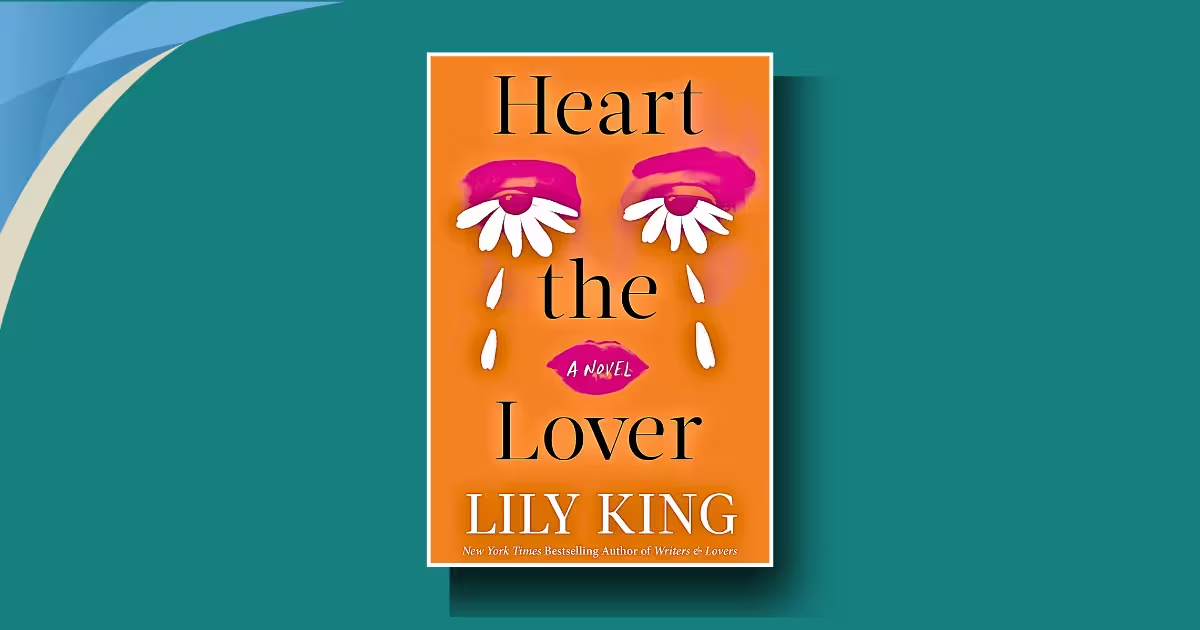
Do you ever wonder why some love stories linger in your mind long after the last page, reshaping how you see your own relationships? As someone who’s devoured countless novels about the twists of romance, I can tell you that Heart the Lover by Lily King hits that sweet spot, pulling you into the raw, messy beauty of human connection and leaving you reflecting on your own heart’s history.
Heart the Lover captures the bittersweet evolution of a passionate college romance into a lifelong haunting, showing how love’s initial spark can flicker into profound loss and self-discovery.
Heart the Lover is perfect for readers who crave introspective literary fiction with deep emotional layers, like fans of Sally Rooney or Elizabeth Strout—those who enjoy unpacking complex relationships and personal growth. It’s not for folks seeking high-stakes thrillers or light beach reads; if slow-burn character studies bore you, you might bounce early.
From the book itself, as the narrator reflects, “You knew I’d write a book about you someday. You said once that I’d dredged up the whole hit parade minus you” highlighting its appeal to those who appreciate meta-narratives on past loves.
On the flip side, if dense academic references like discussions of Cromwell and 17th-century literature feel tedious, steer clear—”He’s not focusing enough on Cromwell… and how resistance to him galvanized the imagination of this whole generation of writers” might test your patience.
Table of Contents
1. Introduction
Heart the Lover is the 2025 novel by Lily King, the acclaimed, New York Times-bestselling author of Writers & Lovers and Euphoria. Published by Grove Press, this novel marks a return to the potent emotional and intellectual terrain of young adulthood and the lasting reverberations of first love.
2. Background
While set in the recognizable world of American college life and its aftermath, Heart the Lover is less about a specific historical moment and more about the timeless, often brutal, archaeology of memory.
It examines how the relationships forged in the formative crucible of university—charged with intellectual passion, sexual awakening, and a desperate search for identity—can define the trajectories of a lifetime.
The novel’s span from the late 1980s into the 2010s allows it to trace the evolution of its characters without the crutch of nostalgia, presenting their youth with clear-eyed honesty and their maturity with unflinching gravity.
3. Heart The Love summary
PART I: COLLEGE YEARS & THE LOVE TRIANGLE
The novel is narrated by Jordan (the protagonist, whose real name is never given; she’s nicknamed “Jordan” by Yash).
In her senior year at college, she meets Sam Gallagher, a serious, intellectually intense, and devoutly religious English major. They begin a cautious, physically restrained relationship. Sam lives with his best friend Yash Thakkar in a professor’s borrowed house, nicknamed the “Breach House.”
Jordan is quickly drawn into their world of intellectual debates, card games (like “Sir Hincomb Funnibuster”), and late-night talks. She feels like an outsider to their deep academic camaraderie but is fiercely attracted to Sam’s intensity and Yash’s sharp, witty charm.
Yash, the son of an Indian immigrant father and a Southern mother, is brilliant, charismatic, and perpetually dating “daisies” but never the woman he truly likes (Lara Mertens).
Jordan and Sam’s relationship is fraught with tension due to his religious guilt about sex (stemming from a past relationship with a pious girlfriend, Valerie) and his judgmental, conservative family.
After a disastrous visit to his parents in Atlanta, they have a furious fight on the drive back, followed by their first and only instance of penetrative sex, which leaves Sam conflicted. Soon after, he coldly asks Jordan to leave the Breach House.
They reconcile briefly, but the relationship remains unstable. Meanwhile, Jordan forms a deep, platonic friendship with Yash, bonded by their shared sense of humor and a traumatic connection: they both knew Cyra, a young woman who was raped and murdered the previous summer.
Yash reveals he knew the killer.
As graduation approaches, Jordan, feeling academically adrift compared to Sam and Yash, decides to stay an extra semester to write an honors thesis in creative writing. Sam graduates and leaves for Europe. Yash, having taken a leave earlier, also has another year.
The summer after graduation, Yash unexpectedly returns to town and stays with Jordan. Their friendship ignites into a passionate, all-consuming romantic and sexual relationship. They spend an idyllic summer together in love. Yash confesses he has loved her since they first met.
PART II: SEPARATION & BETRAYAL
Their summer paradise is shattered when Sam returns. Yash tries to tell Sam about their relationship but falters, only saying he’s “thinking of” asking Jordan out. Sam is furious and forbids it, calling it a betrayal. Under this pressure, Yash wavers.
He ultimately tells Sam the truth, which causes a major rift, but Sam remains in his life.
Yash and Jordan continue their relationship secretly for the next semester, while Yash also maintains his friendship with Sam, forcing Jordan into the shadows. The strain is immense. After the semester, Jordan gets a life-changing opportunity: a job as a nanny in Paris. Yash promises to join her after he graduates.
In Paris, Jordan waits for Yash. Their communication becomes sporadic letters. He finally visits in August, and they have a magical time, even discussing moving to India together. Yash is offered a job in Paris but, after a phone call with his domineering father, changes his mind. He decides to return to the U.S., save money, and move to New York to pursue writing. Jordan agrees to join him there.
They plan to reunite in New York on January 1st. Jordan arrives at the airport, but Yash never shows. She learns from his stepmother that he drove to Atlanta to be with Sam instead. He abandons her completely, without a word. This betrayal destroys her. Jordan is left heartbroken and pregnant.
She goes to her mother’s home, gives birth to a daughter, and places her for adoption (in her thoughts, she names the baby Daisy). She rebuilds her life, becomes a successful novelist, and eventually marries a kind man named Silas. They have two sons, Harry and Jack, and build a life in Maine.
PART III: RECKONING & GOODBYE
Twenty-one years later, Yash visits Jordan and her family in Maine. The visit is strained but poignant. He gives her a book with a note inside—the Céline passage about regretting not kissing a lover properly—hinting at his lifelong regret.
The narrative jumps forward. Jordan’s son Jack is now 12 and battling recurrent brain tumors, facing a risky surgery. Out of the blue, she receives a text from Sam: Yash is dying of cancer in an Atlanta hospital.
Jordan flies to Atlanta. Yash is in the final stages of lung cancer, surrounded by family and friends, including Sam, who has been his unwavering caretaker. The hospital room is a chaotic, loving vigil. Jordan spends his last days by his side, reconnecting with his family and with a now-changed, kinder Sam.
Yash and Jordan revisit their past, laughing and arguing.
He expresses regret for how he treated her, believing she “punished” him by cutting off contact.
She confronts him about his abandonment at the airport, which he calls a moment of “freaking out.” They never achieve full reconciliation, and Jordan chooses not to tell him about the daughter they conceived and she gave up for adoption, despite her husband Silas’s belief that she should.
In his final, morphine-fueled hours, Yash has moments of clarity and delirium, once insisting he’s getting better. Jordan sings to him (a callback to how she once sang Sam to sleep), providing comfort. She stays until the end, sharing a final, tender connection.
The novel ends with Jordan leaving the hospital after Yash’s death, having said a fraught but loving goodbye.
She returns to her family in Maine, carrying the weight of their complex history, her son’s ongoing illness, and the secrets she keeps—both the one Yash took to his grave (his ultimate choice of Sam over her) and the one she kept from him (their child).
The story closes on the enduring, painful, and life-shaping power of first love and loss.
4. Heart the Lover analysis
4.1. Heart the Lover characters
The novel’s heart lives in its triad: Jordan (the narrator), Sam, and Yash. Their dynamics are the engine of the story, and their developments are rendered with exquisite, often painful, precision.
Jordan: Our narrator begins as a self-described “mere student” (Page 9) amidst the confident scholars Sam and Yash.
Her journey is one of finding her voice—intellectually, creatively, and emotionally. Initially defined by her relationships with men (the messy breakup with Jay, the intense but flawed connection with Sam), she grows into a formidable writer, wife, and mother.
Her greatest strength and flaw is her capacity for deep, enduring love, which becomes both a source of profound joy (with her family) and lifelong ache (with Yash).
Her decision to withhold the truth about their daughter, Daisy, whom she gave up for adoption, is presented not as malice but as a complex act of protection and unresolved hurt, a secret that “comes up and then goes back down” (Page 141).
Sam Gallagher: The “copper-haired” scholar, devout, intellectually rigid, and emotionally conflicted. Sam is a man wrestling with the binaries of his faith and his desire.
His relationship with Jordan is strained by his “Madonna-whore complex” (Page 34), a diagnosis even his own mother-in-law identifies. His “abstention” (Page 23) and subsequent guilt after their first sexual encounter create an insurmountable rift.
Yet, King refuses to villainize him. In Part III, he is revealed as a steadfast, devoted friend to the dying Yash, sleeping on a cot in his hospital room for a week.
He evolves from a judgmental boyfriend into a man whose love is expressed through service, highlighting the novel’s theme that love takes many, often surprising, forms.
Yash Thakkar: The charismatic, quick-witted “Rooster” with the “thick black ponytail” (Page 9). Yash is the novel’s magnetic center, the “Heart the Lover” of the card game and the title.
He is intellectually brilliant, emotionally elusive, and deeply loyal, yet crippled by an internal conflict between his expansive potential and a cautious, almost fatalistic, fear of failure.
His greatest tragedy is his inability to fully claim the life—and the love—he wants. He tells Jordan, “It just hurts a little, to feel this good” (Page 87), a line that encapsulates his self-sabotage. His abandonment of Jordan in Paris and his choice to go to Sam in Atlanta instead of New York is the central fracture of the narrative.
His late-stage cancer and death are handled with brutal realism, showing a man seeking connection and forgiveness, telling Jordan, “I’m not angry at you anymore” (Page 149), a revelation that underscores decades of mutual misunderstanding.
4.2. Heart the Lover themes
The Permanence of Youthful Love: The novel argues that first loves are not mere rehearsals; they are foundational.
The Breach House becomes the symbolic heart of this idea—a stolen, perfect world of books, heated debates, and nascent desire. Jordan reflects that the people we love in youth “don’t reenter. Pas comme ça. And no one tells you” (Page 81), a warning from Léa that haunts the entire narrative.
The love between Jordan and Yash is not undone by a lack of feeling but by a fatal misalignment of timing and courage.
Love vs. Fear: The central conflict for all characters is the battle between the risk of love and the safety of fear. Sam fears damnation and imperfection.
Yash fears the vulnerability of success and the pressure of Jordan’s total adoration, comparing himself to a hamster with “all these memories of me stuffed inside you” (Page 92).
Jordan fears rejection and, later, the nuclear impact of her long-held secret.
The Creative Life: The novel is a stark examination of the artistic journey. Jordan’s path is hard-won, through student loans, waitressing, and the transformative mentorship of Dr. Felske, who shows her “the power of fiction, the reason we make things up” (Page 70). Yash, for all his genius, never finishes his novel, a testament to the sometimes-crippling gap between intellect and execution.
The card game “Sir Hincomb Funnibuster” serves as a perfect symbol for their dynamic: a game of strategy, bluffing, and the sweet satisfaction of collecting a “full family,” a unity they never achieve in life.
Moral and Ethical Progress: A fierce debate between Jordan (the “Pollyanna”) and Yash (the pessimist) crystallizes a major theme. Yash argues human nature doesn’t improve: “Inside we are all exactly the same as we have ever been and will always be” (Page 55).
Jordan, and ultimately the novel, argues for the necessity of hope and the evidence of emotional and moral evolution, even in the face of tragedy.
5. Evaluation
1. Strengths
Lily King’s prose is, as ever, masterful. She captures the heady, awkward intimacy of college life and the weary, complex love of a long marriage with equal authenticity.
The structure is brilliant: Part I immerses us in the fever dream of the past; Part II provides the sobering, settled reality of Jordan’s life; Part III forces a wrenching reconciliation.
The emotional payoff is immense and earned. The depiction of Yash’s death and the hospital vigil is some of the most unsentimental, powerful writing about dying I’ve ever encountered.
2. Weaknesses
The novel’s middle section, while necessary for establishing Jordan’s fulfilled life with Silas, can feel slightly untethered from the intense pull of the Breach House narrative.
Some readers may find the relentless intensity of the love triangle overwhelming or question the longevity of Jordan’s obsession.
The secondary characters outside the core triad, like Ivan or Claudette, sometimes feel more like fixtures than fully realized people.
3. Impact
Heart the Lover left me emotionally winded. It’s a novel that doesn’t just describe feeling—it transmits it.
I felt the visceral thrill of Jordan and Yash’s connection, the stifling frustration of her relationship with Sam, the deep comfort of her marriage to Silas, and the profound sorrow of the ending.
Intellectually, it provokes deep reflection on roads not taken, the stories we tell ourselves to survive, and the quiet heroism of building a good life after heartbreak.
4. Comparison with Similar Works
It sits naturally alongside King’s own Writers & Lovers in its exploration of a young woman’s artistic and romantic struggles, but with a broader temporal canvas and darker emotional depths.
It shares DNA with Megan Abbott’s explorations of obsessive group dynamics and Donna Tartt’s The Secret History in its portrayal of the intoxicating, insular world of clever students. In its dissection of a lifelong love affair, it echoes the emotional resonance of Gabriel García Márquez’s Love in the Time of Cholera, though grounded in a thoroughly contemporary realism.
6. Personal Insight & Contemporary Relevance
Beyond its love story, Heart the Lover is a startlingly relevant text about navigating life-altering decisions in your early twenties—a period now extended by economic precarity and overwhelming choice.
Jordan’s mountain of student loan debt and scramble for jobs (“I am going to have to pay it all back, this paltry dabbling I’ve done,” Page 39) mirrors the anxiety of today’s graduates.
Furthermore, the harrowing depiction of Yash’s cancer and Jack’s brain tumor surgeries brings a raw, contemporary urgency to the narrative.
It highlights the terrifying intersection of love and the American healthcare system, the waitlists for specialist “procedures,” and the financial strain of chronic illness—themes explored in works like Suleika Jaouad’s Between Two Kingdoms.
The novel suggests that in a world of uncertainty, our most enduring legacies are not our published works or professional successes, but the depth and honesty of our human connections, a lesson as vital now as ever.
7. Heart the Lover quotes
- “You have no idea. Those feelings, they don’t reenter. Pas comme ça. And no one tells you.” (Page 81)
- “It just hurts a little, to feel this good.” (Page 87)
- “I think for the rest of my life the sound of cowbells will make me horny.” (Page 86)
- “He sounds like the kind of girl you divorce.” (Page 45)
- “I didn’t want to lose either one of you that fall.” (Page 146)
- “Someday we will remember even these our hardships with pleasure.” (Page 69)
8. Conclusion
Heart the Lover is a magnificent, heart-rending novel that confirms Lily King as a preeminent chronicler of the human heart.
It is a story about the love that shapes you, the love that breaks you, and the love that, quietly and steadily, allows you to rebuild. It is about the gap between who we are in our most hopeful moments and who we become in the reality of our choices.
Recommendation: I wholeheartedly recommend this to readers who love deeply character-driven literary fiction, anyone who has ever carried a “what if” from their past, and fans of authors like Ann Patchett, Colm Tóibín, or Claire Messud.
It is not for readers seeking a light, plot-driven romance or a tidy, unambiguous ending. This is a novel for those willing to sit with beauty, regret, and the glorious, messy complexity of a life fully felt.







