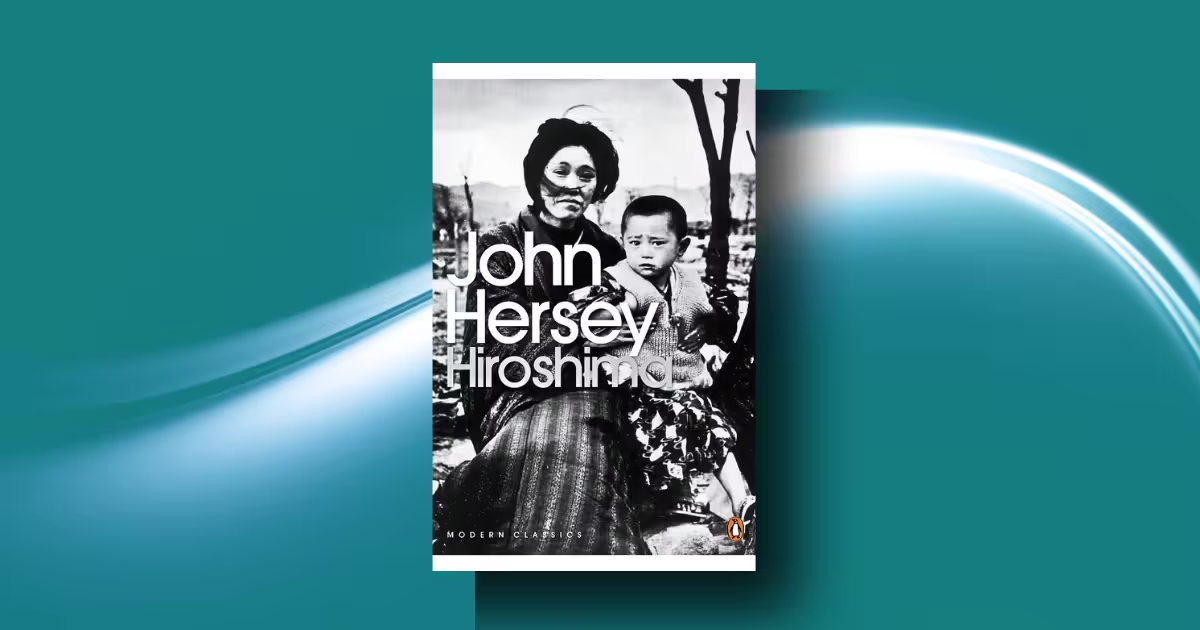

Do you ever wonder what it truly feels like to have your entire world—your home, your family, your city—vanish in a single blinding flash? John Hersey’s Hiroshima doesn’t just answer that question; it places you inside the minds and bodies of six people who lived through the unthinkable.
This isn’t a history book filled with dates and military strategies. It’s a raw, unflinching, and deeply human account of what happens when humanity unleashes its most destructive force upon itself.
Overview
Hiroshima book by John Hersey is a groundbreaking work of narrative journalism that tells the true stories of six ordinary survivors of the 1945 atomic bombing.
By focusing on their minute-by-minute experiences before, during, and after the blast, the book strips away the politics of World War II to reveal the horrific human cost of nuclear weapons and the profound resilience of those who lived through it.
The best idea in the book is that the atomic bomb did not just destroy a city; it forced ordinary people to navigate unimaginable suffering, proving that human connection and raw survival instinct can endure even the end of the world.
Reader preference
Hiroshima by John Hersey is best for readers who appreciate narrative journalism, historical accuracy, and character-driven non-fiction. But not suggested for those who prefer fast-paced action thrillers or are highly sensitive to graphic descriptions of medical trauma and mass casualties.
Table of Contents
Introduction
Hiroshima by John Hersey (Published by Alfred A. Knopf, Inc., 1946; expanded edition 1985; Penguin Books, 2019). The book originated from a 30,000-word article that appeared in the August 31, 1946, issue of The New Yorker—an issue that devoted its entire editorial space to this single piece.
Hersey, a Pulitzer Prize-winning novelist and decorated war correspondent, brought the skills of a fiction writer to the realm of journalism, creating what is now regarded as one of the earliest and most influential examples of New Journalism.
Context
Hiroshima is a work of narrative nonfiction, often classified as literary journalism or creative nonfiction. It tells the stories of six ordinary people who found themselves at the epicenter of an extraordinary catastrophe.
The author, John Hersey, was uniquely qualified to write this account.
He was born in China to missionary parents, graduated from Yale, and worked as a foreign correspondent for Time and Life magazines. He had already won the Pulitzer Prize for Fiction in 1945 for his novel A Bell for Adano.
In the spring of 1946, The New Yorker commissioned him to go to Hiroshima to report on the aftermath of the bombing.
According to the BBC, Hersey fell ill on the voyage out and was given a copy of Thornton Wilder’s The Bridge of San Luis Rey, which inspired him to focus on the stories of individual people rather than just the physical destruction of the city.
Purpose of the Book
The central purpose of Hiroshima is to make the abstract horror of the atomic bomb tangible and personal. Hersey wanted to move beyond statistics and military justifications to show the real human cost of the weapon.
The book’s thesis is that the atomic bomb was not just a military event but a profound human tragedy that shattered the lives of hundreds of thousands of individuals. As The New Yorker editors stated in their introduction to the historic issue, they published the article “in the conviction that few of us have yet comprehended the all but incredible destructive power of this weapon, and that everyone might well take time to consider the terrible implications of its use”.
Hersey’s work performed an antiwar function by acting in direct opposition to the US government’s policy of censorship, exposing the physical, psychological, and material consequences of the first-ever use of a nuclear weapon to the American public.
Historical Background of Hiroshima
On August 6, 1945, a new era in human history opened when an atomic bomb was dropped on Hiroshima.
The city had a population of 250,000 people. As a direct result of the blast and fire, some 60,000 Japanese men, women, and children were killed, and 100,000 were injured. For many months, Western readers had very little exact and reliable news about the details of the destruction.
John Hersey’s Hiroshima emerged from the immediate historical aftermath of the atomic bombing of Hiroshima on 6 August 1945, near the end of the Second World War. The bombing destroyed much of the city and caused enormous civilian casualties, while the full human consequences of the new weapon remained largely unknown to Western readers.
Public discussion initially focused mainly on the scientific achievement and the moral and political debate surrounding the atomic bomb, rather than on the personal experiences of its victims.
To document those human consequences, The New Yorker sent journalist John Hersey to Japan in May 1946. He spent a month gathering firsthand accounts from survivors and based his narrative on the experiences of six ordinary people who were in Hiroshima when the bomb exploded.
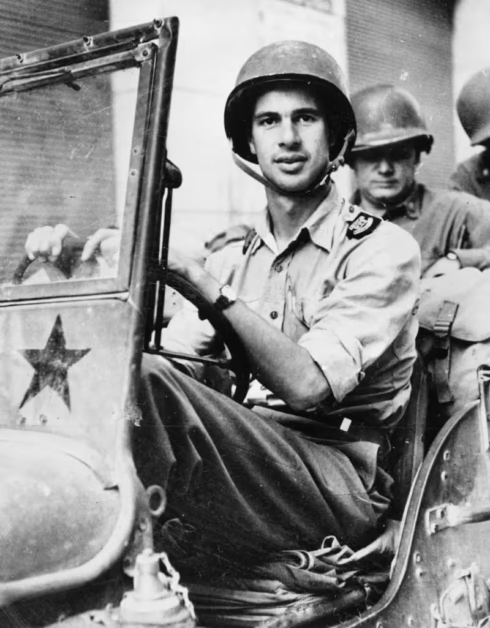
Their stories became the centre of the book, allowing Hersey to portray the bombing not as an abstract military event but as a catastrophe experienced by individual human beings.
The original account was published as a 30,000-word article in the entire 31 August 1946 issue of The New Yorker, an unprecedented editorial decision that attracted enormous public attention. It was subsequently published in book form, including by Penguin Books in November 1946. The book’s historical importance lies in its shift from discussing what the atomic bomb was to showing what it did to people.
By the spring of 1946, when Hersey arrived in Hiroshima, the city was still a wasteland of rubble and ash. He spent three weeks interviewing survivors, gathering their stories of that fateful morning. The result was a piece of journalism that would become legendary.
According to the BBC, the article “had a massive impact, revealing the full horror of nuclear weapons to the post-war generation”. It sold out in hours, was broadcast on radio, and was reprinted in newspapers across the United States.
Albert Einstein reportedly ordered a thousand copies. The book has never been out of print and has sold more than three million copies.
Hiroshima Book Summary
Hiroshima book is divided into four chapters, each representing a different phase of the survivors’ experience. An additional chapter, “The Aftermath,” was added in a 1985 expanded edition, detailing what happened to the six survivors in the four decades following the bombing.
Chapter 1: A Noiseless Flash
This opening chapter introduces the six protagonists and describes their actions in the moments just before and immediately after the bomb exploded at exactly 8:15 a.m. on August 6, 1945. They were all at different locations, ranging from 1,350 to 3,500 yards from the hypocenter, and each experienced the flash and the blast in their own way.
The six survivors are:
- Miss Toshiko Sasaki: A 20-year-old clerk in the personnel department of the East Asia Tin Works.
- Mrs. Hatsuyo Nakamura: A tailor’s widow with three young children.
- Dr. Masakazu Fujii: A prosperous physician running his own private hospital.
- Father Wilhelm Kleinsorge: A German Jesuit priest.
- Dr. Terufumi Sasaki: A young surgeon at the Red Cross Hospital (no relation to Miss Sasaki).
- The Reverend Mr. Kiyoshi Tanimoto: The pastor of the Hiroshima Methodist Church.
The chapter details the mundane, everyday activities each person was engaged in when the flash occurred. Mr. Tanimoto was helping a friend move a cabinet; Mrs. Nakamura was watching a neighbour tear down his house; Dr. Fujii was reading the newspaper on his porch; Father Kleinsorge was reading a Jesuit magazine; Dr. Sasaki was walking through the hospital corridor with a blood sample; and Miss Sasaki was sitting at her desk, about to speak to a colleague.
Then came the flash. The descriptions are chillingly precise. Hersey writes of Mr. Tanimoto: “Then a tremendous flash of light cut across the sky.
Mr. Tanimoto has a distinct recollection that it travelled from east to west, from the city toward the hills. It seemed a sheet of sun”. Mrs. Nakamura saw “everything flashed whiter than any white she had ever seen”.
The immediate aftermath was a scene of unimaginable chaos. Buildings collapsed, people were buried under rubble, and fires began to spread. The chapter ends with each survivor coming to terms with their initial injuries and beginning to navigate the hellish new reality around them.
Chapter 2: The Fire
This chapter covers the hours immediately following the explosion, focusing on the survivors’ desperate attempts to escape the fires that were rapidly consuming the city. Hersey describes the horrific injuries people sustained: “The eyebrows of some were burned off and skin hung from their faces and hands. Others, because of pain, held their arms up as if carrying something in both hands”.
He notes the strange patterns burns left on clothing: “On some undressed bodies, the burns had made patterns—of undershirt straps and suspenders and, on the skin of some women (since white repelled the heat from the bomb and dark clothes absorbed it and conducted it to the skin), the shapes of flowers they had had on their kimonos”.
The survivors made their way to Asano Park, a designated evacuation area by the river, where thousands of wounded had gathered.
The park became a refuge, but also a place of immense suffering. Hersey describes the eerie silence: “To Father Kleinsorge, an Occidental, the silence in the grove by the river, where hundreds of gruesomely wounded suffered together, was one of the most dreadful and awesome phenomena of his whole experience.
The hurt ones were quiet; no one wept, much less screamed in pain; no one complained; none of the many who died did so noisily; not even the children cried; very few people even spoke”.
The chapter also depicts the incredible acts of heroism and selflessness that emerged amidst the chaos. Mr. Tanimoto, despite his own exhaustion, ferried the wounded across the river in a boat and organized bucket brigades to fight the fires. Father Kleinsorge and other priests administered what little aid they could.
Chapter 3: Details Are Being Investigated
This chapter describes the days following the bombing, as the survivors began to learn the true extent of the disaster and the mysterious nature of the weapon that had destroyed their city.
The Japanese government, as the chapter title suggests, was initially vague about what had happened, announcing only that a “new type of bomb” had been used.
Meanwhile, the survivors grappled with the practical and emotional challenges of survival. There was a desperate shortage of medical care.
The chapter starkly illustrates this: “Of a hundred and fifty doctors in the city, sixty-five were already dead and most of the rest were wounded. Of 1,780 nurses, 1,654 were dead or too badly hurt to work”.
Dr. Sasaki, the only uninjured doctor at the Red Cross Hospital, worked for nineteen straight hours, “mechanically wiping, daubing, winding, wiping, daubing, winding”.
This chapter also introduces the concept of radiation sickness, though the survivors and doctors didn’t fully understand it at the time. Miss Sasaki, whose leg was horribly crushed, was left for days without proper medical attention.
The chapter follows her agonizing journey from the ruins of the tin factory to a makeshift hospital, where doctors debated whether to amputate her leg.
Chapter 4: Panic Grass and Feverfew
This chapter covers the weeks and months after the bombing, as the survivors began to recover physically but continued to suffer from the long-term effects of radiation.
It was during this period that the strange, capricious disease came to be known as radiation sickness manifested itself.
Mrs. Nakamura, who had survived the blast with no visible injuries, began to lose her hair in clumps. She and her daughter Myeko became extremely weak and tired. Father Kleinsorge, whose minor cuts refused to heal, developed a fever and was eventually sent to a hospital in Tokyo. Mr. Tanimoto also fell ill with fever and malaise.
Hersey provides a detailed description of the three stages of radiation sickness as understood by the Japanese doctors at the Red Cross Hospital.
The first stage was the direct reaction to the bombardment; the second stage, setting in ten to fifteen days after the bombing, included falling hair, diarrhoea, fever, and blood disorders; the third stage was the body’s struggle to compensate, often leading to complications and death.
The chapter also describes the surreal appearance of the ruined city, which was already being overtaken by new plant life: “Over everything—up through the wreckage of the city, in gutters, along the riverbanks, tangled among tiles and tin roofing, climbing on charred tree trunks—was a blanket of fresh, vivid, lush, optimistic green”.
The Aftermath (1985)
In the expanded edition published in 1985, Hersey added a fifth chapter that follows the six survivors through the next forty years of their lives.
It details their ongoing struggles with illness, poverty, and the psychological scars of the bombing. Miss Sasaki became a cripple; Mrs. Nakamura remained destitute; Father Kleinsorge struggled with health issues; Dr. Sasaki was never able to work as he once did; Dr. Fujii lost his hospital; and Mr. Tanimoto’s vitality had been sapped.
Hiroshima Book Analysis
Reading Hiroshima is a profoundly unsettling experience. Hersey’s prose is remarkably restrained and matter-of-fact, which paradoxically makes the horrors he describes even more devastating. He doesn’t sensationalize or moralize.
He simply presents the facts, allowing the reader to draw their own conclusions. This journalistic detachment, often described as “the simplicity of genius”, is what gives the book its immense power.
As one review noted, Hersey’s delivery is “limpid, seamless, quietly devastating” and can “burn one’s eyes”.
The book’s greatest strength is its focus on individual human beings.
By telling the stories of six ordinary people, Hersey forces the reader to confront the reality that the atomic bomb was not an abstract weapon but a tool of mass murder that destroyed individual lives.
This was a radical approach at the time, as the American public had largely been conditioned to view the Japanese as a faceless enemy, the “yellow peril”. Hersey humanized the enemy and, in doing so, made the immorality of the bombing impossible to ignore.
Hersey’s work is not just a historical document; it is a powerful anti-war statement. It raises profound ethical questions about the use of weapons of mass destruction and the nature of total war.
One of the German Jesuit priests in the book, Father Siemens, articulated this dilemma in a report to the Holy See: “Some of us consider the bomb in the same category as poison gas and were against its use on a civilian population.
Others were of the opinion that in total war, as carried on in Japan, there was no difference between civilians and soldiers, and that the bomb itself was an effective force tending to end the bloodshed… The crux of the matter is whether total war in its present form is justifiable, even when it serves a just purpose”.
The book also serves as a powerful corrective to the often-sanitized narratives of war. It shows that the consequences of conflict do not end when the fighting stops.
The survivors of Hiroshima carried their physical and emotional wounds for the rest of their lives. Their stories are a testament to the enduring human cost of war.
Strengths and Weaknesses
Strengths
Powerful Humanization: The book’s greatest strength is its ability to humanize a catastrophic event. By focusing on six individuals, Hersey makes the abstract horror of the atomic bomb tangible and deeply personal.
Masterful Journalism: Hersey’s prose is clear, concise, and devastatingly effective. His use of narrative techniques borrowed from fiction makes the stories incredibly compelling and immersive.
Historical Significance: As one of the earliest and most influential examples of New Journalism, Hiroshima is a landmark in the history of nonfiction writing.
Unflinching Honesty: Hersey does not shy away from the graphic and gruesome details of the bombing and its aftermath. This honesty gives the book its moral authority.
Enduring Relevance: The ethical questions raised by the book—about the use of weapons of mass destruction, the nature of total war, and the human cost of conflict—remain as relevant today as they were in 1946.
Weaknesses
Lack of Broader Historical Context: Some critics have noted that the book provides very little political or military context for the bombing. It does not delve into the decision-making process that led to the use of the bomb or the broader strategic situation in the Pacific War.
Potential for Perceived Bias: Some reviewers have pointed out a potential bias in the book, though this is a matter of interpretation. Hersey’s focus is entirely on the suffering of the Japanese victims, which could be seen as one-sided by some readers.
Limited Scope: The book focuses on just six individuals. While this is its strength, it also means that it cannot possibly represent the full range of experiences of the hundreds of thousands of people affected by the bombing.
Comparison with Similar Works
Hiroshima is often compared to other powerful personal narratives of historical tragedies. Its focus on individual human stories in the face of overwhelming catastrophe places it in the same category as:
Night by Elie Wiesel: Like Hiroshima book, Night is a deeply personal account of a historical atrocity—the Holocaust. Both books use a stark, unadorned prose style to convey the horrors their authors witnessed.
The Diary of a Young Girl by Anne Frank: This diary offers a similarly intimate and human perspective on a world-shattering event, the Holocaust, seen through the eyes of a young girl.
The Bridge of San Luis Rey by Thornton Wilder: This novel, which inspired Hersey’s approach, tells the story of five people who die in a bridge collapse in Peru.
Hersey adapted Wilder’s narrative technique of focusing on the interconnected lives of individuals to his own work of journalism.
What sets Hiroshima apart from many of these works is its immediate journalistic purpose. It was not written as a memoir years after the event but as a piece of on-the-ground reporting published just one year after the bombing. This gives it a raw, urgent quality that is unique.
Conclusion
John Hersey’s Hiroshima is more than just a book; it is a moral and historical document of incalculable importance. It is a stark and necessary reminder of the devastating human cost of war and the terrible power that humanity has unlocked.
By telling the stories of six ordinary people who lived through an extraordinary catastrophe, Hersey ensured that the victims of Hiroshima would not be forgotten as mere statistics. He gave them names, faces, and voices.
For anyone seeking to understand the true meaning of the atomic bombings, or for anyone who believes in the power of journalism to bear witness to history, Hiroshima is essential reading. It is a book that will stay with you long after you have turned the final page, a quiet but persistent voice asking you to consider the terrible implications of the world we have built.
Recommendation: This book is suitable for general audiences aged 15 and up. It is a must-read for students of history, journalism, and political science, as well as for anyone who cares about the future of humanity in a world still shadowed by nuclear weapons.