
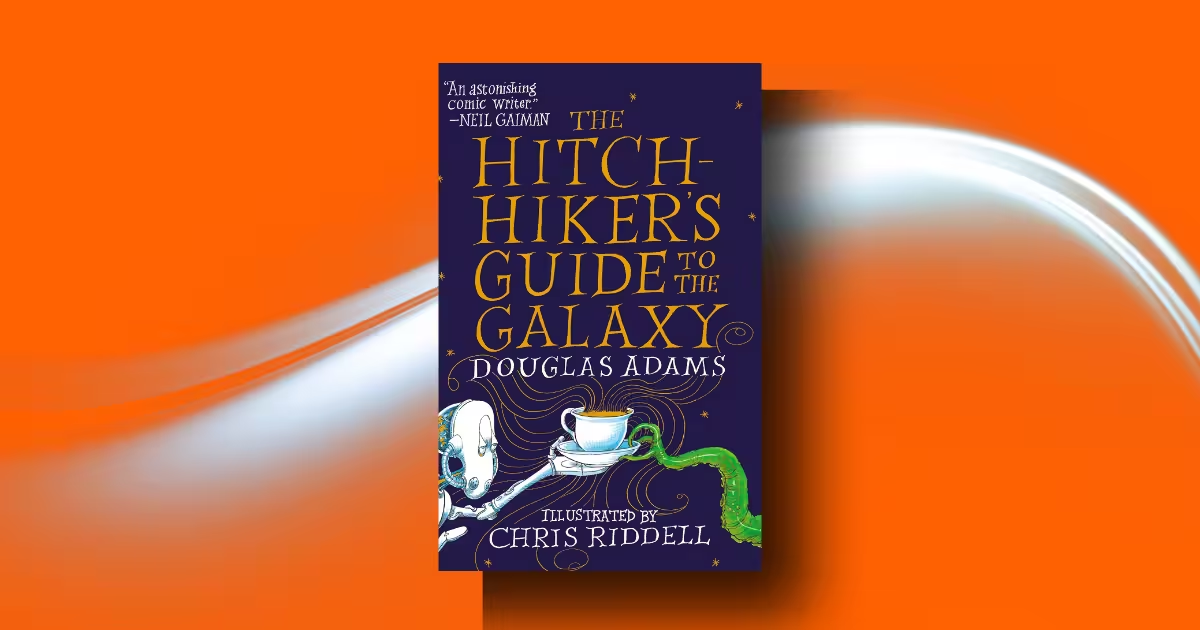

The intergalactic journey of Arthur Dent in The Hitchhiker’s Guide to the Galaxy by Douglas Adams is more than a whimsical space romp; it is a masterclass in the absurdity of existence and the relentless comedy of human (and alien) bureaucracy.
Whether you are a “hoppy” frood who always knows where your towel is or a bewildered earthling wondering why your house was just demolished for a bypass, Adams’ work remains a foundational pillar of science fiction.
The book posits that the universe is an incomprehensibly vast and chaotic place where the “Answer” is a simple number (42), but the “Question” is so complex that even a ten-million-year supercomputer project couldn’t quite figure it out.
The Hitchhiker’s Guide to the Galaxy is best for readers who enjoy dry British wit, philosophical absurdity, and stories that don’t take the end of the world too seriously. But not the best choice for those who prefer hard science fiction with rigorous logic, linear plot progression, or a lack of cynical humor.
Table of Contents
1. Introduction
Title: The Hitchhiker’s Guide to the Galaxy
Author: Douglas Adams
Publication Details: Originally a BBC radio series in 1978, the novel was first published in 1979. It has since grown into a “trilogy of five,” becoming a global cultural phenomenon.
2. Background
The book emerged during a period of rapid technological shift and cold-war anxieties. Adams blended his background in comedy (writing for Monty Python) with a fascination for science and technology.
Historically, it captures the 1970s British sense of “muddling through” amid bureaucratic incompetence—a theme that begins with a local bypass and ends with a galactic one.
3. The Hitchhiker’s Guide to the Galaxy Summary
Introduction: The Significance of Insignificance
The story begins by establishing the Earth’s place in the universe: it is an “utterly insignificant little blue-green planet” orbiting a “small unregarded yellow sun” in the “uncharted backwaters” of the galaxy.
The inhabitants of this planet are described as “amazingly primitive,” still believing that digital watches are a “pretty neat idea”. Most of the people on Earth are perpetually unhappy, and their primary attempts to solve this unhappiness revolve around the movement of “small green pieces of paper”—a pursuit the narrator finds odd, as the paper itself is never unhappy.
On one specific Thursday, a girl in Rickmansworth finally realizes how to make the world a “good and happy place,” but before she can tell anyone, a “terribly stupid catastrophe” occurs, and the idea is lost forever.
Arthur Dent and the Local Bypass
The narrative shifts to Arthur Dent, a dark-haired man in his thirties who works in local radio and is “never quite at ease with himself”.
Arthur’s personal catastrophe begins when he wakes up to find a bulldozer in his garden, intended to demolish his home to make way for a new bypass.
Arthur, hungover and wearing only slippers and a dressing gown, lies down in the mud in front of the bulldozer in a desperate attempt to stop the demolition.
Mr. L. Prosser, the council official tasked with the demolition, argues with Arthur, claiming that the plans for the bypass have been on display in the local planning office for nine months. Arthur retorts that the plans were hidden in the bottom of a “locked filing cabinet stuck in a disused lavatory with a sign on the door saying ‘Beware of the Leopard'”.
This local conflict mirrors the larger galactic bureaucracy that is about to end the world.
Ford Prefect: The Alien in Disguise
Arthur’s friend, Ford Prefect, arrives at the scene. Though he has lived on Earth for fifteen years and claimed to be from Guildford, Ford is actually an alien from a small planet in the “vicinity of Betelgeuse”.
He is a roving researcher for The Hitchhiker’s Guide to the Galaxy, a “wholly remarkable book” that is more popular than the Encyclopedia Galactica because it is cheaper and has the words “DON’T PANIC” inscribed in large, friendly letters on its cover.
Ford manages to convince Mr. Prosser to lie in the mud in Arthur’s place so that he can take Arthur to the local pub, the Horse and Groom, for a “vitally important” talk and some “muscle relaxant” (pints of bitter). In the pub, Ford reveals his true origin and warns Arthur that the world is about to end.
The Destruction of Earth
Just as Arthur realizes that the council is knocking down his house despite his absence, a Vogon Constructor Fleet arrives in the sky. The Vogons are “impossibly huge yellow somethings” that scream through the clouds.
Their leader, Prostetnic Vogon Jeltz, announces over a PA system that the Earth is to be demolished to make way for a “hyperspatial express route”.
When the people of Earth protest, the Vogon captain points out that the plans have been on display at the galactic planning office on Alpha Centauri for fifty Earth years, and if Earthlings couldn’t be bothered to take an interest in local affairs, that was their own lookout.
The Earth is then destroyed.
Hitchhiking and the Babel Fish
Ford and Arthur manage to hitch a lift onto one of the Vogon ships using an “electronic sub-etha signalling device”. They are hidden in a storage area by the Dentrassis, the ship’s cooks, who hate the Vogons and like to annoy them by helping hitchhikers.
While on the ship, Ford places a “Babel fish” in Arthur’s ear.
The Babel fish is a small, yellow, leech-like creature that feeds on brainwave energy and excretes a “telepathic matrix” into its host’s mind, allowing them to instantly understand any spoken language in the galaxy.
The Guide notes that the Babel fish’s existence is so “mindboggingly useful” that it has been used as a proof for the non-existence of God, as it is too perfect to have evolved by chance (and God refuses to provide proof of His own existence because proof denies faith) .
Vogon Poetry and Ejection
The Vogons eventually discover the hitchhikers. Vogon captain Jeltz subjects them to his poetry, which is the “third worst in the Universe”.
The experience is physically painful for Arthur and Ford, but they try to save themselves by pretending to be moved by its “metaphysical imagery”. The captain is unimpressed and orders a Vogon guard to throw them into the vacuum of space.
As they are being dragged to the airlock, Ford tries to appeal to the guard’s sense of culture by humming Beethoven’s Fifth Symphony, but the guard is only interested in his potential promotion to “Senior Shouting Officer” .
Arthur and Ford are ejected into the void.
The Heart of Gold and the Infinite Improbability Drive
Against all odds (specifically 2 to the power of 276,709 to 1 against), Arthur and Ford are rescued by the Heart of Gold, a revolutionary spaceship powered by the “Infinite Improbability Drive”.
This drive allows the ship to pass through “every conceivable point in every conceivable universe simultaneously”.
The ship has been stolen by Zaphod Beeblebrox, the “clever, imaginative, irresponsible” and two-headed President of the Galaxy. Zaphod is accompanied by Tricia McMillan (now known as Trillian), an Earth woman Arthur once met at a party in Islington, and Marvin, a “GPP” (Genuine People Personalities) robot who is “perpetually depressed” and has a “brain the size of a planet”. Marvin finds everything “terrible” and “useless”.
The Quest for Magrathea
Zaphod is searching for the legendary planet Magrathea, which used to build custom-made luxury planets for the richest beings in the galaxy five million years ago before the “Galactic economy collapsed”.
Although everyone believes Magrathea is a myth, Zaphod finds it hidden within the Horsehead Nebula.
As the Heart of Gold approaches the planet, it is attacked by ancient Magrathean automated defense systems that fire two nuclear missiles. Arthur accidentally activates the Infinite Improbability Drive, which transforms the missiles into a “very surprised-looking sperm whale” and a “bowl of petunias”.
The whale has a brief, existential moment of wonder before crashing into the planet’s surface; the petunias simply think, “Oh no, not again”.
Deep Thought and the Answer to the Great Question
While Zaphod, Ford, and Trillian explore the tunnels of Magrathea, Arthur meets an old man named Slartibartfast. Slartibartfast explains that the Magratheans are waking up from a five-million-year sleep because the economy is finally ready for them again.
He takes Arthur on a tour and reveals the true history of the Universe. Millions of years ago, a race of “hyper-intelligent pan-dimensional beings” built a supercomputer called Deep Thought to calculate the “Answer to the Ultimate Question of Life, the Universe, and Everything”.
After seven and a half million years of calculation, Deep Thought revealed the answer: 42.
When the beings complained that the answer was meaningless, Deep Thought pointed out that they had “never actually known what the question is”. Deep Thought then designed a second, even larger computer to find the Ultimate Question.
This computer was so large that it was often mistaken for a planet. It was called Earth.
The Role of the Mice
Slartibartfast reveals that the “hyper-intelligent beings” who commissioned the Earth were actually mice. Mice have been observing and running experiments on humans for millennia, not the other way around. The Earth was destroyed by the Vogons just five minutes before its ten-million-year program was to conclude.
Arthur, Ford, Zaphod, and Trillian are invited to a dinner party by Benji and Frankie, the two mice Trillian brought from Earth. The mice are tired of waiting and want to “buy” Arthur’s brain, as it is the last surviving component of the Earth’s organic computer and likely contains the Ultimate Question.
They propose removing Arthur’s brain and replacing it with an electronic one. Arthur refuses, and a chase ensues .
The Climax and Escape
The group is saved when the Galactic Police arrive to arrest Zaphod for stealing the Heart of Gold. A shootout occurs, but the police officers are suddenly incapacitated when their life-support systems fail.
It is later revealed that Marvin, the depressed robot, talked to the police ship’s computer, and his crushing pessimism caused the ship to commit suicide.
The group flees Magrathea on the Heart of Gold. As the story concludes, Zaphod is recovering with “massive Pan Galactic Gargle Blasters,” Ford and Trillian are “discussing life,” and Arthur is reading The Hitchhiker’s Guide to the Galaxy to learn more about the universe he is now forced to inhabit.
He discovers an entry stating that the history of every civilization passes through three phases: Survival, Inquiry, and Sophistication—or the “How, Why, and Where” phases.
The final phase is characterized by the question: “Where shall we have lunch?” The book ends with the ship’s intercom buzzing, as they head toward the “Restaurant at the End of the Universe”.
Analysis of the Ending
The ending of the first book serves as a perfect encapsulation of Adams’ philosophy: the “Ultimate Question” remains unknown, the “Answer” (42) is absurd, and in the face of a vast, uncaring, and bureaucratic universe, the most important thing is not finding the meaning of life, but finding a decent meal.
The destruction of Earth is treated as a minor bureaucratic error in a project run by mice, highlighting the theme of human insignificance.
The characters find no grand resolution; instead, they continue their aimless journey, armed only with an electronic book that advises them: DON’T PANIC.
4. The Hitchhiker’s Guide to the Galaxy Analysis
4.1. The Hitchhiker’s Guide to the Galaxy Characters (Full Spoilers)
Arthur Dent: The quintessential “everyman” who spends the entire book in his dressing gown. His development is less about growth and more about a desperate attempt to find a decent cup of tea in a universe that doesn’t understand the concept.
Ford Prefect: A researcher for the Guide who spent fifteen years on Earth pretending to be an out-of-work actor from Guildford. He is the pragmatic guide who understands that “Time is an illusion. Lunchtime doubly so”.
Zaphod Beeblebrox: The two-headed, three-armed President of the Galaxy who stole the Heart of Gold. He is a satire of pure political narcissism—his job is not to wield power but to distract from it.
Marvin the Paranoid Android: A robot with “a brain the size of a planet” but suffering from severe depression. He embodies the tragedy of wasted potential and the boredom of a super-intelligence in a mediocre universe.
Trillian: The only other human survivor, who left Earth with Zaphod because he had a spaceship. She provides a rare moment of grounded intelligence in a crew of lunatics.
4.2. The Hitchhiker’s Guide to the Galaxy Themes and Symbolism
The Absurdity of Bureaucracy: The destruction of Earth to make way for a hyperspace bypass mirrors Arthur’s own home being demolished for a local bypass. This suggests that incompetence is a universal constant.
The Search for Meaning: The supercomputer Deep Thought reveals that the Answer to Life, the Universe, and Everything is 42. This symbolizes the futility of seeking a simple answer when one does not even understand the question.
The Babel Fish: A small fish that translates any language when placed in the ear. Adams uses it to mock the existence of God, arguing that something so useful could not have evolved by chance, yet its existence “proves” God—and thus, by a leap of logic, God disappears in a puff of logic.
5. Evaluation
The experience of reading The Hitchhiker’s Guide to the Galaxy is groundbreaking and utterly marvelous. It manages to be both deeply cynical about human nature and incredibly uplifting in its silliness.
Strengths: The prose is sharp, the metaphors are iconic (like a ship hanging in the air “in exactly the way that bricks don’t”), and the pacing is relentless.
Weaknesses: The plot is essentially a series of vignettes tied together by the Guide’s entries, which might frustrate readers looking for a traditional narrative arc.Impact: It resonates intellectually by forcing us to laugh at our own insignificance in a “vastly hugely mind-bogglingly big” universe.
Comparison: Similar to Terry Pratchett’s Discworld in its satirical depth, or Kurt Vonnegut’s Sirens of Titan in its cosmic fatalism.
Adaptation: The 1981 TV series captured the book’s low-budget, high-concept charm, while the 2005 film (starring Martin Freeman) was a visual treat but felt somewhat “Hollywood-ized.” The 2005 film grossed approximately $104 million worldwide.
6. Personal Insight
In a contemporary context, the Guide itself is a prophetic precursor to the modern smartphone and “Answer Engines” like ChatGPT or Google.
Adams’ prediction of a device that provides (sometimes wildly inaccurate) information with “Don’t Panic” on the cover is a perfect metaphor for our current information age.
This teaches an essential educational lesson: having the answer is useless without the critical thinking skills to formulate the right question.
In an era of misinformation, the Guide’s warning that it is “frequently inaccurate” but “cheaper” than the Encyclopedia Galactica is more relevant than ever.
7. The Hitchhiker’s Guide to the Galaxy Quotes
- “Space is big. Really big. You just won’t believe how vastly hugely mindboggingly big it is”.
- “Don’t Panic”.
- “So long, and thanks for all the fish”.
- “The effect of a Pan Galactic Gargle Blaster is like having your brains smashed out by a slice of lemon wrapped round a large gold brick”.
- “I’d far rather be happy than right any day”.
8. Conclusion
Douglas Adams created a universe that is as cruel as it is hilarious. The Hitchhiker’s Guide to the Galaxy is a mandatory read for anyone who has ever felt like an alien in their own life or wondered why the universe doesn’t come with an instruction manual.
It remains significant because it reminds us that while we may be “mostly harmless,” we are also part of a grand, ridiculous adventure.