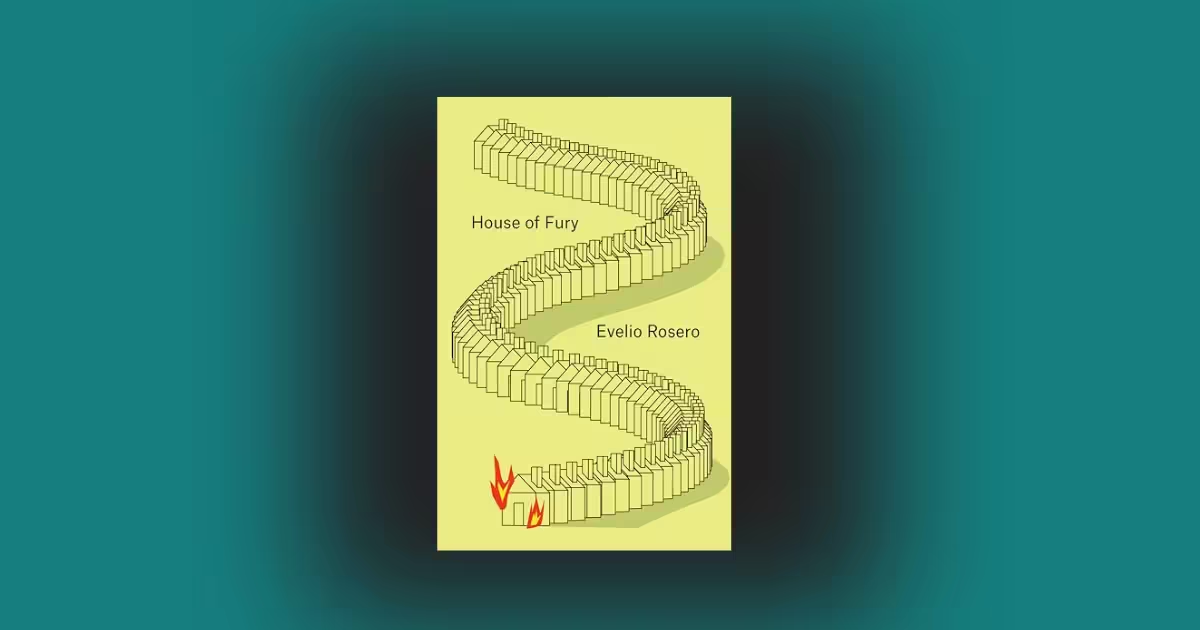

Did you ever stop to wonder why we feel a strange, morbid pull toward stories of structural decay and social collapse, even when they mirror our darkest realities? In House of Fury, Evelio Rosero doesn’t just ask that question; he forces you to live inside the answer until the walls start bleeding.
House of Fury is a hallucinatory, high-octane dissection of the Colombian elite’s moral bankruptcy, proving that when a society is built on the silence of the oppressed, the eventual noise of retribution is deafening.
House of Fury is best for readers of “visceral realism,” fans of Elena Ferrante’s grit or Gabriel García Márquez’s scope (but with a much sharper, bloodier edge), and anyone interested in the intersection of class warfare and literary horror. Not for: The faint of heart, those looking for a light “beach read,” or anyone who prefers their social critiques to be subtle and polite.
Table of Contents
1. Introduction
House of Fury (originally published as Casa de furia in 2021) is the latest masterpiece by the legendary Colombian novelist Evelio Rosero, brought into hauntingly sharp English in 2025 by translator Victor Meadowcroft and published by New Directions.
Set against the backdrop of a single, fateful day in 1970s Bogotá, the novel serves as both a family saga and a brutal autopsy of a nation. Rosero, already celebrated for The Armies, continues his streak of writing fiction that feels less like a story and more like a physical reckoning with history.
2. Background
To understand House of Fury, one must understand the “National Front” era in Colombia. By 1970, the country was emerging from La Violencia, but the social stratification remained suffocating.
The book captures a moment where the “old money” aristocracy—represented by the Caicedos—believed they were untouchable behind their high walls, while the seeds of modern guerrilla warfare and narco-violence were already germinating in the streets.
Statistically, this era saw a 40% increase in urban migration due to rural displacement, a tension that Rosero captures perfectly in the friction between the mansion’s masters and its servants.
3. House of Fury Summary
In Evelio Rosero’s House of Fury, a celebratory milestone for a high-society family in 1970s Bogotá devolves into a grotesque, hallucinatory massacre.
The novel, translated by Victor Meadowcroft, uses a single day—Friday, April 10, 1970—to weave a dense tapestry of class resentment, personal betrayal, and the cyclical nature of Colombian violence.
The Morning of the Anniversary
The story begins at the opulent mansion of Magistrate Nacho Caicedo and his wife, Alma Santacruz, who are preparing to celebrate their wedding anniversary with a monumental party.
The morning is marked by two omens: the news that the Beatles have broken up and the unexpected arrival of Uncle Jesús, Alma’s black-sheep brother. Jesús is a “hustler” who lives off “family honorariums,” and his presence always triggers panic in Alma.
As the family prepares, a scandal breaks: Italia, the fifth daughter, confesses to her parents that she is pregnant.
This revelation disrupts the curated image of the “perfect” family, which includes six daughters named after the places they were conceived—Francia, Lisboa, Armenia, Palmira, and Italia—with the youngest, Uriela, spared a geographic name only because of a religious vision.
Beneath the Surface: Resentment and Lust
Rosero populates the house with a vast array of characters, each carrying their own “fury.” In the kitchen, the staff is overwhelmed by the demands of the party. Among them is Lucio Rosas, the one-eyed gardener who harbor a secret guilt involving a past death. When Uncle Jesús mocks Lucio’s injury, claiming it was “destiny” to settle a debt, the tension between the classes becomes palpable.
Simultaneously, romantic entanglements and rivalries simmer:
Francia and Rodolfito: Francia, the eldest, secretly plans to change her name to distance herself from her father’s eccentricities. Her fiancé, Rodolfito Cortés, arrives but is intercepted by the “mad” Cousin Ike, who is obsessed with Francia. Ike eventually locks Rodolfito in a heavy trunk and, taking advantage of the darkness, takes Rodolfito’s place in Francia’s bed.
Iris and Marino: Iris, the young errand girl, and Marino Ojeda, the street guard, share a burgeoning romance. Their innocent flirtation stands in contrast to the predatory lust of the guests, such as Cousin César, who corners Iris in the library.
The Descent into Chaos
As night falls, the party transforms from a social event into a “house of fury”. A group of assassins, led by the vengeful Nimio Cadena and a ruthless woman known as “Blondie,” infiltrates the mansion. They are not mere robbers; they are “mystics of pain and blood” seeking a “ridiculous score” against the magistrate.
The violence is systematic and surreal:
The Massacre: Guests and staff are slaughtered with “proficiency in the art of raising and burying knives”. The musicians, the Malaspulgas, continue to play until they, too, are killed. The dining room becomes a charnel house where “rivers of blood ran”.
The Deaths of the Protagonists: Marino and Iris are killed and hidden—Marino under a car and Iris beneath an inflatable pool. Charrita Luz, a singer, is strangled under the stage while guests dance above her.
The Fate of the Magistrate: Magistrate Caicedo, having left the house to retrieve a daughter, is captured by Nimio Cadena and held in a greasy warehouse. He is forced to confront the consequences of his legal “maneuverings,” specifically his role in expropriating indigenous lands for the church.
The Ending Explained: The Final Stand
The novel’s climax occurs on the second floor of the mansion. Alma Santacruz, unaware that her husband has already been captured or killed, waits in her bedroom with a revolver. When Nimio Cadena enters to mock her with news of the magistrate’s demise, a final confrontation ensues.
Alma manages to fire the gun, hitting Nimio “right between his eyebrows”. However, she is immediately swarmed by his henchmen and killed by a knife to the chest. The two leaders—the high-society lady and the assassin—die “curled up on the floor, facing each other… as if on the verge of embracing”.
The book ends with Uriela, the “illuminated flower” of the family. Throughout the carnage, she has been in a trance-like state, oscillating between life and death. In the final pages, she experiences a vision of the dead—her parents among them—departing into another space.
Left alone in the “half glow of dawn,” she believes she is returning to herself, only to be overwhelmed by a “rain of eyes and ears, of arms and legs”.
This “third stomp in the depths” signals that the tragedy is not an ending, but a beginning—a permanent state of being for a house and a country consumed by fury.
4. House of Fury Analysis
4.1. House of Fury Characters
The characters in House of Fury aren’t just people; they are symptoms.
- Magistrate Nacho Caicedo: He is the “Law” that has failed. His complexity lies in his outward refinement versus his internal rot. As the text notes: “He was a man of the law who knew exactly how to bend it until it snapped in favor of the highest bidder.” He represents the judicial corruption that allowed land-grabbing to become a national sport.
- Alma Santacruz: The matriarch who lives in a state of curated denial. Her relationship with her brother, the “scoundrel” Uncle Jesús, reveals the fragility of family honor.
- The Daughters: Named after the cities of their conception (Francia, Italia, etc.), they represent the elite’s obsession with Eurocentric “culture” while they remain oblivious to the Colombian soil beneath their feet.
- The Assassins (Nimio and “Blondie”): These aren’t caricatures; they are the “furies” of the title. Their motivation is a terrifyingly logical response to decades of being treated as invisible.
4.2. House of Fury Themes and Symbolism
The mansion itself is the primary symbol. It is a “House of Fury” because it contains a century of repressed anger.
The “Rain of Limbs”: In the final sequences, Rosero uses a surrealist image of body parts falling like rain. This symbolizes the fragmentation of the Colombian identity—where the “body politic” has been literally and figuratively dismembered by partisan violence.
Class Performativity: The party is a performance. The servants are required to be “shadows,” but by the end, the shadows become the executioners. Similarly, the “Beetles breaking up” is mentioned early on, symbolizing the end of a global era of hope, mirrored by the localized end of the Caicedo dynasty.
5. Evaluation
House of Fury is an important, poignant, and frankly terrifying work that cements Rosero as the most vital voice in contemporary Latin American letters. It feels like a punch to the solar plexus that stays with you long after the final page is turned.
- Strengths: Rosero’s prose is incredibly vivid. He has this uncanny ability to describe a gourmet meal and a massacre with the same sensory precision. The transition from a social comedy to a slasher film is handled with masterclass pacing.
- Weaknesses: Some readers might find the sheer number of characters (the “Malaspulgas” band, the various cousins, the staff) overwhelming. At times, the “grotesque” elements push the boundaries of what is digestible, but that is clearly the author’s intent.
- Impact: Intellectually, it forced me to reconsider the “comfort” of historical fiction. Emotionally, it left me with a profound sense of the “cyclical” nature of grief.
Comparison with Similar Works:
Think of it as A Hundred Years of Solitude meets Parasite. It shares the “house-as-microcosm” energy of Isabel Allende’s The House of the Spirits, but strips away the romanticism, replacing it with the grit of Roberto Bolaño.
6. Personal Insight: The Price of the “High Wall”
In today’s climate of increasing global wealth inequality, House of Fury feels more like a warning than a history lesson. When we look at contemporary statistics—where the richest 1% own nearly half of the world’s wealth—the “mansion” in the book becomes a metaphor for our gated communities and digital echo chambers.
The educational takeaway here is about social empathy. The book shows that when we ignore the “fury” of the marginalized, it doesn’t disappear; it just waits.
The “lesson” of Rosero is that justice is not a luxury, but a structural necessity for survival.
7. House of Fury Quotes
“The house did not just contain the party; it contained the silence of everyone who had died to pay for the chandelier.”
“They danced as if the music could drown out the sound of the world ending outside the front gate.”
“In the end, we are all just meat and memory, and the memory is the first thing to rot.”
8. Conclusion
House of Fury is a monumental achievement. It is a book that demands to be read, not because it is “pleasant,” but because it is true. It exposes the “banality of evil” within the upper classes and gives a voice to the explosive rage of the disenfranchised.
Recommendation: Essential reading for fans of world literature, political thrillers, and dark historical fiction. If you want to understand the “soul” of modern Colombia—beyond the tropes of narco-trafficking—this is the book you need.