
Do you ever catch yourself believing something simply because everyone around you believes it, without ever questioning why you hold that belief in the first place? What if the very foundations of your morality, your religion, and your most cherished convictions were built on nothing more than historical accidents and psychological self-deception? Friedrich Nietzsche’s Human, All Too Human doesn’t just ask these questions, it systematically dismantles the comforting illusions we use to navigate life, and in doing so, offers a path toward a more honest, freer way of existing.
Table of Contents
Overview
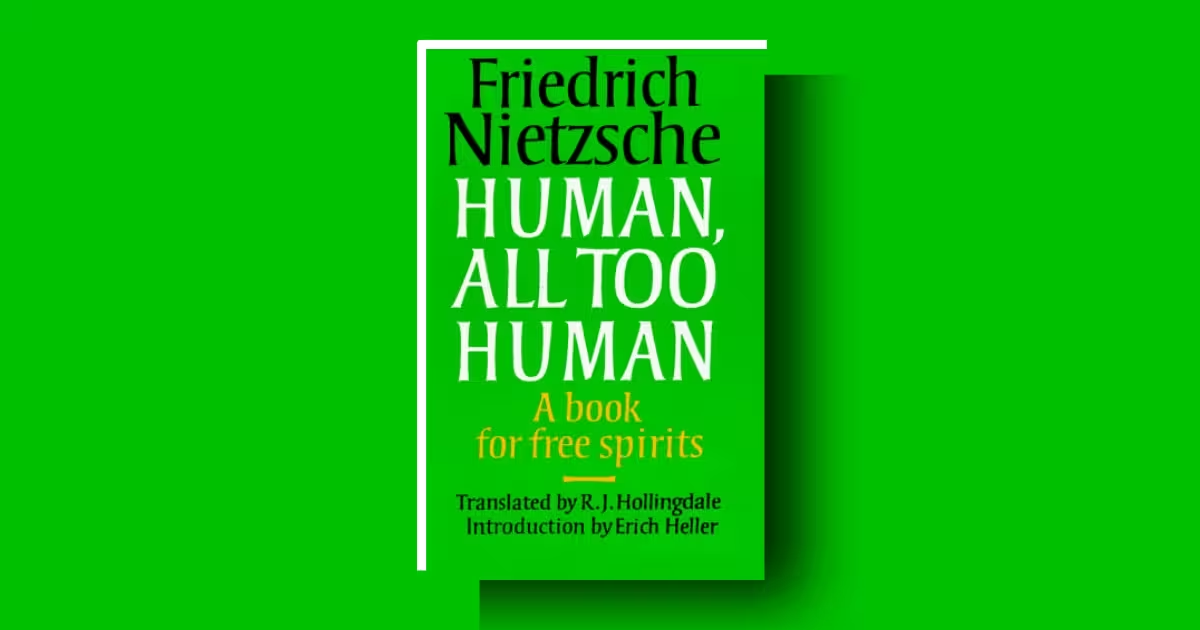
Human, All Too Human: A Book for Free Spirits (1878) marks a radical turning point in Friedrich Nietzsche’s philosophical development. Written after his painful break with Richard Wagner and his departure from academic life due to deteriorating health, this work represents Nietzsche’s first major foray into the aphoristic style that would define his later masterpieces.
The book is essentially a 638-aphorism-long argument for a “chemistry of moral, religious, and aesthetic ideas”—a scientific, historical, and psychological examination of how human values, beliefs, and feelings actually originate. Nietzsche argues that what we call “good” and “evil,” “truth” and “error,” are not eternal verities but products of human evolution, error, and self-interest.
Nietzsche dedicated the original edition “to the memory of Voltaire on the celebration of the anniversary of his death, May 30, 1778”, a deliberate declaration of allegiance to the Enlightenment spirit of critical reason and a repudiation of the Romanticism he had previously embraced alongside Wagner.
Reader recommendation
Human, All Too Human is recommended to:
- Readers who want an accessible entry point into Nietzsche’s philosophy
- Those who enjoy thought-provoking, bite-sized philosophical reflections
- Anyone questioning inherited moral, religious, or cultural assumptions
- Readers interested in the psychology behind human beliefs and behaviors
- People who appreciate dense, quotable writing that rewards slow reading
Human, All Too Human is not recommended to:
- Readers seeking a systematic philosophical treatise with clear conclusions
- Those who prefer narrative-driven or emotionally comforting philosophy
- Anyone looking for a quick, easy read, this book demands active engagement
- Readers who want a definitive moral system or clear “answers”
- Those easily offended by critiques of religion, morality, or traditional values
Introduction
Title and Author Information
Title: Human, All Too Human: A Book for Free Spirits (German: Menschliches, Allzumenschliches: Ein Buch für freie Geister)
Author: Friedrich Wilhelm Nietzsche (1844–1900)
Publication Details: First published in April 1878 by Ernst Schmeitzner. A second part, Assorted Opinions and Maxims, followed in 1879, and a third part, The Wanderer and His Shadow, in 1880. Nietzsche republished all three parts as a two-volume edition in 1886. The first English translation appeared in 1908.
Nietzsche was a German philosopher, classical philologist, and cultural critic who, at the age of 24, became the youngest professor of classical philology at the University of Basel. His health deteriorated after contracting diphtheria and dysentery while serving as a medical corpsman during the Franco-Prussian War in 1870, and he was forced to retire from his academic post by 1874.
Despite living on a small university pension and battling chronic illness, he produced an extraordinary body of work that would profoundly influence 20th-century philosophy, psychology, literature, and cultural criticism.
Context of Human, All Too Human
Human, All Too Human emerged from a period of profound personal and intellectual crisis in Nietzsche’s life. In 1876, he broke with Richard Wagner, the composer who had been his mentor, friend, and artistic idol. The split was devastating; Nietzsche had essentially built his earlier philosophical identity around Wagner’s vision of art as a redemptive, life-affirming force. The disillusionment forced him to fundamentally re-examine his entire worldview.
Simultaneously, Nietzsche’s health was deteriorating to the point that he could no longer continue his academic career. He found himself isolated, physically broken, and intellectually adrift.
Yet from this crisis emerged what many scholars consider the true beginning of his mature philosophy. As Nietzsche himself later reflected, “Human, All Too Human is the monument of a crisis”, the document of a man who had lost everything and was forced to rebuild his thinking from the ground up.
The book’s dedication to Voltaire is significant. Voltaire represented everything Nietzsche now valued: intellectual courage, wit, critical reason, and a relentless war against superstition and dogma. By aligning himself with the Enlightenment tradition, Nietzsche was explicitly rejecting the Romanticism, German nationalism, and metaphysical yearnings that had characterized his earlier work.
Purpose of Human, All Too Human
The pivotal argument of Human, All Too Human is that our highest values—morality, religion, art, truth itself—are not eternal truths discovered by pure reason, but human creations born from error, need, and historical accident. Nietzsche writes:
“All we need, something which can be given us only now, with the various sciences at their present level of achievement, is a chemistry of moral, religious, aesthetic ideas and feelings, a chemistry of all those impulses that we ourselves experience in the great and small interactions of culture and society”.
The book aims to replace metaphysical explanations with historical and psychological ones. Rather than asking “What is the ultimate meaning of X?”, Nietzsche asks “How did X come to be? What human needs did it serve? What errors made it possible?”
Nietzsche’s goal is not to destroy values but to liberate human beings from unexamined beliefs. He wants to create “free spirits”, individuals who can think beyond inherited dogmas and live experimentally, with intellectual honesty and courage.
Background
To understand Human, All Too Human, one must understand the intellectual landscape Nietzsche was reacting against.
German Romanticism had dominated German philosophy and culture for much of the 19th century. Thinkers like Fichte, Schelling, and Hegel had constructed elaborate metaphysical systems that sought to ground reality in absolute spirit or transcendental idealism. Art, particularly music (especially Wagner’s music), was seen as a window into the deepest truths of existence.
Arthur Schopenhauer had offered a more pessimistic version of this metaphysical impulse. For Schopenhauer, the world was fundamentally “will”, a blind, striving force that produced endless suffering. Art offered temporary relief from this suffering, and asceticism offered the possibility of escaping it entirely.
Christian morality provided the ethical framework for most Europeans, grounding moral obligations in divine commands and the promise of eternal reward or punishment.
Nietzsche’s earlier work, particularly The Birth of Tragedy (1872), had been deeply influenced by Wagner and Schopenhauer. It celebrated art as the highest expression of human creativity and saw Greek tragedy as the pinnacle of cultural achievement.
Human, All Too Human represents a total rejection of all this. Nietzsche now sees metaphysics, religion, and Romantic art as forms of self-deception. Instead of looking upward toward transcendent truths, he looks downward—into the psychological, historical, and biological origins of human beliefs.
Human, All Too Human Summary
Part One: “On First and Last Things”
The book opens with Nietzsche’s attack on metaphysical philosophy. He argues that philosophers have always made the same mistake: they assume that human concepts like reason, logic, and morality correspond to eternal truths, when in fact they are products of human evolution.
Nietzsche writes:
“All philosophers suffer from the same defect, in that they start with present-day man and think they can arrive at their goal by analysing him. Instinctively they let ‘man’ hover before them as an aeterna veritas, something unchanging in all turmoil”.
This lack of historical sense is the congenital defect of philosophers. They don’t understand that humanity has evolved and that the faculty of knowledge has evolved with it.
Nietzsche proposes a “chemistry of concepts and feelings”, a scientific analysis of how our moral, religious, and aesthetic ideas actually originate. He argues that what we call “selfless” acts or “disinterested” observations are really just sublimations of more basic drives:
“As historical philosophy explains it, there exists, strictly considered, neither a selfless act nor a completely disinterested observation: both are merely sublimations”.
Part Two: “On the History of Moral Feelings”
In this section, Nietzsche traces the origins of morality. He argues that our moral judgments are the products of historical forces, not eternal truths.
He identifies a crucial error: we have mistakenly attributed responsibility and free will to human beings, when in fact our actions are determined by our nature and circumstances. The history of moral feelings, he writes, is “the history of an error, an error called ‘responsibility'”.
Nietzsche challenges the very concept of good and evil:
“The concept of good and evil has a double prehistory: namely, first of all, in the soul of the ruling clans and castes. The man who has the power to requite goodness with goodness, evil with evil… is called ‘good.’ The man who is unpowerful and cannot requite is taken for bad”.
Morality, in other words, originated as a code of the powerful, not as a universal truth discovered by reason.
Part Three: “Religious Life”
Nietzsche’s analysis of religion is unsparing. He argues that religious belief is based on psychological error, the need to find meaning in suffering and the tendency to interpret natural events as the actions of conscious beings.
He writes:
“Never, neither indirectly nor directly, neither as a dogma nor as an allegory, has religion yet held any truth. For out of fear and need each religion is born, creeping into existence on the byways of reason”.
Religion, for Nietzsche, is a form of self-deception that makes life bearable by providing comforting illusions. But these illusions come at a cost: they prevent us from confronting reality honestly.
Part Four: “From the Soul of Artists and Writers”
Nietzsche turns his critical eye to art and artists. He argues that artists, like religious believers, are invested in maintaining illusions, particularly the illusion of genius as something miraculous and inexplicable.
“The artist knows that his work has its full effect only when it arouses belief in an improvisation, in a wondrous instantaneousness of origin; and so he encourages this illusion”.
But Nietzsche insists that genius is not a miracle. It is the product of hard work, discipline, and the careful cultivation of craft:
“All great men were great workers, untiring not only in invention but also in rejecting, sifting, reforming, arranging”.
Part Five: “Signs of Higher and Lower Culture”
Nietzsche examines the cultural conditions that produce free spirits versus bound spirits. He distinguishes between those who think for themselves and those who merely accept inherited opinions.
“A man is called a free spirit if he thinks otherwise than would be expected, based on his origin, environment, class, and position”.
Bound spirits, by contrast, hold their opinions “out of habit”. They believe what they believe because they have always believed it, not because they have examined the reasons.
Nietzsche sees the free spirit as essential to cultural progress. Bound spirits preserve stability, but free spirits introduce the new ideas that allow culture to evolve.
Part Six: “Man in Society”
This section consists of sharp observations about social interaction, friendship, and human vanity. Nietzsche dissects the psychology of social behavior with surgical precision.
For example:
“People who give us their complete trust believe that they therefore have a right to our own. This conclusion is false: rights are not won by gifts”.
And:
“Shared joy, not compassion, makes a friend”.
These aphorisms reveal Nietzsche’s conviction that most human interactions are governed by self-interest, vanity, and misunderstanding, not by genuine altruism or moral principle.
Part Seven: “Woman and Child”
Nietzsche’s views on women, as expressed in this section, are among the most controversial in the book. He writes, for example:
“The perfect woman is a higher type of human than the perfect man, and also something much more rare”.
He also argues that:
“Women’s intellect is manifested as perfect control, presence of mind, and utilization of all advantages”.
These passages have been widely criticized as misogynistic, and they reflect the deeply patriarchal assumptions of 19th-century European culture. However, it’s worth noting that Nietzsche also critiques traditional gender roles and argues for women’s education and intellectual development in ways that were progressive for his time.
Part Eight: “A Look at the State”
Nietzsche offers a skeptical analysis of political power. He argues that the state is not a divine institution but a human creation that serves the interests of those in power.
He writes:
“The sovereignty of the people, seen closely, serves to scare off even the last trace of magic and superstition contained in these feelings; modern democracy is the historical form of the decline of the state”.
Nietzsche is not a democrat. He believes that higher culture can only flourish when there is a leisured class that is free from the demands of daily labor:
“A higher culture can come into being only where there are two castes of society: the working caste and the idle caste, capable of true leisure”.
Part Nine: “Man Alone with Himself”
The final section consists of reflections on solitude, self-knowledge, and the life of the mind. Nietzsche writes:
“Whoever thinks more deeply knows that he is always wrong, whatever his acts and judgments”.
And:
“Convictions are more dangerous enemies of truth than lies”.
These aphorisms capture the essence of Nietzsche’s mature philosophy: the recognition that certainty is an illusion, that all human knowledge is partial and fallible, and that the only honest response is a kind of cheerful skepticism.
Human, All Too Human Analysis
Evaluation of Content
Reading Human, All Too Human for the first time, I felt like I had been handed a scalpel and told to dissect everything I had ever believed. It’s not a comfortable experience. Nietzsche doesn’t offer reassurance or comfort. He offers something far more valuable: the possibility of genuine intellectual freedom.
The book’s greatest strength is its relentless honesty. Nietzsche refuses to let any belief off the hook. He subjects morality, religion, art, politics, and even his own previous allegiances to the same critical scrutiny. This is philosophy as therapy, a kind of intellectual purging that aims to clear away the accumulated debris of centuries of unexamined assumptions.
Consider this passage, which I found particularly striking:
“All human life is sunk deep in untruth; the individual cannot pull it out of this well without growing profoundly annoyed with his entire past, without finding his present motives (like honor) senseless, and without opposing scorn and disdain to the passions that urge one on to the future and to the happiness in it”.
Nietzsche is not naive about the cost of intellectual honesty. He knows that questioning everything can lead to despair. But he insists that this is a risk worth taking. The alternative, living in comfortable self-deception, is ultimately more destructive.
Another passage that resonated with me:
“No one is responsible for his deeds, no one for his nature; to judge is to be unjust”.
This is not an invitation to moral nihilism. It’s an invitation to replace judgment with understanding, to see human actions as the products of history, biology, and circumstance rather than as manifestations of good or evil will.
What I Learned
Reading this book taught me to question the origins of my own beliefs. Why do I value certain things? Why do I condemn others? Are these values truly mine, or have I simply absorbed them from my culture, my family, my education?
Nietzsche’s “chemistry of concepts and feelings” is a powerful tool for self-examination. By tracing the historical and psychological origins of our values, we can begin to distinguish between what we genuinely believe and what we have merely inherited.
I also learned to appreciate the value of intellectual independence. Nietzsche’s “free spirit” is not someone who rejects all authority, that would be another form of bondage. Rather, it’s someone who recognizes that all authority is human and fallible, and who therefore reserves the right to question everything.
The Aphoristic Style
Nietzsche’s decision to write in aphorisms—short, punchy, self-contained paragraphs—is itself a philosophical statement. He is rejecting the systematic philosophy of his predecessors in favor of a more agile, experimental approach to thinking.
The aphorism forces the reader to slow down and reflect. You can’t breeze through Nietzsche’s prose. Each paragraph demands attention, and many repay re-reading. This is philosophy as a kind of intellectual exercise, a workout for the mind.
Strengths and Weaknesses
Strengths
1. Intellectual Courage
Nietzsche goes where few philosophers dare. He questions not just particular beliefs but the very project of believing. His willingness to follow his arguments wherever they lead, regardless of the consequences, is genuinely inspiring.
2. Psychological Insight
Nietzsche is a brilliant psychologist. His observations about human vanity, self-deception, and the hidden motives behind our most noble actions are as relevant today as they were in 1878. Consider this passage:
“We care about the good opinion of others first because it is profitable, and then because we want to give others joy… Only when someone holds the good opinion of others to be important without regard to his interests or his wish to give joy, do we speak of vanity”.
3. The Aphoristic Form
The aphoristic style makes the book highly quotable and endlessly re-readable. You can open it to any page and find something thought-provoking.
4. Historical Significance
Human, All Too Human marks the beginning of Nietzsche’s mature philosophy. Understanding it is essential for understanding his later works.
Weaknesses
1. Inconsistent Quality
Not every aphorism is equally brilliant. Some are forgettable, and others seem to repeat points made elsewhere.
2. Misogyny
Nietzsche’s views on women are genuinely off-putting. While it’s important to read him in historical context, it’s also fair to acknowledge that these passages reflect prejudice rather than insight.
3. Lack of System
Nietzsche’s aphoristic style, for all its virtues, can be frustrating. He rarely develops an argument at length, and he often leaves his readers to connect the dots themselves.
4. Potential for Misinterpretation
Nietzsche’s ideas have been used to justify everything from fascism to existentialism. His refusal to provide a clear moral framework leaves his work open to dangerous misreading.
Comparison with Similar Works
Beyond Good and Evil (1886)
Nietzsche’s later work develops many of the themes introduced in Human, All Too Human. However, Beyond Good and Evil is more systematic and more aggressive in its rhetoric. It introduces the concept of the “will to power” more explicitly and offers a more detailed critique of philosophical dogmatism.
Human, All Too Human is the gentler, more exploratory work. It’s less polemical and more open-ended. For this reason, many scholars recommend reading it before tackling Nietzsche’s later, more famous works.
The Dawn (1881)
The Dawn (also translated as Daybreak) continues the project of Human, All Too Human, focusing even more intensely on the psychology of moral judgment. It’s perhaps Nietzsche’s most underrated work, and it rewards patient reading.
On the Genealogy of Morals (1887)
The Genealogy is Nietzsche’s most systematic work of moral criticism. It develops the historical method first sketched in Human, All Too Human and applies it to the origins of Christian morality. If Human, All Too Human is the sketch, The Genealogy is the finished painting.
Schopenhauer’s The World as Will and Representation
Nietzsche was deeply influenced by Schopenhauer, but Human, All Too Human represents a decisive break.
Where Schopenhauer saw the world as fundamentally suffering and advocated withdrawal from it, Nietzsche sees the world as fundamentally creative and advocates engagement with it. Schopenhauer’s pessimism is replaced by a kind of tragic optimism, the recognition that life’s difficulties are what make it worthwhile.
Conclusion
Human, All Too Human is not an easy book, but it is an important one. For anyone interested in philosophy, psychology, or cultural criticism, it is essential reading.
I recommend it most strongly to readers who:
- Are willing to question their most cherished beliefs
- Enjoy dense, thought-provoking prose
- Want to understand the foundations of Nietzsche’s later philosophy
- Are interested in the psychology of morality and religion
I would caution against reading it if you:
- Are looking for clear answers or a systematic philosophy
- Are easily offended by critiques of religion or traditional morality
- Prefer narrative-driven or emotionally comforting writing
A Personal Note
Reading Human, All Too Human changed the way I think. It didn’t give me new beliefs to hold—it gave me the courage to question the beliefs I already held. It taught me to see my own convictions as historical products rather than eternal truths. And it showed me that intellectual honesty, however painful, is the only path to genuine freedom.
Nietzsche writes near the end of the book:
“There is one thing one has to have: either a cheerful disposition by nature or a disposition made cheerful by art and knowledge”.
This, I think, is the key to the book. Nietzsche is not offering a philosophy of despair. He is offering a philosophy of liberation. The goal is not to destroy values but to free us from unexamined ones. The goal is not to make us miserable but to make us capable of genuine joy, joy that comes not from comfortable illusions but from honest engagement with reality.
Who Should Read This Book?
Human, All Too Human is for anyone who has ever felt that the world doesn’t make sense, that the values we’ve been taught don’t quite add up. It’s for anyone who suspects that there might be more to life than what they’ve been told. It’s for anyone who wants to think for themselves.
It’s not a book for everyone. But for those who are ready for it, it can be a life-changing experience.