
Ever feel like you’re constantly busy but accomplishing nothing of real value at the end of the day? If your attention span feels shattered and your most important goals are perpetually on the back burner, Chris Bailey’s Hyperfocus isn’t just another productivity book—it’s the mental operating manual you didn’t know you desperately needed.
Hyperfocus is best for knowledge workers who feel perpetually distracted, creatives struggling with idea generation, and anyone who feels their smartphone is an extension of their hand.
If you’ve tried to-do lists and failed, or if you’re managing a complex project that never seems to get the deep attention it deserves, Bailey’s framework will reshape your workday.
Not for those seeking a rigid, one-size-fits-all morning routine (think “wake up at 4:00 a.m. cold showers”).
Bailey is the first to admit that “productivity is highly personal. Everyone is uniquely wired and has different routines.” (p. 7). If you need strict, dogmatic rules rather than adaptable frameworks, you might feel this is too flexible.
Table of Contents
1. Introduction
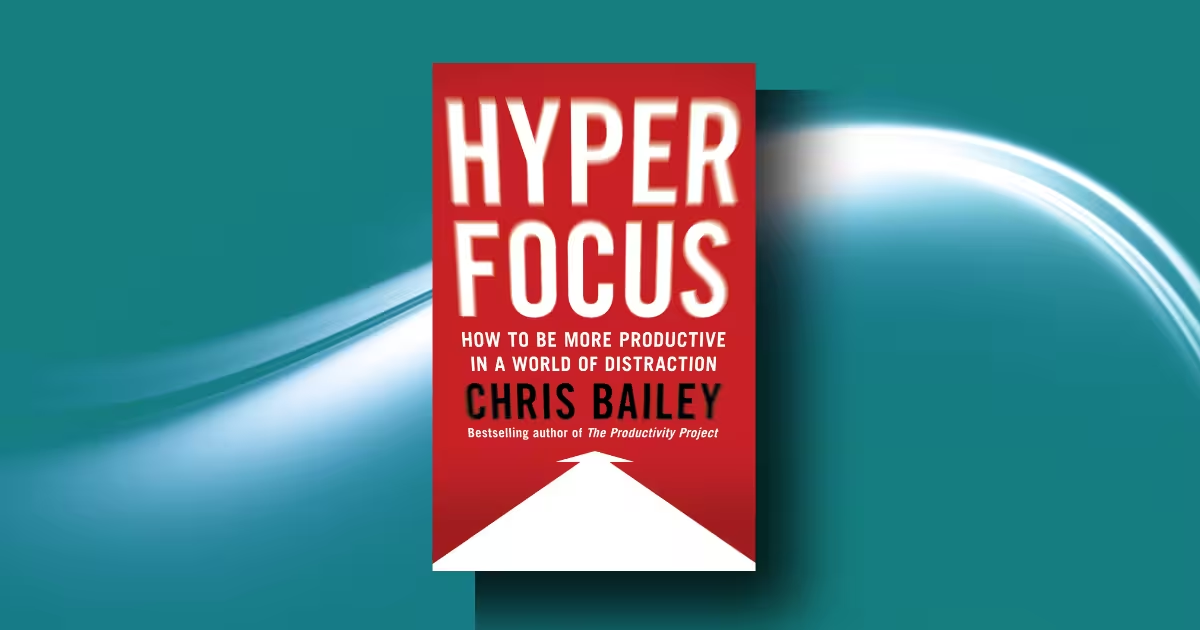
Hyperfocus: How to Be More Productive in a World of Distraction was published by Viking (Penguin Random House) in 2018, following Chris Bailey’s international bestseller The Productivity Project. Bailey isn’t just a theorist; he’s a full-time productivity experimenter who has logged tens of thousands of hours testing research on himself, often with alarming results that he transparently shares.
This book sits at the intersection of cognitive psychology, business, and self-help. Bailey noticed a terrifying trend in his own life: “I had never been so busy while accomplishing so little” (p. 4). He wrote Hyperfocus because he realized that in a world of infinite information, our most finite and valuable resource isn’t time—it’s attention.
The central idea of Hyperfocus is that your brain has two distinct, powerful modes: Hyperfocus (the super-productive state of concentrating on one complex task) and Scatterfocus (the creative, restful state of deliberate mind-wandering).
Bailey argues that learning to strategically toggle between these two modes is the secret not just to productivity, but to a creative and meaningful life. He states it perfectly on page 5: “When we invest our limited attention intelligently and deliberately, we focus more deeply and think more clearly.”
2. Background: The Science of a Shattered Mind
Bailey doesn’t write from opinion; he builds his frameworks on a harrowing scientific reality.
He cites the work of Dr. Gloria Mark, a professor of information science at the University of California, Irvine, whose in situ studies revealed that we can work for an average of just forty seconds in front of a computer before we’re either distracted or interrupted (p. 5, p. 44).
Shockingly, when apps like Slack or Skype are open, we interrupt ourselves every thirty-five seconds (p. 73).
To understand why we fail, Bailey introduces the concept of attentional space. Based on research by psychologist Timothy Wilson, your brain receives 11 million “bits” of information every second, but you can consciously process only forty bits (p. 24).
This is roughly the capacity of a scratch pad that can hold, at most, four unique chunks of information. The goal of productivity, Bailey argues, isn’t to cram more into this small space but to be a “bouncer” for it.
3. Hyperfocus Summary
Bailey structures the book into two distinct parts: Part One covers Hyperfocus, and Part Two covers Scatterfocus. The beauty of his method is that by the end of the summary, you won’t need to go back to the source material—the actionable blueprint is right here.
Part One: Hyperfocus
This is the mode we usually associate with getting things done. Bailey defines it quite simply: “keep one important, complex object of attention in your awareness as you work” (p. 58).
The Four Types of Tasks
Before you can focus, you need to know what to focus on. Bailey provides a 2×2 grid to categorize all tasks based on whether they are Productive/Unproductive and Attractive/Unattractive (p. 20):
Necessary Work: Unattractive but productive (e.g., budget meetings).
Purposeful Work: The sweet spot—attractive and productive. These are the tasks you’re “put on earth to do” (p. 21).
Distracting Work: Attractive but unproductive (e.g., social media, most email).
Unnecessary Work: Neither attractive nor productive (e.g., rearranging files).
Bailey insists that we often default to “Autopilot Mode,” and that switching off this mode is the most consequential decision we make (p. 19).
The Hyperfocus Ritual
To enter Hyperfocus, Bailey prescribes a four-step process (p. 56):
- Choose a productive or meaningful object of attention.
- Eliminate as many external and internal distractions as possible. Bailey notes, “Distractions are infinitely easier to deal with in advance” (p. 57).
- Focus on that chosen object.
- Continually draw your focus back.
A critical tactic here is Intention Setting. Bailey champions the “Rule of 3”: at the start of each day, decide the three things you want to have accomplished. Research from Peter Gollwitzer and Veronika Brandstätter supports this: setting specific “implementation intentions” (the when, where, and how) can double or even triple your odds of success, moving follow-through from 22% to 62% (p. 66).
Taming Distractions
Bailey takes a pragmatic, rather than monastic, approach to our devices. He doesn’t argue you should throw your phone in the sea, but he does call it a “productivity black hole that sits in your pocket” (p. 8).
He distinguishes between Distraction-Free Mode (for Hyperfocus work) and Reduced-Distraction Mode (for collaborative work).
His most powerful email tactic is brutal in its simplicity: “Check for new messages only if you have the time, attention, and energy to deal with whatever might have come in” (p. 93).
He also notes the massive cost of multitasking, citing a study that found it takes an average of twenty-two minutes to resume a task after an interruption, but a punishing twenty-nine minutes if you interrupt yourself (p. 58).
Part Two: Scatterfocus
This is where Hyperfocus truly distinguishes itself from every other productivity manual. While Hyperfocus is about directing attention outward, Scatterfocus is about directing it inward. Bailey calls this your “brain’s hidden creative mode” (p. 133).
If Hyperfocus is the lumberjack cutting down the tree, Scatterfocus is Abraham Lincoln’s four hours spent sharpening the axe.
Why Scatterfocus Works
When you let your mind wander deliberately, it visits three main places: the past (12% of the time), the present (28%), and the future (48%). Bailey writes, “Our mind wanders to think about the future 48 percent of the time—more than our past and present thinking combined” (p. 140).
This is our “prospective bias,” and it proves that rest is not idleness; it’s planning.
The Three Styles of Scatterfocus (p. 143)
Capture Mode: Sitting with a notebook and letting your mind roam freely to capture open loops. Bailey tested this himself: “I just put my computer to sleep, set a timer for fifteen minutes, and captured everything that rose to the surface” (p. 145).
Problem-Crunching Mode: Holding a specific problem loosely in your mind and letting your thoughts wander around it.
Habitual Mode: Engaging in a low-effort, habitual task (like walking or knitting) that anchors you while your mind connects the “dots” of information.
Bailey found this mode to be the most powerful for creative insights, aligning with the Zeigarnik effect: our minds cling to unfinished problems and automatically try to solve them (p. 173).
An alarming study referenced in the book reveals just how resistant we are to this mode: 71% of men in a 2014 study chose to self-administer electric shocks rather than sit alone with their thoughts for 15 minutes (p. 135). In a world that equates stillness with laziness, Bailey’s defense of mind-wandering is a radical call to arms.
Recharging the Battery
The glue holding the two modes together is energy.
Bailey argues that breaks are non-negotiable, citing that mental energy oscillates in ninety-minute waves (p. 164). He references data from the time-tracking app DeskTime, which found that the top 10% of productive users worked for an average of 52 minutes and then took a 17-minute break (p. 165).
His formula is simple: take a break roughly 15 minutes for every hour of work, and never feel guilty about it. “Whenever we rest,” Bailey writes, “we exchange our time for energy” (p. 169).
4. Hyperfocus Analysis
As a reader, I find Hyperfocus to be a profoundly validating and structurally genius piece of work.
The book’s immense strength is that it doesn’t just tell you that you have a short attention span—it convinces you that your distractability is a biological feature, not a personal moral failing.
The revelation that our “attentional space” shrinks by 60% when we’re sleep-deprived (p. 160) fundamentally changed my view on late-night grinding.
Bailey’s voice is the antithesis of the toxic hustle-culture guru. He admits he can’t keep chips in the house without eating them, and he confesses to losing 30 minutes to mindless web surfing immediately after a meditation session (p. 77). This transparency makes the science-backed tactics feel accessible.
Though Hyperfocus is a secular business book, its themes echo spiritual disciplines I deeply respect.
The practice of continually drawing one’s focus back to a single object feels identical to the Buddhist monks Bailey visits for extended meditation retreats. He notes that meditating for two hours on the tip of his nose led to his most productive writing week in years (p. 123). It’s a beautiful intersection of neuroscience and mindfulness.
5. Strengths and Weaknesses
Strengths
The Scatterfocus Counterbalance: Without Scatterfocus, Hyperfocus would be just another “deep work” manifesto. Bailey’s validation of daydreaming as a creative tool is genuinely innovative and fills a gap in the literature.
Actionable Precision: The hourly awareness chime—where you simply ask, “Was my mind wandering?”—is a tiny tactic with seismic results for maintaining intention (p. 63).
Environmental Physics: Bailey’s argument that you need to put “twenty seconds” of distance between you and a distraction to stop the impulse (p. 102n) is a practical, life-altering piece of design advice.
Weaknesses
The “Habitual Scatterfocus” Paradox: For a generation conditioned to reach for the phone during every micro-break, the advice to “knit” or “walk in nature” might feel alienating.
Bailey acknowledges the resistance to boredom but could offer more bridging strategies for those whose “simple habits” involve digital media rather than physical hobbies.
Open-Office Dystopia: While Bailey offers tips for surviving open offices, he is perhaps too polite. The data he cites on 40-second focuses suggests that open offices are, for deep creative work, a complete catastrophe, yet he hedges this for the sake of corporate diplomacy.
6. Comparison with Similar Works
Where Cal Newport’s Deep Work focuses almost exclusively on the intense, monastic side of concentration (the “Hypofocus” side), Bailey’s Hyperfocus provides the complete metabolism of the mind.
Newport tells you to throw your phone away and lock yourself away; Bailey tells you how to manage your brain once you’ve done that, and crucially, how to rest afterward.
It also sits comfortably alongside Atomic Habits by James Clear, providing the cognitive framework for why tiny habits smooth the mental path to focus, but with a much heavier emphasis on cognitive neurology than behavioral outcomes.
7. Conclusion
Ultimately, Hyperfocus: How to Be More Productive in a World of Distraction is not merely a manual for getting more done; it’s a guide for living a life that feels meaningful.
It taught me that “productivity” isn’t about cramming more in; it’s about accomplishing what we intend to. If you feel like your days are slipping away in a blur of notifications and meaningless “busyness,” Chris Bailey has handed you the remote control back.
Read this book if you are ready to stop managing your time and start managing your attention.