
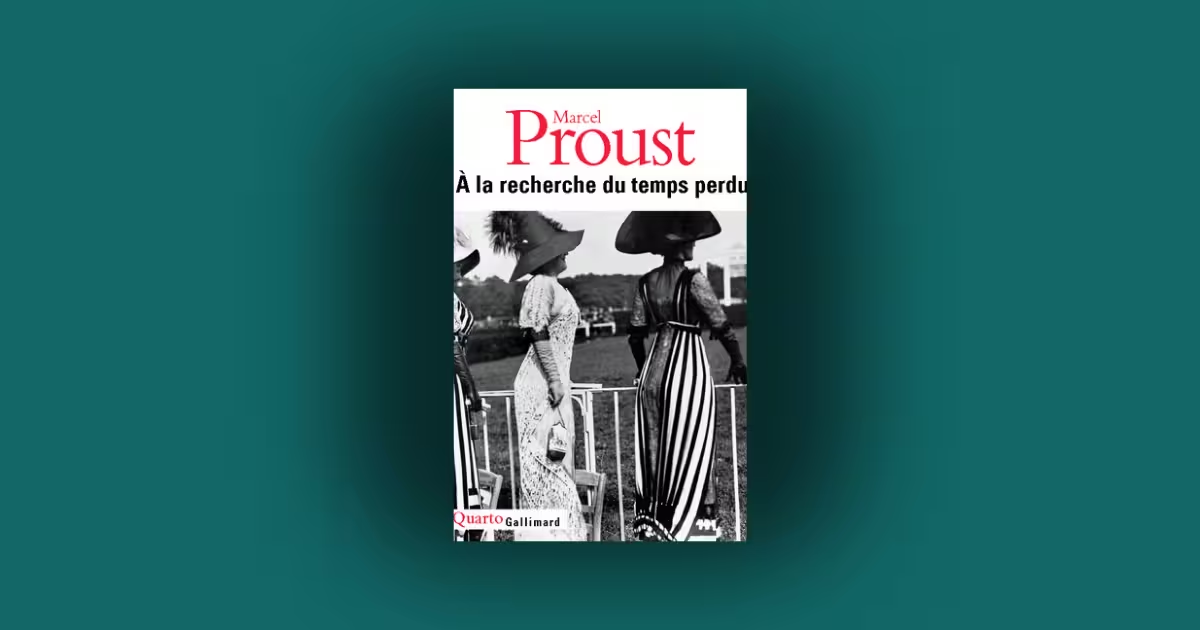
Does a single smell — freshly baked bread, an old perfume, the particular damp of a childhood room — sometimes stop you mid-step and flood you with a past you thought you’d completely forgotten? That sensation, which most of us brush off as a passing oddity, is the entire engine of the greatest novel ever written.
In Search of Lost Time is a seven-volume, 1.5-million-word meditation on the idea that our most meaningful self is not the one we project consciously into the world, but the one preserved — whole and irreducible — in involuntary memory, waiting to be summoned back by a taste, a smell, or a snatch of music.
In Search of Lost Time is best for readers who don’t mind surrendering three to six months of reading life; anyone fascinated by psychology, memory, social class, jealousy, and the nature of art; readers who want a novel that will permanently change how they perceive their own past.
Not for readers expecting a plot-driven thriller or a story that moves quickly; anyone who finds psychological interiority tedious; those unwilling to sit with pages of digression that are, paradoxically, the whole point.
Table of Contents
1. Introduction
Title: In Search of Lost Time (French: À la recherche du temps perdu)
Author: Marcel Proust (1871–1922)
Original Language: French
Publication: Volume 1 (Swann’s Way) published in 1913; final volume (Time Regained) published posthumously in 1927
Translation used in this article: C. K. Scott Moncrieff (Volumes 1–6); Sydney Schiff (Volume 7)
Length: Approximately 1.5 million words across seven volumes — listed in the Guinness Book of World Records as the longest novel ever written
Volumes: Swann’s Way, Within a Budding Grove, The Guermantes Way, Cities of the Plain, The Captive, The Sweet Cheat Gone, Time Regained
There is a particular kind of literary ambition that does not announce itself loudly.
It arrives quietly, disguised as a narrator unable to sleep, lying in a darkened room. Marcel Proust’s In Search of Lost Time begins, famously and disarmingly, with the sentence: “For a long time I used to go to bed early.”
Seven volumes and roughly a million and a half words later, that narrator has not simply told a story. He has dismantled and rebuilt our entire understanding of what time, love, memory, and art actually mean.
I came to this book the way most readers come to it — half in dread, half in reverence.
I expected something exhausting, over-decorated, remote. What I found instead was, at its core, one of the most honest accounts of what it actually feels like to be a human being: the irrational jealousies, the social humiliations, the grief that arrives late, the love that corrodes precisely because it is most intense.
2. Background and Historical Context
Marcel Proust was born on July 10, 1871, in Auteuil, a suburb of Paris.
His father, Adrien Proust, was a prominent doctor; his mother, Jeanne Weil, came from a cultured Jewish bourgeois family.
From childhood, Proust suffered from severe asthma — an affliction that would shape both his reclusive lifestyle and the sustained, inward quality of his prose. He moved in the glittering salons of Third Republic Paris, befriending aristocrats, artists, and intellectuals, while remaining, as a half-Jewish, bisexual man of the middle class, always somewhat peripheral to the circles he inhabited.
The novel spans approximately four decades of French social history, from the relative stability of the 1880s through the Dreyfus Affair (which tore French society apart along lines of anti-Semitism and nationalism), the Belle Époque, and the devastation of World War One.
Proust witnessed these upheavals from close quarters — and the novel’s last volume, Time Regained, set partly during the First World War, carries the full weight of that destruction.
In January 1909, according to Britannica, Proust experienced the involuntary recall of a childhood memory after tasting a rusk dipped in tea — the experience that, transformed in the novel into the famous madeleine scene, would become the conceptual foundation of the entire work.
He retired from public life to write, lining his cork-walled bedroom to insulate against noise and allergens, and worked with an “almost inhuman dedication” until his death in November 1922, leaving the final three volumes in an advanced but unfinished state of revision.
His brother Robert oversaw their posthumous publication.
The first volume was rejected by Gallimard (at the time under André Gide’s editorial influence, who later called that rejection the greatest mistake of his career) and was published at Proust’s own expense by Grasset in 1913.
Within a Budding Grove won the Prix Goncourt in 1919, and Proust became, almost overnight, internationally celebrated.
3. In Search of Lost Time Summary Volumes 1-7
Volume 1: Swann’s Way (1913)
The novel opens with a nameless narrator — whom we gradually come to understand is called Marcel — in a state between waking and sleeping, unable to locate himself in time or space.
It is one of literature’s great opening gestures: a man adrift in his own consciousness, reconstructing where, and even who, he is from the faintest sensory clues. Proust writes with extraordinary precision about that half-world:
“For a long time I used to go to bed early. Sometimes, when I had put out my candle, my eyes would close so quickly that I had not even time to say ‘I’m going to sleep.'”
The novel’s first long section, “Combray,” reconstructs Marcel’s childhood in the fictional French village of Combray, built entirely from memory.
We meet his anxious, loving mother and grandmother; the irritating great-aunt Léonie who never leaves her room; and the neighbor Charles Swann, a cultivated Jewish man of the bourgeoisie who moves in aristocratic circles.
The most psychologically charged moment of Marcel’s childhood is his nightly torment over his mother’s goodnight kiss — a small ritual elevated to the level of existential crisis. His mother sometimes does not come. One night, in an act of desperation, Marcel intercepts her in the hallway, and his father — unexpectedly — tells her to stay with the boy. The mother reads aloud François le Champi by George Sand.
Marcel wins the battle, but the narrator reflects, years later, that this victory marked the beginning of a lifelong tendency toward nervous weakness and emotional dependency.
Then comes the madeleine.
As an adult, Marcel dips a small scallop-shaped cake — a madeleine — into a cup of lime-flower tea, and is suddenly overwhelmed by a sensation of inexplicable joy and recovered life.
He searches his memory deliberately, and after several attempts, it surfaces: the madeleine is the same cake his aunt Léonie used to give him on Sunday mornings in Combray. And with that single taste, the entire world of Combray returns — not as a faded photograph but in full, living detail:
“And suddenly the memory returns. The taste was that of the little crumb of madeleine which on Sunday mornings at Combray (because on those mornings I did not go out before church-time), when I went to say good day to her in her bedroom, my aunt Léonie used to give me, dipping it first in her own cup of real or of lime-flower tea.”
This is the novel’s central thesis, stated through experience rather than argument: that the past is not gone but preserved, whole, in the body — and that it can be recovered not through deliberate effort but through involuntary sensory triggers.
Proust elaborates:
“But when from a long-distant past nothing subsists, after the people are dead, after the things are broken and scattered, still, alone, more fragile, but with more vitality, more unsubstantial, more persistent, more faithful, the smell and taste of things remain poised a long time, like souls, ready to remind us, waiting and hoping for their moment, amid the ruins of all the rest; and bear unfaltering, in the tiny and almost impalpable drop of their essence, the vast structure of recollection.”
The second major section of Swann’s Way — “Swann in Love” — shifts entirely in perspective, narrating the story of Charles Swann’s obsessive love affair with Odette de Crécy, a woman of dubious social standing whom Swann initially finds physically unremarkable.
The Verdurins, a bourgeois couple who run a self-satisfied artistic salon, provide the social context.
Swann is admitted into the Verdurin “clan,” and there he becomes enchanted by a passage from a piano sonata — the “little phrase” by the fictional composer Vinteuil — which becomes the “national anthem” of his love for Odette.
Gradually, Swann’s mild interest curdled into full-blown jealousy. He follows Odette through the streets of Paris at night. He intercepts her messages. He torments himself with images of what she might be doing in his absence.
The novel’s great insight, dramatized here in slow motion, is that romantic jealousy is not an aberration of love but its most honest face: love is not about possession of another person but about the endless, maddening pursuit of an image one has constructed in one’s own mind.
Odette, Swann eventually realizes with devastating clarity, was never quite his type to begin with. He married her — they have a daughter, Gilberte — and by the time we meet him as a neighbor in Combray, the passion has entirely burned out.
The third section, “Place-Names: The Name,” follows young Marcel’s own early crush on Gilberte Swann in the Champs-Élysées, and his fantasy of meeting the glamorous Duchess of Guermantes — whose ancient aristocratic name conjures an entire imaginary world in his imagination.
The volume ends with Marcel’s first bitter lesson in the gap between imagination and reality.
Volume 2: Within a Budding Grove (1919)
Time moves forward. Marcel is an adolescent, socially anxious, desperate to become a writer but wholly uncertain of his talent.
He visits the home of Odette — now Mme. Swann, enshrined in a world of orchids, tea gowns, and elaborate social performance — and befriends Gilberte.
His infatuation, however, slowly fades, a pattern the novel will repeat: desire is always most intense in the moment before possession or familiarity. Marcel eventually stops visiting the Swanns, and within a year has almost entirely forgotten Gilberte.
The second half of the volume follows Marcel on a seaside holiday to the fictional resort of Balbec, accompanied by his grandmother and the family servant Françoise.
There he meets the painter Elstir — a former member of the Verdurin salon — whose method of painting, Proust argues, is essentially Proustian: rendering not the world as the intellect classifies it but the world as the senses actually receive it, before habit and convention have processed it into the familiar.
More significantly, Marcel encounters a group of young girls who bicycle along the seafront — chief among them Albertine Simonet, the “dark girl” with a boyish vigor who will become the central obsession of Marcel’s adult life. Their first acquaintance is glancing, playful, and full of Marcel’s characteristic over-analysis.
The social world expands: Marcel also befriends Robert de Saint-Loup, the charming, progressive nephew of the Duc and Duchess de Guermantes, and meets the alarming Baron de Charlus — Robert’s uncle — whose intense attention makes Marcel deeply uneasy in ways he cannot initially articulate.
Volume 3: The Guermantes Way (1920)
Back in Paris, Marcel’s family has moved to an apartment in the Guermantes mansion.
He becomes, through social persistence and Saint-Loup’s introductions, gradually admitted into the rarefied world of the Guermantes salon — a world that represents, for him, the summit of social prestige and ancient French aristocratic culture.
The volume is, in many ways, the novel’s great satirical set piece. The Duchess of Guermantes — whom Marcel has spent years idolizing — turns out to be witty, cold, and fundamentally shallow.
The aristocratic world he imagined as somehow more real, more beautiful, more meaningful than his bourgeois origins, is exposed as a performance, a game of social exclusion and collective vanity.
The scene in which the Duke de Guermantes refuses to leave a party to attend his dying cousin — because it would mean changing his shoes — is one of the blackest comic moments in all of literature.
The volume’s most devastating passage, however, comes with the death of Marcel’s grandmother. He does not grieve immediately — he barely registers it at the time. Months later, back in Balbec, he bends down to take off his boots, and the gesture triggers a sudden, overwhelming recollection of his grandmother doing the same thing for him.
The grief arrives in full force — retrospectively, involuntarily, unstoppably. It is one of Proust’s most brilliant illustrations of his theory: our emotional life runs on a delay; we only truly feel what has happened to us when a sensory echo calls it back.
Volume 4: Cities of the Plain (1921–1922)
The title (Sodome et Gomorrhe in French) signals this volume’s central revelation.
Marcel witnesses, early in the book, an encounter between Baron de Charlus and the tailor Jupien — and understands, suddenly, the full nature of Charlus’s sexuality. Proust devotes an extended, remarkable opening essay to the social world of homosexuality in fin-de-siècle Paris — men living parallel lives, maintaining public respectability while conducting secret existences.
The passage is unprecedented in its historical scope and its refusal either to moralize or to sentimentalize.
The rest of the volume is dominated by Marcel’s rekindled, now much more intense relationship with Albertine.
The two travel together; Marcel becomes increasingly obsessed with the possibility that Albertine prefers women. His jealousy is now not Swann’s wistful longing but something more totalizing and violent — an attempt to possess another person’s entire interior life.
The volume ends with Marcel’s sudden, apparently impulsive decision to bring Albertine back to Paris to live with him.
Volume 5: The Captive (1923) — Posthumous
Albertine has moved into the Swann family apartment in Paris.
The paradox of Marcel’s position is brutal: having obtained the thing he desired, he is neither happy nor at peace.
He lies awake listening to the sounds of Paris waking — street vendors crying their wares, a particularly lovely passage in which Proust evokes the whole soundscape of a Paris morning — while Albertine sleeps, and he feels no closer to knowing her than when she was inaccessible. He controls her movements, interrogates her memories, and constructs elaborate lies to explain her absences.
The captive of the title refers to both Albertine, imprisoned in the apartment, and Marcel, imprisoned in his own jealousy.
The volume also contains one of Proust’s most extraordinary musical sequences: a performance of Vinteuil’s newly discovered Septet at the Verdurins’ salon.
The music overwhelms Marcel with its beauty and seems to confirm the existence of a kind of spiritual reality that art, alone among human activities, can access. Baron de Charlus, who has orchestrated the performance as a tribute to the musician, is simultaneously and publicly humiliated by the Verdurins, who drop him from their social circle.
The fall of Charlus — from powerful, feared aesthete to social exile — has begun.
The volume ends with a shock: Albertine escapes. She sends Marcel a note saying she needs to leave.
Volume 6: The Sweet Cheat Gone (1925) — Posthumous
The French title Albertine disparue — “Albertine disappeared” — is more accurate and more brutal. Albertine does not merely leave; she vanishes from Marcel’s life completely, and within days he receives word that she has died in a riding accident in Touraine.
What follows is a masterpiece of grief psychology. Marcel does not mourn Albertine as a person he knew but as a series of images, each of which dies at a different rate.
His jealousy does not abate with her death; it intensifies, because now he can never resolve the questions that obsessed him.
He engages in a kind of archaeological excavation of her past, questioning her friends, tracing her movements, trying to establish whether she had, in fact, had the relationship with Mlle. Vinteuil and her friend that he always suspected.
Eventually, piece by piece, he discovers that she probably had. And eventually, the grief begins to dissolve — not through resolution but through the mere passage of time, the natural erosion of even the sharpest pain.
Meanwhile, his old love Gilberte reappears: she has married Saint-Loup (who, it now emerges, shares Baron de Charlus’s sexuality).
Marcel visits Venice — a long section of great visual and philosophical beauty — where his mother receives a letter that falsely appears to be from Albertine, demonstrating how the dead can still haunt the living in cruel and meaningless ways.
Volume 7: Time Regained (1927) — Posthumous
The final volume opens during the First World War, which Proust depicts with darkly comic ambivalence: Paris under blackout, Charlus wandering the darkened streets with a new kind of desperate freedom, Saint-Loup killed at the front.
Marcel, ill and withdrawn, has spent years in a sanatorium.
He returns to Paris for a reception at the Princesse de Guermantes’ mansion. On the way in, a series of involuntary memories — the uneven cobblestones of the courtyard recalling the baptistery of St. Mark’s in Venice; the sound of a spoon against a plate recalling a train journey; the stiffness of a napkin recalling Balbec — suddenly and overwhelmingly return him to the past.
These moments are not merely pleasurable recollections: they are outside time, partaking simultaneously of past and present.
In them, Marcel finally grasps what has been eluding him his entire adult life: the real substance of a human life is not its events, chronologically arranged, but these timeless moments in which past and present are held together by the body’s involuntary memory.
At the party itself, Marcel encounters a world transformed by age. The people he knew — Odette, Gilberte, the Guermantes — are almost unrecognizable. Charlus is a wreck: white-haired, stroke-weakened, bowing to people who once snubbed him because he can no longer remember the social geography. The Duchesse de Guermantes has aged into vulgarity.
The whole “Bal des têtes,” as this section is known, is a devastating theatrical meditation on time as the great leveler and destroyer.
And yet, from within this spectacle of decay, Marcel discovers his vocation. He will write a book — this book — that will capture the dimension of Time that prose has not yet attempted: not time as a chronological sequence but time as the body knows it, layered, recursive, alive.
He races against his own failing health. The novel ends with Marcel at his desk, resolved to begin, understanding at last what his life has been for:
“I should endeavour to render that Time-dimension by transcribing life in a way very different from that conveyed by our lying senses… I would therein describe men… not occupying a place in Time infinitely more important than the restricted one reserved for them in space… they stand like giants immersed in Time.”
The final image — of men standing like giants immersed in time, their legs rooted in the accumulated past — is one of the most beautiful and haunting endings in all of literature. The narrator’s life and his novel are, at last, the same thing.
4. In Search of Lost Time Analysis
4.1 Characters
The Narrator (Marcel)
Proust never names his narrator except in brief, glancing moments — when Albertine calls him “my darling Marcel” — preserving an ambiguity that makes the novel simultaneously autobiography and fiction.
Marcel is not heroic, not especially likeable in the conventional sense. He is hypochondriac, socially anxious, almost entirely passive in his own life. He observes rather than acts.
He loves with an intensity that destroys rather than sustains. Yet his inner life — his capacity for wonder, analysis, and what we might now call hypervigilance toward beauty — is the instrument through which Proust conducts his entire investigation of experience.
By the end, Marcel has grown from a child tormented by his mother’s absence to an artist who has finally understood what his life has meant.
Charles Swann
Swann is the novel’s first great portrait of a mind at war with itself. A cultivated aesthete — he knows Vermeer, he moves in aristocratic Paris, he is effortlessly charming — Swann nonetheless falls into a love affair that demeans and destroys him.
His relationship with Odette is the novel’s first worked example of Proust’s theory: that romantic love is not a response to the beloved’s actual qualities but a fever generated by the lover’s own imagination, sustained by jealousy.
Swann eventually recovers, marries Odette, and by the time of his death in Volume 3 is a somewhat diminished figure — kind, cultivated, but emptied of the obsessive energy that once made him interesting. His trajectory prefigures Marcel’s own with Albertine.
Odette de Crécy / Mme. Swann
Odette is the novel’s great social climber and survivor. Initially a kept woman of uncertain morality, she becomes — through her marriage to Swann and then, after his death, through her relationship with a politician named Forcheville — a respected figure in the very social world that once excluded her.
By the final volume, she is an elderly, still-beautiful woman, the mother of Gilberte, a fixture at the Guermantes circle. She is fundamentally untroubled by the passions she has inspired.
There is something both admirable and chilling about her resilience.
Albertine Simonet
The novel’s most contested figure. Albertine is, for the most part, opaque — we see her almost entirely through Marcel’s distorting jealousy.
She is presented as athletic, cheerful, physically vigorous, and potentially bisexual. But because Marcel’s obsession is about control rather than connection, we never quite know who she actually is.
Her death in Volume 6 does not resolve this opacity; it deepens it. Critics have long noted that Albertine was partly modeled on Alfred Agostinelli, Proust’s secretary and love, who died in a 1914 plane crash — and that the gender transformation illuminates both the novel’s emotional intensity and its deliberate elusiveness.
Baron de Charlus
Charlus is the novel’s most spectacular creation: a Baron of ancient lineage, a man of terrifying social authority and genuine aesthetic culture, whose entire public persona is a performance concealing an obsessive homosexual desire that eventually consumes him.
He is by turns brilliant, cruel, ridiculous, and pathetic. His fall — from social lion to social outcast, from the commanding figure who reduces Marcel to nervous silence to the stroke-weakened, white-haired old man who bows to everyone at the final party — is one of the novel’s great tragic arcs.
His relationship with the violinist Morel, whom he loves with all the jealousy and blindness of Swann loving Odette, mirrors and amplifies the novel’s central argument about the nature of obsessive love.
Robert de Saint-Loup
Saint-Loup is the novel’s most generous portrait of pure attractiveness — physical, intellectual, moral.
He is progressive about the Dreyfus Affair; he is loyal, funny, and kind. His death in the First World War, mentioned almost in passing in Time Regained, is one of the novel’s most understated griefs.
The revelation of his sexuality in the later volumes — he has been living, like his uncle Charlus, a double life — does not diminish him so much as place him within the novel’s larger argument: that the people we love are always partly unknowable, always harboring an interior life we cannot access.
The Grandmother
Brief but essential. Marcel’s grandmother is perhaps the only figure in the novel who loves without possession or self-interest.
Her death — and Marcel’s delayed, devastating grief for her — is the novel’s first major confrontation with mortality and loss.
4.2 In Search of Lost Time Themes and Symbolism
Involuntary Memory vs. Voluntary Memory
This is the novel’s engine.
Proust distinguishes between voluntary memory — the deliberate recollection of the past, which produces only flat, academic images — and involuntary memory, which arrives unbidden through sensory stimuli and restores the past in full, living, emotional immediacy.
The madeleine is the most famous example, but the novel is strewn with them: the uneven cobblestones of the Guermantes courtyard, the sound of a spoon against a plate, the smell of a particular bathroom, the stiffness of a laundered napkin.
Each one detonates a hidden charge of preserved experience.
The implication is radical: our most meaningful experiences are not consciously held. They exist in the body, waiting.
And because a single past moment can be recovered in its full sensory richness, it is, in a sense, not entirely lost — it exists, simultaneously with the present, in a pocket of timeless experience.
This is the theological dimension of Proust’s aesthetics: art, at its highest, partakes of this recovery. A great novel does to the reader’s experience what the madeleine does to Marcel’s: it restores what time has taken.
Time, Mortality, and Art
The seven volumes are, structurally, a meditation on the relationship between time and human consciousness.
Time is the novel’s great antagonist: it fades beauty, erodes memory, destroys love, and ultimately kills. The final scene at the Princesse de Guermantes’ party is the proof: everyone Marcel has known is ravaged by age.
The Duchesse he once idolized is vulgar and diminished. Charlus is broken.
The only revenge available against time’s destruction, Proust argues, is art — specifically, the kind of art that captures not just events but the felt texture of experience, the impression of a moment as the body recorded it.
Marcel realizes at the end that his entire life — including its wasted years, its obsessive loves, its social failures — has been the material of a book. The suffering was not wasted; it was the work. This is a consolation that the novel earns, rather than simply asserts.
Jealousy and the Impossibility of Knowing Another Person
One of the novel’s most unsettling arguments is that romantic love is inherently structured around a fundamental epistemological failure. We cannot know another person’s interior life.
We can only construct an image of them in our own minds — and it is this image, not the actual person, that we love. Jealousy is not a failure of love but its purest expression: the rage of the imagination against its own limitations.
Swann loves an image of Odette. Marcel loves an image of Albertine. Both men are destroyed by the gap between the image and the person.
The irony is that the actual Odette and the actual Albertine may be, in important ways, far less interesting than the obsessed lovers’ constructions.
Proust does not offer this as a counsel of despair; he offers it as liberation. If we could accept that we can never fully possess another person, perhaps we could love with less violence and more grace.
Social Class, Snobbery, and the Aristocracy
The novel is also a vast social comedy. Proust spent his youth in the salons of Parisian high society, and he observed their rituals with a satirist’s precision.
The aristocracy — the Guermantes, Charlus, the entire Faubourg Saint-Germain — are simultaneously elevated by Marcel’s youthful imagination and systematically debunked by his adult experience.
The Duchess of Guermantes is witty but cold. The Duke prefers not to change his shoes. The world Marcel longed to enter turns out to be populated by figures as petty, as vain, and as capable of cruelty as any other social stratum.
Meanwhile, the bourgeoisie — the Verdurins — are brilliant social climbers whose “little clan” parodies the aristocratic salon it aspires to supplant.
By Time Regained, Mme. Verdurin has married and become the new Princesse de Guermantes. The social revolution has been completed without ideology or violence: simply through the operation of time and ambition.
Art and the Artist’s Vocation
Running through all seven volumes is Marcel’s anxiety about whether he has any genuine talent as a writer.
He admires Elstir’s painting, Vinteuil’s music, Bergotte’s prose — and doubts whether his own sensibility can achieve what theirs have.
The resolution, delivered in the final volume, is that the life he has lived — the loves, the jealousies, the social observations, the grief — was never separate from his artistic development.
It was his artistic development. The material of art is not beauty or happiness but the full, unfiltered texture of experience, including its most humiliating and painful dimensions.
The Vinteuil Sonata and the “Little Phrase”
Vinteuil’s fictional sonata — particularly its recurring “little phrase” — functions as the novel’s recurring musical symbol of the ineffable: the dimension of experience that language cannot directly capture but that music, at its most mysterious, approaches.
For Swann, the little phrase becomes inseparable from his love for Odette; it is, briefly, “the national anthem of their love.”
For Marcel, Vinteuil’s Septet in The Captive provides the closest thing the novel offers to a glimpse of transcendence — a world of pure aesthetic value, beyond social status, beyond physical desire, beyond time.
5. Evaluation
In Search of Lost Time is, simply, the most complete and most honest novel ever written about what it is to be alive — and I say that as someone who arrived at it skeptically, half-convinced it would be exactly the kind of self-indulgent modernist monument that literature departments love and actual readers avoid.
5.1 Strengths
The prose is the most obvious and most immediate strength.
Even in translation — and the C. K. Scott Moncrieff translation used here is a literary achievement in its own right — Proust’s sentences have a quality unlike anything else in fiction. They are long, often page-long, but never muddled; they spiral outward to accommodate every shade of qualification, every nuance of perception, and then return to their main clause with complete structural confidence.
They demand attention, but they reward it with a kind of mental pleasure that quicker writing simply cannot provide.
The social comedy is genuinely, laugh-aloud funny.
The Verdurins, Charlus, the entire ritual of the Guermantes salon — Proust has an observational precision that makes his satire bite without cruelty. He understands snobbery because he was a lifelong, self-aware snob himself.
The psychological insight is the other overwhelming strength. Proust knows more about jealousy, grief, desire, and the mechanics of social performance than any other novelist I have read.
His account of Marcel’s delayed grief for his grandmother — of how emotion arrives not when it should but when the body triggers it — is one of the most accurate descriptions of how grief actually works that I have ever encountered in any form.
5.2 Weaknesses
The pacing — there is no pacing, in the conventional sense. Proust moves at the speed of consciousness, which means some sections are glacially slow by narrative standards.
The middle of The Captive, in which Marcel’s jealousy is dissected at length for hundreds of pages, can feel genuinely airless. There is also a repetitiveness that is, I think, partly intentional — the novel circles its obsessions the way the jealous mind circles its — but which can test even sympathetic readers.
The later volumes, published posthumously without Proust’s final revisions, occasionally feel unfinished: passages are repeated, contradictions are unresolved.
Albertine’s character, in particular, feels deliberately opaque in a way that sometimes tips into simple underdevelopment.
5.3 Impact and Controversy
The novel’s reception has never been entirely straightforward. Its frank treatment of homosexuality made several passages controversial at the time of publication and contributed to some sections being edited or softened in early translations.
More recently, critics have debated the extent to which the novel’s Jewishness — Proust was half-Jewish, and the Dreyfus Affair is central to the social world of the later volumes — has been adequately attended to in literary scholarship.
The Albertine question remains unresolved: how much does knowing that Albertine was based on a man (Agostinelli) change our reading of the jealousy sequences? Proust critics are divided. Some argue that the gender change is incidental; others that it is the central interpretive key.
Intellectually, the novel’s impact has been enormous.
Proust influenced Virginia Woolf, Samuel Beckett, Alain Robbe-Grillet, and virtually every serious novelist of the twentieth century who cared about interior consciousness.
Cognitive scientists have, in recent decades, found striking parallels between Proust’s phenomenological account of involuntary memory and contemporary neuroscience’s understanding of how episodic memory actually functions.
5.4 Comparison with Similar Works
Readers of Middlemarch will recognize the wide-canvas social portrait; readers of Mrs. Dalloway will recognize the privileging of consciousness over event; readers of The Magic Mountain will recognize the philosophical meditation-disguised-as-novel.
But In Search of Lost Time has no true equivalent. Its length gives it a power that shorter novels, however brilliant, cannot replicate: the experience of reading it — over months, over years — becomes, itself, a reflection of the novel’s themes.
You end it having lived with it long enough to recognize what time has done to your own reading.
5.5 Adaptations
The novel has been adapted several times, most notably:
Nina Companéez’s À la recherche du temps perdu (2011): A four-hour French television film covering all seven volumes, starring Didier Sandre and Miou-Miou. Generally praised for its visual beauty and structural ambition, though inevitably a compression that sacrifices much of the novel’s interiority.
Harold Pinter’s screenplay (1972): Pinter wrote a screenplay for a film that was never made, published in 1978 as The Proust Screenplay.
A remarkable document in its own right — Pinter’s adaptation emphasizes discontinuity and sexual jealousy — it was eventually adapted for BBC Radio 3 in 1997.
BBC Radio 4 (2005): Dramatized by Michael Butt, condensed to six episodes starring James Wilby. Received excellent reviews.
Stéphane Heuet’s graphic novel adaptation (published in French from 1998, translated into English): An acclaimed ongoing pictorial adaptation, praised for its fidelity to Proust’s visual imagination.
None of these adaptations can reproduce the central experience of the novel, which depends on length — on the reader’s own elapsed time during reading.
In this sense, In Search of Lost Time is the one major work of literature that is most fundamentally untranslatable to any other medium.
6. Personal Insight with Contemporary Educational Relevance
Five Lessons from Proust for How We Live Now
Lesson 1: Involuntary Memory Is Not Nostalgia — It Is Intelligence
Proust was not writing about nostalgia, which is sentimental and passive.
He was writing about a specific cognitive phenomenon: the body’s capacity to store experience outside conscious memory and to retrieve it — with extraordinary completeness — through sensory triggers.
Contemporary neuroscience has validated this insight in striking ways. Research published in Nature Neuroscience has demonstrated that the olfactory system has a more direct pathway to the hippocampus — the brain’s memory hub — than any other sense, which is why smell-triggered memories are often experienced with unusual vividness and emotional intensity.
Proust intuited in 1909 what brain imaging would confirm a century later. The lesson for us: our “unimportant” sensory experiences — the texture of a chair, the smell of a schoolroom — are not trivial. They are the archive of who we are.
Lesson 2: Social Media Is a Verdurin Salon
The Verdurins run a social circle based on performed enthusiasm, constant flattery, collective exclusion of outsiders, and the careful management of who is “in” and who is “out.”
Sound familiar? Proust’s account of how the Verdurins weaponize social belonging — how belonging to the “clan” requires constant performance and the systematic humiliation of anyone who fails to perform correctly — is a precise description of how online communities, influencer cultures, and social media dynamics operate today.
The lesson: performance of belonging is not belonging. The energy spent on social performance is energy taken from actual experience.
Lesson 3: Jealousy Is Always About Yourself
One of the most practically useful insights in all of Proust — and one supported by contemporary psychological research on attachment — is that romantic jealousy is less about the beloved than about the jealous person’s own anxieties, early attachment patterns, and need for control.
A 2019 meta-analysis published in the Journal of Personality and Social Psychology found that attachment anxiety (a fear of abandonment originating in early childhood) was the single strongest predictor of romantic jealousy across cultures.
Proust dramatizes this before Bowlby and Ainsworth had the vocabulary for it: Marcel’s obsession with Albertine is rooted in the same anxiety as his childhood torment over his mother’s goodnight kiss.
The lesson: if you find yourself consumed by jealousy, the most useful question is not “what is my partner doing?” but “what is this fear telling me about myself?”
Lesson 4: Grief Runs on Its Own Timeline
The death of Marcel’s grandmother is one of the most psychologically accurate accounts of grief I have read, and its central insight — that we do not grieve at the time of loss but when a sensory trigger later restores the full reality of what we have lost — is now well-supported by bereavement research.
The concept of “delayed grief,” or what researchers call “inhibited grief,” is documented in clinical literature; sensory triggers activating what psychologists term “grief bursts” are a recognized feature of normal bereavement.
Proust described all of this fifty years before the clinical literature caught up. The lesson: grief’s timeline is not yours to set. Be patient with yourself, and with others.
Lesson 5: The Unlived Life Is Also Material
Marcel spends much of the novel convinced that he is wasting his time — at parties, in social performance, in obsessive love affairs — rather than writing.
The novel’s final revelation is that none of it was wasted; all of it was the novel. This is not merely a comfortable rationalization.
It is an argument about the relationship between experience and art that has significant implications for anyone working in any creative field: the things you do when you’re not working are not breaks from your work.
They are its raw material. The deepest question you can ask yourself is not “am I being productive?” but “am I paying attention?”
7. In Search of Lost Time Quotes
On the opening of the novel and the reconstruction of self from sleep:
“For a long time I used to go to bed early.”
— The most famous opening sentence in the French novel. Everything that follows is implicit in this simple line.
On the madeleine and involuntary memory:
“But when from a long-distant past nothing subsists, after the people are dead, after the things are broken and scattered, still, alone, more fragile, but with more vitality, more unsubstantial, more persistent, more faithful, the smell and taste of things remain poised a long time, like souls, ready to remind us, waiting and hoping for their moment, amid the ruins of all the rest; and bear unfaltering, in the tiny and almost impalpable drop of their essence, the vast structure of recollection.”
On the moment of involuntary recovery:
“No sooner had the warm liquid, and the crumbs with it, touched my palate than a shudder ran through my whole body… An exquisite pleasure had invaded my senses, but individual, detached, with no suggestion of its origin. And at once the vicissitudes of life had become indifferent to me, its disasters innocuous, its brevity illusory — this new sensation having had on me the effect which love has of filling me with a precious essence; or rather this essence was not in me, it was myself. I had ceased now to feel mediocre, accidental, mortal.”
On the search:
“Seek? More than that: create. It is face to face with something which does not so far exist, to which it alone can give reality and substance, which it alone can bring into the light of day.”
On the “little phrase” from Vinteuil’s sonata and Swann’s love:
“And Swann, in his heart of hearts, turned to it, spoke to it as to a confidant in the secret of his love, as to a friend of Odette who would assure him that he need pay no attention to this Forcheville.”
On the nature of time and the structure of human life:
“This idea of death installed itself in me definitively as love does. Not that I loved death, I hated it. But I dare say I had thought of it from time to time as one does of a woman one does not yet love and now the thought of it adhered to the deepest layer of my brain so thoroughly that I could not think of anything without its first traversing the death zone and even if I thought of nothing and remained quite still, the idea of death kept me company as incessantly as the idea of myself.”
On the goal of the final work — the closing vision:
“I should endeavour to render that Time-dimension by transcribing life in a way very different from that conveyed by our lying senses… I would therein describe men… not occupying a place in Time infinitely more important than the restricted one reserved for them in space… they stand like giants immersed in Time.”
On the immobility of the world and perception:
“Perhaps the immobility of the things that surround us is forced upon them by our conviction that they are themselves, and not anything else, and by the immobility of our conceptions of them.”
8. Conclusion
In Search of Lost Time is the longest, the most demanding, and — I am now convinced — the most rewarding novel ever written.
It asks everything of its reader: time, patience, a willingness to live inside another consciousness for months. What it gives back is a complete recalibration of how you understand your own past, your own loves, your own grief.
Proust does not offer comfort in the conventional sense.
He does not tell you that love will be requited, that loss will be redeemed, or that life makes linear sense.
What he offers instead is something rarer and more useful: the argument that every moment you have ever lived is preserved — whole, charged, waiting — in your body’s involuntary memory, and that the recovery of those moments, through art or through the accidents of sensory experience, constitutes the only kind of immortality available to us.
Recommended for: Serious literary readers; anyone interested in psychology, memory, or the philosophy of time; readers who want to understand modernism from its most ambitious source; those willing to make a significant reading investment in exchange for a permanent shift in consciousness.
Not recommended for: Genre readers seeking plot-driven narrative; those with limited reading time who find digression frustrating.







