
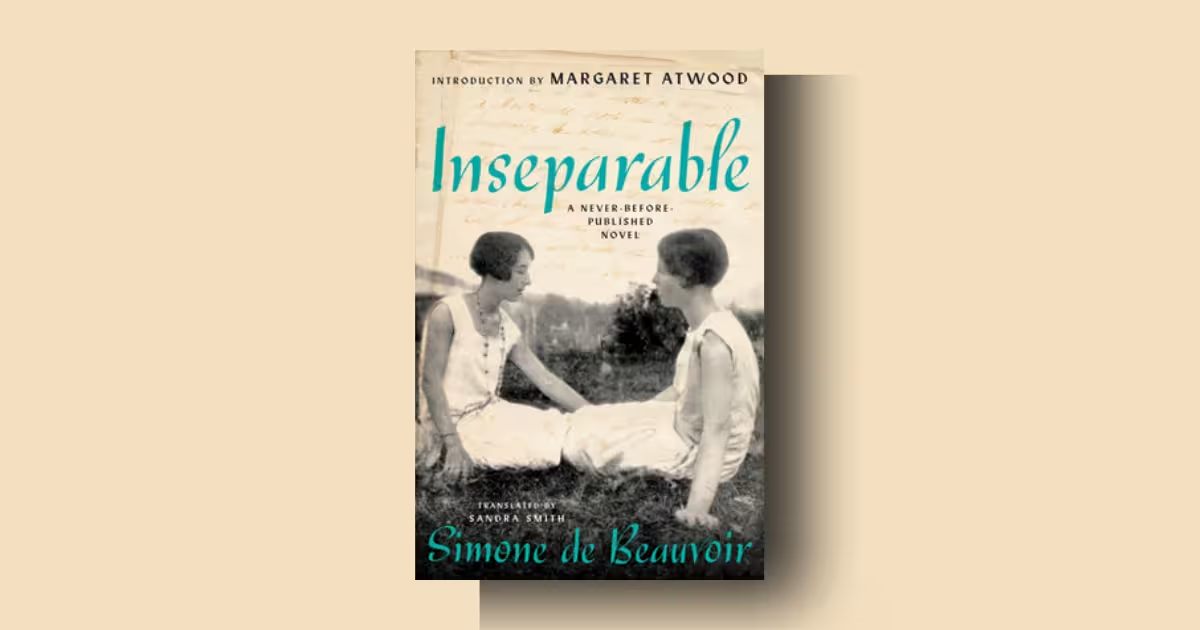

Did you know that Simone de Beauvoir, the woman who wrote The Second Sex and became the intellectual godmother of modern feminism, spent decades trying to write the same story over and over again- the story of a friendship so intense it shaped everything she would later become? I didn’t either, until I picked up Inseparable.
Table of Contents
1. Overview
Inseparable is a slim, posthumously published novel that Simone de Beauvoir wrote in 1954 but never released in her lifetime. It tells the fictionalised story of her real-life friendship with Élisabeth “Zaza” Lacoin, a girl she met at age nine in a Parisian Catholic school. The two became so close that their teachers called them “the inseparables.” Zaza died at twenty-one from viral encephalitis.
Beauvoir was haunted by this loss for the rest of her life. The novel is less a conventional plot-driven story and more an intimate portrait of a friendship that was, in many ways, a love story—one that never got to play out.
2. Reader recommendations for Inseparable
Inseparable is best for readers who love intimate, character-driven literary fiction. Fans of Elena Ferrante’s My Brilliant Friend will find obvious parallels. Anyone interested in Beauvoir’s intellectual and emotional development, or in the hidden lives of young women in early twentieth-century France.
Inseparable is not for readers looking for fast-paced plots, dramatic twists, or philosophical treatises in the style of The Second Sex. If you prefer your fiction heavy on action and light on introspection, this one might test your patience.
3. Introduction
Title: Inseparable: A Never-Before-Published Novel
Author: Simone de Beauvoir
Translator: Sandra Smith
Introduction by: Margaret Atwood
Afterword by: Sylvie Le Bon de Beauvoir (Beauvoir’s adopted daughter)
Publication Date: Originally written in 1954; first published in French in 2020; English translation published in September 2021
Publisher: Ecco (US) / Vintage (UK)
Inseparable arrived in English with a kind of quiet astonishment. Here was a novel by one of the most influential thinkers of the twentieth century, a book she had written and then set aside, a book that had been sitting in a drawer for over six decades.
It was discovered by her adopted daughter, Sylvie Le Bon de Beauvoir, who eventually brought it to publication.
4. Background
To understand Inseparable, you need to understand Zaza. Élisabeth Lacoin, called Zaza by everyone who knew her, was born on December 25, 1907, into a wealthy, militantly Catholic family. She was one of nine children. Simone de Beauvoir was born in 1908, the older of two daughters, into a similarly bourgeois Catholic household.
They met in 1917 at the Cours Adeline Désir, a fashionable Catholic school in Paris. Zaza had been absent for a year recovering from a severe burn—her dress had caught fire while she was cooking potatoes over a campfire, and her right thigh was “grilled to the bone”. When she returned to school, she sat next to nine-year-old Simone and asked, with characteristic directness: “Are you the best pupil?”
From that moment, they were inseparable. The nuns who taught them gave them that name.
Zaza died on November 25, 1929, one month before her twenty-second birthday. The official cause was viral encephalitis. But Beauvoir believed something else: she believed Zaza had been killed—slowly, systematically—by the weight of her family’s expectations, by the suffocating demands of her Catholic milieu, by a world that could not accommodate a girl as brilliant, passionate, and stubborn as she was.
Beauvoir tried to write about Zaza four times before Inseparable, in unpublished novels from her youth, in the collection When Things of the Spirit Come First, and in a passage removed from The Mandarins. None of them satisfied her. Inseparable was her fifth attempt. It still didn’t satisfy her. She showed it to Sartre, who dismissed it as inconsequential. She put it away and never looked at it again.
She did, however, write about Zaza one more time in Memoirs of a Dutiful Daughter (1958), the first volume of her autobiography. That version finally worked. But Inseparable remained hidden, a private memorial, until 2020.
5. Inseparable Summary
Part One: The Meeting
The novel opens with nine-year-old Sylvie Lepage (Beauvoir’s fictional avatar) walking to school on the first day of the academic year. Sylvie is a “very good girl”, she has been tamed by war and religion, taught that her behaviour and piety will determine whether God saves France. She prays constantly, takes her First Communion in a tulle dress and Irish lace bonnet, and is held up as an example to her younger sisters.
Everything changes when she meets Andrée Gallard (Zaza’s avatar). Andrée is small for her age, with hollow cheeks and dark, shining eyes that stare at Sylvie with “intense” concentration. She asks Sylvie if she’s the best pupil, whether she can borrow last year’s notebooks.
There’s no shyness in her, no deference. When Mademoiselle Dubois, the teacher, asks if she’s intimidated, Andrée replies: “I’m not shy, Mademoiselle… besides, you’re not intimidating”.
Sylvie is enchanted. She learns that Andrée’s family has seven children; that her mother, Madame Gallard, allows the children to run wild; that Andrée was “burned alive” in a camping accident and spent a year recovering. Andrée is brilliant at everything, she plays the violin, does cartwheels and somersaults, writes well enough to have her essays copied into the school’s “excellent work” book. She also has “certain unique characteristics”: when she looks at a peach or an orchid, she shudders and her arms break out in goosebumps.
Sylvie decides that Andrée is a child prodigy, the kind of person whose life will one day be written about in books.
Part Two: Growing Up Together
The friendship deepens over the years. Sylvie and Andrée are inseparable at school; they walk together on the playground, whisper in class, share jokes about their teachers. But the relationship is uneven. Sylvie is devoted to Andrée with a passion that borders on worship. Andrée, meanwhile, is devoted to her mother. “I envied the freedom she gave to Andrée,” Sylvie says, “but even though she always spoke to me most kindly, I felt uncomfortable with her”.
One day, Sylvie sends Andrée a long letter describing the springtime in the countryside. Andrée doesn’t reply. When Sylvie asks why, Andrée laughs and says she thought it was homework: “Come on, you didn’t churn out all that prose just for me!” Sylvie is crushed. She realises that Andrée has no idea how deeply she feels.
For Andrée’s thirteenth birthday, Sylvie sews her a handbag—an elaborate creation of red and blue silk and gold brocade. Andrée is touched, but Sylvie notices something else: Madame Gallard doesn’t like her anymore.
Part Three: The First Love
When the girls are around fifteen, Andrée reveals that she has a secret: she’s in love with a boy named Bernard, the son of a wealthy Basque family who owns the estate next to her grandmother’s house. They met during her long recovery from the burn; he visited her every day. They’ve been seeing each other every summer, riding horses together, falling in love.
Madame Gallard has forbidden Andrée from seeing Bernard again. Bernard’s family is rich but “not part of our social circle,” and his mother is Jewish.
Andrée is devastated. She tells Sylvie that she climbed onto the roof of the house and considered jumping. She stayed there for two hours, trying to decide whether to kill herself. What stopped her wasn’t fear of death but fear of hell: “If I go to hell, it’s for eternity; I would never see Bernard again”.
Sylvie, who has secretly lost her faith, can only watch helplessly as Andrée’s world crumbles.
Part Four: Béthary
Madame Gallard invites Sylvie to spend two weeks at the family’s country estate, Béthary. She picks Sylvie up from the station and, on the carriage ride to the house, explains that Andrée is “upset” and that Sylvie must help distract her. Sylvie realises she’s being used as a babysitter, and she hates Madame Gallard for it.
At Béthary, Sylvie sees Andrée’s world for what it is: a prison disguised as a paradise. The house is full of ancestors—militant Catholics, all of them—and the family’s traditions are crushing. Andrée smokes cigarettes her mother has forbidden, talks about how she’s “tired of being a child,” and seems increasingly distant.
One night, Andrée tells Sylvie the full story of her relationship with Bernard. She says that before meeting him, she thought no one could ever love her. “Bernard was the only one in the world who loved me for myself,” she says. Sylvie protests: “What about me?” Andrée looks surprised. Sylvie realises that despite years of devotion, Andrée has never fully understood how much she means to her.
Part Five: The Sorbonne and Pascal
The girls grow up. They pass their baccalaureates and begin studying at the Sorbonne, Sylvie in philosophy, Andrée in literature. Sylvie meets a young Catholic philosopher named Pascal Blondel (based on Maurice Merleau-Ponty). She introduces him to Andrée, and the two fall in love.
Pascal is everything Madame Gallard should approve of: intelligent, pious, from a respectable family. But when Andrée tells her mother about him, Madame Gallard doesn’t give an answer. She says she needs “time to think”.
Andrée is tormented. Pascal hasn’t told her he loves her; he’s cautious, scrupulous, unwilling to commit. Andrée’s faith, which had been strengthened by Pascal’s example, begins to waver again.
Part Six: The Summer of Hell
Madame Gallard invites Sylvie back to Béthary for the summer. It’s a nightmare. The house is full of relatives; Andrée is run ragged by social obligations; Madame Gallard is orchestrating meetings with prospective suitors. Andrée is barely eating, not sleeping, and has started taking amphetamines to keep going.
On a picnic by the Adour River, Andrée disappears. Sylvie finds her swimming in the freezing water. Madame Gallard is furious. Later, Sylvie realises something horrifying: Andrée has deliberately cut her own foot with an axe to avoid a social obligation. “I couldn’t stand it anymore,” Andrée says.
Part Seven: The Engagement That Wasn’t
Back in Paris, Andrée tells Sylvie that Pascal won’t get engaged. He says he needs time; his father would be upset; two years of separation isn’t that long. Madame Gallard is sending Andrée to Cambridge.
Sylvie confronts Pascal. She argues, pleads, tries to make him understand how much Andrée is suffering. Pascal won’t budge. He talks about his father’s age, his sister’s feelings, the importance of patience. He also says something that shocks Sylvie: “Andrée is a real woman, a woman of flesh and blood. Even if we didn’t give in to temptation, we would always be aware of it”. He’s afraid of their physical attraction. He thinks separation is safer.
Sylvie can’t convince him. Andrée, when Sylvie tells her, is resigned. “All my unhappiness is because I don’t have enough faith,” she says. She agrees to go to Cambridge.
Part Eight: The End
Two days before she’s supposed to leave, Andrée shows up at Pascal’s apartment. His father is home. Andrée, feverish and delirious, begs him not to send her away. She talks about managing a household, having children, playing her violin. Pascal’s father, bewildered and sympathetic, promises her everything will be fine.
Pascal finds her there. He kisses her for the first time.
But it’s too late. Andrée falls ill—meningitis, encephalitis, the doctors aren’t sure. She’s taken to a private hospital. She spends three days in isolation, delirious. On the fourth night, she recognises her mother and says: “Am I going to die? I can’t die before the wedding: the little ones will look so adorable in that blue silk!”
She dies the next morning.
The novel ends with Sylvie at Andrée’s funeral. She places three red roses on the grave—red, the colour of life, on top of the white flowers that symbolise the “whiteness” that suffocated Andrée.
6. Inseparable Analysis
6.1. Characters
Sylvie Lepage (Simone de Beauvoir)
Sylvie is the novel’s narrator and its moral centre. She’s intelligent, observant, and deeply in love with Andrée in a way she doesn’t fully understand. She tells us she would “walk for two days and two nights without eating or drinking to see Andrée for an hour, to spare her any pain”.
This isn’t hyperbole; it’s the literal truth of her emotional life.
Yet Sylvie is also passive. She watches Andrée’s suffering and can’t stop it. She confronts Pascal but fails to change his mind. She loves Andrée with an intensity that borders on obsession, but she can’t save her.
There’s a crucial moment in the novel when Sylvie realises that she and Andrée have been “inseparable for so many years” but that she doesn’t really know her friend at all. That insight is the novel’s emotional core: love, even the deepest love, doesn’t guarantee understanding.
Andrée Gallard (Élisabeth “Zaza” Lacoin)
Andrée is the novel’s tragic heroine. She’s brilliant, passionate, and fiercely alive, but she’s also trapped. Her family, her faith, her society, and even her own conscience conspire to crush her.
The burn that scarred her thigh is a metaphor for everything that happens to her: she’s marked, damaged, but she survives. She’s also a Jansenist, in Pascal’s words—someone who suspects God of “diabolical conspiracies”. She believes that the more irrational things seem, the more likely they are to be true. This isn’t just theology; it’s a worldview that makes her vulnerable to every form of manipulation.
What makes Andrée so compelling is that she’s not a passive victim.
She fights back, she defies her mother, she smokes forbidden cigarettes, she cuts her own foot with an axe to escape a social obligation. She’s fierce.
But she also loves her mother, and that love is her undoing. “Mama never gets angry,” she says triumphantly as a child. But by the end, she’s crying out: “I’ve never given you anything but trouble!”
Madame Gallard (Madame Lacoin)
Madame Gallard is the novel’s antagonist, but she’s not a villain. She’s a woman who was once a young girl forced into a marriage she didn’t want. She “adapted,” as Beauvoir’s afterword puts it, and then reproduced the same crushing cycle on her own daughters.
She loves Andrée, in her way. But her love is conditional, controlling, and suffocating. She tells Andrée: “I know you very well; you’re my daughter, my flesh and blood. You’re not strong enough for me to allow you to be exposed to temptation; if you gave in, your sins would fall back on me, and I would deserve it”. That’s not love; it’s fear masquerading as love.
Pascal Blondel (Maurice Merleau-Ponty)
Pascal is a difficult character to like. He’s intelligent, pious, and well-meaning, but he’s also weak. He’s afraid of his father, afraid of his sister, afraid of his own desires. He loves Andrée but won’t commit to her; he talks about patience and trust while she’s falling apart.
There’s a cruel irony in Pascal’s role in the novel. He’s supposed to be the “true Christian” who reconciles Andrée with her faith. Instead, he becomes one more person who can’t or won’t save her. His scrupulosity, his caution, his refusal to act, these are the very things that doom her.
6.2. Inseparable Themes and Symbolism
The Weight of Expectation
The novel’s central theme is the crushing weight of social and familial expectation, particularly on women. Andrée is a “problem child,” as she says on her deathbed, not because she’s bad, but because she doesn’t fit. She’s too brilliant, too passionate, too alive. The world she lives in can’t accommodate her.
Beauvoir makes this explicit in the afterword: “Zaza died because she was extraordinary”. She was “assassinated” by a system that demanded conformity.
Religion as Oppression
The novel is deeply critical of Catholicism, but it’s not a simple attack. Andrée’s faith is genuine; it’s also the source of much of her suffering. She’s tormented by the idea that God might be against her, that her desires might be sins, that her love for Pascal might be a trap set by Satan.
Beauvoir doesn’t blame religion itself; she blames a particular kind of Catholicism, the “spiritualism” that masks class values in the language of the supernatural. The Gallards are “militant Catholics” who use their faith to justify everything from arranged marriages to social exclusion.
The Mystery of Female Friendship
The friendship between Sylvie and Andrée is the heart of the novel. It’s intense, passionate, and unspoken. There are no kisses, no declarations of love, just a devotion so complete that it’s almost unbearable.
Critics have compared the novel to Elena Ferrante’s My Brilliant Friend, and the comparison makes sense. Both novels explore the strange, intense, often unspoken bonds between young women, bonds that are as powerful as romantic love but more difficult to name.
Whiteness and Death
The novel ends with an image that’s both beautiful and horrifying: Andrée’s grave covered in white flowers. “In some strange way,” Sylvie says, “I understood that Andrée had died, suffocated by that whiteness”.
The “whiteness” is everything that killed her: the purity demanded by her family and her faith, the blank conformity expected of a “dutiful daughter,” the erasure of her individuality. Andrée was too colourful for a world that wanted only white.
7. Inseparable Evaluation
Inseparable is not a perfect novel. It’s too short, too thin in places, too reliant on the reader’s outside knowledge of Beauvoir’s life. But it is a profoundly moving work, an intimate, heartbreaking portrait of a friendship that shaped one of the twentieth century’s most important thinkers.
Strengths
The prose. Beauvoir’s writing, beautifully translated by Sandra Smith, is clean, precise, and emotionally resonant. She doesn’t overwrite; she lets the scenes speak for themselves.
The emotional honesty. There’s no sentimentality here, no false comfort. Beauvoir shows us Andrée’s suffering without flinching, and she doesn’t pretend that love can conquer all.
The portrait of Andrée. Zaza finally gets to be a character in her own right, not just a ghost in Beauvoir’s memoirs, but a living, breathing, complicated person.
The historical detail. The novel vividly evokes the world of the Parisian bourgeoisie between the wars—the convent schools, the large families, the social obligations, the suffocating piety.
Weaknesses
The novel feels unfinished. Beauvoir herself thought it lacked “inner necessity,” and you can see why. The plot is thin; the pacing is uneven; the ending feels abrupt.
Sylvie is a passive narrator. She watches Andrée suffer and can’t do anything to stop it. That’s probably the point—Beauvoir was haunted by her own helplessness, but it makes for a frustrating reading experience.
The novel relies too much on outside knowledge. If you don’t know about Zaza, if you haven’t read Memoirs of a Dutiful Daughter, some of the emotional weight is lost.
Impact
Inseparable is a book that stays with you. I finished it in one sitting, and I couldn’t stop thinking about it for days. There’s something almost unbearable about watching Andrée be slowly crushed by a world that can’t accept her, and knowing that her real-life counterpart actually died.
The novel also forced me to think about Beauvoir in a new way. I’d always known her as the formidable intellectual, the author of The Second Sex, the partner of Sartre.
I hadn’t fully appreciated how much she was shaped by loss, by grief, by the memory of a girl she loved and couldn’t save.
8. Comparison with Similar Works
Inseparable is often compared to Elena Ferrante’s My Brilliant Friend, and the comparison is apt. Both novels explore the intense, complicated bonds between young women—friendships that are also rivalries, love stories that are never quite romantic.
It also echoes A Room of One’s Own by Virginia Woolf. Both works are about the conditions that prevent women from becoming themselves—the lack of privacy, the weight of expectation, the constant demand to be someone else.
9. Personal Insight with Contemporary Educational Relevance
Inseparable is a book about a girl who was killed by expectations. Andrée was brilliant, talented, and passionate, but she was also a daughter in a Catholic family in 1920s France. She was expected to be obedient, selfless, and conventional. She couldn’t be herself, and in the end, she couldn’t survive.
This isn’t just a historical problem. In 2024, girls and young women around the world are still being crushed by expectations, by families, by cultures, by religions, by social media, by their own internalised standards. The pressure to be “good,” to be “perfect,” to be “enough” is relentless.
Consider the statistics: According to the World Health Organization, depression is the leading cause of illness and disability among adolescents, and girls are disproportionately affected. The pressures that killed Andrée—the pressure to conform, to please, to be everything to everyone- are still killing girls today.
What’s the lesson? It’s that we need to give young people, especially young women, permission to be themselves. We need to teach them that it’s okay to say no, to set boundaries, to walk away from expectations that don’t fit. We need to tell them that they don’t have to be perfect; they just have to be alive.
10. Inseparable Quotes
On the intensity of young love:
“I would walk for two days and two nights without eating or drinking to see Andrée for an hour, to spare her any pain.”
On religious doubt:
“People say you have to have faith because believing is irrational. So I end up thinking that the more irrational things seem, the more likely they are to be true.”
On the loneliness of not being understood:
“It’s funny,” said Andrée, “we’ve been inseparable for so many years, and I now realize that I don’t know you well at all!”
On the impossibility of doing right:
“Sometimes, no matter what you do, everything is bad.”
On the exhaustion of resistance:
“I think I have no strength left; but people always do.”
On the tragedy of a life unlived:
“There’s a problem child in every family: and that’s me.”
11. Conclusion
Inseparable is a small book about a huge thing: the loss of someone you love, the weight of expectation, the suffocating pressure of a world that can’t accept you as you are.
It’s not a perfect novel. It’s too short, too thin in places, too reliant on the reader’s knowledge of Beauvoir’s life. But it’s also a deeply moving work, a love letter to a girl who died too young, a memorial that took Beauvoir decades to write, and a reminder that the people we lose never really leave us.
If you’re interested in Simone de Beauvoir, if you’re interested in the hidden lives of women, if you’re interested in the strange, intense bonds that form between young people, read this book. It’s short. You can finish it in an afternoon. But you’ll be thinking about it for a long time.