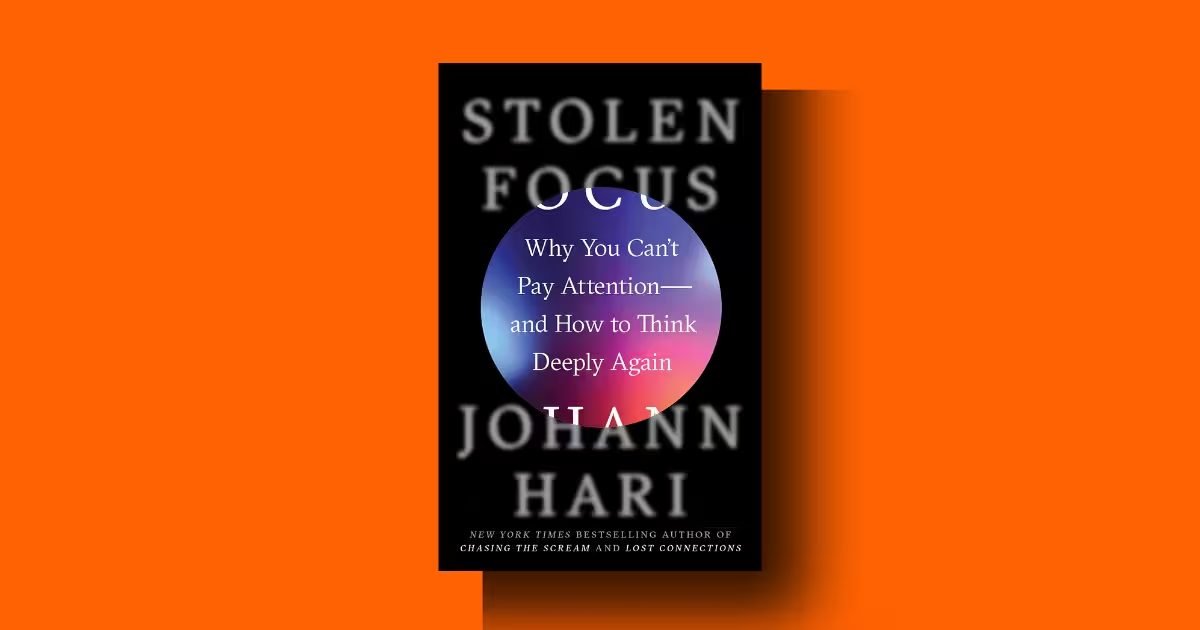
Does it ever feel like your brain has been hijacked? Like you’re constantly swimming against a current just to finish a single thought, read a chapter, or have an uninterrupted conversation? You’re not broken, and you’re not lazy. According to Johann Hari’s groundbreaking New York Times bestseller Stolen Focus: Why You Can’t Pay Attention—and How to Think Deeply Again, your attention hasn’t collapsed—it has been stolen.
Stolen Focus is a 345-page investigation into why our collective ability to concentrate is deteriorating at an alarming rate. Hari, a British-Swiss journalist and author of Chasing the Scream and Lost Connections, spent three years traveling across the globe, interviewing over 200 experts—from neuroscientists at MIT to Silicon Valley defectors to veterinarians diagnosing dogs with ADHD.
His central argument is both liberating and unsettling: this is not a personal failing. We are living in what Professor Joel Nigg calls an “attentional pathogenic culture”—an environment deliberately designed to fragment our focus.
Hari identifies twelve deep causes of our attention crisis, ranging from the obvious (technology designed to hook us) to the surprising (diet, pollution, sleep deprivation, and the confinement of our children).
The book is part memoir (Hari documents his own three-month digital detox in Provincetown), part investigative journalism, and part call to action. He concludes by urging readers to join an “attention rebellion”—a collective movement to reclaim our minds from the forces that have stolen them.
Stolen Focus is best for:
- Anyone who feels their attention span has fragmented and wants to understand why
- People tired of self-help books that blame individuals for systemic problems
- Readers interested in the intersection of technology, psychology, and social policy
- Parents concerned about their children’s relationship with screens and focus
- Those who want practical, evidence-based explanations for modern distraction
Not for:
- Readers seeking a quick-fix self-help manual with 10 easy steps
- People who prefer a narrow focus on technology rather than systemic critique
- Those uncomfortable with Hari’s controversial past (plagiarism admissions) or his polemical style
- Anyone looking for a neutral, balanced treatment of ADHD—this chapter has drawn significant criticism
Table of Contents
Background: Who Is Johann Hari and Why Should You Listen?
Before diving into the book itself, it’s worth understanding the author’s complex background. Johann Hari (born January 21, 1979) is a British-Swiss writer and journalist who rose to prominence as a columnist for The Independent. His previous books—Chasing the Scream (about the war on drugs) and Lost Connections (about depression)—were international bestsellers, translated into 38 languages.
However, Hari’s career has been shadowed by controversy. In 2011, he was suspended from The Independent and subsequently resigned after admitting to plagiarism and fabrications dating back to 2001. He also admitted to maliciously editing Wikipedia pages of journalists who had criticized his work. These revelations have led some critics to question his credibility.
Nevertheless, Hari has publicly acknowledged his failures and attempted to rehabilitate his career. His TED Talks have been viewed over 70 million times, and his work has been praised by figures ranging from Oprah Winfrey to Noam Chomsky.
Stolen Focus won the Porchlight Business Book Award and was named one of the best books of the year by The Wall Street Journal, Financial Times, and New York Post.
Stolen Focus is not a scientific treatise—it’s a work of journalism. Hari synthesizes complex research from neuroscience, psychology, and sociology into an accessible narrative. This approach has both strengths (accessibility) and weaknesses (potential oversimplification), which I’ll explore throughout this review.
Stolen Focus Summary: The 12 Causes of Our Attention Crisis
Hari’s central thesis is that our attention crisis has twelve distinct causes, and understanding each one is essential to solving the problem. Let me walk you through them.
Cause One: The Increase in Speed, Switching and Filtering
Hari begins by documenting how the pace of life has accelerated dramatically. A study of Twitter data found that in 2013, a topic would remain in the top 50 most-discussed subjects for 17.5 hours; by 2016, that had dropped to 11.9 hours. More startlingly, when researchers analyzed books written between the 1880s and the present day, they found that topics have come and gone faster with each passing decade for over 130 years.
The average college student now switches tasks every 65 seconds; the average office worker manages just three minutes of sustained focus; and even Fortune 500 CEOs get only 28 uninterrupted minutes a day.
Professor Earl Miller at MIT explains that “your brain can only produce one or two thoughts in your conscious mind at once”. When we think we’re multitasking, we’re actually “juggling”—switching back and forth rapidly, incurring significant costs: we become slower, make more mistakes, are less creative, and remember less.
Cause Two: The Crippling of Our Flow States
Hari introduces us to Mihaly Csikszentmihalyi, the psychologist who identified “flow”—the state of being so absorbed in an activity that you lose all sense of time and self. Flow is the deepest form of focus we can experience.
To achieve flow, you need three things: a clearly defined goal, an activity that is meaningful to you, and a challenge at the edge of your abilities but not beyond them. Yet our culture of constant interruption actively destroys the conditions for flow.
Cause Three: The Rise of Physical and Mental Exhaustion
Forty percent of Americans are chronically sleep-deprived, getting less than seven hours a night. Since 1942, the average amount of sleep a person gets has been slashed by an hour a night. The average child has lost 85 minutes of sleep every night over the past century.
Sleep deprivation doesn’t just make you tired—it actively impairs your ability to focus. Charles Czeisler at Harvard Medical School found that if you stay awake for 19 hours straight, you become as cognitively impaired as if you were drunk.
Even more concerning, if you miss just a few hours of sleep night after night, within a week or two, you’re at the same level of impairment as someone who stayed up all night.
Cause Four: The Collapse of Sustained Reading
The proportion of Americans who read books for pleasure is at its lowest level ever recorded. Between 2004 and 2017, the proportion of men reading for pleasure fell by 40 percent; for women, it was down by 29 percent. Some 57 percent of Americans now do not read a single book in a typical year.
Anne Mangen, a professor of literacy at Stavanger University, has shown that reading on screens trains us to scan and skim, and this behavior “bleeds over” into how we read on paper. This “screen inferiority” means we understand and remember less of what we absorb on screens compared to printed books.
Cause Five: The Disruption of Mind-Wandering
For over a century, scientists thought attention was simply a spotlight—the ability to narrow focus onto one thing. But neuroscientist Marcus Raichle discovered the “default mode network,” the part of the brain that becomes active when we’re not focused on anything in particular.
Mind-wandering is not a failure of attention—it’s a different and essential form of attention. During mind-wandering, you make sense of the world, make new connections between ideas, and engage in “mental time-travel” that helps you prepare for the future. Yet our culture of constant stimulation is suppressing this crucial cognitive function.
Causes Six and Seven: The Rise of Technology That Can Track and Manipulate You
Hari introduces us to Tristan Harris, a former Google engineer who became one of Silicon Valley’s most prominent critics. Harris explains that social media companies are engaged in what he calls a “race to the bottom of the brain stem”—they’re competing to see who can most effectively hijack our attention.
The business model is simple: the more time you spend looking at screens, the more money these companies make. So they design their products to be maximally distracting. Hari quotes Sean Parker, Facebook’s first president, who admitted: “God only knows what it’s doing to our children’s brains”.
Cause Eight: The Surge in Stress and How It Is Triggering Vigilance
In a YouGov poll commissioned by Hari, 48 percent of people cited stress as the number-one reason for their attention problems. Dr. Nadine Burke Harris, who later became Surgeon General of California, found that children who experienced four or more types of childhood trauma were 32.6 times more likely to be diagnosed with attention or behavior problems.
When you’re stressed, your brain shifts into a state of hypervigilance—constantly scanning for threats rather than focusing on the task at hand. This isn’t a failure; it’s a natural response to danger. But when stress becomes chronic, it wreaks havoc on our ability to pay attention.
Cause Nine and Ten: Our Deteriorating Diets and Rising Pollution
Hari argues that our modern diet—full of processed foods, sugar spikes, and nutrient deficiencies—directly impairs our ability to focus. A Dutch study found that when children cut out preservatives and dyes, over 70 percent improved their ability to pay attention.
Even more alarming is the evidence on pollution. Professor Barbara Demeneix, a French scientist, told Hari: “There is no way we can have a normal brain today”. Air pollution, lead exposure, and endocrine-disrupting chemicals are all contributing to neurological damage that affects attention.
Cause Eleven: The Rise of ADHD and How We Are Responding to It
This is the most controversial chapter in the book. Between 2003 and 2011 alone, ADHD diagnoses in the United States soared by 43 percent. Hari argues that many of these diagnoses may be misattributed—that children are being labeled with a biological disorder when they’re actually responding to environmental stressors.
He presents the case of Dr. Sami Timimi, a British child psychiatrist who argues that “ADHD is not a diagnosis. It’s just a description of certain behaviors that sometimes occur together”. This perspective has drawn fierce criticism from many experts who argue that ADHD has a strong biological basis.
Cause Twelve: The Confinement of Our Children
Finally, Hari argues that we’ve fundamentally changed childhood in ways that damage attention. In 1969, half of American kids walked or biked to school; by 2009, that number had dropped to just 12 percent. Children today are imprisoned in their homes, constantly supervised, and deprived of the free, unstructured play that teaches them how to focus.
Stolen Focus Analysis
Reading Stolen Focus felt like watching a slow-motion car crash where all the passengers have been sedated—and the rest of the world is standing on the sidelines, blaming the passengers for failing to steer. That’s the power of this book: it reframes a problem we’ve all internalized as personal failure into a systemic crisis requiring collective action.
Hari’s greatest strength is his ability to synthesize complex research into compelling narrative. The book is structured around his personal journey—from his three-month digital detox in Provincetown to his interviews with experts across the globe—which makes the science feel human and urgent. As one reviewer noted, “Hari appears to aim at a full-blown takedown of the modern world as we know it”.
I was particularly struck by his argument that our attention crisis is connected to the climate crisis. As James Williams, the former Google strategist, puts it: “The liberation of human attention may be the defining moral and political struggle of our time.
Its success is the prerequisite for the success of virtually all other struggles”. This is a powerful insight: we can’t solve the world’s biggest problems if we can’t focus on them.
However, I have significant reservations about this book. The ADHD chapter, in particular, left me deeply uncomfortable. Hari presents a highly skeptical view of ADHD diagnosis and stimulant medication, relying heavily on anecdotal evidence from a single psychiatrist. This is reductionist and dismissive of the real struggles of people with ADHD. As one critic noted, “The ADHD chapter is shallow and muddled”. Another reviewer called it “ableist” and “frustrating”.
There’s also the question of Hari’s credibility. Given his history of plagiarism and fabrication, readers are right to approach his claims with skepticism. Some critics argue that he “presents well-known concepts and ideas” as if they’re his own discoveries.
This doesn’t invalidate everything he says—the sources he cites are legitimate—but it does mean readers should verify his claims independently.
Strengths and Weaknesses
Strengths
Compelling framing: Hari’s central argument—that attention is not a personal failing but a systemic crisis—is both liberating and accurate. He quotes Professor Joel Nigg, who asks: “If I put you in charge of the world, and you wanted to ruin people’s ability to pay attention, what would you do? Probably about what our society is doing”.
Broad scope: Unlike many books on attention that focus narrowly on technology, Hari examines twelve different causes, from diet to pollution to childhood confinement. This holistic approach is refreshing and necessary.
Powerful anecdotes: Hari’s personal stories—from his godson Adam’s struggle with distraction to his three-month digital detox—make the science feel urgent and human.
Call to action: The book doesn’t just diagnose the problem; it offers a path forward through collective action—an “attention rebellion”.
Weaknesses
Controversial ADHD chapter: This section has drawn widespread criticism for being reductionist, ableist, and dismissive of legitimate medical conditions. Hari’s reliance on a single psychiatrist’s perspective and his skepticism of medication feel one-sided.
Overreach: By blaming “pretty much everything” for our shrinking attention spans, Hari sometimes spreads himself too thin. Each of the twelve causes could warrant its own book.
Credibility issues: Hari’s history of plagiarism and fabrication means readers must approach his claims with caution.
Meandering structure: Some readers find the narrative “meandering” and the solutions “impractical”.
Alarmist tone: The book can feel overwhelming, leaving readers with a sense of dread rather than empowerment.
Comparison with Similar Works
Stolen Focus joins a growing body of literature on the attention economy. It’s most directly comparable to:
The Shallows by Nicholas Carr (2010): Carr’s book was one of the first to warn that the internet was changing how we think. Hari builds on Carr’s work but expands the scope to include diet, pollution, stress, and childhood.
Irresistible by Adam Alter (2017): Alter focuses on behavioral addiction to technology. Hari covers similar ground but adds a more explicitly political and systemic analysis.
Deep Work by Cal Newport (2016): Newport offers practical strategies for cultivating focus in a distracted world. Hari is more interested in diagnosing systemic causes than offering individual solutions.
The Distracted Mind by Adam Gazzaley and Larry Rosen (2016): This is a more scientifically rigorous treatment of the same topic. Hari’s book is more accessible but less precise.
What sets Stolen Focus apart is its explicit call for collective action. Hari doesn’t just tell you to put down your phone; he argues that we need to change the system that’s stealing our attention.
Conclusion: Should You Read Stolen Focus?
Stolen Focus is an important, if flawed, book. It succeeds brilliantly in reframing our attention crisis as a systemic problem rather than a personal failing. The evidence Hari presents—from the 65-second attention spans of college students to the 32.6-fold increase in attention problems among traumatized children—is genuinely alarming.
The book’s greatest contribution is its insistence that we can’t solve this problem alone. As Hari writes, “Systemic problems require systemic solutions”. We need to ban surveillance capitalism, introduce a four-day work week, and rebuild childhood around free play.
However, readers should approach the ADHD chapter with extreme caution. Hari’s skepticism of diagnosis and medication is not supported by the mainstream scientific consensus, and his reliance on anecdotal evidence is troubling.
Who should read this book? Anyone who has ever felt their attention fragmenting and wondered what’s wrong with them. Parents concerned about their children’s relationship with technology.
Citizens who want to understand how our society is being reshaped by forces we can’t see. And anyone who believes that we can do better—that we can build a world where deep thought and sustained focus are possible again.
Stolen Focus won’t give you a quick fix. But it will give you something more valuable: a framework for understanding what’s happening to you, and a reason to believe that it doesn’t have to be this way.