
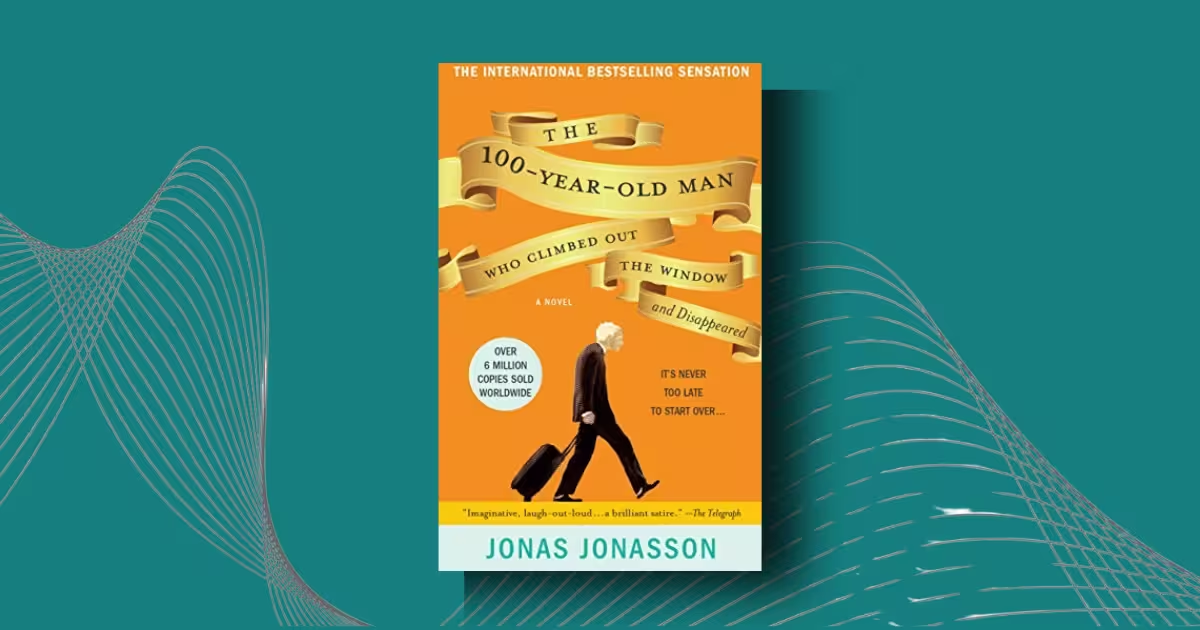
Do you ever feel that life becomes predictable after a certain age? What if, on your 100th birthday, you decided to reject the scheduled party, climb out of your window, and step into an adventure that rewrites your entire story?
The 100-Year-Old Man Who Climbed Out the Window and Disappeared is a satirical novel that follows a centenarian’s spontaneous escape from a nursing home, triggering a wild chase involving stolen cash, gangsters, and an elephant, while weaving in his improbable past as an accidental player in 20th-century world events.
The novel spent over 200 weeks on the Swedish bestseller list, has been translated into 40+ languages, and draws consistent praise for its unique blend of picaresque adventure and historical farce, similar to the success of Forrest Gump.
Best for: Readers who enjoy dry Scandinavian humor, historical satire, and lighthearted adventures with an eccentric cast. Not for: Those seeking serious historical fiction, tight plotting, or deeply emotional character studies.
Table of Contents
Introduction
Title: The 100-Year-Old Man Who Climbed Out the Window and Disappeared
Author: Jonas Jonasson
Publication Details: First published in Sweden in 2009; English translation by Rod Bradbury published in 2012 by Hesperus Press.
This internationally bestselling debut novel took the literary world by storm with its audacious premise and uniquely Scandinavian tone of deadpan humor. It masterfully blends a present-day caper with a sweeping, satirical revision of the 20th century through the eyes of its blissfully apolitical protagonist.
Background
While purely a work of fiction, the novel is steeped in the historical context of the 1900s. Allan Karlsson, born in 1905, lives through virtually every major global event. Jonasson uses this not for a sober history lesson, but as a canvas for farce.
The book playfully inserts its protagonist into the orbits of Franco, Stalin, Truman, and others, satirizing the absurdities of political ideologies and the chaotic nature of history itself.
It reflects a postmodern, almost irreverent attitude towards grand historical narratives, suggesting that chance and simple practicality often play bigger roles than ideology.
The 100-Year-Old Man Who Climbed Out the Window and Disappeared summary
The narrative unfolds in two interwoven timelines: the present-day chase in 2005 and the retrospective story of Allan Karlsson’s long life.
The Present (2005): On the morning of his 100th birthday at the Malmkoping Old Folks’ Home, Allan Karlsson decides he has no interest in the scheduled party with the mayor.
He climbs out his ground-floor window, shuffles to the local bus station in his slippers, and on a whim, steals a large suitcase from a young, unpleasant man who asks him to watch it. The suitcase, it turns out, contains 50 million Swedish kronor, belonging to the biker gang “Never Again.”
Allan boards a bus, and his spontaneous escape becomes a flight. He befriends Julius, a petty thief living in a disused train station, and they are joined by Benny, a former hot-dog-stand owner with multiple almost-degrees, and Gunilla (The Beauty), a fiercely independent woman who owns an elephant named Sonya.
The quartet, plus elephant, find themselves pursued by both the incompetent gangsters from “Never Again” and the baffled police, led by Chief Inspector Aronsson. Their journey across the Swedish countryside is marked by accidental deaths (the gangsters keep meeting unfortunate ends, often involving Sonya the elephant), bumbling misadventures, and the forging of an unlikely family.
The Past (1905-2005): In alternating chapters, we learn Allan’s astonishing life story.
An explosives expert by trade, his apolitical nature and sheer luck place him at the center of seminal world events.
He inadvertently saves Franco’s life during the Spanish Civil War and dines with him, helps the American scientists at Los Alamos solve the triggering mechanism for the atomic bomb (over tequila with Vice President Truman), is recruited by Mao’s wife to blow up bridges in China, and traverses the Himalayas with Iranian communists.
His philosophy, inherited from his mother—“Things are what they are, and whatever will be will be”—allows him to navigate wars, revolutions, and dictators with bland equanimity, more concerned with the quality of the vodka than the political stakes.
The Ending: In the present, after numerous chases and the accidental dispatch of their pursuers, Allan and his new friends—now in possession of the 50 million—successfully fake their own deaths in a bus explosion.
They retire to a luxury hotel in Bali, living out their days in peaceful, wealthy anonymity. The novel closes with the 101-year-old Allan contentedly reflecting on his unexpectedly eventful life, proving it’s never too late for a new beginning.
The 100-Year-Old Man analysis
4.1 The 100-Year-Old Man Who Climbed Out the Window and Disappeared Characters
Allan Karlsson: The centenarian protagonist is the heart of the novel.
His defining trait is a profound and consistent apathy towards politics and ideology. He is a vessel for the novel’s satire; his simple, practical nature (love for vodka, good food, and explosives) contrasts absurdly with the self-important figures of history he encounters.
As he tells various revolutionaries, “I’m not interested in politics… I’ve never voted in my life” (Page 55).
He develops not through internal change, but through the accumulation of incredible experiences. His emotional core is his resigned philosophy, which shields him from trauma but also from deep connection—until he finds his oddball family in the present.
Julius Jonsson: A lifelong small-time criminal with a good heart. He represents the possibility of redemption and friendship in later life. His immediate acceptance of Allan and his expertise in theft and survival are crucial to the present-day plot.
The Beauty (Gunilla Björklund) & Benny: They provide the emotional and logistical backbone of the group. Their budding romance adds warmth, while Benny’s vast but useless knowledge and The Beauty’s no-nonsense practicality (“This is not a damn hotel”) make them endearing and essential.
The Antagonists: The members of “Never Again” and the police are largely comic figures. The gangsters are hilariously incompetent, and Chief Inspector Aronsson is perpetually one step behind, piecing together an increasingly unbelievable story.
4.2 The 100-Year-Old Man Themes and Symbolism
The Absurdity of History: This is the central theme. Jonasson dismantles the “Great Man” theory of history by showing figures like Franco, Truman, and Mao through the eyes of a man who finds them mildly inconvenient dinner companions.
History is portrayed as a series of random, often ridiculous events driven by ego and chance. Allan’s role in the atomic bomb’s creation—solving the problem casually while serving coffee—is the ultimate symbol of this.
Aging and Agency: The novel fiercely rejects stereotypes of passive, declining old age. Allan’s escape is an act of supreme agency. Jonasson writes, “The 100-year-old man set off in his pee-slippers… he told himself that he could die some other time, in some other place” (Page 3). The adventure argues that curiosity and the capacity for change do not diminish with time.
The Virtue of Apathy: In a world torn apart by “isms,” Allan’s peaceful, apolitical stance is presented as a viable, even superior, alternative. His neutrality allows him to survive where ideologues perish. The novel suggests that fanaticism, whether political or criminal, is ultimately self-defeating and foolish.
Found Family: The makeshift family formed by Allan, Julius, Benny, and The Beauty is the true source of happiness and success in the story. It is a family built on choice, mutual need, and acceptance of quirks, symbolizing that meaningful connections can be found at any stage of life.
The 100-Year-Old Man evaluation
The 100-Year-Old Man Who Climbed Out the Window and Disappeared is a delightfully clever and consistently amusing romp that uses its absurd premise to deliver surprisingly sharp satire.
Strengths:
Unique Voice & Humor: The book’s greatest strength is its distinctive, dry, and understated Scandinavian humor. The narration remains deadpan even during the most outrageous events, which amplifies the comedy.
Pacing and Plot: The intercutting between the thrilling present-day caper and the epic historical farce is expertly handled, preventing either timeline from growing stale.
Satirical Brilliance: The historical vignettes are masterpieces of satire. They are laugh-out-loud funny while making a perceptive point about the follies of the powerful.
Weaknesses:
Character Depth: Allan is a brilliant comic device but a somewhat static character. His emotional detachment, while key to the satire, can make him hard to connect with on a deeper level.
Repetitive Structure: The pattern of Allan’s historical encounters—arrive, be indifferent, solve a problem with explosives, share a drink, leave—can feel formulaic after several iterations.
Tonal Consistency: The lighthearted treatment of very dark historical events (the Spanish Civil War, the Atomic Bomb) may not sit well with all readers, though this is clearly a deliberate satirical choice.
Impact: The book is intellectually engaging in its satire and emotionally uplifting in its celebration of late-life adventure. It leaves you with a warm, optimistic feeling and a slightly altered perspective on the headlines of the past.
Comparison with Similar Works: It is most frequently and aptly compared to Forrest Gump for its simple protagonist navigating major historical events. However, Jonasson’s novel is far more cynical, politically pointed, and rooted in European black comedy than the sentimental American film.
Adaptation: The book was adapted into a successful Swedish film in 2013, directed by Felix Herngren.
Comparison: The film is a faithful and energetic adaptation that captures the book’s spirit and humor. It necessarily condenses Allan’s long backstory, focusing on a few key historical episodes, and amplifies the slapstick elements of the present-day chase.
The casting of Robert Gustafsson as Allan is particularly inspired.
Box-Office: It was a major box office hit in Sweden and across Europe, becoming one of the highest-grossing Swedish films of all time.
Personal Insight with Contemporary Educational Relevance
One of the novel’s most resonant themes is its challenge to ageism. In a world where populations are aging rapidly, the book offers a refreshing narrative counter to the pervasive stereotype of the elderly as frail, technophobic, and burdensome.
A 2022 study by the World Health Organization found that ageism remains a globally prevalent and socially normative prejudice, leading to poorer health outcomes and social isolation.
Allan Karlsson is the antithesis of this: he is adaptable, courageous, and technologically savvy enough to evade modern police.
His story is a literary argument for intergenerational solidarity and for designing societies that value the ongoing potential of all citizens.
It suggests that the “silver economy” isn’t just about healthcare, but about adventure, learning, and new friendships—a lesson vital for policymakers and individuals alike. For more on combating ageism, see the WHO’s Global Report on Ageism.
The 100-Year-Old Man Quotes
“Things are what they are, and whatever will be will be.” (Allan’s mother, Page 26) – The novel’s defining philosophy.
“You should beware of priests, my son. And people who don’t drink vodka. Worst of all are priests who don’t drink vodka.” (Allan’s father, Page 102)
“Allan thought about whether he should make the effort to crawl back in through the window to get his hat and shoes, but when he felt his wallet in his inside pocket, he decided that it would suffice.” (Page 3) – Perfectly captures his pragmatic spontaneity.
“The problem was that Allan had been obliged to cheat a little. The trees were not yet fully grown, so the poles were a yard shorter than what had been ordered.” (Julius’s story, Page 13) – Exemplifies the book’s tone of understated chaos.
Conclusion
The 100-Year-Old Man Who Climbed Out the Window and Disappeared is a marvelously entertaining and witty novel that succeeds as both a rollicking adventure and a clever satire of 20th-century history.
While its protagonist may not plumb great emotional depths, the joy of the book lies in its inventive plotting, its consistently funny voice, and its life-affirming message about never being too old to seek freedom and fun.
Recommendation: Highly recommended for fans of offbeat European comedy, historical satire à la Goodbye, Lenin!, or anyone who needs a reminder that life can be an adventure at any age.
It’s a perfect book club pick, promising lively discussion about history, humor, and the art of living.
Final Reflection: In an era often dominated by cynicism and polarization, Jonasson’s book is a significant breath of fresh air.
It proposes that a little indifference to dogma, a focus on simple human decency (and good vodka), and the courage to climb out of your own window might just be the keys to a long and remarkably interesting life.







