
Last updated on January 13th, 2026 at 05:20 am
Do you ever wonder why the pursuit of knowledge can feel like a descent into madness, where ambition devours your health, relationships, and sense of self Katabasis by R.F. Kuang is a razor-sharp dark academia fantasy that transforms the mythical journey to the underworld into a brutal metaphor for graduate school hell, where two rival students risk everything to retrieve their abusive mentor’s soul—only to confront how academia itself is the true inferno of exploitation, burnout, and self-destruction.
Kuang draws from her own PhD experiences at Cambridge and Yale, weaving in real academic pressures that mirror widespread issues: studies show over 40% of graduate students experience severe anxiety or depression (according to a 2021 Nature survey of 6,000+ PhDs worldwide), while reports of mentor abuse and chronic illness stigma in academia are rampant, making the novel’s critiques feel painfully authentic rather than exaggerated.
Katabasis is best for fans of dark academia who crave intellectual depth mixed with visceral emotion—like if you loved The Secret History by Donna Tartt or Babel by Kuang herself—and anyone who’s survived (or is surviving) the soul-crushing grind of higher education.
You’ll devour this if you’re drawn to stories about toxic power dynamics, philosophical riddles, and enemies-to-lovers tension in extreme circumstances.
But not for readers seeking fast-paced action, light escapism, or straightforward fantasy adventures; the heavy exposition on logic paradoxes, mythology, and academic satire can feel dense and slow if you’re not in the mood for brainy debates over plot momentum.
Table of Contents
1. Introduction
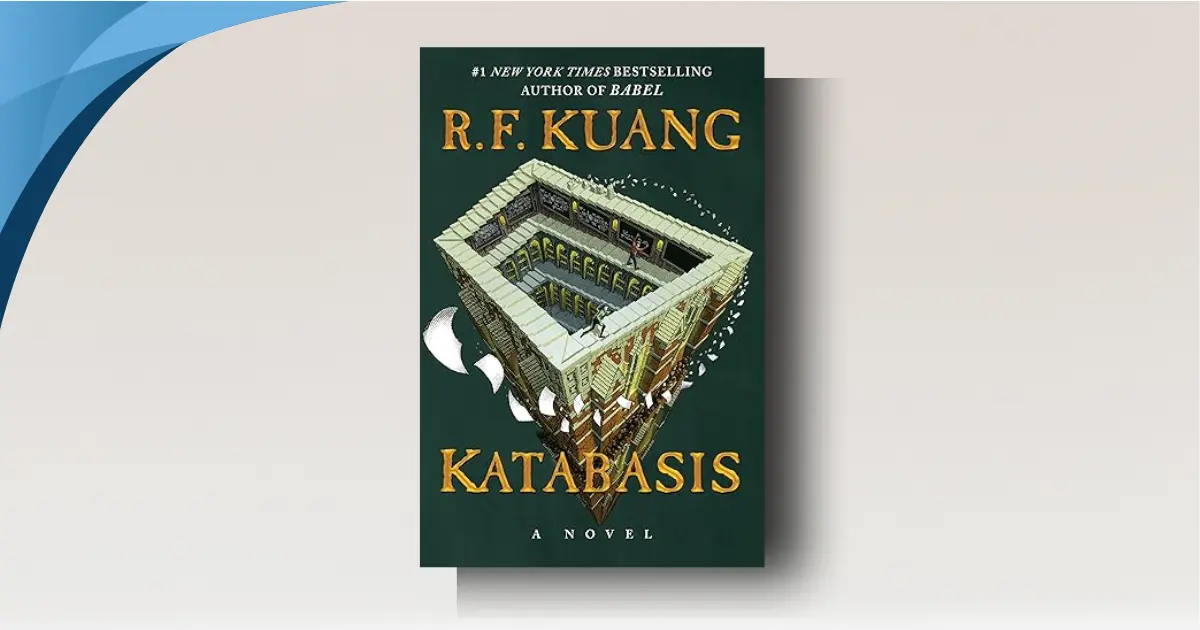
Katabasis is the stunning 2025 standalone fantasy novel by R.F. Kuang, the #1 New York Times bestselling author of Babel and Yellowface.
Published by Harper Voyager on August 26, 2025, this 560-page beast is a dark academia triumph that blends Dante’s Inferno with philosophical puzzles and a scathing takedown of university life.
Kuang, fresh off processing her own PhD turmoil (including her husband’s Crohn’s diagnosis), delivers a story that’s as intellectually thrilling as it is emotionally raw.
2. Background
While Katabasis stands alone—no prior Kuang reads needed—it’s deeply rooted in the dark academia genre that exploded with books like Ninth House by Leigh Bardugo or Vita Nostra by Marina and Sergey Dyachenko.
Historically, “katabasis” refers to ancient Greek myths of descent into the underworld (think Orpheus, Aeneas, or Dante), often symbolizing trials of the soul. Kuang flips this into modern commentary on 1980s-2020s academia, drawing from real-world scandals like professor-student abuse cases (echoing #MeToo in universities) and the mental health crisis in grad programs.
No strict historical events tie in directly, but the novel’s Hell draws from Chinese Diyu mythology (Eight Courts, King Yama) alongside Western classics, reflecting Kuang’s signature cultural fusion seen in The Poppy War trilogy.
3. Katabasis Summary
The novel opens in Cambridge during the chilly Michaelmas Term, in a world where analytic magick is an elite, punishing academic discipline. Spells are drawn with chalk pentagrams, powered by logical paradoxes and precise inscriptions—mistakes can be catastrophic.
Our protagonist, Alice Law, is a fiercely ambitious PhD candidate obsessed with perfection and securing a tenure-track future.
Her advisor is the legendary Professor Jacob Grimes: department chair, Nobel-level genius, charismatic but tyrannical. During a lab session, Alice—exhausted from nonstop work—fails to properly close the loops in a complex pentagram spell.
The result is horrific: Grimes’s body explodes in a gruesome spray, his soul damned to the Eight Courts of Hell (inspired by a blend of Dante’s Inferno and Chinese Diyu mythology).
Devastated but pragmatic, Alice sees this as both her fault and a career-ending crisis. Without Grimes’s glowing recommendation, her dissertation defense and job prospects collapse.
Over the next month, she becomes a Tartarology expert (the rare, dangerous study of journeys to the underworld), poring over fragmented accounts from Orpheus, Dante, Aeneas, and Eliot.
She decides to descend into Hell herself, retrieve Grimes’s soul, and force him back to the living world for that all-important letter. The portal spell demands a steep price: half her remaining natural lifespan. She draws the pentagram meticulously, steps inside… only for her rival, Peter Murdoch, to burst in at the last second.
Peter is the department’s golden boy—disheveled, effortlessly brilliant, with bird’s-nest hair and a charm that masks deeper struggles. Alice resents how he seems to succeed without the grind she endures.
He insists on joining her, paying the same lifespan price, claiming shared responsibility for Grimes’s death.
Reluctantly, she agrees. As they cross over, Hell materializes based on their perceptions: a vast, oppressive wasteland resembling an eternal, gray Cambridge campus under a perpetual sunset, with the real university tauntingly visible high in the sky like a distant heaven. Magick twists here—chalk spells require blood, and paradoxes can trap or liberate.
Even the department cat, Archimedes, casually wanders in and out of the barrier.
Their journey begins in Asphodel, a limbo meadow filled with shades (ghostly souls) of indifferent undergrads who died years ago in a lab accident under Grimes’s negligent supervision.
These shades warn that Grimes has already moved deeper into the Courts. To progress, Alice and Peter scale a massive wall into the First Court: Pride, an endless, labyrinthine library where shades obsessively research futile theses on the nature of “goodness.”
A helpful but increasingly obsessive shade named Moore guides them briefly, but when they express intent to leave, he turns hostile. Alice distracts him with a logical paradox, allowing their escape.
Next comes the River Lethe, the waters of forgetting guarded by the deity Old Lady Meng Po, who tempts travelers to drink and erase their pains.
Alice resists fiercely, flashing back to why: Grimes experimentally tattooed a pentagram scar on her body years ago, granting perfect, painful recall—at the cost of constant torment and no ability to forget trauma.
Peter urges caution as Lethe exposure risks memory loss, but Alice’s immunity (partial, at least) holds. Magick fails conventionally here; they adapt by using blood-chalk.
In the Second Court, Desire—a chaotic student union building where shades loop in endless lustful encounters—bone-things attack: terrifying reanimated skeletons of chalk and bone, controlled by living intruders.
Alice fights viciously, splashing Lethe water on them. Flashbacks intensify: Alice remembers Grimes’s grooming, romantic manipulation, forced witnessing of his affairs, attempted assault, and professional retaliation when she rejected him—leading to her isolation, health collapse, suicidal thoughts, and the fatal lab mistake.
Peter shares vulnerabilities too: his chronic Crohn’s disease (hidden due to stigma), flare-ups mistaken for “genius absences,” surgery, and Grimes stealing his research during recovery, forcing sloppy proofs that contributed to the explosion.
Tensions peak when Alice snoops Peter’s notebook, finding an “organic exchange” spell—she suspects he plans to trade her soul for Grimes’s. In Greed (a marketplace of hoarded knowledge?), mutual suspicions boil: Did Peter spread sabotaging rumors?
Did Alice intentionally kill Grimes? They encounter the Weaver Girl (from Chinese myth), who tests loyalty with red and green apples: choices determining safe passage, betrayal, or entrapment.
Traumatized flashbacks cause Alice to subconsciously choose betrayal; Peter is briefly captured, heightening mistrust.
Bone-things assault again, but they’re rescued by Elspeth Bayes—a poignant shade and former Grimes advisee who suicided after his relentless torment.
Elspeth, ferrywoman-like, explains the self-torturer paradox (logical small choices leading to endless suffering, mirroring PhD burnout) and her own despair.
She warns of the Kripkes: a deranged American magician family (Nick, wife Magnolia, son Theophrastus) who mutually murdered each other to enter Hell, now feral, Lethe-addicted hunters creating bone-things by draining living magicians’ blood.
They’re seeking the Dialetheia—a ultimate true contradiction paradox—to bargain escape with King Yama.
Elspeth, pursuing reincarnation herself, knows the Dialetheia’s location. Desperate, Alice and Peter betray her—trapping her in a paradox pentagram for information.
Furious at learning they want to resurrect abusive Grimes, Elspeth reverses the trap, explodes into wrathful butterflies, and banishes them to isolation.
Stranded in Wrath (stormy plains of rage?), regret forces raw confessions.
Alice details her assault trauma and vengeful plan: not true resurrection, but binding Grimes’s soul to his earthly remains as a tortured puppet.
Peter admits partial blame for the death (stolen work, bad proofs) and his love for Alice, wanting to sacrifice himself via the organic exchange so she escapes with Grimes.
Suspicions dissolve into understanding—Grimes pitted them against each other, exploited vulnerabilities.
Proximity forges tender enemies-to-lovers romance amid horror.
An Escher-like infinite staircase trap by the Kripkes drains them. Peter heroically sacrifices using the Hangman’s Paradox (a logic loop ensuring one escapes), “killing” himself so Alice survives.
Devastated and alone, Alice presses to the City of Dis—the deepest court, a bureaucratic metropolis where shades write endless “crime” dissertations on their sins for potential reincarnation credits.
Guided by shade John Gradus (who embraces uncertainty for rebirth), she navigates bazaars, workshops, and the Rebel Citadel (stagnant shades turning vegetative or leaping into Lethe). Horrified by this eternal academic drudgery, Alice resolves to confront threats.
Stalked and trapped by Kripkes, she turns hunter: crafts bone weapons/armor from a slain leopard, snorts chalk for super-senses.
In brutal fights, she traps the family—pushing Magnolia and Theophrastus willingly into Lethe (erasing memories, causing bodily/mental decay), binding Nick’s soul to Grimes’s rotting remains above for eternal torture while drowning him below.
A fall into Lethe erases Alice’s painful scar-tattoo, freeing her from perfect-memory curse.
Weak but liberated, Alice reunites with remorseful Elspeth—who’d long held the Dialetheia (Kripkes hunted her, not them). Elspeth gifts it for bartering, seeks her own reincarnation; they share a poignant kiss before parting.
Ferried to King Yama’s majestic court, Alice confronts pathetic shade-Grimes: no longer god-like mentor, just a berating, remorse-less petty man begging alliance for eternal research.
Disillusioned, Alice uses Peter’s organic exchange spell—trading Grimes’s soul for Peter’s revival. Yama, moved by their love and sacrifice (or the Dialetheia?), restores half their lost years and permits ascent.
Emerging together, Alice and Peter embrace, kiss passionately. Alice rejects academia’s soul-crushing chains—anticipating simple joys like food, rest, touch—and embraces a future valuing body, connection, and life over mindless ambition.
Grimes remains damned; scars linger, but hope blooms earned through hellfire.
4. Katabasis Analysis
4.1. Katabasis Characters
Alice Law is the beating heart—complex, hypocritical, fiercely intelligent yet self-destructive.
Her arc from idolizing Grimes (internalized ambition blinding her to abuse) to empowered rejection is masterful; the assault reveal hits like a gut punch, explaining her precision obsession and burnout. She’s not always likable (ruthless betrayals, like against Elspeth), but deeply human.
Peter Murdoch starts as the charming rival—effortless genius masking Crohn’s struggles (inspired by Kuang’s husband)—evolving into a noble, flawed hero. His sacrifice redeems unreliability, and the romance builds slowly from mistrust to profound love, feeling authentic amid trauma.
Grimes is a monster unmasked gradually: charismatic authority figure revealed as abuser, thief, manipulator—pathetic in Hell, begging without growth.
Elspeth Bayes shines as tragic survivor-turned-ferrywoman: her suicide backstory critiques academia’s mental toll; betrayal and redemption add layers.
The Kripkes are effective villains—feral, blood-drunk—but slightly cartoonish compared to nuanced protagonists.
Relationships drive impact: Alice/Peter’s enemies-to-lovers is tense, proximity-forged; mentor-student dynamics expose power imbalances devastatingly.
4.2. Katabasis Themes and Symbolism
Academia as literal Hell is the core theme—courts mirror grad life: endless research (Pride), burnout forgetting (Lethe), competition/exploitation (Greed/Wrath). Symbolism abounds: chalk pentagrams for fragile logic holding reality; Lethe as tempting escape from trauma/memories; bone-creatures as reanimated failures.
Deeper meanings: body vs. mind (successful scholars balance both, per Kuang’s notes—Peter’s illness highlights ignoring health for “genius”); ambition’s paradoxes (self-torturer like PhD choices); abuse in institutions (Grimes’s unchecked power); love as salvation (romance enables survival/escape).
Kuang integrates effectively—philosophical debates (Plato, Schrödinger, Nash) feel organic to magick system, not dumped. Chinese Yama/Diyu blends with Dante for cultural commentary on judgment/reincarnation vs. stasis.
5. Evaluation
1. Strengths/pleasant/positive experiences with book
The vivid Hell-scape had me immersed—eternal gray plains, Cambridge-in-sky taunting, bone attacks visceral.
Kuang’s prose is sharp, witty; satire of academia (endless theses, ignored emails) had me nodding/laughing bitterly. Revelations build masterfully—Grimes’s abuse reveal devastated me; Peter/Alice romance felt earned, tender amid horror.
Philosophical layers enriched without overwhelming (mostly).
2. Weaknesses/negative experiences with book
Pacing drags in middle courts—exposition on paradoxes/philosophers stalls momentum sometimes. Kripkes feel undercooked as villains; some resolutions (Elspeth’s MacGuffin return) convenient. Early Alice/Peter tension resolves too neatly into romance for my taste—could’ve lingered on ambiguity.
3. Impact
This resonated hard emotionally—triggered my own grad school memories of burnout, toxic mentors. Intellectually, it challenged me on ambition’s cost; left me reflective, grateful for life’s “trivial” joys post-Hell ascent.
4. Comparison with similar Works
Echoes Piranesi in surreal otherworld exploration, Inferno in structured descent/trials. Darker than The Secret History (more fantasy, less murder mystery); sharper academia satire than Babel (less historical, more personal).
Stands alongside If We Were Villains for campus intensity, but with mythical stakes.
6. Personal insight with contemporary educational relevance
Reading Katabasis hit me during a time when academic mental health crises are headline news—like the 2023 Cornell reports of PhD student suicides amid pressure, or ongoing #MeToo cases exposing professor abuse (e.g., Harvard scandals).
Kuang nails how grad school demands transcending the body—skipping meals/sleep for “dedication”—leading to burnout; stats show 36% of PhDs consider quitting (2022 Berkeley study), with chronic illness stigma worsening isolation (Peter’s Crohn’s arc mirrors real stories).
Thematically, it warns against mentor worship in unequal power structures—relevant amid 2025 pushes for better oversight (see AAC&U reports on mentoring reform).
Ultimately, it’s a call to prioritize humanity over prestige: balance mind/body, seek connection. As someone who’s felt that “hell is a campus” grind, it inspired me to value life beyond credentials. (Read Nature and Insidehighered for more).
7. Katabasis Quotes
- Opening epigraph (Plato’s Phaedo): “For I deem that the true votary of philosophy is likely to be misunderstood by other men; they do not perceive that he is always pursuing death and dying…” —Sets the tone for academia’s self-destructive “pursuit.”
- Early Alice on magick: “Magick demanded precision. She glared at the neat white lines until they swam before her eyes.” (From the proof—captures her obsessive control amid chaos.)
- On Hell/academia: “Hell is a campus.” (Direct indictment—chillingly funny.)
- Alice’s realization post-Lethe: The erasure of her scar symbolizes freedom from trauma/memory’s burden—”She was free, finally, to forget.”
- Climactic barter: Alice to Grimes’s shade: Something like his pathetic begging exposes him as “petty, not deity-like”—no exact quote, but the dismissal of idolized abuser is cathartic.
- Ending reflection: Alice anticipating joys—”material joys and a future with Peter”—underscores theme of life over ambition.
8. Conclusion
Overall, Katabasis left me awed, unsettled, and oddly hopeful—Kuang’s best since Babel, blending fury and tenderness in a way only she can.
It’s significant for unflinchingly exposing academia’s dark underbelly while celebrating intellectual joy and human resilience. Worth reading for its timely warnings and emotional punch.
Highly recommend for dark academia lovers, philosophy buffs, or anyone navigating ambition’s traps—especially grad students/postdocs. Skip if you want pure escapism. This one’s a modern myth that’ll linger.







