
Last updated on October 19th, 2026 at 09:52 pm
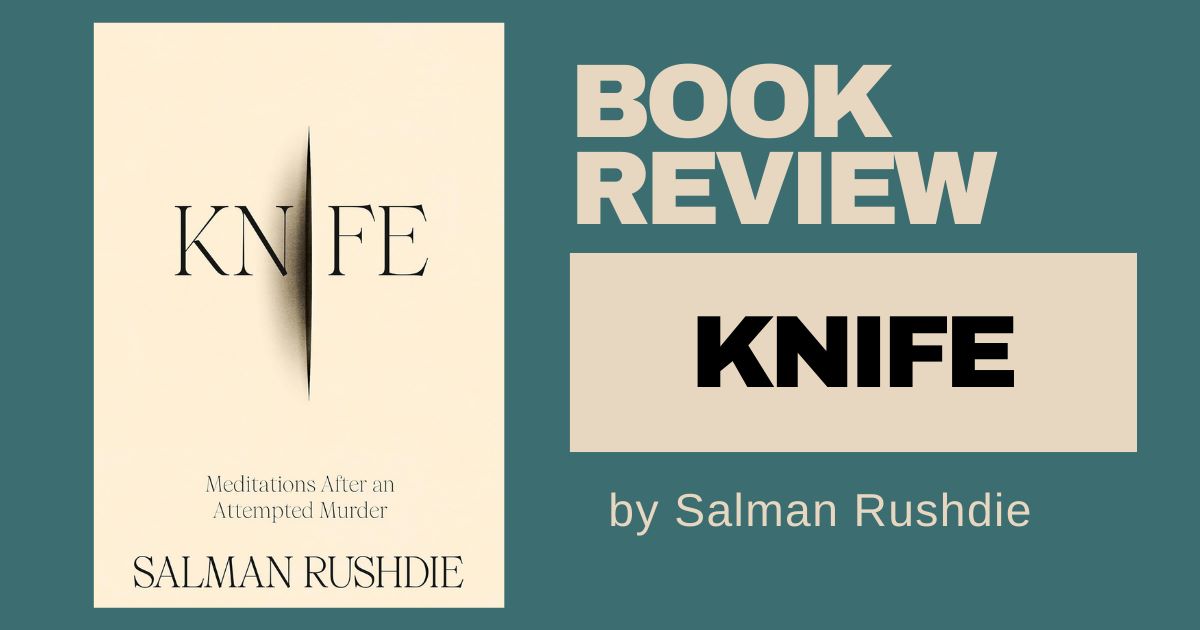
Knife: Meditations After an Attempted Murder by Salman Rushdie was published on 16 April 2024. The US publisher is Random House, and the UK publisher is Jonathan Cape. The memoir concerns the attack on Rushdie at Chautauqua, New York, on 12 August 2022, and the physical, emotional, and intellectual work of rebuilding his life afterward (Penguin Random House publication announcement).
Table of Contents
Knife by Salman Rushdie review
Knife: Meditations After an Attempted Murder is more than Salman Rushdie’s account of surviving a near-fatal attack. I read it as a struggle to recover ownership of a life that political hatred had tried to turn into a public symbol. Rushdie writes about the stabbing, the damage to his body, his wife Eliza’s care, the people who saved him, and the difficult return to ordinary life.
Yet his most interesting question is not simply why someone wanted him dead. It is how a writer can remain himself when violence, religion, public opinion, and even sympathy threaten to define him from the outside.
What are the main lessons of Knife?
Knife is a nonfiction memoir published on 16 April 2024. It recounts the attack on Rushdie at the Chautauqua Institution on 12 August 2022 and his subsequent recovery (publisher’s book announcement).
The most important lessons and arguments are these:
Violence attacks a person’s sense of reality as well as the body. Rushdie describes how an ordinary public event suddenly becomes incomprehensible when an armed attacker rushes towards him.
A person’s public image can become detached from the actual person. Rushdie argues that his attacker knew very little about his writing, yet apparently believed that he understood the author he wanted to kill.
Love is practical work, not merely a comforting idea. His wife, Rachel Eliza Griffiths, remains central to the story of survival, along with medical professionals, friends, family members, and strangers who intervened.
Recovery involves accepting lasting changes. Rushdie survives but loses sight in his right eye and experiences serious damage to his hand and other parts of his body. The memoir does not suggest that survival means returning completely to the person he was before (Associated Press report).
Art can answer violence without pretending to prevent it. Rushdie does not claim that a novel can physically stop an attacker. He argues that writing can preserve truth, challenge false narratives, and refuse the erasure of individual identity.
Closure does not mean forgetting. His return to Chautauqua helps him reclaim a place associated with terror, but the book does not promise that fear, vulnerability, or the past will disappear.
My central conclusion is that Knife is strongest when Rushdie moves beyond the public controversy surrounding him and examines the fragile, imperfect human life beneath it.
Who should read Knife?
I recommend Knife to readers interested in literary memoirs, freedom of expression, political violence, atheism, trauma, and the relationship between art and personal identity. You do not need to have read The Satanic Verses or Rushdie’s earlier memoir, Joseph Anton, to understand the book.
However, some familiarity with the controversy surrounding The Satanic Verses helps explain why the attack carries such historical weight. Readers seeking a neutral investigation into the attacker’s psychology may find the book less conclusive, because Rushdie’s imagined dialogue with his attacker is a literary device rather than a recorded interview or a clinical assessment.
Introduction: What makes Knife different from an ordinary survival memoir?
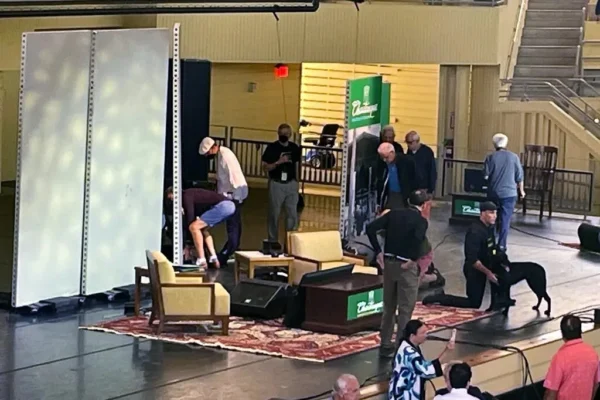
The book begins with an event that could easily dominate everything that follows. On 12 August 2022, Rushdie was about to appear at the Chautauqua Institution in upstate New York for a discussion about keeping writers safe when a man armed with a Knife rushed towards him and attacked him (Random House’s book description).
Rushdie was 75 years old. The assault left him critically injured, and he permanently lost the sight in his right eye. The Associated Press account of his later courtroom testimony provides further reporting on the attack and its consequences.
These facts explain the memoir’s immediate subject, but they do not fully explain its purpose.
Rushdie has spent much of his public life navigating the consequences of the controversy over The Satanic Verses, published in 1988. In 1989, Iran’s then leader, Ayatollah Ruhollah Khomeini, issued a religious edict calling for his death following the controversy over the novel (Associated Press background on the attack). Rushdie had therefore lived for decades with the knowledge that a literary work could influence how strangers perceived and judged his existence.
In Knife, however, he does not simply retell the history of that controversy. He asks what it means to survive an act of violence that seems to bring the past back into the present.
Rushdie’s credentials matter here. He won the 1981 Booker Prize for Midnight’s Children, and his career includes fiction, essays, and earlier autobiographical writing (The Booker Prizes’ author biography). He brings a novelist’s attention to imagery, narrative, irony, and character to an event that might otherwise be presented as a straightforward chronology of injury and treatment.
The title is therefore carefully chosen. The Knife is a physical object, but it also represents a threat to personal freedom, a means of turning a human being into a target, and an image Rushdie repeatedly reconsiders through literature.
What impressed me most is that he does not let survival become the whole meaning of his life. He is determined to remain a writer, a husband, a father, a friend, and a politically engaged individual, rather than become permanently identified with the violence inflicted on him.
Knife summary
The book is divided into two parts, The Angel of Death and The Angel of Life, with eight chapters in total. That structure moves from the attack and its immediate aftermath towards recovery, reflection, and an attempt to reclaim ordinary life.
Part One: The Angel of Death
Chapter 1: Knife
Why does Rushdie begin with the attack instead of offering a conventional life history? Because the assault is the event through which he must reconsider the meaning of everything that came before it.
The memoir opens on the morning of 12 August 2022. Rushdie arrives at the Chautauqua Institution intending to discuss safe spaces for writers alongside Henry Reese, co-founder of City of Asylum Pittsburgh, a project that offers refuge to writers at risk in their home countries.
The irony is immediate. Rushdie is about to speak about protecting writers when the venue itself fails to protect him.
He describes seeing a man run towards him. His response is not the heroic resistance readers might expect from an experienced public figure. He stands there, transfixed, and raises a hand defensively as the attacker begins stabbing him.
This moment leads to one of the chapter’s most revealing observations:
“Violence smashes that picture.” (Knife, Part One, Chapter 1.)
Rushdie is referring to the stable assumptions people bring to familiar places. A school is supposed to be a place of learning; a supermarket is where people shop; a stage is where speakers address an audience. Suddenly, those assumptions no longer make sense.
He uses this experience to examine his own apparent failure to fight back. He wonders whether he was feeble or fatalistic, but eventually acknowledges that an unexpected act of extreme violence can disrupt a person’s ability to understand what is happening.
I found this more compelling than a conventional account of courage. Rushdie does not rewrite himself as a fearless hero after the event. He describes confusion, fear, and paralysis, then tries to understand them honestly.
The chapter also establishes the contrast that shapes the rest of the book. Rushdie experiences the worst of human behaviour in the attacker, but he is saved by other people who intervene at considerable risk to themselves. Henry Reese and audience members help subdue the attacker, while people at the scene provide urgent assistance.
Rushdie thus refuses to make the story entirely about evil. The assault reveals the possibility of cruelty, but the response reveals the possibility of courage.
He also considers the meaning of the attack in relation to The Satanic Verses. He writes that the attacker had read barely two pages of his work and watched a couple of YouTube videos. That detail matters because it complicates the assumption that the assault represented a considered response to the contents of Rushdie’s nove.
The book cannot establish every aspect of the attacker’s motivation from this observation alone. Nevertheless, Rushdie’s question is powerful: what happens when someone forms a murderous opinion of a person without making a serious attempt to understand that person’s work?
The chapter ends with a disturbing recognition. The threat he had imagined for decades has become real, but he has survived long enough to tell the story.
Chapter 2: Eliza
How does Eliza change the meaning of the memoir? She moves it from the experience of an individual victim to the shared experience of two people whose future has suddenly become uncertain.
Rushdie recounts how he met Rachel Eliza Griffiths, a novelist, poet, and photographer, in 2017 through a literary event connected with the PEN America World Voices Festival.
Their relationship develops into a deeply important part of his life. He describes falling in love unexpectedly, finding happiness in companionship, and building relationships with each other’s families. His account includes humour, awkwardness, and the ordinary incidents that make a relationship believable.
These details are important because Rushdie does not introduce Eliza merely to give the book a conventional romantic subplot. Their life together establishes what the attacker threatens to destroy.
When the stabbing occurs, Eliza must confront the possibility of losing her husband. Rushdie also imagines what his death would mean for the people he loves. In the immediate aftermath, his greatest fear is not a philosophical question about mortality but the prospect of dying far from his family, without another opportunity to see them.
The book repeatedly returns to the relationship between private life and public violence. Rushdie is internationally recognised, but the person who lies injured in hospital is also someone’s husband, father, brother, and friend.
Eliza’s role in his recovery becomes tangible. She helps him face the medical consequences of the attack, makes decisions when he cannot manage everything himself, and protects him from some of the emotional impact of seeing his injuries.
I particularly liked the way the memoir gives attention to the ordinary parts of love. Care does not happen only in declarations of devotion. It means remaining present when the future is uncertain, helping someone through humiliating medical procedures, and continuing to believe in a shared life when neither person knows what that life will look like.
The chapter therefore prepares us for the book’s central contrast. Violence tries to reduce Rushdie to a target. Love insists that he is a whole person with relationships, memories, habits, and responsibilities.
Chapter 3: Hamot
What does the hospital section reveal about survival? It reveals that being kept alive is only the beginning of a long and uncertain process.
Rushdie is taken to UPMC Hamot in Erie, Pennsylvania, after the attack. The book describes serious wounds to his neck, chest, hand, and face, together with the devastating injury to his right eye.
He undergoes emergency treatment and surgery. Parts of his intestine have to be removed, his liver has been damaged, and the medical team must address multiple injuries. His hand suffers serious damage to tendons and nerves. These details are consistent with reporting about the attack and Rushdie’s subsequent testimony (Associated Press, February 2025).
The account is sometimes difficult to read because Rushdie does not turn his body into an abstract symbol. He writes about pain, the loss of privacy, helplessness, and the strange distance that can arise between one’s experience and what other people observe.
He also admits that his memory is incomplete. He remained partly aware during the emergency, but painkillers, shock, and confusion affected his recollections. As he explains at the beginning of the book, the narrative is partly assembled from memories and partly from what other people subsequently told him.
That admission strengthens the memoir. He does not pretend that suffering automatically produces perfect knowledge. Instead, he distinguishes what he remembers from what he learned afterward.
The hospital chapters also describe the people who keep him alive. Doctors and nurses treat his injuries, family members travel or follow his condition from a distance, and Eliza remains close to him. The rescue at the amphitheater is followed by another kind of collective effort, this time involving medical professionals.
Rushdie’s reflections on mortality remain grounded in his physical experience. He does not report a supernatural revelation or claim that the attack supplied proof of an afterlife. His account is personal rather than doctrinal.
The most important idea here is that survival depends on both individual will and the work of others. Rushdie’s desire to live matters, but it cannot replace surgery, medical attention, rehabilitation, or companionship.
Chapter 4: Rehab
Does Rushdie’s survival mean that he can simply return to his former life? No. The rehabilitation chapters show how much work stands between staying alive and regaining independence.
Recovery brings its own frustrations. Rushdie has to learn how to manage his altered body, rebuild strength, and deal with lasting physical limitations. His damaged hand needs therapy, his eyesight has changed permanently, and the simplest daily tasks can become difficult.
The loss of sight in his right eye is especially important. For a writer who has depended on reading and writing throughout his adult life, the change requires adjustments that cannot be solved by determination alone.
Rushdie also struggles with the psychological effects of the assault. The body may be healing, yet the mind keeps returning to what happened. He describes nightmares, discomfort, fear, and impatience with the slow pace of recovery.
At one point, he remembers the importance of Victory City, the novel he had been preparing for publication. Its emphasis on the power of words gives him a reminder of his life as a writer. The book’s closing idea, “Words are the only victors,” becomes particularly moving in the circumstances.
Here, art does not function as a magical treatment. It gives Rushdie a reason to keep looking forward and helps reconnect him with the work that existed before the attack.
The chapter also explores the indignities of dependency. Other people must help him with tasks he once performed without thinking. His recovery takes place in hospital and rehabilitation settings rather than through a dramatic return to independence.
That is one of the most convincing features of the memoir. Rushdie does not present healing as an inspirational sequence in which each day brings an obvious improvement. He shows a slower process, marked by physical limitations, frustration, patience, and occasional relief.
Part Two: The Angel of Life
Chapter 5: Homecoming
What does going home mean after a life-threatening attack? For Rushdie, it means recovering some control over his daily life while learning that home can no longer be treated as an entirely separate space from danger.
He eventually leaves rehabilitation and returns to a more familiar environment. Being surrounded by his books and domestic possessions helps him reconnect with the identity that the attack disrupted.
Yet homecoming is not the same as complete recovery. Rushdie still needs rehabilitation, assistance, security, and further medical attention. The memoir describes continued difficulties, including uncertainty about his health and anxiety about what lies ahead.
He gradually resumes public life, although with new precautions. A return to a restaurant or another public venue becomes a meaningful event because it shows that he is willing to live in the world again.
Rushdie’s relationship with Eliza remains central. Their shared experiences change how they understand safety and intimacy. The attack threatens both his life and the future they had begun to imagine together, yet they continue to build that future.
The chapter’s emotional force comes from the modesty of its achievements. Going outside, seeing friends, attending an event, or working at a desk may not appear extraordinary. After a near-fatal assault, however, these actions signify the gradual recovery of freedom.
The distinction matters. Rushdie does not suggest that survivors should be expected to overcome every fear or return immediately to their former routines. Rather, he shows how a person can begin to reclaim a life while accepting that some changes will remain.
Chapter 6: The A.
Can Rushdie explain the mind of the man who attacked him? He tries, but the chapter makes clear that imagination cannot supply certainty where direct knowledge is missing.
This is one of the book’s most unusual sections. Rushdie constructs an imagined conversation with his attacker, whom he calls “the A.” throughout the memoir.
The conversation did not take place. Rushdie is not reproducing an interrogation or claiming to have access to the attacker’s private thoughts. He invents a dialogue to test possible explanations for the assault and to challenge the ideology he associates with the attacker.
The fictional encounter touches on religion, identity, masculinity, American society, online information, and the appeal of belonging to a cause that promises moral certainty.
Rushdie repeatedly presses the imagined attacker to explain why he believes he has the authority to judge another person’s life. The responses reveal a person whose understanding of the world appears to depend on simplified categories of good and evil.
The exchange also asks how someone can become convinced that violence is justified without seriously engaging with the person being targeted.
One of Rushdie’s central observations is that the attacker knew little about his writing. The contrast between Rushdie’s complex literary career and the attacker’s apparent confidence in his judgment becomes a criticism of ideological thinking. A person can become the object of intense hatred without being understood as a person.
The chapter is compelling because Rushdie uses the tools of fiction to address something that factual narration alone might not resolve. His imagined dialogue gives form to questions that remain unanswered.
However, it also has a limitation. Because the conversation is fictional, it cannot serve as proof of the attacker’s internal motives. Readers should distinguish Rushdie’s interpretations from independently established facts about radicalisation. The chapter is most persuasive as a literary and moral inquiry, not as a psychological case study.
Even so, the technique reinforces the book’s wider purpose. Rushdie has long been described through the controversy surrounding his writing. Now, in a reversal, he attempts to understand the man who decided to kill him without treating that man as a complete explanation of his own life.
Chapter 7: Second Chance
What does a second chance mean when life cannot be restored exactly as it was? Rushdie’s answer is that survival provides an opportunity to continue living and creating, not a guarantee of returning to the past.
In this section, he considers the value of a life that has been interrupted. The attack has changed his body, his relationships, his sense of security, and his awareness of mortality. He cannot simply erase those changes.
He also returns to the question of writing. The memoir itself is an act of authorship, but it emerges from an event he would rather not have experienced. Rushdie had intended to concentrate on fiction, yet the experience of the stabbing becomes so pressing that he must address it in nonfiction first.
The tension is important. He does not want his public identity to become permanently attached to violence, but he cannot honestly pretend that the event has not altered his life.
Rushdie also considers the deaths of friends and the broader political conditions of the world around him. Personal survival does not remove him from public responsibility. His account suggests that a second chance should not be spent entirely on private comfort when political falsehoods and violence continue to affect other people.
I found this part particularly revealing because it complicates the usual survivor narrative. Survival is not presented as a simple reward or a proof of moral superiority. It is an uncertain opportunity to continue working, maintaining relationships, thinking independently, and participating in public life.
Chapter 8: Closure?
Does Knife end with complete closure? No. Rushdie offers a more realistic conclusion in which he begins to accept what happened without allowing the attack to dictate his whole identity.
The question mark in the chapter title matters. Closure is not a switch that can be turned on after physical recovery. It involves deciding how much space the event will occupy in the future.
Rushdie revisits his relationship with the past, the public image attached to his name, and the question of whether the attacker has succeeded in changing the kind of writer he will become.
He also restates his position on religion. He is an atheist, but he acknowledges that faith can serve as a moral anchor for many people. His objection arises when religion is politicised or used to justify imposing beliefs on others.
The book moves towards a practical rather than supernatural conclusion. Love and work remain important. So does the duty to oppose false narratives that permit or encourage violence.
The final movement returns to Chautauqua. Thirteen months after the attack, Rushdie goes back to the place where he nearly died and stands on the stage again.
This return provides an effective ending because it is an action, not merely a declaration. He cannot undo the assault, restore his lost sight, or guarantee his safety. But he can decide to occupy the place again and continue living as a writer.
For me, that is the book’s most persuasive account of closure. It means refusing to surrender the future, not pretending the past has ceased to matter.
What is the central argument of Knife?
The central argument is that political violence tries to take control of a person’s life story, while writing allows that person to resist the meanings imposed on them.
This idea links several otherwise different parts of the memoir.
First, Rushdie describes his attack as a return of the past. The threat associated with The Satanic Verses had shaped his life for decades, and the stabbing makes that old threat physically immediate again.
Second, he considers the difference between his actual identity and the identity attributed to him. His writing career is long and varied, but public discussion of his life often centres on one controversial novel and the threats surrounding it.
Third, he examines the attempt to restore ordinary life after physical violence. The process involves accepting the consequences of the attack rather than treating them as an episode that can be neatly removed from the story.
Finally, he uses the memoir itself to reclaim the power of narration.
In an interview reported by the Los Angeles Times in April 2024, Rushdie described writing the book as a way of “taking the power back” (Los Angeles Times interview report).
That phrase captures an important distinction. Writing cannot reverse the physical harm, but it can challenge the idea that the person responsible for the harm gets to determine what the event means.
This argument is also why the memoir’s apparently digressive sections matter. Rushdie moves between personal memories, literary references, philosophical questions, and political commentary because he is trying to recover the complexity that violence and public controversy reduce.
A human life is not a single event, a political slogan, or an easily defined moral category. Knife insists that Rushdie remains more than the controversy attached to his name.
Why is the title Knife so important?
The Knife is both the instrument of the attack and the book’s central metaphor.
As a weapon, it represents the physical closeness of the assault. Rushdie describes the attack as an intimate encounter forced upon him by a stranger. There is no distance between the attacker and the victim, no possibility of treating the weapon as an abstract political idea while ignoring the body it injures.
Yet Rushdie’s literary imagination also gives the Knife other meanings. He thinks about knives in fiction and film, including works in which a blade represents danger, a turning point, or the opening of another possibility.
This is where the memoir becomes more than an account of an injury. Rushdie asks what a weapon can mean in a culture that repeatedly uses stories to justify violence.
The Knife cannot speak for itself. Its meaning comes from the person who wields it and the circumstances in which it is used. The same is true of language, which can be employed to threaten and manipulate but also to question authority and expose falsehood.
In the rehabilitation section, Rushdie expresses this idea directly:
“Language, too, was a knife.” (Knife.)
The metaphor is effective because it avoids a simplistic division between violent objects and harmless words. Language can cause harm, but it can also cut through deception. For Rushdie, writing becomes a means of resisting the attempt to silence him.
I found this one of the most distinctive ideas in the book. The title initially suggests the object that nearly killed him. As the memoir unfolds, it also points towards the instrument through which he chooses to answer that experience: language.
5. How does Rushdie portray love and recovery?
Rushdie presents love as one of the conditions that make survival meaningful, but not as a substitute for medical care or the difficult work of rehabilitation.
Eliza’s presence gives the account much of its emotional weight. She does not experience the attack from the same physical position as Rushdie, yet she must live with the possibility that he will die and with the uncertainty of his future condition.
Her care is concrete. She helps him through recovery, supports his independence, and remains part of the work required to build a future after the attack.
The memoir also credits people outside the relationship. Audience members intervened during the assault. Medical professionals treated Rushdie’s injuries. Family members and friends supported him during a frightening period. This collective response challenges any interpretation of survival as the achievement of one exceptional individual alone.
Still, the book does not turn these people into interchangeable symbols of goodness. Rushdie’s personal relationships, humour, and recollections give the account an everyday quality that keeps the theme of love grounded in experience.
One of the most moving aspects of the recovery narrative is its attention to practical indignities. The injured person must accept help with tasks that were previously private and ordinary. Independence has to be rebuilt one action at a time.
This makes the memoir more honest than a story in which love magically heals everything. Rushdie’s injuries remain real, and some of their consequences are permanent. His relationship with Eliza does not undo the damage. It helps him imagine a life in which the damage does not have the final word.
The Guardian review by Blake Morrison describes the book as “a story of hatred defeated by love.” I agree with that reading, although I would add that love’s victory is practical rather than absolute. The hatred still existed, the injuries remained, and the danger could not simply be forgotten.
What changes is Rushdie’s willingness to continue living and working in spite of those facts.
6. Does Knife make a convincing argument about religion and political violence?
Rushdie makes a clear argument that freedom of belief does not justify violence or the imposition of religious authority on others.
His position is not that religious people cannot live ethical lives. He acknowledges that religion provides meaning and moral structure for many people. His criticism focuses on the point at which religious belief becomes a political instrument used to limit freedom or justify harm.
This distinction is important. The book is written by an author whose life has been shaped by a long-running controversy over religion and literature. He has strong reasons to defend the right to question religious ideas, including ideas that others hold sacred.
He does not apologise for his views in the memoir. Instead, he argues that ideas should be answered with other ideas, criticism, satire, and debate rather than threats and violence.
I find this argument persuasive as a defence of freedom of expression. The ability to question a belief is an essential part of intellectual freedom, and the use of force to silence an author cannot be justified simply because readers find a work offensive.
However, the memoir is openly polemical. Rushdie’s account reflects his own atheism and his experience of being threatened. It should therefore be read as a personal argument about freedom and violence, not as a comprehensive study of religion or of every form of religiously motivated extremism.
That limitation does not diminish the central point. Readers do not have to agree with Rushdie’s views on religion to recognise that disagreement cannot justify murder.
What does Rushdie say about online radicalisation and false narratives?
Rushdie suggests that the attacker was influenced by a simplified image of the author and by online material that supplied a hostile framework for understanding him.
In Knife, the detail that the attacker had read little of Rushdie’s work becomes central to this concern. Rushdie contrasts the complexity of a writer’s actual work with the confidence of someone who believes he knows enough to condemn its author.
The imagined conversation in Chapter 6 expands this theme. Rushdie considers how digital media, group thinking, and political or religious narratives may contribute to a person’s sense of identity and purpose. He asks how someone can become convinced that violence is an acceptable response to a person they scarcely understand.
This is a meaningful question for the present, but the evidence must be treated carefully.
The book offers Rushdie’s interpretation of his attack and the ideological environment surrounding it. The imagined conversation is not a transcript of the attacker’s testimony. Nor does the memoir provide a controlled study proving that a particular platform, video, or online community caused the assault.
For those reasons, I would not use Knife as a standalone source for broad statistical claims about online radicalisation. A reader researching that subject should supplement the memoir with independent research and reliable reporting.
Its contribution is different. Rushdie gives a human example of what can happen when a public figure becomes a symbol in someone else’s story. The attacker appears to have acted against an image of Rushdie rather than an informed understanding of his literary work.
The wider question is how societies can encourage people to examine claims, question sources, and recognise the difference between criticism and dehumanisation.
Rushdie cannot answer every part of that question, but his personal account shows why it matters.
How convincing is Rushdie’s writing and reasoning?
Rushdie is most convincing when he distinguishes his own memories from information gathered later and when he acknowledges what he cannot know.
The opening account makes clear that his recollection of the assault is not complete. He combines his memories with information from witnesses and news reports. This gives the narrative a degree of honesty that would be absent if he presented every detail as certain.
The book is also careful about the attacker’s identity. Rushdie calls him “the A.” rather than repeatedly granting him the attention of a named character. The choice reflects Rushdie’s refusal to let the assailant become the central figure in the author’s own life story.
However, this narrative decision has consequences. It creates a strong literary contrast between the author and the attacker, but it may also limit a reader’s ability to understand the perpetrator beyond the role he occupies in Rushdie’s reflections.
The imagined dialogue partially addresses that limitation, but it cannot resolve it. Rushdie’s questions are real; the replies are a fictional construction. The distinction matters for any serious reader who wants to separate established facts from interpretation.
The memoir also moves between intensely personal material and broader political commentary. At times, these transitions can feel abrupt. A reader who wants a tightly argued study of political violence might prefer more external evidence and less personal association.
Yet I would not judge the book by the standards of a social science monograph. Its purpose is to make sense of an experience through autobiographical writing. Rushdie’s willingness to acknowledge uncertainty and to leave some questions unanswered is a strength within that genre.
The book fulfils its purpose because it does not pretend to offer a complete explanation of an incomprehensible act. It shows how a writer tries to live with what happened and decide what to do next.
9. What are the strengths and weaknesses of Knife?
Strengths
The narrative voice remains personal. Rushdie writes about the attack with immediacy, but he also retains his humour, self-awareness, and distinctive literary style. The result is a memoir that feels connected to the writer’s wider body of work rather than detached from it.
The recovery is described without false simplicity. The physical consequences of the assault are lasting, and ordinary tasks become difficult. Rushdie shows that survival requires continued effort and support rather than a single decisive act of courage.
The role of other people is taken seriously. Eliza, the medical teams, Henry Reese, audience members, and others all contribute to the story. The memoir does not imply that Rushdie recovered by willpower alone.
The book has a strong central metaphor. The Knife begins as a physical weapon and becomes a way to think about language, identity, and the relationship between violence and art.
The return to Chautauqua provides a meaningful ending. Instead of claiming that the attack has been forgotten, Rushdie shows himself returning to the place where he nearly died. This gives the conclusion an action that supports its central argument.
Weaknesses
The book is openly partisan. Rushdie’s criticism of religious and political extremism follows naturally from his experience, but readers seeking an impartial account of all the issues surrounding the attack will need additional sources.
The imagined dialogue cannot establish motive. It is an ambitious literary section, but its invented responses should not be mistaken for direct evidence of what the attacker thought.
The digressions may distract some readers. Rushdie makes frequent literary, cultural, and political associations. These passages reveal how his mind works, but they occasionally pull attention away from the central narrative.
The memoir does not offer a complete medical or psychological study. Rushdie describes his own experiences rather than presenting a clinical account that can be generalised to all survivors of serious violence.
I also understand why readers may react differently to Rushdie’s personality on the page. In her Guardian review, Rachel Cooke praises aspects of the writing while criticising its self-regard. Blake Morrison’s review for the same newspaper is more warmly affirmative.
Those different responses point to a genuine feature of the memoir. Rushdie does not disappear behind the suffering he describes. His confidence and self-consciousness remain visible, and some readers will find that invigorating while others will find it excessive.
For me, that quality makes the book more interesting, not less. Its author is trying to retain his identity rather than replace it with an artificially modest version of himself.
How does Knife compare with similar books?
Readers interested in Knife may find the following books useful comparisons, although each explores survival and personal identity from a different perspective.
Joseph Anton: A Memoir by Salman Rushdie
Rushdie’s earlier memoir, Joseph Anton, concerns the years shaped by the threat following the controversy over The Satanic Verses. It offers the most direct comparison because it examines the long-term effects of threats, public controversy, and the struggle to preserve a writing life.
The distinction is that Knife places physical injury and recovery at the centre. Its question is not only how to continue living under threat, but how to rebuild a daily life after violence has actually occurred. Rushdie’s own account in Knife explicitly distinguishes the earlier period from the new crisis.
Disturbance by Philippe Lançon
Philippe Lançon’s Disturbance, also published in English as The Flap, is a memoir associated with his survival of the 2015 Charlie Hebdo attack in Paris. The book examines severe injury, recovery, memory, and the effort to reconstruct an ordinary life after violence.
A useful discussion of the relationship between these works appears in The Christian Century’s review of Rushdie’s return to Chautauqua.
Both memoirs demonstrate that survival does not end when an injured person leaves the hospital. The body, relationships, and sense of self require continued attention.
The Year of Magical Thinking by Joan Didion
Joan Didion’s The Year of Magical Thinking examines grief after the sudden death of her husband. It differs from Knife because its central experience is bereavement rather than attempted murder. Nevertheless, both books show how an unexpected event can disrupt a person’s assumptions about ordinary life.
The comparison is useful for understanding Rushdie’s treatment of memory and time. A life-changing event does not remain safely in the past simply because the event has ended. The surviving person must find a way to live with its continuing effects.
Salman Rushdie: Through a Glass Darkly
The BBC documentary Salman Rushdie: Through a Glass Darkly offers a related audiovisual account of the attack and its aftermath. The Guardian review of the programme discusses its use of material also found in the memoir.
For readers who want to compare Rushdie’s written account with a documentary presentation, it provides a useful companion. I would still recommend reading Knife first because its literary references, narrative choices, and imagined dialogue are central to understanding how Rushdie makes meaning from the event.
What happened after the events described in Knife?
The memoir closes with Rushdie revisiting Chautauqua approximately thirteen months after the attack. Subsequent court proceedings took place after the period covered by his account.
In February 2025, Hadi Matar was convicted in New York state court of attempted murder and assault. In May 2025, he received a 25-year state prison sentence for the attack, with a concurrent seven-year sentence for the assault charge (Associated Press report on the sentence).
Later, on 29 July 2026, a federal jury convicted Matar of three terrorism-related offences connected with the attack, including attempting to provide material support to Hizbollah and engaging in an act of transnational terrorism (US Department of Justice announcement). This is later legal context, not a conclusion contained in Rushdie’s 2024 memoir.
These developments add information about the legal consequences of the assault, but they do not replace the memoir’s central purpose. Knife is not principally a trial record. It is Rushdie’s account of how he experienced the attack and attempted to recover his physical independence, relationships, and identity.
That distinction is important when reading the book today. We now know more about the legal outcome, but the questions Rushdie asks about language, freedom, love, and the lasting consequences of violence remain relevant independently of the verdicts.
Final verdict: Is Knife by Salman Rushdie worth reading?
Yes. Knife: Meditations After an Attempted Murder is a powerful and often moving memoir that turns an experience of extreme violence into an argument about personal identity, freedom of expression, and the work required to continue living.
What makes the book memorable is not the suffering alone. Rushdie has the literary ability to connect physical experience with questions about stories, political belief, religion, and the way public narratives can distort individuals. He also retains enough humour and self-awareness to keep the memoir from becoming an uncomplicated account of heroic survival.
I found the relationship between the Knife and language especially effective. One is used to injure and threaten; the other becomes Rushdie’s means of answering the experience without surrendering his identity to it. The imagined dialogue with the attacker is less conclusive, but it shows the limits as well as the possibilities of using fiction to confront an event that resists explanation.
The book’s strongest lesson is not that love conquers every form of hatred, or that writing can undo physical damage. It is that a person can continue to choose relationships, creative work, and independent thought even when violence has permanently changed the conditions of life.
Rushdie’s return to Chautauqua provides the right ending because it shows that choice in practice. He does not recover his former body or erase the past. He returns to the place where he nearly died and stands there again.
That is why I recommend Knife to general readers as well as people interested in literature, political history, and freedom of expression. It is personal without being merely private, political without losing sight of the body, and hopeful without pretending that recovery is easy.
My rating: 4.5 out of 5 stars. It is an affecting, intellectually engaged memoir, particularly strong in its treatment of narrative identity and recovery. Its digressions and speculative account of the attacker’s thinking may not appeal to every reader, but they do not undermine its overall achievement.
Knife: Meditations After an Attempted Murder
Knife: Meditations After an Attempted Murder by Salman Rushdie was published on 16 April 2024. The US publisher is Random House, and the UK publisher is Jonathan Cape. The memoir concerns the attack on Rushdie at Chautauqua, New York, on 12 August 2022, and the physical, emotional, and intellectual work of rebuilding his life afterward (Penguin Random House publication announcement).
URL: #
Author: Salman Rushdie
4.5
Pros
- Powerful personal writing; vivid depiction of recovery; effective central metaphor; thoughtful defence of freedom of expression; moving portrayal of love and human courage
Cons
- Occasional digressions; openly partisan treatment of religion and politics; imagined dialogue cannot establish the attacker's actual motives







