
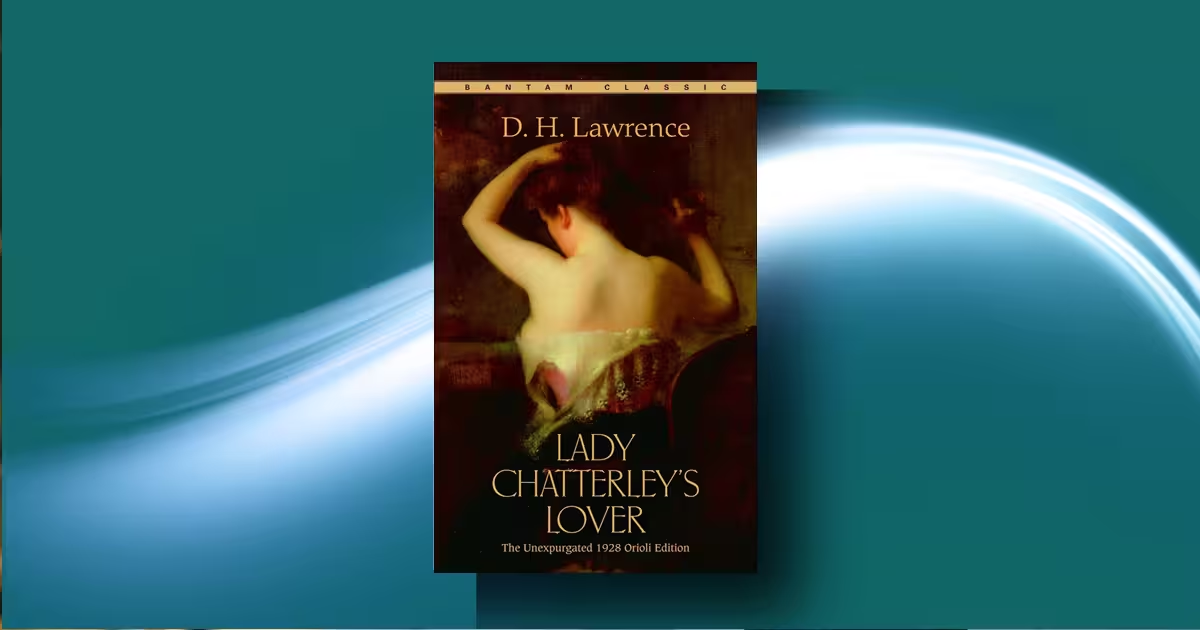

Does it ever strike you in the middle of a perfectly comfortable life — good job, decent income, maybe even a partner — that something essential is still missing, as though your body and your mind have stopped talking to each other? D.H. Lawrence knew that feeling in 1928, and he wroteLady Chatterley’s Lover about it.
Lady Chatterley’s Lover is not, at its heart, a scandalous love story — it is a devastating diagnosis of how industrial society teaches human beings to amputate their own feeling selves, and a fierce argument that tenderness, not class, is the only thing that can put us back together.
Lady Chatterley’s Lover is best for readers who want literary fiction with ideas that bite; anyone interested in class, gender, and emotional repression; students of modernism or censorship history; fans of Anna Karenina, Madame Bovary, or Women in Love.
Not for readers who need a fast-moving plot — this novel moves at the pace of the English countryside. Also not for those who expect titillation as the main event; Lawrence is far more interested in the philosophy of the body than in the body itself.
Table of Contents
1. Introduction
Lady Chatterley’s Lover is the final novel by the English writer David Herbert Lawrence (1885–1930), first published privately in Florence, Italy, in 1928, under the imprint of bookseller Giuseppe Orioli.
The third and final version of a manuscript Lawrence worked on obsessively through illness — it was written during the winter of 1927–28 in a state of near physical collapse — it became one of the most fiercely debated, banned, celebrated, and misread books of the twentieth century.
The Grove Press unexpurgated American edition appeared in 1959 after a landmark legal victory, and the unexpurgated British edition followed in 1960 after a watershed obscenity trial against Penguin Books — a trial the prosecution famously lost.
Today, Lady Chatterley’s Lover stands not as a period curiosity about sex and censorship but as a still-urgent work of social philosophy, whose central argument — that industrial modernity has severed human beings from their own bodies, their own tenderness, and each other — feels, if anything, more relevant now than when Lawrence first put it on paper.
2. Background
Historical Context
Lawrence wrote Lady Chatterley’s Lover against the scarred backdrop of post-World War One Britain. The Great War had shattered the aristocratic myth of ruling-class invincibility; the coal industry — the economic spine of the English Midlands where Lawrence himself was born and raised — was visibly declining.
The General Strike of 1926, which Lawrence witnessed firsthand, had exposed the depth of class antagonism in British society. Unemployment was endemic, industrial communities were rotting, and the old hierarchies were fracturing without any new vision of human connection to replace them.
Lawrence was the son of a Nottinghamshire coal miner — he knew working-class England from the inside, viscerally, bodily. He also knew, through his education and his international literary life, the cold intellectual culture of the British upper classes. Lady Chatterley’s Lover sits precisely at that intersection.
It is, accordingly, not merely a love story across class lines. It is a reckoning with what England — and by extension industrial modernity — had done to the human animal: clapped it in a wheelchair, handed it a radio set, and called it civilized progress.
Lawrence was also dying. By the time he completed the third version in January 1928, tuberculosis was consuming him. He would be dead by March 1930, aged forty-four. There is an urgency in the novel that cannot be separated from this fact — the ache of a man who knows the body is finite, precious, and being squandered.
3. Lady Chatterley’s Lover Plot Summary
Part One: The World That Has Fallen
Lady Chatterley’s Lover opens with one of the most striking first sentences in twentieth-century fiction: “Ours is essentially a tragic age, so we refuse to take it tragically.” This is not just atmosphere — it is Lawrence’s thesis statement, delivered on the first page, as bluntly as a diagnosis.
We meet Constance Reid — Connie — a well-educated, bohemian young woman of the English upper-middle class. Her background has been cosmopolitan and intellectually stimulating. She and her sister Hilda were raised in an atmosphere of art, socialist politics, and free thinking. They were sent to Dresden as teenagers, mingled with university students, argued philosophy, and had their first love experiences.
Yet even these early relationships, Lawrence makes clear, were fundamentally cerebral: “The arguments, the discussions were the great thing: the love-making and connection were only a sort of primitive reversion and a bit of an anti-climax.” In other words, Connie has been trained from girlhood to live in her mind and regard her body as an inconvenient appendage.
In 1917, Connie marries Clifford Chatterley, the scion of a Midlands baronet family, during his leave from the Front. They have one month together as husband and wife before he returns to Flanders. Six months later he comes back, as Lawrence puts it with brutal economy, “more or less in bits” — paralyzed from the hips down, impotent, permanently wheelchair-bound. He is twenty-nine. She is twenty-three.
They settle at Wragby Hall, the Chatterley family seat, a large, gloomy house set on a hill above the coal-mining village of Tevershall. The landscape is one of Lawrence’s most sustained pieces of symbolic writing.
Tevershall itself is a vision of industrial desolation — “rows of wretched, small, begrimed, brick houses, with black slate roofs for lids” — and the pit-bank has been burning for years, filling the air with sulphur. Clifford and Connie inhabit one world; the colliers inhabit another. There is no communication between Wragby Hall and Tevershall village, Lawrence tells us — “Gulf impassable, breach indescribable.”
Clifford is not cruel. He is, by his own lights, devoted to Connie. But his devotion is entirely mental. Paralyzed below the waist, he has retreated further and further into pure intellect.
He writes short stories — clever, detached, slightly fashionable — and fills Wragby with literary cronies who talk endlessly but feel nothing. Connie types his manuscripts, sits through these intellectual gatherings, and slowly feels herself turning to stone. “She was like a plant whose roots had been cut.”
Part Two: The Brief Affairs
Before Mellors enters the picture, Lawrence takes care to show that Connie’s problem is not simply the absence of physical intimacy. She has a brief affair with a visiting playwright named Michaelis — an Irish social climber, clever, charming, physically available.
The sex is initially welcome, a relief from the numbness of Wragby. But Michaelis is emotionally hollow. He is, in Lawrence’s damning phrase, “the last word in what was caddish and yet likeable.” He uses Connie, and what is worse, uses her in the wrong way — as a mirror for his own ego. The affair dies, and Connie is left feeling more forlorn than before.
This is crucial. Lawrence is at pains to show that the answer to Connie’s emptiness is not simply sex as a physical transaction, but something far more specific and far harder to achieve: a complete meeting of body and feeling, tenderness without the suppression of either party.
Part Three: The Wood and the Gamekeeper
Meanwhile, the Chatterley estate’s gamekeeper, Oliver Mellors, has been a peripheral presence — glimpsed across the park, spoken of briefly. He is, by background, a collier’s son from Tevershall who served as an officer in the British Indian Army before retreating from the world into the isolation of the keeper’s cottage.
He speaks in Midlands dialect when he chooses, in standard English when he must, and the gap between the two registers is itself a form of self-defence. He is intelligent, sardonic, deeply solitary, and nursing wounds from a catastrophic marriage to a woman named Bertha Coutts.
The decisive scene is one of Lawrence’s finest pieces of writing.
Connie has been visiting the pheasant coops in the wood — the keeper’s domain — seeking comfort in the sight of the brooding hens and their chicks, “the only things in the world that warmed her heart.”
One afternoon, distressed and weeping, she crouches before a coop as a newly hatched chick totters on its legs in her hand. Mellors crouches beside her. He reaches into the coop with “sure gentle fingers” and draws out the chick; he places it in Connie’s cupped palms. The chick stands on its impossible little legs, lifts its head boldly, and gives “a little ‘peep.'”
Connie weeps. Mellors sees. And something shifts: “Suddenly he was aware of the old flame shooting and leaping up in his loins, that he had hoped was quiescent for ever.” He fights it. He cannot. He leads her to the hut.
Their first encounter is not, Lawrence insists, a conquest or a seduction. It is a meeting of two people who have both, in different ways, been broken by their times. It is tentative, almost wordless, and — significantly — it leaves Connie unsatisfied in the straightforward physical sense, though stirred and altered in some deeper way.
Lawrence will build through the subsequent meetings to the full emotional and physical consummation he considers the only genuine form of human connection: one where neither party retreats, neither protects themselves, both surrender to tenderness.
Part Four: The Affair Deepens
The relationship between Connie and Mellors develops through a series of meetings in the gamekeeper’s hut and in the wood. Lawrence describes these with his characteristic combination of lyrical sensory precision and philosophical annotation — he cannot help himself from commenting on what the body means, what touch means, what the modern world has done to both.
The wood is deliberately counterposed to Wragby Hall: it is alive, seasonal, unmanaged by industry, governed by the rhythms of animal life. The pheasant chicks growing into birds; the bluebells flooding the path; the rain; the foxes — all of it is Lawrence’s way of insisting that the body belongs to nature, not to coal production or intellectual prestige.
Connie begins to revive. She looks healthier. Clifford notices but misinterprets it as contentment with Wragby life.
In one of the novel’s more devastating ironies, he is increasingly detaching from Connie emotionally and physically — becoming obsessively absorbed in his new role as industrial entrepreneur, driven by the influence of Mrs. Bolton, the village nurse who has come to care for him.
Mrs. Bolton shaves him, sponges him, flatters him, gossips to him about the village, and gradually becomes indispensable to him in a way that Connie never was. Under her influence, Clifford undergoes a troubling transformation: he becomes harder, sharper, more effective as a businessman — and simultaneously more infantile in his private emotional life.
He allows Mrs. Bolton to treat him like a child; he leans on her, clings to her, lets himself be mothered. Lawrence reads this as the logical conclusion of the purely cerebral life — when the intellect becomes entirely dominant, the emotional self devolves not to animal health but to infantile dependency.
Meanwhile, Connie is falling in love with Mellors — genuinely, not merely physically. Their conversations in the hut range from the practical to the philosophical. Mellors is no simple working-class primitive, as the clichéd reading of this novel would have it.
He is a man of considerable intelligence and education, embittered by his experiences with institutional power — the army, class hierarchy, industrial capitalism — and by his disastrous marriage.
He detests modernity’s machine-logic applied to human beings. He has the “courage of his own tenderness” — a phrase Connie uses late in the novel that I consider the key to Lady Chatterley’s Lover
Part Five: Wragby Crumbles
Connie becomes pregnant. This precipitates everything. She arranges to travel abroad to Venice with her sister Hilda, ostensibly for her health. Before leaving, she tells Clifford she is unhappy and needs a change.
Clifford, in a scene of almost painful self-deception, tells her he would not mind if she had a child, provided it made no difference to their relationship — meaning he would accept another man’s child as his heir, as long as Connie’s loyalty to him remained formally intact.
Connie is horrified by this — “What man in his senses would say such things to a woman!” — and recognizes it for the last gasp of a relationship built entirely on the head and not the heart.
In Venice, Connie meets her father, Sir Malcolm Reid — a sensual, worldly old artist who, when told of the pregnancy, responds with a kind of bawdy pragmatism that is both funny and depressing: he sees no problem with the whole arrangement, provided the social surface is maintained. His lack of genuine moral concern for his daughter’s soul is, in its way, another indictment of the class Lawrence is critiquing.
Back in England, the affair becomes public through Mellors’s estranged wife Bertha, who accuses him of adultery and creates a scandal. Mellors loses his position as gamekeeper. The world moves to separate them.
The Ending
The final chapter takes the form of a letter. Mellors has found work on a farm, waiting out the period before his divorce from Bertha is finalized. Connie has written to Clifford confessing the affair — telling him at last that she loves Mellors, that she is having his child, and that she will not return to Wragby.
Clifford’s reaction is volcanic and then, through Mrs. Bolton’s nursing of his hysterics, infantile — he weeps, is rocked in her arms, and becomes entirely dependent on her.
Mellors’s letter to Connie is Lady Chatterley’s Lover‘s coda and its most poignant passage. He is working on the farm, watching the pits work two-and-a-half days a week, watching the miners drift in their “deadened” lethargy. He is afraid of the future — “There’s a bad time coming, boys, there’s a bad time coming!” — but he clings to what he calls “the little pentecost flame” between himself and Connie.
They are separated, awaiting their respective divorces, planning eventually to marry and farm together somewhere modest. The baby is coming. The world is hostile. But the flame is real.
“John Thomas says good night to lady Jane, a little droopingly, but with a hopeful heart.”
It is an ending of deliberate, hard-won, unillusioned hope — not the triumphant romantic finale, but the battered, clear-eyed determination of two people who have chosen tenderness in the face of everything the machine-world can throw at them. They are not free. They are not safe. But they are together in the only way Lawrence believes human beings can genuinely be together: bodily aware of each other, tender, alive.
4. Lady Chatterley’s Lover Analysis
4.1 Lady Chatterley’s Lover Characters
Constance (Connie) Chatterley is the novel’s emotional centre and, despite the title giving her the possessive role, she is the character who undergoes the deepest transformation.
Lawrence presents her at the outset as someone whose considerable natural vitality has been systematically suppressed — first by her bohemian-intellectual upbringing, which taught her to privilege the mind; then by her marriage to Clifford, which demanded her physical and emotional servitude.
Her journey through the novel is toward what Lawrence calls “the resurrection of the body” — not just sexual awakening, but a recovery of the whole felt self. By the novel’s end, Connie is willing to sacrifice social position, economic security, and the approval of her class for the sake of a real life with a man she genuinely loves. She is not reckless or self-destructive; she is lucid.
This lucidity is her most compelling quality.
Oliver Mellors is deliberately constructed to confound easy readings. He is not the noble savage — Lawrence is too intelligent for that. Mellors is educated, articulate, and politically sophisticated. His use of dialect is not ignorance; it is a conscious choice, a refusal of the social performance demanded by class.
His misogyny, particularly toward his ex-wife Bertha, is one of the novel’s genuine weaknesses — Lawrence can’t entirely separate his character’s legitimate anger from some uglier attitudes — but Mellors’s tenderness is real and hard-won. He has been damaged by modernity just as Connie has. The difference is that he has preserved something raw and live at his centre, something the intellectual world cannot reach and deaden.
His willingness, at the novel’s end, to face poverty, social contempt, and uncertainty for the sake of “the little flame” gives him a dignity that Lawrence contrasts sharply with Clifford’s retreat into industrial power and infantile dependency.
Sir Clifford Chatterley is not a villain, and Lawrence is careful to show us this. He is a genuinely intelligent, in some ways sympathetic man, trapped by his class, his paralysis, and his historical moment.
His transformation across Lady Chatterley’s Lover from sensitive (if bloodless) intellectual to hard-nosed industrial operator is Lawrence’s most extended portrait of what happens to a human being who amputates their feeling self: “As if his very passivity and prostitution to the Magna Mater gave him insight into material business affairs, and lent him a certain remarkable inhuman force.”
The man becomes, literally, a crab in a shell — hard outside, pulpy within. His final regression into Mrs. Bolton’s arms, weeping like a child, is neither comic nor contemptible; it is tragic.
Mrs. Bolton is one of Lawrence’s great secondary characters — far more complex than she might initially appear. She is loyal, capable, warm in her own way, and genuinely skilled.
She is also deeply complicit in Clifford’s infantilization, and she knows it. Her inner contempt for the man she coddles — “How she despised him and hated him!” — runs alongside her real devotion to him. She is, in a sense, a figure for the relationship between the working class and the aristocracy: servile on the surface, quietly sovereign underneath.
Hilda Reid (Connie’s sister) and Sir Malcolm Reid (their father) represent two faces of the liberal upper-middle class: Hilda moralistic, protective, ultimately more concerned with scandal than her sister’s soul; Sir Malcolm worldly, charming, sensually alive but entirely without the depth of feeling that could make his sensuality meaningful.
4.2 Lady Chatterley’s Lover Themes and Symbolism
The Mind-Body Split is the novel’s governing concern. Lawrence presents industrial modernity as having enacted a catastrophic separation between intellectual and physical life — the head has been exalted at the expense of the body, and the result is not civilization but a peculiar form of living death.
Clifford, who lives entirely in his mind, is literally paralyzed below the waist — a symbolism so on-the-nose that it would be heavy-handed in a lesser writer’s hands, but Lawrence earns it by making Clifford genuinely interesting before the paralysis takes hold.
Connie’s restoration comes through the body — through the experience of touch, tenderness, physical presence — but Lawrence is equally clear that pure body without feeling is not the answer either (Michaelis represents that dead end).
The ideal is integration: what Mellors calls “cunt-awareness” — which sounds deliberately crude but means something precise: a bodily awareness of the other person that does not suppress emotional or intellectual life but grounds it.
Class and Power operate through every scene. The “gulf impassable” between Wragby Hall and Tevershall village is not just social — it is existential, in Lawrence’s argument. The industrial system has created a world where human beings are sorted by function: the owners live in their heads; the workers live in their bodies. Neither group is complete. Neither is truly alive.
The affair between Connie and Mellors is Lawrence’s dramatic argument that the division is artificial and destructive — that tenderness, which is the true basis of human connection, belongs to no class.
Industrialization vs. Nature is sustained through the novel’s setting. Wragby Hall is surrounded by “chimneys of Tevershall pit, with its clouds of steam and smoke”; the wood, where Connie and Mellors meet, is a realm apart — seasonal, alive, governed by different laws.
Lawrence is not arguing for a return to pre-industrial primitivism; he is arguing that industrialism has colonized human inner life as thoroughly as it has colonized the landscape, and that the inner life resists — in dreams, in desire, in the irreducible fact of the body.
Tenderness as Revolutionary Act is perhaps the least noticed but most important theme. The word tender appears throughout the novel with unusual frequency and weight. At the climax of Lady Chatterley’s Lover, Mellors articulates it explicitly: “It’s the courage of your own tenderness, that’s what it is.”
In a world defined by industrial hardness, financial power, and intellectual performance, the willingness to be soft, to touch gently, to acknowledge another person’s physical reality is — Lawrence genuinely means this — a form of political resistance.
The Wood as Sacred Space is the novel’s most sustained piece of symbolism. The gamekeeper’s wood is set against Wragby Hall and against Tevershall pit as a third term — a space outside both aristocratic culture and industrial production.
The pheasant chicks hatching in their coops, the bluebells flooding the paths in spring, the “pure sparky fearless new life” of the newborn chick that moves Connie to tears — all of this is Lawrence’s insistence that the life of the body belongs to a natural order that modernity has not yet entirely destroyed, and from which human beings can still, if they choose, draw their own renewal.
5. Evaluation
Lady Chatterley’s Lover is a groundbreaking, maddening, and profoundly important novel — one of those rare books that argues so hard for something it half-convinces you the argument was unnecessary, which is perhaps the best sign that it was not.
5.1 Strengths
Lady Chatterley’s Lover‘s philosophical architecture is genuinely impressive. Lawrence had a thesis, developed it through three complete manuscript versions, and embedded it in every layer of the prose — character, setting, dialogue, even the weather. The wood scenes are luminous.
The portrait of Clifford’s disintegration is psychologically penetrating. And Mellors’s closing letter has a kind of poignant, bruised eloquence that no other Lawrence passage quite matches — “There’s a bad time coming, boys, there’s a bad time coming!” is an ordinary miner’s grumble, but also, in context, something close to prophecy.
The novel’s tenderness — its own, not merely its characters’ — is also remarkable. Lawrence’s women are not symbols or projections; Connie is a complete person, with a complete inner life, and her journey is drawn with extraordinary care and emotional honesty.
5.2 Weaknesses
Two weaknesses are real and ought to be said plainly. First, the pacing. Lawrence is not interested in plot in the conventional sense, and long stretches of Lady Chatterley’s Lover — particularly the political conversations between Clifford and his cronies, and the extended Mrs. Bolton gossip sequences — slow to a near-standstill. Some readers will find this meditative; others will find it testing.
Second, the treatment of Mellors’s ex-wife Bertha is troubling. Lawrence’s account of Bertha through Mellors’s eyes is unrelievedly hostile — she is presented as a kind of demonic female will, whose sexuality is predatory and whose desire for autonomy is portrayed as pathological. This is the shadow side of Lawrence’s otherwise sophisticated treatment of women, and it cannot be waved away.
5.3 Impact and Controversy
Few novels have had a more dramatic legal and cultural history.
The obscenity trial at the Old Bailey in October–November 1960 was a watershed moment in British cultural life. When the prosecution asked whether the jury could recommend Lady Chatterley’s Lover as a book that a man’s wife or servants ought to read, it inadvertently showed how completely out of touch the prosecutorial class was with the society it claimed to protect.
Penguin won, sold three million copies in days, and British publishing was never quite the same again.
Beyond the legal history, the novel’s influence on how we talk and think about sexuality, class, and the body in literature has been pervasive. From The Female Eunuch to contemporary discussions of emotional labour and class mobility, the conversations Lawrence started in 1928 have not stopped.
5.4 Comparison with Similar Works
Lady Chatterley’s Lover invites comparison first with Lawrence’s own Women in Love (1920) — a richer, more formally accomplished novel, but less emotionally direct. For readers who find Women in Love too abstractly philosophical, Lady Chatterley’s Lover offers a warmer entry point into Lawrence’s world.
Thematically, the novel belongs to the tradition of European novels of adultery and class transgression: Madame Bovary, Anna Karenina, Effi Briest. In each of these, a woman trapped in a suffocating marriage seeks escape through romantic love — and in each the social world eventually reasserts itself.
What distinguishes Lawrence’s novel from the European tradition is its qualified optimism.
Emma Bovary dies; Anna Karenina throws herself under a train. Connie Chatterley, battered but intact, is waiting out the winter for spring and a small farm with the man she loves.
Closer in spirit and period is E.M. Forster’s Maurice — a novel about class transgression and sexual love, written in 1914 but published posthumously in 1971, whose gamekeeper-figure may, according to some scholars, have influenced Lawrence’s conception of Mellors.
Both novels end with their protagonists choosing love over social standing; both are, in their different registers, deeply English acts of defiance.
5.5 Adaptation
The 2022 Netflix adaptation, directed by Laure de Clermont-Tonnerre and written by David Magee (Life of Pi), is the most recent and in some respects the most watchable. Emma Corrin brings a luminous, emotionally transparent quality to Connie; Jack O’Connell is a physically compelling Mellors.
The film premiered at the Telluride Film Festival in September 2022 and received strong reviews — 86% of critics on Rotten Tomatoes gave it positive reviews, with an average rating of 7/10. Corrin is the film’s real standout, and her performance carries the viewer through the story from beginning to end.
Compared to the novel, the film softens some of Lawrence’s sharper philosophical edges — the extended passages on industrialization, the conversations about class and industrial decay, and much of Mellors’s explicit social criticism are compressed or omitted.
What remains is primarily the love story, which is beautifully rendered but somewhat decontextualized.
The novel’s argument — that this is not just a love affair but a political act, a form of resistance against the industrial world’s dehumanization — is present in the background but muted. It is, accordingly, a better film adaptation than most, but a somewhat less radical one than the source material demands.
As a Netflix streaming release rather than a theatrical production, it had no conventional box office tracking. It was, however, reported as one of Netflix’s most-watched films in December 2022 in multiple markets, indicating strong audience engagement with the material.
6. Personal Insight with Contemporary Educational Relevance
Five Lessons from Lady Chatterley’s Lover for the 21st Century
Reading Lady Chatterley’s Lover in the twenty-first century is not an act of nostalgia. It is, if anything, an act of self-recognition — uncomfortable, bracing, and necessary.
The world Lawrence described in 1928 — defined by industrial alienation, class anxiety, the suppression of feeling in favour of productivity, the retreat into cerebral performance — is recognizably our own, only accelerated.
Lesson 1: The disconnection between mind and body is a structural problem, not a personal failure.
Lawrence’s diagnosis was that industrial capitalism required human beings to function as heads without bodies — to value cognitive output and suppress physical need. In 2026, we call this by different names: burnout, anxiety, dissociation, the epidemic of loneliness.
The World Health Organization classified burnout as an occupational phenomenon in 2019 (ICD-11). According to a 2023 Gallup survey, approximately 44% of workers globally reported experiencing significant stress — the highest figure on record. Lawrence would not have been surprised. He would have pointed to Clifford Chatterley and said: this is what we are building.
Lesson 2: Class is not just about money — it is about whose body matters.
One of Lawrence’s most penetrating insights is that class operates through the body. The working-class man is valued for physical labour; the upper-class man is valued for mental output. Both are distorted by this division. Both become less than fully human.
Connie and Mellors’s relationship is transgressive not because it crosses a social line but because it insists that both their bodies matter equally — that tenderness belongs to no economic category.
In 2026, as discussions of economic inequality, class mobility, and the body politic continue to intensify globally, this insight has lost none of its edge. For further reading, see the Pew Research Center‘s ongoing studies on class and identity.
Lesson 3: Tenderness is not weakness — it is the most demanding form of courage.
Mellors’s “courage of his own tenderness” is a phrase that should be carved above every school door. In a culture that rewards hardness, performance, and competitive self-assertion, the capacity to be tender — physically present, emotionally available, genuinely responsive to another person’s reality — is extraordinarily difficult to maintain and extraordinarily easy to suppress.
Lawrence’s novel argues that this suppression is not personal cowardice but cultural violence, and that resisting it is a form of heroism.
Lesson 4: Nature and the body as sites of resistance.
Lawrence’s wood — alive, seasonal, ungoverned by industrial time — is not a romantic escape but a political argument: there are dimensions of human experience that the machine world cannot fully colonize, if we choose to inhabit them.
The contemporary movement toward embodied practices — mindfulness, physical presence, ecological awareness — is, in Lawrence’s terms, a return to the wood. Research consistently suggests that time in natural environments reduces cortisol levels and supports mental health. For current data, see the Mental Health Foundation‘s resources.
Lesson 5: The personal is always political.
Connie and Mellors do not simply fall in love. They make a choice — repeatedly, at real cost — to be real to each other in a world that rewards performance.
Lawrence insists, with great force, that this choice is not private but political; that how we treat each other in intimate life is inseparable from how we organize collective life. In an era of social media performance, curated identity, and digital disconnection, the argument that genuine human contact is both radical and necessary feels entirely contemporary.
7. Lady Chatterley’s Lover Quotes
On the state of the post-war world:
“Ours is essentially a tragic age, so we refuse to take it tragically. The cataclysm has happened, we are among the ruins, we start to build up new little habits, to have new little hopes. It is rather hard work: there is now no smooth road into the future: but we go round, or scramble over the obstacles. We’ve got to live, no matter how many skies have fallen.”
On the gulf between classes:
“Gulf impassable, breach indescribable, such as is perhaps non-existent south of the Trent. But in the Midlands and the industrial North gulf impassable…”
On Clifford’s transformation into an industrial operator:
“He became almost a creature, with a hard, efficient shell of an exterior and a pulpy interior, one of the amazing crabs and lobsters of the modern, industrial and financial world, invertebrates of the crustacean order, with shells of steel, like machines, and inner bodies of soft pulp.”
On the newborn chick — the novel’s pivot:
“Life, life! Pure, sparky, fearless new life! New life! So tiny and so utterly without fear!”
On the key of the whole novel:
“It’s the courage of your own tenderness, that’s what it is, like when you put your hand on my tail and say I’ve got a pretty tail.”
Mellors on touch and modern alienation:
“Sex is really only touch, the closest of all touch. And it’s touch we’re afraid of. We’re only half-conscious, and half alive. We’ve got to come alive and aware. Especially the English have got to get into touch with one another, a bit delicate and a bit tender. It’s our crying need.”
Mellors in his closing letter, on money and life:
“Money poisons you when you’ve got it, and starves you when you haven’t.”
And on hope, despite everything:
“I feel my inside turn to water sometimes, and there you are, going to have a child by me. But never mind. All the bad times that ever have been, haven’t been able to blow the crocus out: not even the love of women.”
The letter’s closing line:
“John Thomas says good night to lady Jane, a little droopingly, but with a hopeful heart.”
8. Conclusion
Lady Chatterley’s Lover is not the book it was banned for being. It is not — at its heart — a book about sex at all. It is a book about the costs of living entirely in the mind, and about the radical, quietly heroic act of choosing to be fully human in a world that rewards the machine.
D.H. Lawrence was a flawed writer and a flawed man, and the novel carries both his genius and his limitations in its pages.
The pacing will lose some readers; the treatment of Bertha Coutts will alienate others; and the philosophical commentary, woven so thickly into the narrative, demands patience and engagement that the modern reading culture does not always encourage. Nevertheless, the novel repays serious attention more richly than almost anything published in its century.
It is essential reading for anyone interested in the literature of modernity, in the politics of class and the body, or in the question — urgent now as it was in 1928 — of what it means to be fully alive in a world structured to prevent it.
Specifically, it is the book for: readers of social fiction who want their stories to think; students of British modernism or literary censorship; anyone who has felt, in the middle of a comfortable life, that something essential is missing.
It is D.H. Lawrence’s greatest novel. Read it not as a relic of a scandalous past, but as a letter addressed, with characteristic impatience and characteristic tenderness, to us.