
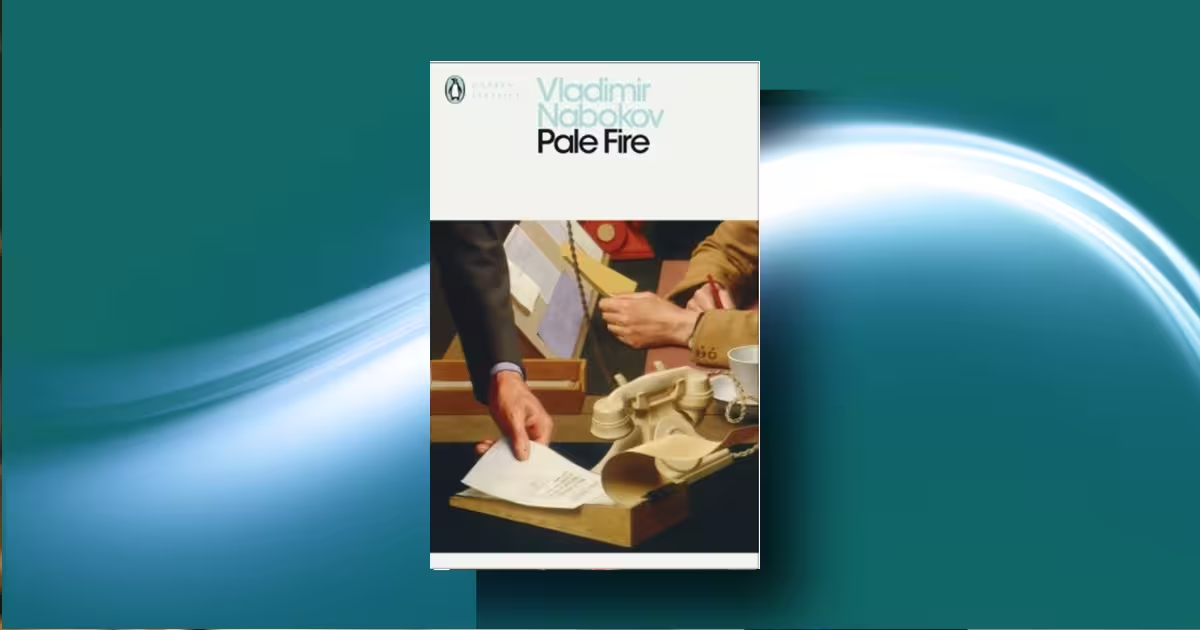
Did you ever read a book that made you question whether you are the one misreading reality—or whether the narrator has simply handed you a mirror designed to shatter? If you’re ready to have your understanding of fiction, sanity, and storytelling completely rewritten, Vladimir Nabokov’s Pale Fire is waiting to break your brain in the most beautiful way possible.
Pale Fire is a 999-line poem written by a dead poet, but the real story lives in the margins—where a delusional, possibly exiled king hijacks the commentary to weave his own paranoid fantasy of assassins, lost kingdoms, and stolen identity, forcing readers to decide who is the true madman.
Pale Fire is best for readers who love puzzle-box narratives, unreliable narrators, literary detective work, metafiction, Jorge Luis Borges fans, Italo Calvino enthusiasts, graduate students in creative writing, and anyone who has ever argued with footnotes in a textbook.
Not for people who want straightforward storytelling, linear plots, emotional resolution without ambiguity, or books you can safely skim. If you dislike feeling intellectually outmaneuvered by an author who died decades ago, Pale Fire will frustrate you to tears.
Table of Contents
Introduction
Vladimir Nabokov published Pale Fire in 1962, just five years after Lolita made him both famous and infamous.
The book arrived as a hardcover from G.P. Putnam’s Sons, and its structure was so bizarre that early readers genuinely didn’t know what they were holding.
It pretends to be a scholarly edition of a 999-line poem by the fictional American poet John Francis Shade—but the foreword, commentary, and index are written by Shade’s neighbor and self-appointed editor, Charles Kinbote, a man whose grip on reality becomes more questionable with every footnote.
Publication details: G.P. Putnam’s Sons, 1962 (Berkley Medallion edition, June 1968). Dedicated “To Véra” (Nabokov’s wife). Epigraph from James Boswell’s Life of Samuel Johnson about Dr. Johnson’s cat Hodge.
Background
Nabokov wrote Pale Fire while living in Switzerland, having fled revolutionary Russia as a teenager, then Nazi Europe as an adult. This personal history of exile—of losing a homeland, of reinventing identity through language—permeates every page.
As noted in the foreword’s description of the Zemblan King’s escape: “The narrow and bumpy lane that engulfed them passed by a woodshed, arrived at a torrent, crossed it with a great clacking of boards, and presently degenerated into a stump-cluttered cutting.” (Note to line 149)
The Cold War context matters too. The fictional kingdom of Zembla (a name Nabokov likely borrowed from Pope’s Essay on Man: “At Greenland, Zembla, or the Lord knows where”) exists somewhere near Russia, and its revolution is funded by a “gigantic neighbor.”
The book appeared during heightened nuclear anxiety, the Space Race, and American paranoia about Communist infiltration—all of which echo in Kinbote’s obsessive fear of “Gradus,” the assassin he believes is tracking him.
Pale Fire Summary
The Framing Device: What You’re Actually Reading
Let me explain what Nabokov has done here, because the trick is everything.
Pale Fire consists of five parts:
- A Foreword written by “Charles Kinbote,” a scholar at Wordsmith University in New Wye, Appalachia. He claims to be the late John Shade’s closest friend and literary executor.
- The Poem Itself—Pale Fire in four cantos, 999 lines of heroic couplets. The poem is autobiographical: Shade writes about his childhood, his odd fainting spells, his marriage to Sybil, the suicide of his daughter Hazel, his near-death experience (a heart attack during a lecture), and his philosophical meditations on death, art, and the afterlife.
- A Massive Commentary—Kinbote’s line-by-line notes on Shade’s poem. The commentary is longer than the poem itself, and it gradually reveals that Kinbote is almost certainly insane.
- An Index—which contains its own jokes, cross-references, and buried confessions.
- Variants and Drafts—Kinbote claims Shade preserved rejected lines, which he prints as “evidence” of his own influence.
The Poem’s Actual Content (What Shade Wrote)
Shade’s Pale Fire is, on its surface, a poignant meditation on mortality written by a man who knows he’s dying. Here’s what happens in the poem itself:
Canto One opens with the famous image: “I was the shadow of the waxwing slain / By the false azure in the windowpane.” A bird flies into a window, mistaking the reflected sky for real space. Shade uses this as an epigraph for consciousness itself: we are all shadows, trapped by illusions.
He describes his childhood as an orphan (both parents were ornithologists who died young), raised by his eccentric Aunt Maud. He recalls strange fainting fits—episodes where he felt “distributed through space and time: / One foot upon a mountaintop, one hand / Under the pebbles of a panting strand” (lines 149-150).
These episodes stopped after several weeks, but “the wonder lingers and the shame remains” (line 166).
Canto Two shifts to darker territory. Shade reflects on his adolescent obsession with death and the afterlife, his suspicion of “a great conspiracy / Of books and people” hiding the truth from him (lines 171-172). He writes lovingly of his wife Sybil (“My dark Vanessa, crimson-barred, my blest / My Admirable butterfly!” lines 270-271), then pivots to their daughter Hazel.
Hazel Shade was an awkward, strange, possibly mentally ill girl. As Shade writes: “Alas, the dingy cygnet never turned / Into a wood duck” (lines 319-320).
She twisted words backward (“spider” became “redips”), spent nights investigating paranormal phenomena in an old barn, and ultimately drowned herself—or did she? Shade is ambiguous: “People have thought she tried to cross the lake… Others supposed she might have lost her way… and some say / She took her poor young life. I know. You know” (lines 490-493). The canto ends with Hazel’s death: “A blurry shape stepped off the reedy bank / Into a crackling, gulping swamp, and sank” (lines 499-500).
Canto Three describes Shade’s near-death experience during a heart attack at a poetry reading. He recalls seeing “a tall white fountain played” (line 708) in the darkness—a vision so vivid he becomes convinced it was genuine. Later, he reads a magazine article about a Mrs. Z. who, after being resuscitated, described a “tall white fountain” in the afterlife. Excited, Shade tracks her down—only to discover the article contained a misprint. The woman had seen a “mountain,” not a fountain.
The crushing disappointment nearly destroys him.
But then Shade has an epiphany: “Life Everlasting—based on a misprint!… this / Was the real point, the contrapuntal theme; / Just this: not text, but texture; not the dream / But a topsy-turvical coincidence… a web of sense” (lines 807-810). He concludes that meaning isn’t found in literal truth but in pattern, coincidence, and art—“a web of sense” woven by some hidden player.
Canto Four is more relaxed, almost domestic. Shade describes his creative process, his love for Sybil, his contentment in middle age. The poem ends with an image of a butterfly—“A dark Vanessa with crimson band” (line 993)—settling on sand, as a gardener trundles past with an empty barrow.
The final line was meant to loop back to line 1, completing the 1,000-line symmetry, but Shade was murdered before he could write it.
What Kinbote’s Commentary Reveals (The Real Plot)
Now for the nightmare.
Kinbote’s footnotes tell a completely different story. Line by line, he reveals that he is not a mild-mannered professor at all—but Charles Xavier, the last King of Zembla, who fled his homeland after a revolution.
According to Kinbote, Zembla was a “distant northern land” with a glorious history, a language of its own (Nabokov invented fragments of it), and a beloved king (Charles II, nicknamed “the Beloved”).
The king was forced to abdicate when Extremists—backed by a “gigantic neighbor” (clearly the Soviet Union)—seized power. He escaped through a secret passage in the palace that led to the Royal Theater, then fled across the Bera Mountains disguised in a red sweater.
A loyal actor named Odon helped him reach the coast, where a motorboat carried him to freedom.
Kinbote claims he told Shade all of this—the palace intrigue, the mountain crossing, the sexual escapades with young pages, the unhappy marriage to Queen Disa—and that Shade promised to turn it into a poem. He believed Pale Fire would be “a poem about the King of Zembla.”
But it wasn’t. Shade wrote an autobiographical poem about his own life, his own dead daughter, his own near-death vision. Kinbote is furious and heartbroken: “Where were the battlements of my sunset castle? Where was Zembla the Fair?” (Commentary, final pages).
The commentary becomes increasingly unhinged. Kinbote obsesses over a shadowy assassin named Gradus (also called Jack Degree, Jacques de Grey, d’Argus), whom he believes was sent by Zemblan revolutionaries to kill him.
He tracks Gradus’s progress across Europe and America in meticulous, paranoid detail—and Gradus does indeed exist, and does indeed travel to New Wye. But here’s the final twist:
Gradus wasn’t trying to kill Kinbote. He was trying to kill Judge Goldsworth.
The Ending Explained
Late in the commentary, Kinbote reveals that he rented his house from Judge Goldsworth, a man who had sent countless criminals to prison.
One of them—Jack Grey—escaped from an insane asylum and came looking for revenge. He mistook John Shade for the judge (both were older men with gray hair) and shot him dead on Kinbote’s porch.
Shade’s death is accidental. The “assassin” was never after the king. Kinbote’s entire paranoid narrative—his belief that Zembla matters, that he is the target, that the poem is about him—collapses into tragic farce.
But does Kinbote accept this? No. He concludes his commentary with a chilling prediction: “Whatever happens, wherever the scene is laid, somebody, somewhere, will quietly set out—somebody has already set out, somebody still rather far away is buying a ticket, is boarding a bus, a ship, a plane, has landed, is walking toward a million photographers, and presently he will ring at my door—a bigger, more respectable, more competent Gradus” (Commentary, final page).
The delusion never ends. Kinbote will always believe he is hunted. Pale Fire is a portrait of madness disguised as scholarship—and the reader, complicit in following the footnotes, becomes part of the delusion too.
Pale Fire Analysis
4.1. Pale Fire Characters
John Francis Shade (The Poet) – Shade is presented as a genuinely gifted, emotionally honest poet. His 999-line poem is melancholic, self-aware, and technically masterful. He lost his daughter to suicide, nearly died himself, and finds solace in art—“Man’s life as commentary to abstruse / Unfinished poem” (lines 939-940).
The tragedy is that Shade never knew his neighbor was insane. He thought Kinbote was just an eccentric European scholar, not a delusional king projecting his fantasy onto Shade’s work.
Charles Kinbote / King Charles Xavier of Zembla (The Commentator) – One of literature’s greatest unreliable narrators. Kinbote is hilarious, pathetic, cruel, paranoid, and deeply lonely.
He genuinely believes Shade was writing his story—“I was holding all Zembla pressed to my heart” (Commentary, note to line 991)—and cannot accept that the poem is about nothing more than mortality, love, and a misprinted fountain.
His obsession with Gradus mirrors his obsession with Shade: both are projections of a mind unable to face its own emptiness.
Is Kinbote actually the king? The evidence is ambiguous. He claims he is, but no one else in the book confirms this. Shade’s wife Sybil calls him “an elephantine tick” (note to line 247). Students mock him as “the Great Beaver” (Foreword). His only “proof” is his own word.
Most Nabokov scholars conclude Kinbote is a delusional academic named V. Botkin (the Index hints at this: “Botkin, V., American scholar of Russian descent… kingbot, maggot of extinct fly”), who has invented an entire royal identity to escape his lonely, marginal existence.
Sybil Shade (The Poet’s Wife) – She despises Kinbote and tries to keep him away from her husband. Throughout the commentary, Kinbote portrays her as a shrewish censor who “made him tone down or remove from his Fair Copy everything connected with the magnificent Zemblan theme” (note to lines 47-48).
But this is almost certainly projection. Sybil was protecting her husband from a crazy neighbor—and she was right to do so.
Hazel Shade (The Dead Daughter) – She haunts the poem like a ghost. Her suicide is the emotional core of Shade’s Pale Fire, yet Kinbote barely mentions her. He is too absorbed in his own fantasy to notice the real tragedy standing next to him. In one devastating line, Shade describes Hazel’s loneliness: “She hardly ever smiled, and when she did, / It was a sign of pain” (lines 350-351).
Kinbote’s footnote to this passage? He talks about himself waiting for ping-pong friends.
Jakob Gradus (The Assassin) – Gradus is almost a parody of evil: a mediocre, bumbling, sexually frustrated, poorly-dressed killer who “spiritually did not exist” (note to line 949).
He travels across Europe and America with the single-minded determination of a clockwork toy, only to shoot the wrong man. His name (gradually revealed through variants) contains the word “gradual”—he is the slow, inevitable approach of death, but also of absurdity.
As Kinbote writes: “Gradus should not kill kings… because if he does, a pair of colossally thick, abnormally hairy arms will hug him from behind and squeeze, squeeze, squeeze” (note to line 171).
4.2. Pale Fire Themes and Symbolism
The Unreliable Narrator as a Philosophical Problem – Pale Fire forces readers to ask: how do we know anything is true? Kinbote’s commentary is filled with lies, distortions, and self-serving interpretations. But the poem itself is also subjective—Shade’s memory of his daughter, his near-death vision, his marriage. Nabokov offers no stable ground. We are all making sense of the world through broken lenses.
Exile and Identity Reinvention – Kinbote/Charles has lost his country, his crown, his language, and his name. He rebuilds himself as a scholar, but the mask keeps slipping. This theme resonated deeply with Nabokov, who spent his life in exile from Russia. As Kinbote writes in a moment of rare honesty: “A man who sinks his identity in the mirror of exile is in a sense a king’s destroyer” (note to line 894).
The Afterlife as a Misprint – Shade’s great revelation is that the “evidence” for heaven was a typo: mountain/fountain. Yet he doesn’t despair. Instead, he finds meaning in the pattern—the coincidence itself becomes proof of something, though he can’t say what. This is Nabokov’s sly argument for art over religion: a beautiful mistake is more truthful than a literal fact.
Doubles, Shadows, and Mirrors – The poem opens with a bird deceived by a reflection. The commentary is a reflection of the poem. Kinbote is a reflection of the king. Gradus is a reflection of Shade’s mortality. Even the book’s structure mirrors itself: 999 lines, symmetrical cantos, an index that points to itself. Nabokov is playing a game of infinite regress—and we are all trapped inside the glass.
The Violence of Interpretation – Kinbote’s footnotes “kill” the poem’s original meaning. Every time he explains a line, he overwrites Shade’s intention with his own fantasy. This is what critics do, Nabokov suggests. They claim to serve the text, but they actually consume it. The commentary is a parasite feeding on the poem—and the reader, by reading the commentary, becomes complicit in the murder.
Evaluation
My one-sentence verdict: Pale Fire is not just Nabokov’s masterpiece—it is the most cunning, hilarious, and heartbreaking novel ever written about the distance between what we create and what we need it to mean.
Strengths
The structural audacity still feels fresh six decades later. No one had written anything like this before: a poem, a commentary, and an index that all tell different versions of the same story, with the real plot hiding in the margins. Nabokov trusted his readers to be smart enough to catch up—a rare and beautiful gift.
The voice of Kinbote is a miracle of characterization.
He is pompous (“I am a very sly Zemblan”), paranoid, desperately lonely, and genuinely funny. His footnotes about his gardener (“completely impotent which I found discouraging”) or about Sybil’s cooking (“allergic to artichokes, avocado pears, African acorns—in fact to everything beginning with an ‘a'”) are comic gold. But he is also tragic.
When he writes, near the end, “My notes and self are petering out. Gentlemen, I have suffered very much, and more than any of you can imagine,” you feel real pity for a man who has constructed an entire kingdom just to survive his own insignificance.
The layered reading experience rewards multiple rereads. The first time through, you’re confused. The second time, you start noticing the cracks. The third time, you realize the cracks are the point. Nabokov has built a book that changes every time you open it.
Weaknesses
The poem itself is uneven. Some passages are gorgeous (the opening lines, the fountain sequence, the final canto). Others are deliberately flat—Shade was not, by Nabokov’s standards, a great poet.
He was a good, sincere, occasionally clumsy American poet. This was a choice: if the poem were too brilliant, the commentary would feel unnecessary. But it does mean sitting through some mediocre couplets to reach the fireworks.
The Zemblan sections can be exhausting. Kinbote’s endless digressions about palace intrigue, mountain passes, and obscure nobles (Baron A., Baron B., “Odon,” “Fleur,” “Garh”) read like someone telling you their dream in excruciating detail. This is intentional—Nabokov is parodying epic fantasy—but it still drags in places.
The emotional distance is a problem for some readers. Nabokov famously said, “I am not a writer of social comment.” He doesn’t want you to cry for Hazel Shade. He wants you to admire how he built the puzzle. If you need warmth or human connection in your fiction, Pale Fire will leave you cold.
Impact and Controversy
When Pale Fire was published, critics were baffled.
Some called it a hoax. Others accused Nabokov of self-indulgence. Mary McCarthy famously called it “one of the great works of art of this century”—but she was in the minority. It took years for the novel to find its audience.
Today, Pale Fire is considered a cornerstone of postmodern literature. It influenced David Foster Wallace (Infinite Jest’s footnotes), Italo Calvino (If on a winter’s night a traveler), and Thomas Pynchon (The Crying of Lot 49). It remains the definitive example of how to use paratext (footnotes, indexes, forewords) as narrative machinery.
Comparison with Similar Works
| Work | Similarity | Difference |
|---|---|---|
| Don Quixote (Cervantes) | Unreliable narrator, fictional authorship | Cervantes plays with sources; Nabokov plays with scholarship |
| The Turn of the Screw (James) | Ambiguous ghost story, interpretive uncertainty | James gives you anxiety; Nabokov gives you laughter |
| If on a winter’s night a traveler (Calvino) | Metafiction, interrupted narratives | Calvino is playful; Nabokov is savage |
| House of Leaves (Danielewski) | Footnotes within footnotes, labyrinthine structure | Danielewski is horror; Nabokov is tragicomedy |
Personal Insight with Contemporary Educational Relevance
The single most important theme in Pale Fire for today’s readers is how we construct meaning from fragments.
We live in an age of information overload—headlines, tweets, status updates, comments, footnotes to footnotes. Everyone is a commentator now. Everyone has an angle. And everyone, like Kinbote, believes their interpretation is the real story.
Consider this: a 2023 Pew Research study found that 64% of Americans say made-up news causes “a great deal” of confusion about basic facts. We are drowning in competing narratives. The same event—a protest, an election, a war—generates radically different “commentaries” depending on who is speaking.
Like Shade’s “white fountain” misprinted as “mountain,” we often build entire worldviews on errors, then refuse to let them go.
Five lessons from Pale Fire for modern life:
- Your interpretation is not the text. Kinbote thought Shade was writing about Zembla. He was wrong. Before you argue that someone “clearly meant” something, check your sources.
- Paranoia is a lonely religion. Kinbote’s belief that Gradus is hunting him gives his life meaning—but it also isolates him completely. No one else shares his delusion. In the age of conspiracy theories, this is a necessary warning.
- Beauty survives misreading. Shade’s poem remains beautiful even when Kinbote hijacks it. Art is stronger than the people who claim to explain it.
- The footnote is not the truth. Online, we privilege the “correction,” the “context,” the “thread.” But sometimes the original is all that matters. Don’t let the commentary eat the poem.
- Everyone is the hero of their own story. Kinbote cannot imagine a world where he is not the protagonist. Neither can most people. Learning to step outside your own narrative is the hardest skill of all.
For more on Nabokov’s theory of “poshlust” (vulgarity disguised as profundity) which permeates Pale Fire, see The Nabokov Museum in St. Petersburg.
Pale Fire Quotes
- “I was the shadow of the waxwing slain / By the false azure in the windowpane.” (Lines 1-2) — The novel’s thesis statement. We are all shadows deceived by reflections.
- “A syllogism: other men die; but I / Am not another; therefore I’ll not die.” (Lines 213-214) — The pathetic arrogance of youth, and the false logic we use to deny mortality.
- “Life is a message scribbled in the dark. Anonymous.” (Lines 235-236) — Shade at his most bleak.
- “Life Everlasting—based on a misprint!” (Line 807) — The novel’s philosophical pivot. Heaven is a typo. And yet.
- “Not text, but texture; not the dream / But a topsy-turvical coincidence… a web of sense.” (Lines 808-810) — Shade’s final wisdom. Pattern matters more than fact.
- “Man’s life as commentary to abstruse / Unfinished poem.” (Lines 939-940) — The line that explains everything. We are all footnotes.
- “I was holding all Zembla pressed to my heart.” (Note to line 991) — Kinbote’s most heartbreaking confession. He loved a country that may never have existed.
- “My notes and self are petering out. Gentlemen, I have suffered very much, and more than any of you can imagine.” (Final commentary page) — The madman’s dignity, purchased at enormous cost.
Conclusion
Pale Fire is not a novel you finish. It’s a novel you survive—and then immediately want to reread, because you suspect you missed everything. Nabokov has written a book that is simultaneously a beautiful poem about death, a hilarious parody of academic pretension, a tragic portrait of madness, and a fiendish puzzle box with no solution.
The genius is that every reading is different. Some days, I feel sorry for Kinbote. Other days, I want to throw the book across the room. Most days, both at once.
Who should read this: Fans of metafiction, unreliable narrators, literary puzzles, Vladimir Nabokov completists, anyone who loved House of Leaves or Infinite Jest, and English majors who secretly love the footnote more than the text.
Who should not: Anyone looking for a beach read, a comforting story, or a clear resolution. This book will fight you. It wants you to lose.
Final reflection: The most terrifying line in Pale Fire is not in the poem. It’s in the Index, under “Gradus”: “his name in a variant”—pointing to a page where a single syllable contains the killer’s identity.
Nabokov buried his secrets everywhere. He is still laughing at us from the grave. And honestly? I’m grateful for it.







