
Last updated on November 6th, 2026 at 11:41 am
Why does a novel about parties, fashion, and beautiful people leave such a bruise? Because Last Night in Brooklyn understands that sometimes what breaks your heart is not only a person, but a place, a version of yourself, and a whole neighborhood slipping out of reach.
In Last Night in Brooklyn, Xóchitl González turns pre-recession Brooklyn into a dazzling, sad, razor-sharp story about ambition, class, desire, and the cost of trying to become someone new before the city swallows the old you whole.
Last Night in Brooklyn is best for readers who love literary fiction with social bite, Brooklyn novels, women-centered coming-of-age stories, and modern/class-conscious riffs on The Great Gatsby. Not for readers who want a plot-first thriller, a neat moral universe, or a completely comforting ending.
The official positioning of the book as a Gatsby-inflected Brooklyn story is supported by the publisher and author materials.
Table of Contents
1. Introduction
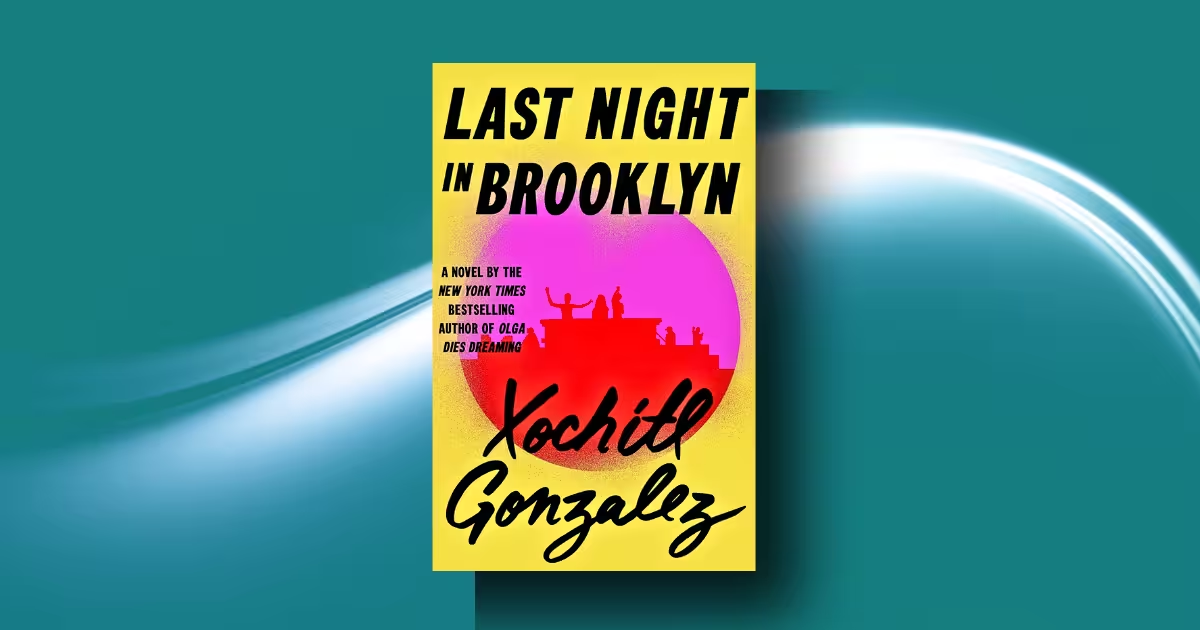
Last Night in Brooklyn is a novel by Xóchitl González, published by Flatiron Books on April 21, 2026. González, a Brooklyn-born novelist and Atlantic writer, is also the author of Olga Dies Dreaming and Anita de Monte Laughs Last.
The author bio in the back matter describes González as a Brooklyn native, Brown graduate, Iowa Writers’ Workshop MFA, and Pulitzer finalist for commentary. Public publisher and author pages confirm the 2026 publication, the Flatiron imprint, and the novel’s broad framing as a major new Brooklyn novel.
What struck me immediately is that this is not merely a “Brooklyn novel” in the postcard sense. It is a book about what Brooklyn felt like at a specific historical hinge: the mid-2000s, before the financial crash fully hit, during the Atlantic Yards battles, when whole blocks and social worlds seemed to be turning into capital.
The opening pages make that plain: Freddy’s is not just a bar under threat, but a symbol of who gets to decide what counts as valuable, and who gets erased when value finally arrives.
2. Background
The novel is set against the transformation of early-2000s Fort Greene, Prospect Heights, and adjacent Brooklyn neighborhoods. Inside the novel, characters argue directly about eminent domain, rezonings, “opportunity,” and who development is really for. When a stadium representative insists the new arena will benefit “all of Brooklyn,” Alicia immediately pushes back: “I’m from Gravesend. What opportunity is it creating there?”
That exchange gives the novel its political weather: this is a book about official uplift versus lived displacement.
That background is not invented out of thin air. The real Atlantic Yards project was announced in 2003 and approved in 2006, and it remained controversial for years over eminent domain, housing promises, and neighborhood change.
Empire State Development still describes the project as a 22-acre development including Barclays Center and thousands of apartments, while critics and watchdogs have documented the delays, litigation, and fallout around affordable housing and the long buildout.
That is one reason Last Night in Brooklyn lands so hard. González is not using “gentrification” as a trendy backdrop word. She is writing from inside the texture of a borough where recognition itself feels insulting.
One of the novel’s sharpest observations comes when Alicia reflects on Brooklyn being “discovered” and newly called valuable by people who would not have crossed a bridge for it a few years earlier. That feeling aligns with longer-term data showing just how dramatically neighborhoods like Fort Greene and nearby central Brooklyn changed in income, rents, and housing composition over the following years.
NYU Furman Center reports that in 2023 Fort Greene/Brooklyn Heights ranked among the city’s most expensive rental neighborhoods, and the area added large numbers of new housing units from 2010 to 2024, the majority market-rate.
There is another background layer too: literary. Public descriptions from the publisher, author, and interviews repeatedly frame the book as a reimagining of The Great Gatsby for Black and brown Brooklyn.
That matters, but I do not think the Gatsby comparison is the whole story.
Last Night in Brooklyn is less interested in mere homage than in asking what the American Dream looks like when race, class mobility, neighborhood belonging, and feminine self-invention all collide in one borough.
3. Last Night in Brooklyn Summary
Setting and Premise:
The story is framed by the narrator, Alicia Forten, preparing to attend the “last night” at Freddy’s, a beloved local bar in Brooklyn being demolished for development (the Barclays Center arena project).
This event triggers her memory of the fateful summer of 2007, specifically the rise and tragic fall of her neighbor, the fashion designer La Garza (Garza Rivera, nicknamed “Gigi”) .
Part 1: Alicia’s World and Meeting La Garza
Alicia is a copywriter from Gravesend, Brooklyn, trapped in a stagnant, indefinitely postponed engagement to James, a medical student in Syracuse. She is biracial (Black father/Puerto Rican mother) and feels like an outsider in her wealthy father’s elite Black family (the Fortens of Martha’s Vineyard).
She moves to Fort Greene, subletting from her glamorous friend Lorraine, and becomes captivated by La Garza, a local celebrity designer who lives across the street. La Garza is known for her wild, seemingly spontaneous parties, her fierce Brooklyn authenticity, and her mystery.
Alicia’s cousin, Devon Forten, a wealthy finance bro, and his status-obsessed wife, Marla, move back to Brooklyn from Paris. At a dinner party, Devon introduces Alicia to his friend Matteo “Tayo” Jones, a financier/DJ. Matteo kisses Alicia in the bathroom, though she is still technically engaged.
Part 2: The Scheme
La Garza personally invites Alicia to one of her legendary parties, where she announces her company’s upcoming IPO, backed by a shady childhood friend, Augustus Jankovskis. Matteo warns Alicia that La Garza is a creature of calculation. He reveals the backstory: La Garza and Devon dated seriously a decade ago, but Devon ghosted her abruptly when he left for business school, likely under pressure from his elitist mother. La Garza was devastated.
Alicia realizes La Garza invited her specifically because of her connection to Devon. La Garza wants Devon’s Wall Street connections to legitimize her IPO and get revenge on the man who abandoned her. Alicia agrees to facilitate a “chance” meeting.
Part 3: The Affair and The IPO
At a staged “fitting” for a custom suit, the old flame between Devon and La Garza reignites instantly and intensely. They begin a reckless, public affair, often seen around Brooklyn and the Hamptons by Alicia and Matteo. La Garza, who was once fiercely independent, becomes lovesick and subservient to Devon, believing they are soulmates.
Meanwhile, Marla (who is oblivious to the affair) commissions an artist named Felix to paint portraits of her and Devon. Felix, needing money, is also secretly on Devon’s payroll to keep Marla entertained. During a session with Devon, La Garza stops by, and Felix captures a painting of them together—Devon in his ice-blue suit with La Garza giggling on his lap.
The IPO (NASDAQ: GRZA) goes public and soars, driven by hype and Devon’s marketing. La Garza is briefly a media darling. However, the business is a front; the stock is part of a pump-and-dump scheme orchestrated by Augustus’s Latvian mob-connected uncle.
Part 4: The Unraveling
Marla’s Discovery: Marla sees the portrait of Devon and La Garza hanging in La Garza’s Hamptons pop-up shop. She realizes the truth. Instead of confronting them directly, she executes a cold, calculated revenge: She calls Devon’s mother, gets Felix evicted and blacklisted from his gallery, and invites her in-laws to the Hamptons for a “surprise” lunch.
The Hamptons Showdown: At the lunch, with La Garza present, Marla and Devon’s mother use class and etiquette as weapons to humiliate La Garza. La Garza confronts Mrs. Forten about blocking her calls years ago. Finally, La Garza asks Devon to leave with her. Under the glare of his father and the revelation that Marla is pregnant, Devon sits back down. La Garza flees the house in humiliation and despair.
Omar’s Arrest: During the Hamptons opening, police arrest La Garza’s best friend Omar and an associate for exchanging duffel bags of cash. The SEC is closing in on Augustus’s brokerage.
Part 5: The Murder
Alicia returns to Brooklyn and spends the night with a devastated La Garza, who tells her full life story: growing up poor in the Farragut Houses, losing her sister Karina on 9/11, being saved from bankruptcy by Augustus, and her obsessive love for Devon—the only man who ever made her feel beautiful. La Garza mentions a strange car (sent by Augustus’s uncle) was following her.
The next day, Alicia goes to Soul Summit in Fort Greene Park. She has a moment of clarity listening to “Young Hearts Run Free,” realizing she needs to find her own identity outside of men and family expectations. She rushes back to check on La Garza.
She finds La Garza dead in the bathtub. She has been strangled. The scene was staged to look like an accident or suicide, but it is clearly murder. It is heavily implied that Augustus (or someone from his uncle’s crew) killed her.
Augustus was in love with La Garza, and his jealousy over Devon combined with the legal heat from the IPO investigation likely led to the murder. La Garza’s warehouse is later burned down in an arson fire to destroy evidence.
Part 6: Aftermath & Ending Explained
Devon: He abandons La Garza in death as he did in life. He refuses to attend the memorial, cuts off contact with Alicia, and sells his Brooklyn brownstone right before the housing market crash. He and Marla move away to raise their child in wealthy obscurity.
Matteo: He asks Alicia to run away to Hawaii with him to care for his sick mother. Alicia refuses, realizing she is not ready for another relationship defined by a man’s journey. She needs to find herself first.
Alicia’s Transformation: The summer events force Alicia to break off her engagement to James for good. She realizes she is “more Brooklyn than Forten”—meaning she values authentic community over the cold, transactional elitism of her father’s family. She begins her career as a filmmaker.
The Final Scene (Present Day):
Back at the “Last Night at Freddy’s,” Alicia parties hard, mourning the loss of the old Brooklyn. After the bar closes forever, she drunkenly wanders past the site of Devon’s new luxury condo development—the same project he bragged about that displaced low-income residents.
In a moment of rage for La Garza, for the neighborhood, and for the past, Alicia picks up a brick from a nearby construction site and hurls it through the glass window of Devon’s building. She then runs home. It is an act of vandalism that symbolizes her final rejection of the “Forten” world and her loyalty to the lost city of Brooklyn and the memory of La Garza.
4. Last Night in Brooklyn Analysis
4.1 Last Night in Brooklyn Characters
Alicia Forten
Alicia is the novel’s great achievement.
She is observant without being omniscient, funny without undercutting feeling, and compromised enough to be believable. Her class position is especially interesting: she is neither the poorest person in the room nor comfortably secure, and she moves uneasily between worlds of working-class precarity, aspirational Black bourgeois respectability, and Brooklyn creative hustle.
That makes her a perfect witness to the borough’s transformations. The novel’s first pages already show how alert she is to the politics of value and belonging.
La Garza
La Garza is mesmerizing because the book refuses to flatten her into a symbol.
Yes, she is the Gatsby figure: self-fashioned, glamorous, surrounded by rumor, radiating impossible magnetism. But she is also a woman from Brooklyn trying to turn style, force of will, and social intelligence into permanence in a system designed to use and discard people like her. Alicia initially sees her as a legend, then gradually as a person whose confidence is partly scaffolding.
One of the saddest retrospective lines in the novel says that everyone thought La Garza “should have known better,” but Alicia eventually sees that she was climbing in terrain whose dangers she could not fully map.
Matteo Jones
Matteo begins as seduction, then becomes something more painful: the possibility of a real adult love that still cannot substitute for self-knowledge. He is sharp enough to read people and worldly enough to seem like an exit ramp from Alicia’s confusion, but the novel finally treats him as insufficient rescue. That is a strength.
Too many books let the “right” man solve the heroine’s interpretive crisis. This one does not.
Devon and Marla
Devon is perhaps the novel’s most underrated character: funny, vain, ambitious, intermittently thoughtful, and often morally compromised. He embodies a specific kind of upwardly mobile Black capitalist confidence, convinced that green outranks all other colors.
Marla, meanwhile, is fascinating because she could easily have been written as just shallow. Instead, González lets her emerge as insecure, strategic, lonely, status-trained, and desperate to become legible inside spaces where taste is social power. She is a very recognizable New York type, but she also becomes more than that.
4.2 Last Night in Brooklyn Themes and Symbolism
Gentrification as emotional theft
Last Night in Brooklyn‘s most important theme is not simply gentrification as policy, but gentrification as feeling: the insult of being told your home has become valuable only once other people want it.
Alicia’s line of thought about Brooklyn being “discovered” and “reassessed as valuable” is one of the cleanest statements of that wound. The same logic appears in the Freddy’s opening, where what is really at stake is who has the power to declare value in the first place.
Self-invention and its cost
Like Gatsby, this novel is obsessed with reinvention. But it asks harder questions about who gets to reinvent themselves cleanly. Men in finance, development, and politics can turn reinvention into leverage.
Women, especially women of color, are more often forced to turn reinvention into performance. La Garza’s entire life dramatizes that distinction.
Friendship as infrastructure
One of the loveliest things about the novel is how seriously it takes friendship. Public commentary around the novel has described it as, among other things, a “field guide to friendship,” and that feels right.
Alicia’s world is made possible by friends who give introductions, couches, gossip, warnings, reality checks, and courage. The dispersal of those friendships by the end hurts almost as much as the central tragedy.
The city as mirror
Brooklyn, here is not a backdrop but a diagnostic instrument. The WATCHTOWER sign, the rooftops, the bars, the lofts, the brownstones, the luxury condos replacing older buildings: all of it reveals the moral weather of the book.
Alicia’s description of WATCHTOWER as both a warning and a beacon is one of the novel’s best symbolic passages.
The Great Gatsby Parallel:
González doesn’t hide the structural homage to Fitzgerald. La Garza is Gatsby, the self-made bootlegger of fashion striving for an unattainable green light (Devon/Acceptance).
Devon and Marla are the careless Buchanans who “smash up things and creatures” and retreat back into their money. Alicia is the Nick Carraway figure, both enchanted and repelled by the inexhaustible variety of life.
The Illusion of Upward Mobility
The novel argues fiercely that for people of color, the rules of upward mobility are rigged. No matter how much money La Garza makes, she is still viewed by Devon’s family as “vulgar” and unworthy. Her attempt to cross the class divide proves fatal.
5. Evaluation
My own verdict: Last Night in Brooklyn is sharp, intoxicating, and sad in exactly the right proportions. It is the kind of novel that gives you the pleasure of immersion first and only later reveals how much grief it has smuggled into your chest.
Strengths
Its greatest strength is voice. Alicia sounds alive. The social observation is quick, intimate, and unsparing without losing tenderness. The set pieces also crackle: the shopping-cart race, the Dumbo loft night, the rooftop party, the uneasy brownstone dinner.
González is superb at making a crowd feel specific and a room feel morally charged. That public critical response is consistent with how the publisher and author materials position the book: lively, ambitious, and deeply tied to Brooklyn’s texture.
Weaknesses
The very abundance that makes the novel so pleasurable can also make it feel slightly overfull. Some readers may wish for tighter control in the middle sections or deeper development for a few secondary figures. A few public reader responses point to a slightly choppy flow even while praising the character work.
Impact
What stayed with me most was the ache of retrospect. The novel understands that by the time you can name what a city, friendship circle, or phase of life meant to you, part of it is already gone. That feeling is built right into its frame, with Alicia looking back from a later Brooklyn at the vanished one.
Comparison with similar works
The obvious comparison is The Great Gatsby, and the comparison is justified by both publisher framing and the novel itself.
But I would also put it in conversation with González’s Olga Dies Dreaming for its interest in Puerto Rican identity, ambition, class performance, and elite New York spaces, and with contemporary Brooklyn fiction that treats neighborhood change as lived catastrophe rather than abstract sociology.
6. Personal insight with contemporary educational relevance
The most educationally urgent angle here is Last Night in Brooklyn’s treatment of gentrification not as an abstract urban-studies term but as a struggle over memory, dignity, and who gets to narrate “improvement.”
The novel’s characters are not debating whether neighborhoods change; they are asking who pays for change, who profits from it, and why communities suddenly become desirable only after decades of being neglected.
Alicia’s skepticism toward promises of opportunity and her anger at Brooklyn being newly “discovered” map uncannily onto real development battles around Atlantic Yards/Pacific Park, eminent domain, and the long history of delayed or partial public benefits.
That is why the novel still feels contemporary even though it is set in 2007–2008. Today, Fort Greene/Brooklyn Heights ranks among New York City’s highest-income and most expensive-rent areas, with major market-rate housing growth in the last decade-plus.
Read beside those realities, Last Night in Brooklyn becomes more than nostalgic fiction.
It becomes a warning about how cities can convert culture into real estate, and how communities can be praised, branded, and economically cannibalized in the same motion.
For readers, students, and anyone interested in urban change, Last Night in Brooklyn offers a deeply human case study in why “development” is never just about buildings.
7. Last Night in Brooklyn Quotes
“The hand you are dealt is determinism; the way you play it is free will.”
“Once there was another city here, and now it is gone. There are almost no traces of it anymore, but millions of us know it existed, because we lived in it: the Lost City of New York.”
“El mono sabe en qué palo trepa,” she would say. The monkey knows the tree it climbs.
“Because suddenly, what you had—what you cherished and loved that had been shat on and forgotten by everybody? Well, suddenly, it has value. It is deemed nice.”
“Everybody in Brooklyn—our kind of Brooklyn—believed in a fair fucking fight.”
“WATCHTOWER. Word as threshold.”
“Freedom is fun, except when it’s lonely.”
“The only color that matters in this country now is green.”
8. Conclusion
Last Night in Brooklyn is significant because it is not content to mourn a vanished Brooklyn in the easy, romantic way.
It asks what exactly vanished, who helped vanish it, who tried to monetize it, and what kinds of people were forced to become fluent in performance just to survive inside it. It is best for readers who want literary fiction with atmosphere, class tension, female complexity, and a real feeling for place.
The novel’s reception and official framing both emphasize those qualities: a vivid Brooklyn time capsule, a coming-of-age story, and a meditation on the hidden costs of “making it.”







