

Last updated on October 17th, 2026 at 12:49 pm
The longest word in any major English dictionary is pneumonoultramicroscopicsilicovolcanoconiosis, at 45 letters. It was coined in 1935 to be the longest word and names a lung disease caused by very fine silica dust. If you count chemical names, the full name of the protein titin runs to 189,819 letters.
The longest word that was not invented just to be long is pseudopseudohypoparathyroidism (30 letters), and the longest non-technical word in major dictionaries is floccinaucinihilipilification (29 letters).
Long words have a strange pull. They look like puzzles, they sound like spells, and nearly every one of them carries a small story about who built it and why. Because I care about how English is spoken, I did not want to stop at a list.
I recorded the pronunciation of these words myself and set each recording beside its IPA (International Phonetic Alphabet) transcription, so you can hear the word and read it at the same time.
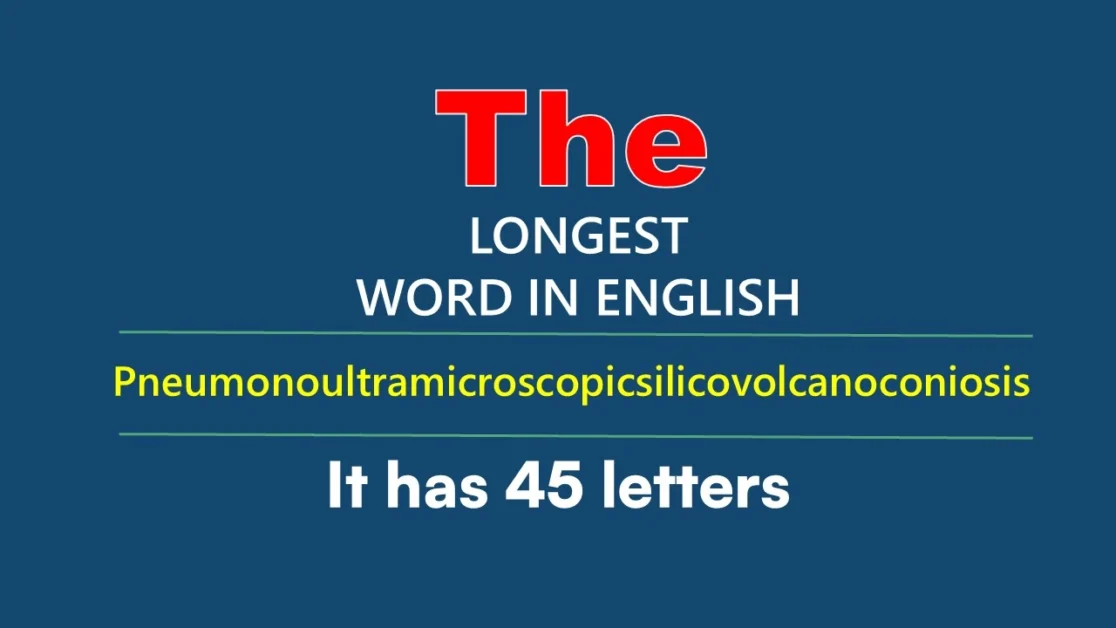
One honest warning first. “The longest word in English” has no single answer. It depends on what you count as a word: technical names, coined words, and words that exist mainly in lists of long words all change the result. So below I rank the famous contenders by letter count and tell you exactly what kind of word each one is.
A note on accents: most of these words are too rare to have settled British and American versions, so the transcriptions below follow the dictionary sources I checked. If you want the general rules for a British accent, my guide on how to improve English pronunciation with IPA exercises covers Received Pronunciation (RP) in detail.
Table of Contents
The longest words in English at a glance
| Rank | Word | Letters | Meaning | Dictionary status |
|---|---|---|---|---|
| 1 | Pneumonoultramicroscopicsilicovolcanoconiosis | 45 | A lung disease from inhaling very fine silica dust | In the OED and Merriam-Webster’s medical dictionary |
| 2 | Hippopotomonstrosesquipedaliophobia | 35 | Fear of long words (a joke word) | Labelled humorous; not a clinical term |
| 3 | Supercalifragilisticexpialidocious | 34 | Wonderful; a nonsense word of approval | Recorded by the OED; not entered by Merriam-Webster |
| 4 | Pseudopseudohypoparathyroidism | 30 | An inherited disorder | In the OED and Merriam-Webster’s medical dictionary |
| 5 | Floccinaucinihilipilification | 29 | The habit of judging something worthless | Recorded by the OED; not entered by Merriam-Webster |
| 6 | Antidisestablishmentarianism | 28 | Opposition to separating a state church from the state | Not entered by Merriam-Webster |
Sources for the table: Wikipedia, Longest word in English; Merriam-Webster, The Longest Long Words List; Wiktionary. Letter counts checked by hand.
1. Pneumonoultramicroscopicsilicovolcanoconiosis (45 letters)
What it means. Merriam-Webster keeps this word in its medical dictionary and defines it as a lung disease caused by inhaling very fine silicate or quartz dust. In practice it is a stretched-out name for silicosis, though most real silicosis has nothing to do with volcanic dust, and Vocabulary.com points out that nobody has ever been diagnosed with silicosis from volcanic dust.
Studies of volcanic silica have found little evidence that it causes silicosis-type disease.
Where it came from. The word was coined in 1935 by Everett M. Smith, then president of the National Puzzlers’ League. The New York Herald Tribune reported it on 23 February 1935, when the league declared it the longest word in English at its meeting at the Hotel New Yorker.
League members then campaigned to get it into dictionaries, and it first appeared in the 1939 supplement to Merriam-Webster’s New International Dictionary.
One puzzle archive notes that it is not certain Smith coined it himself rather than presented it, so treat the credit as the standard account rather than settled fact.
How it breaks down. Read it as a chain of Greek and Latin parts: pneumono (lungs), ultra (beyond), micro and scopic (small, looking), silico (silicon), volcano, coni (dust) and -osis (a medical condition).
How to pronounce it.
- IPA: /ˌnjuːmənoʊˌʌltrəˌmaɪkrəˈskɒpɪkˌsɪlɪkoʊvɒlˌkeɪnoʊˌkoʊniˈoʊsɪs/
- Say it as: NEW-mə-noh-ultrə-my-krə-SKOP-ik-SIL-ih-koh-vol-KAY-noh-koh-nee-OH-sis
2. Hippopotomonstrosesquipedaliophobia (35 letters)
What it means. The fear of long words, which is the joke: the name is itself one of the longest words people know. Wiktionary labels it humorous and notes that the plain term sesquipedalophobia is the one used in formal writing. It is not a recognised clinical diagnosis.
Where it came from. The core is sesquipedalian, from Latin for “a foot and a half long”. The Roman poet Horace used sesquipedalia verba in his Ars Poetica to tease poets who used overlong words. Someone later bolted on extra pieces from hippopotamus and Latin monstrum (monster) to make the word bigger and scarier.
A spelling note. You will also see a double-p form, hippopotomonstrosesquippedaliophobia, which Merriam-Webster uses in its own long-words list and counts as 36 letters. The single-p spelling has 35.
How to pronounce it.
- IPA (UK): /ˌhɪ.pəˌpɒ.tə(ʊ)ˈmɒn.stɹə(ʊ)ˌsɛs.kwɪ.pɪˌdɑːl.ɪ.ə(ʊ)ˈfəʊ.bɪ.ə/
- Syllables: hip-po-po-to-mon-stro-ses-qui-pe-dal-i-o-pho-bi-a, with the main stresses on MON and FOH.
3. Supercalifragilisticexpialidocious (34 letters)
What it means. Nothing precise, which is part of its charm. In the film it is offered as something to say when you don’t know what to say, and in everyday use it means “wonderful”.
Where it came from. The word was made famous by the song of the same name in Disney’s 1964 film Mary Poppins, written by the Sherman Brothers and sung by Julie Andrews and Dick Van Dyke. But it is older than the film. The Oxford English Dictionary’s earliest record is a variant spelling in a Syracuse University student newspaper column dated 10 March 1931. The Shermans themselves said they made up double-talk words like this as children, and in another account recalled hearing a version of it at a summer camp in the Adirondacks in the mid-1930s.
The lawsuit. In 1965, the writers of a 1949 song titled “Supercalafajalistickespeealadojus” sued Disney’s music publisher. They lost, partly because sworn statements showed variants of the word had been known for years before 1949.
Is it in the dictionary? The OED records it, but Merriam-Webster does not enter it, because the word is mostly used as an example of a long word rather than to say something.
How to pronounce it.
- IPA: /ˌsuː.pər.ˌkæ.lɪ.ˌfræ.dʒɪ.ˌlɪs.tɪk.ˌɛks.pi.ˌæ.lɪ.ˈdoʊ.ʃəs/
- It has 14 syllables. A simple guide based on the IPA: soo-per-kal-i-fraj-i-lis-tik-eks-pee-al-i-DOH-shus.
4. Pseudopseudohypoparathyroidism (30 letters)
What it means. An inherited disorder in which a person has the physical features of pseudohypoparathyroidism but normal blood calcium and parathyroid hormone levels. The doubled “pseudo” literally marks it as a false version of a condition that is itself a false version of another. Merriam-Webster notes it is the only word in its dictionary with a repeating pseudo.
Where it came from. Fuller Albright described the condition in 1952 as “pseudo-pseudohypoparathyroidism”, with a hyphen.
Why it matters for this list. Unlike the two words above it, nobody built this one to break a record. That makes it the longest word in a major dictionary that was not deliberately contrived.
How to pronounce it.
- IPA: /ˌsuːdoʊˌsuːdoʊˌhaɪpoʊˌpærəˈθaɪrɔɪdɪzəm/
- A simple guide based on the IPA: SOO-doh-SOO-doh-HY-poh-PARR-ə-THY-roy-diz-əm.
5. Floccinaucinihilipilification (29 letters)
What it means. The action or habit of estimating something as worthless.
Where it came from. This is a learned schoolroom joke. It strings together four Latin words, flocci, nauci, nihili and pili, all meaning “for nothing” or “at a small price”, which appeared together in a rule of the Eton Latin Grammar, then adds -fication. The first known use is in a 1741 letter by the poet William Shenstone, published in 1769.
Where it turns up. It has had rare public outings. US Senator Jesse Helms used it in 1999 when dismissing the Comprehensive Test Ban Treaty. The Guinness Book of Records called it the longest real word in English in its 1992 and earlier editions, and it is still the longest non-technical word in major dictionaries.
How to pronounce it.
- IPA: /flɒksɪˌnɔːsɪˌnɪhɪlɪˌpɪlɪfɪˌkeɪʃn/
- A simple guide based on the IPA: flok-si-naw-si-nih-hil-ih-pil-ih-fih-KAY-shun.
6. Antidisestablishmentarianism (28 letters)
What it means. The position that a state church should not be disestablished, that is, separated from the state.
Where it came from. It grew out of 19th-century British politics. The Liberal Party pushed to remove the Church of England’s status as the official church of England, Ireland and Wales, and the people who resisted were the antidisestablishmentarians. They kept the church established in England, but the Church of Ireland was disestablished in 1871, and four Welsh dioceses followed in 1920 to become the Church in Wales. The etymologist Ernest Weekley traced the word’s first recorded use to 1838.
How it is built. Read it from the middle out: establish → establishment (the state church) → establishmentarian (a supporter of it) → disestablishmentarian (someone who wants it separated) → antidisestablishmentarian (someone against that) → -ism (the position itself). Wikipedia calls it the longest common example of a word built by stacking prefixes and suffixes.
Is it in the dictionary? Not in Merriam-Webster. Its editors say they have only three citations of the word used with its real meaning in more than 100 years of files, which is not enough to count as sustained, widespread use.
How to pronounce it.
- IPA: /ˌæntidɪsɪˌstæblɪʃmənˈtɛəriənɪzəm/
- Say it as: AN-tee-dis-ih-STAB-lish-mən-TAIR-ee-ə-niz-əm (American speakers may also start with “ANTY-“).
What about the 189,819-letter word?
If you allow chemical names, every word above looks tiny. The full chemical name of titin, a giant protein, begins methionylthreonylthreonylglutaminyl… and runs to 189,819 letters. Merriam-Webster says it fills more than 50 pages and takes more than three hours to say.
So why is it not the answer? Because chemical naming rules can generate words of any length, so a protein name is closer to a formula written in letters than a word people use. Merriam-Webster’s own verdict is that it isn’t technically a word, and you will not find it in a standard dictionary.
Other long-word records worth knowing
Longest word in Shakespeare: honorificabilitudinitatibus (27 letters), from Love’s Labour’s Lost. It is also the longest English word that alternates consonants and vowels.
Longest word in Merriam-Webster.com: not antidisestablishmentarianism but acrylonitrile-butadiene-styrene, a tough plastic also known as ABS.
Longest words with no repeated letters: subdermatoglyphic, dermatoglyphics and uncopyrightable.
Longest words you are likely to meet in normal reading: according to the word researcher Ross Eckler, deinstitutionalisation and counterrevolutionaries, at 22 letters each.
Longest word in literature: a dish in Aristophanes’ play Assemblywomen, 171 letters in Greek and 183 in English transliteration.
Longest place name in an English-speaking country: an 85-letter Māori name for a hill in New Zealand, usually shortened to Taumata.
How to pronounce any long word
The recordings help, but the method matters more, and it works on any monster word you meet.
- Find the parts. Almost every word here is a chain of smaller pieces. Pneumono-ultra-micro-scopic-silico-volcano-coni-osis stops being frightening once you see eight familiar chunks.
- Say each chunk slowly, then join two at a time. Build up: pneumono-ultra, then pneumono-ultra-micro, and so on.
- Find the main stress. In the IPA, the mark ˈ comes before the strongest syllable. Land on that syllable firmly and let the others stay light.
- Listen, then copy the rhythm. Play the recording, pause, and repeat it in sections before trying the whole word at speed.
If your trouble is with sounds rather than length, my guide to British accent and IPA exercises is the place to start.
Frequently asked questions
What is the longest word in English?
In a major dictionary, it is pneumonoultramicroscopicsilicovolcanoconiosis, with 45 letters. The chemical name of the protein titin is far longer at 189,819 letters, but it is not usually counted as a word.
What is the longest word in the Oxford English Dictionary?
Pneumonoultramicroscopicsilicovolcanoconiosis (45 letters). The OED also contains pseudopseudohypoparathyroidism (30 letters), the longest entry that was not coined to break a record.
Is supercalifragilisticexpialidocious a real word?
It is a real nonsense word with a long history. The OED records a variant from 1931, decades before Mary Poppins made it famous in 1964, though Merriam-Webster does not enter it.
How do you pronounce pneumonoultramicroscopicsilicovolcanoconiosis?
NEW-mə-noh-ultrə-my-krə-SKOP-ik-SIL-ih-koh-vol-KAY-noh-koh-nee-OH-sis. Break it into its Greek and Latin parts and practise two chunks at a time.
What is the fear of long words called?
Jokingly, hippopotomonstrosesquipedaliophobia (35 letters). In formal writing the term is sesquipedalophobia. Neither is a recognised clinical diagnosis.
Why is antidisestablishmentarianism not in Merriam-Webster?
Because it is used almost only as an example of a long word. Merriam-Webster found just three citations of it used with its actual meaning in more than a century of records.
What is the longest word Shakespeare used?
Honorificabilitudinitatibus, 27 letters, spoken by the character Costard in Love’s Labour’s Lost.
A last word on long words
What strikes me most about this list is how few of these words were born naturally. A puzzle league made the longest one, a schoolroom joke made another, a songwriting team made a third famous, and the phobia word was stretched on purpose to laugh at itself.
Only pseudopseudohypoparathyroidism earned its length honestly, by describing something real. Long words, it turns out, are mostly a story about people playing with language, and that is exactly why they are worth learning to say.
You may also like:
- How to Improve English Pronunciation: British Accent + IPA Exercises
- Politics and the English Language: Orwell’s Warning Against Linguistic Decay
- Algospeak Explained: How Social Media Algorithms Influence Language







