
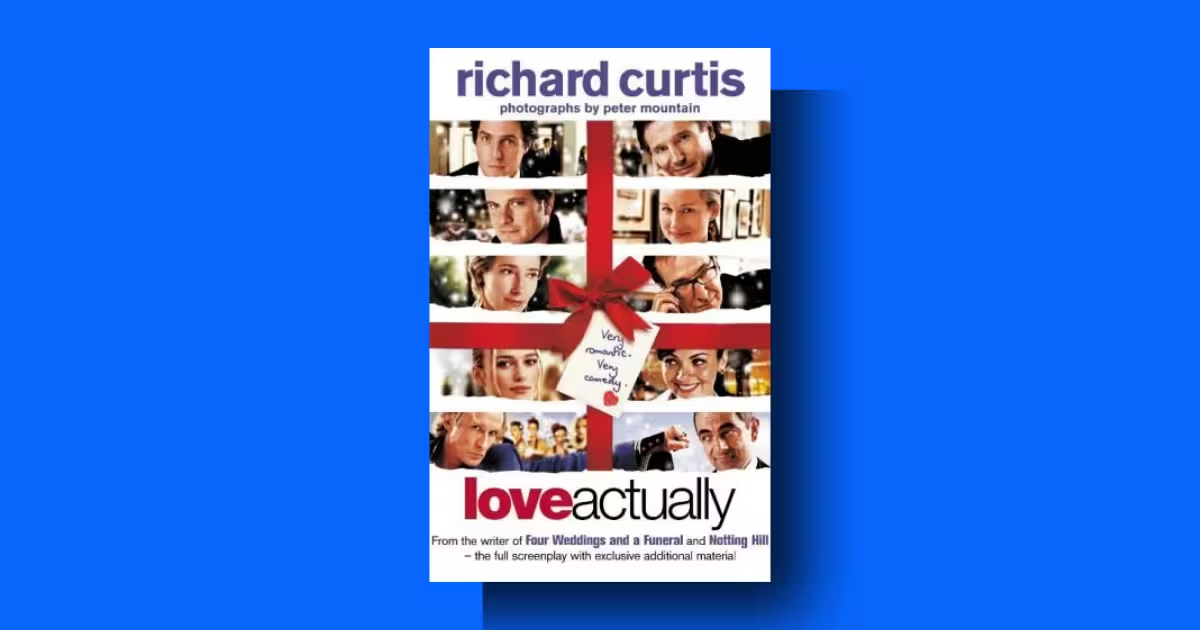
Are you wondering how a massive, multi-story movie looks on paper before it hits the big screen? I recently read the published screenplay for Love Actually, and it completely changed how I view the final film. We always see the polished, final cut in theaters, but reading the raw script shows the messy, beautiful reality of the writing process.
Overview
What it is: The published, original script of the 2003 holiday romantic comedy Love Actually, written by Richard Curtis.
The Core Story: It follows the intertwined lives of several distinctly different couples and individuals in London during the frantic weeks leading up to Christmas, exploring the messy, painful, and beautiful realities of love.
What makes it special: It reveals the raw, unfiltered writing process behind the hit movie. Love Actually includes an introduction by Curtis detailing how his massive five-hour first draft had to be ruthlessly edited down by his girlfriend, resulting in the removal of entire plotlines and scenes.
Why read it: It is perfect for massive fans of the film seeking behind-the-scenes trivia, deleted scenes, and character insights, as well as aspiring screenwriters wanting to study how to juggle a massive ensemble cast.
Best for / Not for: Love Actually is best for film students, aspiring writers, and massive fans of the movie who want behind-the-scenes trivia. Not for readers expecting a traditional prose novel.
Table of Contents
1. Introduction
- Title: Love Actually (The Screenplay)
- Author: Richard Curtis
- Publication Details: Published in 2003 by St. Martin’s Griffin, this book includes the full screenplay, an introduction by the author, and behind-the-scenes photographs.
2. Background
Before I get into the story, the background of how this script came to be is fascinating. Richard Curtis explains in the introduction that he originally wanted to write a film with multiple plots, inspired by movies like Robert Altman’s Nashville and Quentin Tarantino’s Pulp Fiction.
He came up with the stories while walking in Bali in 2000 while recovering from back surgery. Amazingly, his first draft was five hours long. It had to be heavily cut down by his girlfriend, Emma, who removed entire plotlines, including a story about gay schoolgirls and a man meeting Debbie Harry.
3. Love Actually Summary
Love Actually opens at the Arrivals Gate at Heathrow Airport. The Prime Minister provides a voiceover, noting that despite a world full of greed, love is present everywhere, especially when you watch people greeting each other at the airport.
We immediately cut to an old rock star named Billy Mack. He is in a recording studio with his manager, Joe, trying to record a Christmas version of “Love Is All Around”. Billy hates the song, calling it a “festering turd of a record,” but he knows it might be his last chance at a comeback.
Next, we meet Jamie. He is running late and leaves his sick girlfriend, Katya, in bed. However, when he returns home unexpectedly, he catches Katya having an affair with his own brother, Chris. Jamie is heartbroken and retreats to a farmhouse in France to write his novel.
Meanwhile, Daniel is grieving. He has just lost his wife, Jo. He calls his friend Karen for support, though she is busy dealing with her daughter Daisy, who has just been cast as the “First Lobster” in the school Nativity play. Daniel is also incredibly worried about his stepson, Sam, who locks himself in his room. After a heart-to-heart on a bench by the river, Sam admits he is not just sad about his mother, he is experiencing the “total agony of being in love” with a classmate named Joanna. To win her attention before she moves back to America, Sam decides to learn how to play the drums for the school Christmas concert.
Then there is Juliet and Peter’s wedding. Peter’s best friend, Mark, films the entire event. At the end of the ceremony, Mark surprises the couple with a choir singing “All You Need Is Love,” complete with hidden instruments in the pews. Later, Juliet asks to see Mark’s video because the official wedding video turned out blue. When she watches Mark’s tape, she realizes the footage is entirely focused on her face.
This reveals Mark’s secret, unrequited love for her, which he tries to brush off as a “self-preservation thing”.
In the political world, David has just been elected as the new British Prime Minister. On his first day at 10 Downing Street, he meets a cheerful, slightly clumsy staff member named Natalie. She accidentally swears in front of him, but David finds her charming. Later, the American President visits.
He is arrogant and bullies the PM in negotiations. When David catches the President inappropriately hitting on Natalie in his office, David decides to stand up for Britain during the joint press conference.
He declares that a friend who bullies is no longer a friend, which thrills his cabinet and the British public.
We also follow Colin, a quirky guy who delivers sandwiches. After striking out with English women, he decides to travel to Wisconsin, convinced that his British accent will instantly attract American girls. His friend Tony thinks this is a terrible idea. However, the moment Colin arrives in an American bar, he meets three stunning women (Stacey, Jeannie, and Carol Anne) who instantly invite him to share their bed.
In the film industry, John and Judy are stand-ins for a movie. They meet on set and strike up a polite, friendly conversation while simulating a sex scene. They eventually go on a date, ending with a sweet kiss at her door.
In a busy office, Sarah has been secretly in love with the chief designer, Karl, for over two years. Her boss, Harry, encourages her to make a move. At the company Christmas party at an art gallery, Karl asks her to dance. They go back to her flat and begin to undress.
Just as things get romantic, Sarah’s phone rings. It is her brother, Michael, who is in a high-security hospital ward. Sarah answers the phone, prioritizing her brother’s needs, and the romantic moment with Karl is lost.
Harry, Sarah’s boss, is facing his own issues. He is married to Karen, but his new secretary, Mia, starts heavily flirting with him. While Christmas shopping with Karen, Harry sneaks off to a jewelry counter to buy a gold heart necklace for Mia. He is nearly caught because the salesman, Rufus, takes an agonizingly long time to gift-wrap it with cinnamon sticks and dried roses. Later, Karen finds the necklace box in Harry’s coat pocket and assumes it is her Christmas present. On Christmas Eve, she opens a similarly shaped box from Harry, only to find a Joni Mitchell CD.
Realizing the necklace was for someone else, Karen goes into her bedroom, plays the CD, and cries before putting on a brave face for her children.
Back in France, Jamie meets his new Portuguese housekeeper, Aurelia. They cannot speak each other’s language, leading to funny and awkward interactions. One day, Jamie’s manuscript pages blow into a lake, and Aurelia strips down to save them.
A quiet romance blooms between them. When it is time for Jamie to leave, Aurelia kisses him gently. Realizing his feelings, Jamie begins secretly taking Portuguese language classes, while Aurelia starts learning English.
The provided script text ends on Christmas Eve. Billy Mack wins the Christmas Number One spot. Instead of celebrating with his manager Joe, he heads off to a glamorous party hosted by Elton John. Jamie abandons his family gathering to catch a cab to Gatwick Airport.
Meanwhile, Sarah is left alone in the dark office after Karl says a polite goodnight to her. She calls her brother, trying her best to sound cheerful.
4. Love Actually Analysis
4.1. Characters
The characters are deeply flawed but highly relatable. David, the Prime Minister, balances immense political pressure with extreme personal awkwardness. Karen represents quiet, domestic loyalty, which makes Harry’s wandering eye feel so painful.
The text highlights Sarah’s tragic loyalty to her brother. She is not a victim of bad luck; she actively chooses her brother over her own romantic happiness, making her character highly complex.
4.2. Love Actually Themes and Symbolism
A major theme is the failure and triumph of communication. Jamie and Aurelia connect deeply despite sharing no common language. On the other hand, Harry and Karen speak the same language but fail to communicate honestly about their marriage.
The airport acts as a recurring symbol of raw, unfiltered human emotion. It frames the story as a place where pretenses are dropped, and people show how they truly feel.
5. Love Actually Evaluation
1. Strengths/Positive Experiences:
The overlapping storylines are a structural marvel. The dialogue is snappy and realistic, especially the banter between Daniel and Sam.
2. Weaknesses/Negative Experiences:
Colin’s storyline in Wisconsin feels entirely disconnected from the emotional weight of the other plots. It plays out like a teenage fantasy rather than a grounded romantic comedy plot.
3. Impact:
Reading Love Actually left me feeling that love is rarely perfect. The script does not shy away from pain, showing that sometimes love means sacrificing your own happiness, like Sarah does for Michael.
4. Comparison with Similar Works:
Richard Curtis explicitly mentions being inspired by Robert Altman’s Nashville and Woody Allen’s Hannah and Her Sisters. Like those films, this story uses a large ensemble cast, but it focuses strictly on the emotion of love rather than broad societal critiques.
6. Personal Insight with Contemporary Educational Relevance
One of the most striking elements of the screenplay is how it handles the concept of global and personal connection in an increasingly divided world. The Prime Minister’s speech about standing up to the American President feels highly relevant today. It is a lesson in boundaries. Here are five lessons I took away from the reading:
Non-verbal cues are powerful: Jamie and Aurelia prove that human connection relies on effort and attention, not just shared vocabulary.
Vulnerability is a strength: David is the most powerful man in the country, but he wins our respect by admitting his faults and acting purely on his protective feelings for Natalie.
Love requires sacrifice: Sarah’s choice to care for her brother over dating Karl is a harsh but realistic look at familial duty.
Grief needs an outlet: Daniel uses humor and pop culture (like the movie Titanic) to connect with his stepson during a dark time.
Honesty matters: Harry’s secret gift-buying creates a ripple of pain that could have been avoided with honest communication.
7. Love Actually Quotes
“Whenever I get gloomy with the state of the world, I think about the Arrivals Gate at Heathrow Airport.”
“Often it’s not particularly dignified, or newsworthy – but it’s always there – fathers and sons, mothers and daughters, husbands and wives, boyfriends, girlfriends, old friends.”
“I feel it in my fingers, I feel it in my toes. Christmas is all around me…”
“I’ll give you anything you ask for – as long as it’s not something I don’t want to give.”
“We may be a small country but we’re a great one too. A country of Shakespeare, Churchill, the Beatles, Sean Connery, Harry Potter, David Beckham’s right foot – David Beckham’s left foot, come to that.”
8. Conclusion
My final impression is that the screenplay is just as warm and funny as the movie itself. Seeing the stage directions and author notes adds a personal touch that fans will adore.
I highly recommend Love Actually to anyone who loves romantic comedies or wants to learn how to juggle multiple character arcs in writing. It proves that behind every polished film is a writer pulling their hair out over early drafts and deleted scenes.







