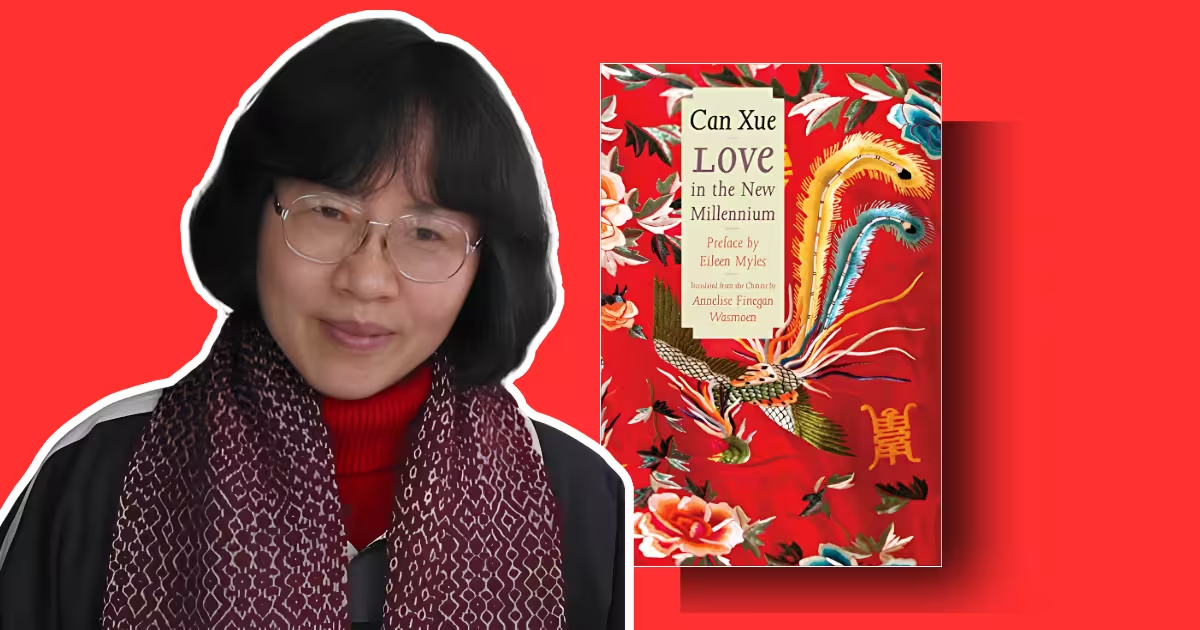

Love in the New Millennium by Can Xue is not a romance you read for comfort. It is a hallucination with a plot, a prison break disguised as a love story, and one of the strangest novels I have ever finished. I read the Yale University Press translation by Annelise Finegan Wasmoen, with the foreword by Eileen Myles.
The original Chinese edition, 新世纪爱情故事, was published in 2013 by 作家出版社. The English translation came out in 2018. From the first page, I felt like I had walked into a city where the streets rearranged themselves at night.
Table of Contents
Brief Summary
Love in the New Millennium by Can Xue follows Wei Bo, a married soap factory worker, and his lover Niu Cuilan, a widow and warehouse clerk, as their affair collapses into a maze of prisons, dream towns, sex work, antique shops, and a county called Nest.
The novel is less a traditional love story than a surreal study of love as an escape route from work, history, family, and the self. It has no single hero. It has many people who keep wandering, talking, having sex, going to prison, running businesses, and trying to break out of whatever box society has put them in. The ending does not resolve everything. A Si, the former cotton mill worker and sex worker, loses her lover A Yuan, then finds a new life with Liusha.
Wei Bo stays in prison by choice. Cuilan waits for a new lover. Xiao Yuan builds a life in Nest County with Dr. Liu. The novel closes with A Si kissing Liusha, hopeful, but still inside Can Xue’s strange loop of desire and survival.
Reader recommendation for Love in the New Millennium by Can Xue
Who will actually love this book? If you like linear love stories, clear morals, and tidy endings, you will bounce. If you like Kafka, dream logic, Chinese avant-garde fiction, or novels where the city itself feels alive, you will probably keep reading. I would recommend it to readers who enjoyed Can Xue’s The Last Lover, or who want translated fiction that refuses to explain itself.
It also suits readers interested in sex work, labor, and women’s lives in contemporary Chinese fiction. Love in the New Millennium is not for someone looking for a simple romance. It is for someone willing to sit in confusion and let the confusion become a kind of pleasure.
Introduction
Love in the New Millennium was written by Can Xue, the pseudonym of Deng Xiaohua. According to the author bio at the end of the book, she began writing fiction in 1983. She lived in Changsha, Hunan province, until 2001, and now lives in Beijing. The bio says she writes every day, even during festivals, and jogs every day too. Love in the New Millennium is her ninth book to appear in English.
Her novel The Last Lover won the Best Translated Book Award for Fiction. The English edition I read was published by Yale University Press in the Margellos World Republic of Letters series. The ISBN is 978-0-300-22431-3. The frontispiece illustration is by Wei Ke.
Love in the New Millennium has eleven chapters, and each one shifts focus to a different character or pair. The chapter list includes Cuilan and Wei Bo, Wei Bo and A Si’s Past Affair, Long Sixiang’s Inner Quest, Wei Bo’s Wife Xiao Yuan, The Antiques Appraiser, The Doctor’s Worldview, Wei Bo in Prison, Officer Xiao He’s One-Sided Love, Sentimental Education, In Nest County, and Brave A Si.
Background
Can Xue belongs to the wave of Chinese avant-garde fiction that emerged after the Cultural Revolution. The foreword by Eileen Myles places the book in a lineage of dreamlike cinema and storytelling. Myles compares the light in the novel to Tarkovsky’s Solaris and Fellini’s Satyricon. That comparison helped me understand why the book feels less like a novel and more like a movie projected inside a fever.
The original Chinese edition appeared in 2013. The English translation appeared in 2018. The book’s world is not the China of export realism. It is a China of cotton mills, hot spring spas, detention centers, county towns, antique shops, and underground pachinko parlors. The historical context matters because the cotton mill is not just a setting. It is a grave. Long Sixiang says the workroom was like being sealed in a cement mixer.
A Si says the factory left her with memories of machines banging. The novel turns those labor memories into surreal afterlife.
Love in the New Millennium Summary
I will summarize the plot in instalments, with full spoilers. This is not a short book, and the plot is not linear. I will follow the chapter order as much as possible.
Chapter 1: Cuilan and Wei Bo
Love in the New Millennium opens with Niu Cuilan, a thirty-five-year-old widow, waking before dawn to wash and dress because her lover Wei Bo might visit. Wei Bo is forty-eight and works at a soap factory. They met a year earlier at a hot spring spa that offers sex among its services.
Cuilan first saw Wei Bo in a plum-colored workout shirt and thought he looked furtive. She elbowed him in the hallway. Later he tracked her down, and they became lovers. Wei Bo has a family and some gray income. Cuilan sees him as her underground husband. On this day, she waits and eats mangoes, ruining her makeup. Wei Bo finally knocks four times. He says he has to leave immediately because something important happened at home.
He stays two minutes. Cuilan is devastated. Two months pass without him.
Cuilan goes to a noodle shop and runs into Mr. You, an antiques appraiser. He is overdressed and slick, with white teeth. He tells her someone she knows was at the spa with him. Cuilan leaves.
She decides to get her life back on track. She goes back to the hot springs on a Sunday. There she meets Long Sixiang, a former cotton mill worker who wants to become a sex worker. Long Sixiang says she knows Wei Bo. She says Wei Bo talks about Cuilan and calls her a virtuous woman. Long Sixiang says Wei Bo is in debt for Miss Si, a young woman from the cotton mill. Cuilan later dreams of Wei Bo and the spa. She goes to the countryside to visit her cousin Niu Yiqing. The countryside is strange. Her cousin and his wife seem shrunken and dark.
The wife makes cicada sounds. The cousin talks about analyzing soil. At night, Cuilan hears them in a camphor tree. They fall, but are unhurt. Fourth Uncle, a dead relative, calls to her. He says Wei Bo will not abandon her. Cuilan returns home. Wei Bo visits the next day. They have great sex. He says he has known her cousin and Fourth Uncle. Then he goes home. Later, in the park, the police arrest Wei Bo.
A young policeman says he belongs to a criminal organization. Wei Bo goes cheerfully. Cuilan visits him at the detention center. He gropes her, and she pushes him away. He says prison changes a man. He says he has broken the law. Cuilan leaves confused.
Chapter 2: Wei Bo and A Si’s Past Affair
Wei Bo first saw A Si when he worked part-time at the same cotton mill. He fell for her. She asked him how much he would pay to keep her. He said he was not rich but would help. A Si became a sex worker at the hot springs. Wei Bo tried to rescue her, but she was calm and earned enough to plan for an apartment. A Si is candid and has other boyfriends. She says she regrets not leaving the cotton mill sooner.
One time a criminal beat her and cut her hair. Wei Bo sat with her. She says she is the kind of person who would die for love. Wei Bo loves her. Long Sixiang tells Wei Bo that A Si has a secret lover and maybe a disease. Wei Bo and Long Sixiang visit A Si’s mother, who lives on the outskirts surrounded by pigsties. The mother is harsh. Wei Bo does not understand. Later Wei Bo sees A Si at the spa. She is injured but still working.
Wei Bo feels abandoned. He goes to a bar and meets Mr. You. Mr. You talks about Long Sixiang. Wei Bo goes home. His wife Xiao Yuan says she knows about his affairs. She admires A Si but does not want to lose the home. Wei Bo thinks of Cuilan. He goes to an alley near a theater where gamblers gather. A man named Long Hair tells him to go back to his hometown. Wei Bo remembers his childhood trips to an enormous ancestral home. His father blindfolded him on the train. The house was cold. His uncle and aunt drank tea on the balcony. Wei Bo does not know where his hometown is.
A Si learns from Long Sixiang that her mother lives near the pigsties. A Si does not go see her. Wei Bo visits A Si. He is ashamed. She says meeting him was the greatest happiness of her life. Long Sixiang and A Si go to the West Pavilion bar. Mr. You joins them. They drink and talk about a shared childhood courtyard. The bartender says Wei Bo is in prison undergoing reform. They get on a tractor to find Wei Bo.
The tractor overturns in a pond. A Si swims ashore. Lao Yong says Long Sixiang planned it. A Si goes home. The Informant, her neighbor, says he reported her to raise her status. Later A Si goes back to the cotton mill. She climbs a tree and enters the abandoned workshop. She finds Hong Sheng, the old receptionist, living in a loft. He says he is writing the history of the cotton mill, which has a 150-year history. He calls the women lovebirds who flew away from hell. Four men in helmets and protective gear break in and destroy the loft. Hong Sheng disappears. A Si leaves.
She later learns A Yuan, the opium dealer, died in a fire at the paper warehouse, which was the free port. She kisses his charcoal lips. She releases the red scorpion into the sewer. She meets Silver, a tall girl who says she is thirty-five and used to work at the cotton mill.
Silver says she is history. They go to the free port. A Si meets Cuilan in a shop. They talk about Wei Bo and A Yuan. Cuilan says they should each start new lives. A Si goes to the riverside. Gu Dabo has transferred his fishing boat to Liusha. A Si and Liusha become lovers.
Love in the New Millennium ends with A Si kissing Liusha and saying she believes him.
Chapter 3: Long Sixiang’s Inner Quest
Long Sixiang’s infant dies. She faints. She divorces her husband Xiao Wu. She goes back to the cotton mill. She meets A Si, who is nineteen and plays featherball. They become close. A Si asks Long Sixiang for advice about three men pursuing her. Long Sixiang gives her an iron bar. Later Long Sixiang decides to pursue a man.
She considers sex work. She and Jin Zhu, a divorcee with tuberculosis, visit erotic venues. No one wants to hire them because they are old. Then Long Sixiang sees Wei Bo at the hot springs. He helps them get jobs as sex workers. Long Sixiang and Jin Zhu fall in love with Wei Bo, but not sexually. Long Sixiang becomes jealous of A Si. She spreads rumors.
Later Long Sixiang meets Lao Yong, a farmer-entrepreneur and cement merchant. Jin Zhu services him first, but he shifts to Long Sixiang. Jin Zhu plots murder but does not act. Long Sixiang refuses to marry Lao Yong. They go to the Mandarin Ducks Suites. The place is strange. Lao Yong says it was built over his old village, which was destroyed by cholera. Long Sixiang and Lao Yong fight and separate and reunite.
Jin Zhu marries Camel, Lao Yong’s hunchbacked cousin. Camel says Lao Yong pushed him into a well when they were children. Long Sixiang returns to the spa. She has a dream about A Si being attacked. She wakes to a customer. She has sex with him gloomily.
Chapter 4: Wei Bo’s Wife Xiao Yuan
Xiao Yuan left her teaching post years ago. She travels for work. She meets Dr. Liu on a train. He runs a Chinese medicine clinic in Nest County. Xiao Yuan has many timepieces. Dr. Liu is annoyed by them. They talk. She says she controls the radio’s time announcements with her thoughts. They stay at his sister’s home in the capital, then go to Nest County.
They spend a day on Nest Mountain. They part at a crossroads.
Xiao Yuan keeps a train ticket and a piece of rhinoceros horn. She later has a boyfriend named Flax. She cannot forget Dr. Liu. She hears a clock in the sky. She finds Wei Bo at the stone table under the scholartree. They talk. She travels northeast to Manchuria. On the train, she meets a blind man named Cricket. He can keep time better than a clock. He says he has always wanted someone to hear his heartbeat. She hears it.
A young man in the upper bunk falls dead. Cricket disappears. Xiao Yuan goes to a hotel. A young man says he is looking for his blind brother. Xiao Yuan says she fell in love with him. She returns home. She tells Wei Bo she likes returning home in the middle of the night. She flies south. On the plane, she sits next to a white-bearded massage therapist. He sticks a needle in his tiger’s jaw. They talk about Dr. Liu.
They get drunk in a small bar. Xiao Yuan cries. She goes to a school factory to buy teaching aids. The factory director has a horse face. He says he knows Old Needle and Dr. Liu. Xiao Yuan is knocked down. She returns home. She thinks she is happy. She hears a figure at the head of her bed saying, “Everything is provided for.”
Chapter 5: The Antiques Appraiser
Mr. You is fifty-four but looks younger. Cuilan visits his shop. She sees him looking old and flabby.
A Liang, a vagrant woman, is hiding in his closet. A Liang says she lost her hometown. Cuilan leaves. Mr. You’s face becomes smooth again. He and A Liang go to a restaurant. They talk about the river and the underworld. The restaurant owner plucks lilies from the wall. A Liang and Mr. You become lovers. A Liang says she is from Cuilan’s cousin’s village. Mr. You fights nightly against enemies in the dark. He is a “staunch defender” of the city.
He meets an old man at 132 Sea Line Drive, a pachinko parlor. The old man says it is a free trade port. Mr. You meets an electrician who wants to die. A Liang’s friend Xiao Lan arrives. Xiao Lan says today’s authentic antiques are forgeries. A Liang becomes ill. She says she will go to the old mansions in the south part of the city with Xiao Lan. She gives Mr. You a tiny vase. She says she will leave soon.
Mr. You hears a steam whistle far away.
Chapter 6: The Doctor’s Worldview
Dr. Liu had a libertine youth but became a serious loner. He runs a clinic in Nest County. He wears a white lab coat. He has mysterious visitors. He believes herbal medicine grows alongside the human body. He treats an elderly patient with a tumor.
The patient says they belong to a secret organization. A bird lives with the patient. Dr. Liu has a patient named Danniang who wants to marry him. He avoids her. He hides for four days. Danniang calls. He says he is in the countryside. He is actually upstairs. He ends the relationship. Later he sees a girl with roundworms. She says to leave a few worms in her stomach. Dr. Liu thinks his life is a legend. He goes to a county in the central province to visit a qigong magazine.
The director is named Hu Gua. The office is a one-person magazine. A monkey lives on the desk.
Director Hu says the magazine has 2,025 subscribers. A window shatters. Director Hu is injured. His left eye may be removed. Dr. Liu leaves. He meets a short man named Zhu. He returns home. Old Man Lin with the tumor dies in the mountains. His house is demolished. Dr. Liu feels sorrow.
Chapter 7: Wei Bo in Prison
Wei Bo is sentenced to three months. Xiao Yuan visits once. Wei Bo hauls sand. He feels joy at night. He thinks of Cuilan. He believes she is his lucky star. His cellmates are Lao Zhang, Lao Lu, and Xiao Yan. Lao Zhang says he charged the prison with a gun.
Lao Lu says he was tired of life. Xiao Yan has a diamond ring for his girlfriend. Xiao Yan escapes and returns. Guard Yang finds the ring. Xiao Yan is upset. Wei Bo faints from exhaustion. Lao Zhang tells him his hometown is a prison. Xiao Yan is almost hired as a guard but is replaced. Guard Yang tells Wei Bo to watch Xiao Yan. Xiao Yan says people like them should stay in prison. Cuilan’s Fourth Uncle visits Wei Bo in prison.
He says Cuilan is busy listening to people’s love problems. Wei Bo is shot in the calf by Lao Lu. The bullet embeds but does not bleed much. Wei Bo adapts but still feels like an outsider.
Chapter 8: Officer Xiao He’s One-Sided Love
Xiao He is thirty-six, married, with a son. He cannot forget his first love, Cuilan. He remembers their trip to Pear Mountain. He showed Cuilan’s threatening letter to Wei Bo. He wants to help and hurt them. After Wei Bo goes to prison, Xiao He and Cuilan meet. They plan Fourth Uncle’s visit. Xiao He drinks with Yuan Hei. They go on a fishing boat at night. The boatman is Gu Dabo. They nearly die.
They return to the bar. Xiao He meets Cuilan in a basement coffee shop. Cuilan says Wei Bo will wear through the prison floor. Xiao He says prison can change a person. The server brings a small dish. Cuilan sees a hideous face. She leaves. Xiao He goes to the riverside. The fisherman says he wrecked the deck. Xiao He apologizes. The fisherman says he was happy to save a life.
Chapter 9: Sentimental Education
A Si and Yuan Hei sit by the river. They were separated years ago. A Si says her boyfriend is an opium dealer. Yuan Hei’s lover is a prison guard named Feixia. A Si leaves. Yuan Hei goes onto Gu Dabo’s boat. Gu tells him about A Si. Yuan Hei leaves.
He goes to 132 Sea Line Drive. The pachinko hall is a free port. A Si appears. She says the free port is an intelligent trap. Yuan Hei meets a girl named Chan. She is a bench worker. Her lover died in a planer. She has a razor blade in her hand. She cuts Yuan Hei. The manager appears. Yuan Hei leaves. He has trouble breathing. He wakes at home. Feixia is there.
She says she is her body double. She leaves a furry animal tail. Yuan Hei puts it in a pot of narcissi. He wonders if the free port is the ancient city wall.
Chapter 10: In Nest County
Xiao Yuan moves to Nest County to teach geography. She does not tell anyone. She becomes fond of the students. Little Rose and Little Green love plants. Little Rose says plants travel in glass bottles. Little Green says gardenias travel by scent. Xiao Yuan sleeps at Little Rose’s house.
Little Rose takes a phoenix-tail fern to Nest Mountain at night. Xiao Yuan worries. Little Rose returns. Xiao Yuan visits Teacher Zhong, a mathematics teacher and beekeeper. He lives in an earthen house. He says he keeps no bees. He imagines honeybees. Xiao Yuan likes him. She returns to school. Her student Lü is trying to save his mice from a mouse extermination campaign. Xiao Yuan scatters seeds that do not grow. Teacher Zhong tells her to join a collective absentmindedness. Her tulips bloom. The wonton shop woman says Dr. Liu asked about her. Xiao Yuan realizes Dr.
Liu helped her transfer. She goes to the wasteland with her students for a geography conference. Dr. Liu sees her from a taxi. She sees him. They do not speak. Later Dr. Liu comes to her home. They become lovers. Xiao Yuan’s golden trumpet flowers bloom.
Dr. Liu says he planted them. Xiao Yuan visits a white-bearded man who is dying. He plans to die in his garden. Little Green leaves for a border county town. Xiao Yuan waits for Dr. Liu.
Chapter 11: Brave A Si
Gu Dabo returns from Dongting Lake. A Si visits him. She says she wants to belong to him. He says she will become a dried lemon. She leaves in a coffin-shaped truck with the opium dealer. They go to a sewer tunnel. A Si is left on watch. A man and woman fight. The woman stabs the man. A Si has sex with the injured man. He leads her into the pipe. She is bitten by a scorpion. She faints. She wakes at home.
A Yuan says she has a travel pass. He shows her the red scorpion. A Si wants to rest. The Informant says she has duties. A Si goes to the cotton mill. She finds Hong Sheng again. Four men destroy the loft. A Si leaves. She goes to a café. Long Sixiang says she and Lao Yong are getting married. A Si goes to the free port. The manager shows her A Yuan’s pachinko machine. A Yuan died in the Sahara.
The manager says A Yuan’s truck returned from the desert. A Si leaves. She meets Silver. They go to the theater. Silver sits on the roof terrace. A Si fears Silver will jump. Gu Dabo appears. Silver leaves. A Si goes to Gu Dabo’s boat. She meets his nephew Xigou. She goes into the river. Xigou supports her. She hears the Lady of the Camellias singing. She asks Gu how many times a person can die. He says it depends on potential.
A Si and Gu visit the Lady of the Camellias on a fishing boat. The old woman sings. A Si says her singing gave her life. A Si promises to keep living. She and Gu part. A Si sees the free port manager. He says A Yuan’s truck will charge out. A Si meets Silver again. Silver says the café is an entrance to the free port. A Si sees a screen with yellow sand and a wooden cabin. She meets Cuilan. Cuilan says Wei Bo does not plan to leave prison.
Cuilan says they should start new lives. A Si agrees. She goes to the riverside. Gu Dabo has transferred the boat to Liusha. A Si and Liusha become lovers. She kisses him.
Love in the New Millennium ends.
Love in the New Millennium Analysis and Criticism
Characters
Wei Bo is the closest thing to a central character, but he is not a hero. He is forty-eight, married, and a soap factory worker. He is passive, evasive, and self-examining. He goes to prison on purpose. He says, “I think I’ve broken the law” (Page 44). He is loved by Cuilan, A Si, Xiao Yuan, and Long Sixiang, but he cannot fully belong to any of them. His name appears in almost every chapter. He is a connector, not a decision-maker.
Niu Cuilan is a thirty-five-year-old widow. She works at a gauge and meter factory. She wants love but also independence. She is practical, jealous, and curious. She goes to the countryside and finds her cousin transformed. She says, “Life is so wonderful in the countryside after all!” (Page 32). She later becomes a listener for people with love problems.
She is not a passive victim. She chooses to wait for Wei Bo, then chooses to move on. Her final scene with A Si in the shop is quiet and strong.
A Si is the most vivid character. She is a former cotton mill worker turned sex worker. She is beautiful, reckless, and brave. She says, “I prefer to follow my heart and do as I please” (Page 15). She loves Wei Bo, then the opium dealer A Yuan. She survives violence, arrest, and the free port. She says, “I am that history” (Page 14). She is Love in the New Millennium‘s emotional center in the last third. Her ending with Liusha is not a fairy-tale ending, but it is a beginning.
Long Sixiang is a former cotton mill worker who becomes a sex worker. She loses an infant, divorces, and fights to survive. She is tough and talkative. She says, “I believe there’s no too late, only too lazy” (Page 78). She loves Wei Bo, then Lao Yong. She refuses to marry him. She is jealous of A Si, but also loves her. Her inner quest is not about finding a man. It is about finding a life she can stand.
Xiao Yuan is Wei Bo’s wife. She is a teacher and traveler. She is obsessed with timepieces. She meets Dr. Liu and cannot forget him. She moves to Nest County. She is intelligent, independent, and strange. She says, “I like to travel. Making a journey is the same as clinging to one place” (Page 10). She finds a new life with Dr. Liu. She is not a scorned wife. She is a woman rebuilding herself.
Mr. You is an antiques appraiser. He is fifty-four, dandyish, and lonely. He loves women and antiques. He says, “Women are mysterious and unfathomable” (Page 58). He is also a night wanderer who guards the city. He loves A Liang. He is a comic and tragic figure. He says, “Love has been an unlucky pursuit recently” (Page 26). He is one of the novel’s most original creations.
Dr. Liu is a Chinese medicine doctor in Nest County. He is handsome, single, and self-contained. He believes needles entering the body are sounding the universe (Page 11). He helps Xiao Yuan come to Nest County. He is afraid of family life. He is a healer who cannot heal himself. He becomes Xiao Yuan’s lover. He is a quiet counterweight to Wei Bo.
A Yuan is the opium dealer. He is A Si’s lover. He dies in the free port fire. He leaves her a red scorpion. He is a criminal, but also a romantic. He says, “Three hundred days and nights leading to the grave!” (Page 88). He is not fully explained. He is a ghost who returns as Xigou and Liusha in different forms.
Love in the New Millennium Themes and Symbolism
Love as prison break is the central theme. The novel is full of prisons. Wei Bo goes to prison on purpose. The cotton mill is a prison. The Mandarin Ducks Suites are a prison. The free port is a prison. Marriage is a prison. Love is the only escape, but it is also another trap. Wei Bo says, “People like us, more dead than alive, always indecisive. We ought to stay here” (Page 12). A Si says, “I don’t want liberation.
I yearned to be tied up tight in ropes so that I could never go too far” (Page 300). The novel refuses to say whether love frees or imprisons. It says both.
History and memory are also central. Hong Sheng wants to record the history of the cotton mill. He says the factory has a 150-year history. A Si says, “It turns out this is also history. Fortunately it’s been destroyed!” (Page 14). History is not a record. It is a wound that repeats. The four men who destroy the loft are trying to reverse the verdict of history. A Si learns that history is “an event that repeated unforgettably in the mind” (Page 14).
Love in the New Millennium asks whether history can be escaped or only relived.
Work and sex work are intertwined. The cotton mill is a place of heavy labor, flying cotton, and early death. Long Sixiang and Jin Zhu escape to become sex workers. They say they are happier. The novel does not moralize. It shows sex work as labor, love, risk, and freedom. Long Sixiang says, “It’s the risk that makes it interesting” (Page 52). Jin Zhu says, “Our backs are straight now, we know what we are capable of, and we can also love!” (Page 53).
Love in the New Millennium treats these women as workers, not victims.
Dreams and reality have no clear border. Cuilan’s cousin and his wife fall from a tree and are unhurt.
A Liang hides in a closet and says she lost her hometown. Mr. You’s antiques are alive. The free port appears and disappears. Dr. Liu hears the earth. Xiao Yuan enters a wall. The novel uses dream logic to say something true about how people actually live. People do not experience their lives as a straight line. They experience them as a series of haunted rooms.
The city and the countryside are both alive. The city is full of night wanderers, insomniacs, prostitutes, prisoners, and ghosts. The countryside is not a peaceful escape. It is full of disappeared villages, burning grass, and people who sit in trees. Cuilan’s cousin says, “Our daytime and nighttime are two completely different days” (Page 9). The novel suggests that place is not a container. It is a character.
Evaluation
Love in the New Millennium is an outstanding, maddening, and unforgettable novel. It is not a comfort read. It is a book that makes you feel like you have been walking through a city at night for hours and have forgotten where you live. I felt lost, then found, then lost again. It is one of the few contemporary novels I have read that treats love as a philosophical problem rather than a plot device.
Strengths
The prose is vivid and strange. The characters are memorable, especially A Si, Long Sixiang, and Mr. You. The novel has a strong visual quality. The scenes in the cotton mill, the free port, the Mandarin Ducks Suites, and Nest County are hard to shake.
The translation by Annelise Finegan Wasmoen reads smoothly while keeping the uncanny tone. The foreword by Eileen Myles is a useful entry point. Love in the New Millennium also gives space to middle-aged women, sex workers, and workers. That is rare.
Weaknesses
The plot can be hard to follow. Some chapters feel like they reset the story. Love in the New Millennium has many characters and not all of them are equally developed. The ending is not a resolution. Some readers will find the dream logic tiring.
Love in the New Millennium also repeats certain phrases and scenes. That is part of its style, but it can slow the reading. I sometimes wanted a clearer emotional throughline. I also could not always tell whether a scene was meant to be real or imagined. That is intentional, but it is still a challenge.
Comparison with similar works
If you like Kafka’s The Trial, you will recognize the prison logic. If you like Murakami’s dream worlds, you will recognize the talking cats, strange women, and disappearing towns. If you like Toni Morrison’s Beloved, you will recognize the way history haunts the present.
If you like Chinese avant-garde writers such as Yu Hua or Mo Yan, you will find a similar interest in violence, memory, and the grotesque. Can Xue is less historical than Mo Yan and less satirical than Yu Hua. She is closer to a poet who writes novels.
The closest comparison might be to dream narratives like Kobo Abe’s The Woman in the Dunes. Love in the New Millennium also shares something with Eileen Myles’s own writing, which is interested in sex, cities, and the sacred ordinary.
Personal insight with contemporary educational relevance
One important angle in Love in the New Millennium is the way labor shapes the psyche. The cotton mill is not just a workplace. It is a trauma that follows the women into their new lives. Long Sixiang says the workroom was like being sealed in a cement mixer.
Jin Zhu says she and Long Sixiang have cotton in their lungs. They escape to sex work, but the factory is still inside them. This matters today because discussions of labor and mental health often separate the two.
Love in the New Millennium says they are the same. It also says that people can build new lives without pretending the old ones never happened.
Five lessons I took from this angle:
- Escape is not the same as healing. Long Sixiang and Jin Zhu leave the mill, but the mill leaves them.
- Work can be a prison even when it is legal. The novel shows that exploitation does not need bars.
- Sex work is work. The novel treats it as labor, with risks, skills, and relationships.
- History lives in the body. A Si’s scar, Jin Zhu’s lungs, and Long Sixiang’s grief are all archives.
- Love is not a solution. It is a practice. It is something people do badly, again and again, because they need it.
Love in the New Millennium Quotes
“Have you always treated the whole world as your home, Fourth Uncle?” / “Not the whole world—I’m always wandering nearby.” (Page 8)
“Our daytime and nighttime are two completely different days. If you always lived here and never left you’d be able to sense this. It’s too bad you won’t have the chance.” (Page 9)
“I like to travel. Making a journey is the same as clinging to one place. If you settle down in your hometown, it feels instead as though you are drifting along.” (Page 10)
“He believed needles entering the body were sounding the universe. No need to fear the divide of mountains and rivers—the distance would vanish in an instant.” (Page 11)
“People like us, more dead than alive, always indecisive. We ought to stay here.” (Page 12)
“It turns out this is also history. Fortunately it’s been destroyed!” (Page 14)
“I am that history.” (Page 14)
“I prefer to follow my heart and do as I please.” (Page 15)
“From each according to his ability, to each according to his needs.” (Page 34)
“You are time itself, time that no one can possess.” (Page 134)
“Your problem is written on your face. The answer is inside my taxi. Get in the car.” (Page 12)
“I want to go for a walk inside the ancient city walls, otherwise I cannot close my eyes in death.” (Page 10)
“The free port isn’t the kind of place you can just go to because you want to go there.” (Page 241)
“I am a free person! Come with me!” (Page 166)
Conclusion
Love in the New Millennium by Can Xue is a difficult, rewarding, and deeply original novel. It is not for every reader. It is for readers who want fiction that feels like a fever dream and a philosophical argument at the same time. I would recommend it to fans of surrealism, translated fiction, and stories about women who refuse to be reduced to their circumstances.
It is also a good book for writers who want to see how far a novel can go without a conventional plot. The ending is not a bow. It is a door. A Si kisses Liusha. Wei Bo stays in prison. Cuilan waits. Xiao Yuan builds a home. Love in the New Millennium does not tell us what happens next. It tells us that people keep going. That is enough.