
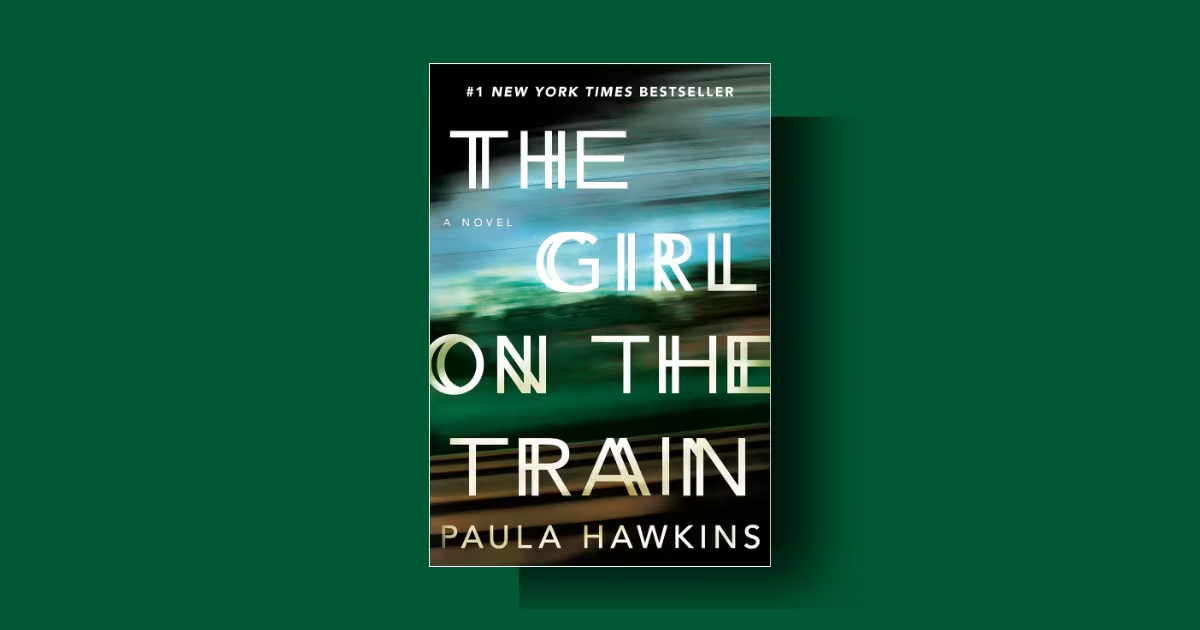

The Girl on the Train by Paula Hawkins, published in January 2015, is a psychological thriller told through the alternating first-person narratives of three women: Rachel Watson, a divorced alcoholic; Anna Watson, Rachel’s ex-husband’s new wife; and Megan Hipwell, a young woman living a few doors down from Anna and Tom. Rachel commutes daily past her old home and becomes obsessed with a couple she calls “Jason and Jess,” who live at number fifteen Blenheim Road.
When Megan Hipwell disappears, Rachel inserts herself into the investigation, convinced she saw something important on the night Megan vanished. The novel’s central twist is that Tom Watson, Rachel’s ex-husband, is the killer.
He manipulated Rachel for years, gaslighting her into believing her own memories were false, and he was also having an affair with Megan. Rachel eventually kills Tom in self-defense with a corkscrew, and Anna covers it up.
The book explores addiction, domestic abuse, gaslighting, and the unreliability of memory. It sold over 15 million copies worldwide by October 2016 and was adapted into a 2016 film starring Emily Blunt that grossed $174.3 million worldwide.
Table of Contents
Reader Recommendation
Who will love this book: Fans of psychological thrillers with deeply flawed, morally complicated narrators will find The Girl on the Train hard to put down. Readers who appreciated the unreliable narration in Gone Girl or the slow-burn dread of The Woman in the Window will feel at home here. The novel’s willingness to sit inside Rachel’s shame, confusion, and self-loathing makes it an uncomfortable but gripping read.
Who might bounce: Readers who need a likable protagonist will struggle. Rachel is difficult to root for at times, and the men in the novel are largely unsympathetic. Those who prefer fast-paced, plot-driven thrillers may find the middle section repetitive. And readers who want a clean, morally satisfying resolution might be unsettled by the ending, where two women cover up a killing.
Reader sentiment: Goodreads data shows a 3.96 average rating from over 3.3 million ratings, with 33% of readers giving it 5 stars and 38% giving it 4 stars.
Introduction
The Girl on the Train by Paula Hawkins was published on 13 January 2015 by Riverhead Books in the US and 15 January 2015 by Doubleday in the UK. Hawkins, a former journalist, wrote the novel as her debut psychological thriller. It debuted at number one on The New York Times Fiction Best Sellers list on 1 February 2015 and remained there for 13 weeks.
By October 2016, an estimated 15 million copies had been sold worldwide, and the book had been translated into over 40 languages and published in 50 countries.
Background
The novel emerged in the wake of Gone Girl’s massive success in 2012, which had reignited publisher and reader appetite for domestic psychological thrillers with unreliable female narrators. However, The Girl on the Train is not simply a Gone Girl clone.
Hawkins has said she was specifically interested in how alcoholism divorces a person from a proportionate sense of guilt and responsibility. In a 2024 interview, she explained: “I was specifically interested in the thing where someone drinks to the point where they can’t remember what they did the night before, and the fact that that divorces the person from a proportionate sense of guilt and responsibility for what they’ve done”.
That thematic focus sets the novel apart. The unreliability of Rachel is not a plot device designed to fool the reader. It is a condition of her addiction, and Hawkins treats it with a seriousness that elevates the book above typical genre fare.
The Girl on the Train: Full Plot Summary
Part One: Rachel
Rachel Watson is 32 years old, divorced, unemployed, and an alcoholic. She rents a small room in Ashbury from Cathy, a university friend she was never particularly close to. Every weekday morning she takes the 8:04 slow train from Ashbury to Euston, pretending she still has a job in London. In the evenings she returns on the 5:56. She drinks on the train. She drinks before the train. She drinks after.
The train always stops at a red signal opposite a row of Victorian houses backing onto the railway line. Rachel fixates on number fifteen, where a couple she calls “Jason and Jess” live. She constructs an entire life for them in her head. Jason is handsome, strong, protective. Jess is beautiful, artistic, free-spirited. They are everything Rachel and Tom used to be, she believes. They are what she lost.
Five doors down from number fifteen is number twenty-three Blenheim Road. That is Rachel’s old house. Tom still lives there with Anna, the woman he left Rachel for, and their baby daughter, Evie. Rachel cannot stop looking at it. She cannot stop calling Tom. She cannot stop showing up.
One Friday morning in July 2013, Rachel sees Jess kissing a man on the lawn. It is not Jason. Rachel is devastated, as though she has been cheated on herself. She feels a familiar ache, the same pain she felt when she discovered Tom’s affair with Anna by reading his emails. She had found messages where Tom wrote to Anna: “I fell asleep last night thinking of you, I was dreaming about kissing your mouth, your breasts, the inside of your thighs. I woke this morning with my head full of you, desperate to touch you.
Don’t expect me to be sane, I can’t be, not with you.”
Part Two: Megan
A year earlier, in May 2012, Megan Hipwell is sitting on her terrace, listening to the trains go past. She is 29, married to Scott, a self-employed IT consultant. She used to manage a small art gallery in Witney, but it closed down. She is restless, bored, and haunted by her past.
Megan’s brother, Ben, died in a motorcycle accident when she was 15 and he was 19. She ran away from home three days after his funeral. She was arrested twice, once for theft and once for soliciting. At 16, she moved in with an older man named Mac, a musician who lived in a cottage near Holkham in north Norfolk. She lived there for about three years.
At 19, Megan became pregnant. She gave birth at home with the help of a nurse friend of Mac’s. The baby was a girl. Megan named her Libby. One night, after an argument with Mac, Megan drew a bath and took the baby in with her.
She fell asleep. When she woke, Libby was dead, wedged between her arm and the edge of the tub, her face in the water. Megan and Mac buried her in the garden near a disused railway line, marked with a cairn of stones. Mac left the next day. Megan never saw him again.
In the present, Megan is seeing a therapist, Dr. Kamal Abdic, for anxiety and insomnia. She develops feelings for him and kisses him. He resists at first but eventually returns her affection. They meet at a hotel called the Swan in Corly. Megan also begins an affair with Tom Watson, who lives down the road with Anna and Evie. Tom and Anna had hired Megan as a part-time nanny for Evie, and Tom and Megan started sleeping together while she was working in their home.
Megan becomes pregnant again. She does not know if the father is Scott or Tom. She decides to tell Scott everything, including the affair, and to raise the baby honestly. On Saturday, 13 July 2013, she tells Scott about the affair. He attacks her, pinning her against the kitchen wall with his forearm across her throat. She locks herself in the bedroom, packs a bag, then unpacks it. She sends a text to Tom: “I need to talk to you. URGENT. Call me back.” He does not respond. She calls and calls, and finally leaves a message: “Pick up the phone, or I’m coming round there. I mean it this time.”
She leaves the house, walks past number twenty-three, past the underpass, and continues to the park. She calls Tom one more time and tells him she will wait for him. He does not come. She walks back towards home. She sees Tom emerging from the underpass, his shoulders hunched, his fists clenched. He beckons her over. “We can’t talk here,” he says. “The car’s over there.” She gets into his car.
Part Three: Anna
Anna Watson is Tom’s second wife. She was the other woman. She met Tom while selling a house on Cranham Road, and they began an affair there, meeting in the empty property while Rachel was still married to him.
Anna never felt guilty about it. In her narration, she says: “I never felt bad for Rachel, even before I found out about her drinking and how difficult she was, how she was making his life a misery. She just wasn’t real to me, and anyway, I was enjoying myself too much. Being the other woman is a huge turn-on, there’s no point denying it.”
Anna now lives in the house Rachel once shared with Tom. She hates it. She hates the trains, the memories, and she hates Rachel. She is also frightened of her. She logs Rachel’s calls and sightings. She keeps a harassment log. She calls the police.
On the morning of Rachel’s confrontation with Tom, Anna is in the house. She has been discovering things. She found a secret mobile phone in Tom’s gym bag, a phone that turns out to belong to Megan. She heard Megan’s voice on the voicemail greeting: “Hi, it’s me, leave a message.” She knows.
Part Four: The Truth
Rachel’s memory of the night Megan disappeared has been fractured by alcohol and by years of Tom telling her that her recollections were wrong. She has been gaslit for years. Tom told her she attacked him with a golf club when she only remembers feeling fear. He told her she humiliated him at parties when she remembers kindness. He told her she was the reason their marriage failed when he was the one having the affair.
In the final act, Rachel goes to Anna’s house. Anna is in the garden with Evie. Tom is out. Rachel tells Anna about the secret phone and about Tom’s affair with Megan. Anna, who has already found the phone, is already half-convinced. When Tom returns, he tries to talk his way out of it, blaming Rachel, blaming Anna, blaming Megan.
He admits to the affair and then, chillingly, to the murder. He says Megan was screaming at him, threatening to tell Anna, and he “just needed her to stop.” He picked up a rock and hit her. She tried to crawl away. He finished it. He buried her in Corly Wood.
Rachel tries to run. Tom hits her with a beer bottle, drags her back into the kitchen, and stands over her. Anna takes Evie upstairs. Rachel, on the floor, remembers everything. She remembers Tom hitting her in the underpass that night, leaving her bleeding. She remembers him driving off with Megan.
Tom leans over Rachel. He tells her she is like a mistreated dog, cringing and wagging its tail, begging for love. He kisses her. While he is close, Rachel reaches into the kitchen drawer behind her, the drawer where the corkscrew used to be kept. She finds it. She stamps on his foot, knees him in the face, grabs the keys, and runs for the garden. He catches her. She runs to the bottom of the garden, to the fence by the tracks.
The train is coming. Tom strides towards her. When he is almost upon her, she swings. She jams the corkscrew into his neck. He falls without a sound. Anna comes out of the house, kneels beside him, and twists the corkscrew deeper, making sure. She tells Rachel: “You take care of yourself, Rachel.” It sounds like a warning.
The Ending Explained
Tom dies. Rachel and Anna give matching statements: Tom attacked Rachel with the corkscrew, and Rachel defended herself. Anna claims she saw everything and that she tried to save Tom. The police accept the story. No charges are filed.
The novel ends with Rachel in a hotel in a small town on the Norfolk coast, planning to go farther north, to Edinburgh perhaps. She has been sober for twenty-one days. She visits the churchyard where Megan’s ashes are buried next to Libby’s bones. She sends Scott an email apologizing for her lies.
He does not reply. She thinks about the final moments: “I heard a noise behind me and saw Anna coming out of the house. She walked quickly towards us and, reaching his side, she fell to her knees and put her hands on his throat… She was making sure. Twisting the corkscrew in, farther and farther, ripping into his throat.”
Rachel and Anna are bound together forever by the story they told: that Rachel had no choice but to stab Tom, and that Anna tried her best to save him. Rachel says: “We are tied together, forever bound by the stories we told.” She ends with a simple statement: “I have to get up early tomorrow morning to catch the train.”
The Girl on the Train: Analysis and Criticism
Characters
Rachel Watson is one of the most fully realized unreliable narrators in contemporary thriller fiction. She is not unreliable because she is lying. She is unreliable because she genuinely does not know what happened.
Her blackouts are not convenient plot devices. They are a real consequence of severe alcohol use disorder. Hawkins has said: “The thing about Rachel is that she’s unreliable in quite a specific way, because she’s not even reliable to herself. She literally doesn’t know what time she came home, whether she called someone, what she said to them”.
This distinction matters. Rachel is not deceiving the reader. She is deceived by her own brain. As a result, her narration carries a kind of desperate honesty.
She knows she cannot trust herself, and she tells us so. Her development over the novel is not a recovery from alcoholism in the traditional sense. She does not go to rehab or join AA. She simply stops drinking because she becomes too afraid to make herself vulnerable.
That is not a tidy recovery arc, but it is a realistic one for a character in her situation.
Tom Watson is the villain, but he is not a cartoon. He is charming, handsome, and manipulative. He gaslights Rachel for years, convincing her that her memories of his violence are false, that her perception of reality is warped by drink.
He does the same, to a lesser extent, to Anna. He tells Anna that his parents cut him off because of Rachel, when the truth is more complicated and more selfish. He lies about everything, even when there is no reason to lie. As Rachel observes: “He lied all the time, about everything. Even when he didn’t need to, even when there was no point.”
Tom is a specific type of abuser: the kind who believes his own lies. When Rachel confronts him, he genuinely seems to believe that she is the cause of all his problems. He tells her: “You’ve brought this upon yourself… If you hadn’t been there that night… then I’d probably have just been able to sort things out with Megan. I wouldn’t have been so riled up. I wouldn’t have lost my temper. I wouldn’t have hurt her.”
That is gaslighting in its purest form: the abuser reframing his violence as a consequence of his victim’s behavior.
Anna Watson is more complex than she first appears. In her early chapters, she is almost a caricature of the smug second wife, secure in her triumph, contemptuous of the “crazy” ex-wife.
But as the novel progresses, Anna becomes a mirror of Rachel. She starts drinking alone. She starts snooping. She starts keeping a log of Rachel’s calls, just as Rachel kept a log of her own blackouts. She cracks Tom’s laptop password (it is “Blenheim”).
She finds the secret phone. By the end, Anna is the one who twists the corkscrew deeper. She is not a passive bystander. She is complicit in Tom’s death, and she knows it. The final image of Anna is not of a woman freed from an abusive husband. It is of a woman who has chosen to cover up a killing and who will spend the rest of her life bound to Rachel by that choice.
Megan Hipwell is the victim, but she is not a saint. She is selfish, impulsive, and haunted by genuine trauma. Her affair with Tom is not born of love. It is born of boredom and a need for control. She tells Kamal: “I liked the feeling of control. It was as simple and stupid as that. I didn’t want him to leave his wife; I just wanted him to want to leave her.” Megan is also a grieving mother.
The scene where she finally tells Kamal about Libby’s death is one of the most affecting passages in the novel.
She says: “I fell asleep… and then I can’t say any more, because I can feel her again, no longer on my chest, her body wedged between my arm and the edge of the tub, her face in the water. We were both so cold.” Megan is not a plot device. She is a woman destroyed by an accident she cannot forgive herself for, and her death is not just a mystery to be solved. It is a tragedy.
The Girl on the Train Themes and Symbolism
Gaslighting and the erosion of self-trust is the novel’s central theme. Rachel does not simply have a drinking problem. She has been systematically manipulated by Tom into believing that her perception of reality is unreliable. The golf club incident is the clearest example. Tom told her she attacked him in a rage. Rachel remembers feeling fear, not anger.
But because she had been drinking, she accepted his version. She apologized. She believed she was capable of violence she had no memory of. This is what gaslighting does. It makes the victim the author of her own suffering. The Cambridge University Press analysis of the novel describes it as operating “squarely within the murder mystery tradition” while using addiction to “wrest new meanings” from the genre.
Addiction as a prison is another major theme. Rachel’s drinking is not glamorized. It is presented as a grinding, humiliating cycle. She drinks to numb herself, then wakes in shame, then drinks to escape the shame. Her blackouts are not exciting. They are terrifying voids where she cannot account for hours of her life. Hawkins has said she was interested in the way drinking “divorces the person from a proportionate sense of guilt and responsibility”.
That is exactly what happens to Rachel. She cannot feel fully responsible for the things she has done because she cannot remember them. And Tom exploits that inability mercilessly.
Voyeurism and the male gaze is a theme the Los Angeles Review of Books noted as central to the novel’s power. Rachel watches Jason and Jess from the train, projecting her own desires and losses onto them. She constructs a fantasy of their perfect marriage, a fantasy that is shattered when she sees Jess kissing another man. But the novel subverts that gaze. Rachel is not just a passive observer.
She becomes an active participant. She inserts herself into their lives. She lies to Scott. She goes to their house. She takes control of the narrative in a way that the men in her life never expected. The LARB review notes that Hawkins “manipulates and ultimately subverts the male gaze” in ways that make the novel more than a simple thriller.
Evaluation
I came to The Girl on the Train expecting a twisty thriller. I got something more uncomfortable and more interesting. The twist is not the point. By the time Tom confesses, most attentive readers will have guessed that he is the killer. The point is not who did it.
The point is what it feels like to be a woman whose testimony is systematically dismissed, whose memory is treated as unreliable, whose suffering is reframed as the cause of her own abuse.
Rachel is not a reliable narrator. But she is a truthful one. She tells us exactly what she knows, which is very little, and she tells us exactly what she fears, which is almost everything. That is a brave thing for a novelist to do. I found the middle section of the novel, with its repetitive scenes of Rachel drinking and waking in confusion, difficult to get through. But I think that difficulty is the point. Rachel’s life is repetitive.
Her shame is repetitive. Her blackouts are repetitive. The novel does not let the reader escape that boredom and frustration. It makes you feel it.
Strengths
The characterization of Rachel is the novel’s greatest strength. She is not likable in the conventional sense, but she is deeply human. Her voice is distinctive and consistent. The structure, with its three alternating first-person narrators, is handled with skill. The reveals are earned. The final confrontation in the kitchen is genuinely tense.
Weaknesses
The middle section drags. Scott is underdeveloped compared to the women. The resolution, where Rachel kills Tom and Anna covers it up, is morally murky in a way that some readers will find unsatisfying. The police investigation, led by Gaskill and Riley, is not particularly compelling. And the novel’s reliance on a final confession from the villain, while dramatically effective, is a well-worn genre trope.
Impact and Controversy
The novel sparked conversations about gaslighting and emotional abuse that were ahead of their time. The term “gaslighting” has since become part of mainstream vocabulary, and The Girl on the Train is often cited as a fictional exploration of how it works.
The novel was also criticized by some readers for its portrayal of addiction, which some found stigmatizing. Others argued that the depiction was accurate and unflinching. What cannot be disputed is the novel’s commercial impact. It sold over 15 million copies and was one of the bestselling books of the decade.
Comparison with Similar Works
The inevitable comparison is Gone Girl. Both novels feature unreliable female narrators and shocking twists.
But Rachel is a fundamentally different character from Amy Dunne. Amy is a sociopath who fabricates her unreliability as a weapon. Rachel is a victim whose unreliability is inflicted upon her. The novel also shares DNA with The Woman in the Window by A.J. Finn, which features a similarly isolated, unreliable narrator, and with Before I Go to Sleep by S.J. Watson, which deals with memory loss and manipulation.
Adaptation
The film adaptation of The Girl on the Train was released on 7 October 2016, directed by Tate Taylor and starring Emily Blunt as Rachel. It opened at number one at the US box office, taking $24.7 million in its opening weekend, with 68% of the audience made up of women.
It went on to gross $75.4 million domestically and $98.9 million internationally, for a worldwide total of $174.3 million. The film made significant changes from the novel.
It relocated the story from London to New York. It introduced a new character, Martha, played by Lisa Kudrow, who helps Rachel realize she has been gaslighted. It softened Scott and reduced his role. And it downplayed the sexual relationship between Rachel and Scott. The film received mixed reviews, though Blunt’s performance was widely praised.
Personal Insight: The Gaslighting We Still Don’t Talk About
The most important theme in The Girl on the Train, for me, is gaslighting. Not the pop-psychology version where someone mildly contradicts you, but the systematic, long-term erosion of a person’s trust in their own mind. Rachel is told, over and over, that her memories are wrong.
She is told that her perception is warped by alcohol. She is told that she is the problem. And because she cannot remember the details, she has no choice but to believe it. This is abuse. It is domestic abuse. The United Nations estimates that globally, nearly one in three women has experienced physical or sexual violence, most commonly from an intimate partner. Gaslighting is often part of that violence, but it leaves no bruises.
It leaves something worse: the belief that you deserved it.
I think about Rachel’s line: “It’s possible to miss what you’ve never had, to mourn for it.” She is talking about a child she could not conceive. But she is also talking about a version of herself that Tom slowly destroyed. She mourns the woman she used to be, the one who had willpower, who could run 10k before breakfast, who had a career and a marriage and hope. Gaslighting takes that person away.
It replaces her with someone who apologizes constantly for things she does not remember doing. The Girl on the Train is not just a thriller. It is a portrait of what it feels like to be erased by someone who claims to love you.
The Girl on the Train Quotes
“Life is not a paragraph, and death is no parenthesis.”
“I have never understood how people can blithely disregard the damage they do by following their hearts.”
“Hollowness: that I understand. I’m starting to believe that there isn’t anything you can do to fix it. That’s what I’ve taken from the therapy sessions: the holes in your life are permanent. You have to grow around them, like tree roots around concrete; you mould yourself through the gaps.”
“Living like this, the way I’m living at the moment, is harder in the summer when there is so much daylight, so little cover of darkness, when everyone is out and about, being flagrantly, aggressively happy.”
“Sometimes I catch myself trying to remember the last time I had meaningful physical contact with another person, just a hug or a heartfelt squeeze of my hand, and my heart twitches.”
“There’s nothing so painful, so corrosive, as suspicion.”
“One for sorrow, two for joy, three for a girl… Three for a girl. I’m stuck on three, I just can’t get any further.”
Conclusion
The Girl on the Train is not a perfect novel. It is too long in the middle, it leans on some genre clichés, and its moral universe is uncomfortable. But it is an important novel. It gave a generation of readers a vocabulary for gaslighting and emotional abuse.
It made a deeply unlikable woman the center of a bestselling thriller and asked readers to sit with her shame and her confusion rather than judge her from a distance. Rachel Watson is not a hero. She is a survivor. And that, I think, is what makes the book worth reading.
Recommendation: This book is for readers who want psychological depth in their thrillers, who are interested in unreliable narration as a narrative technique, and who can tolerate morally ambiguous endings. It is not for readers who need likable characters or tidy resolutions.





