
Do you ever wonder why the quiet moments in life often reveal the deepest struggles, especially for men navigating a world of unspoken emotions and lost connections? In Men Without Women, Hemingway masterfully illustrates the profound isolation and stoic resilience of men facing life’s brutal realities without the anchoring presence of women.
This collection shines for lovers of introspective literature who savor sparse, evocative prose that digs into themes of masculinity, war, and loss—think fans of Raymond Carver or J.D. Salinger.
However, it might not click for readers craving plot-driven adventures, feel-good endings, or diverse female perspectives, as the stories can come across as brooding and narrowly focused on male experiences.
Table of Contents
1. Introduction
Men Without Women is a collection of 14 short stories by Ernest Hemingway, first published in October 1927 by Charles Scribner’s Sons in the United States with an initial print run of about 7,600 copies priced at $2. The U.S. copyright expired on January 1, 2023, entering the public domain.
Hemingway, born in 1899 in Oak Park, Illinois, drew from his own adventurous life—including his time as an ambulance driver in World War I, where he was wounded, and his experiences in Europe as a journalist—to craft these tales.
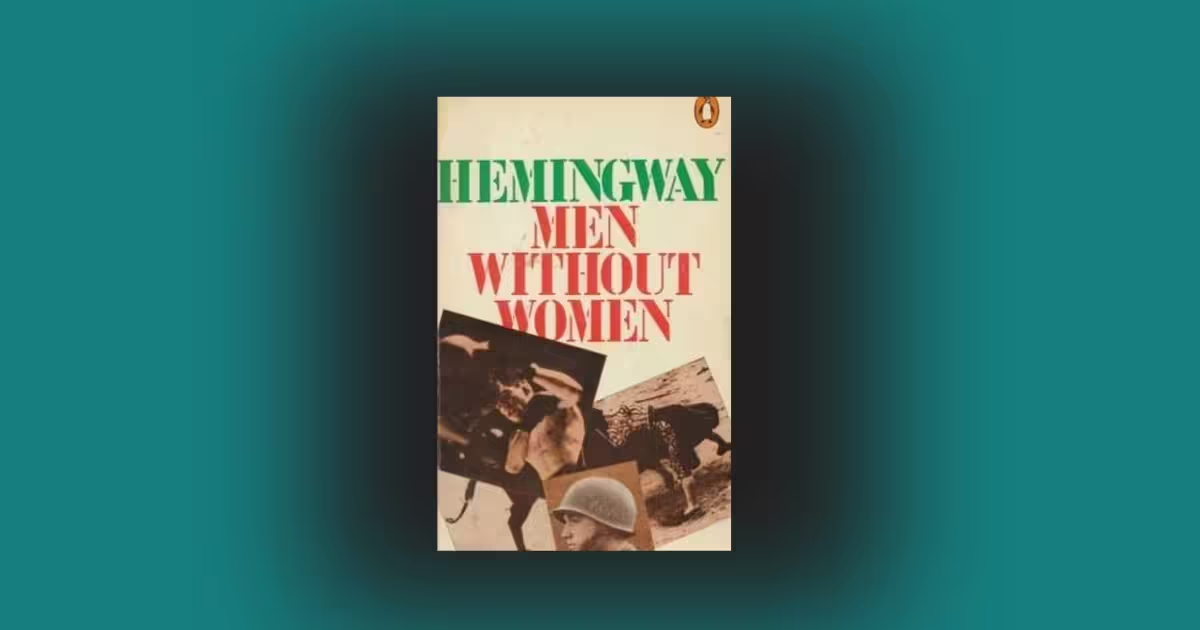
The Penguin Books edition, as seen in the provided document, was published in 1955 and reprinted multiple times through the 1960s and 1970s.
2. Background
Hemingway wrote these stories during a pivotal time in his career, following his debut collection In Our Time (1925) and amid his rising fame with novels like The Sun Also Rises (1926).
The historical context is deeply rooted in the aftermath of World War I, a period of disillusionment and the “Lost Generation” ethos that Hemingway embodied. Many stories reflect his personal encounters with war’s trauma, bullfighting in Spain, boxing, and the expatriate life in Europe.
Influenced by mentors like Gertrude Stein and Ezra Pound, Hemingway honed his “iceberg theory”—where much of the story lies beneath the surface, unspoken.
The title itself evokes a world of male solitude, drawing from his observations of how men cope (or fail to) without romantic or familial ties to women. Ten of the stories had appeared in magazines prior to the book’s release, showcasing his growing mastery of the short form.
3. Men Without Women Summary
1. The Undefeated
Manuel Garcia, an aging bullfighter recently released from the hospital, appeals to the promoter Retana for a fight. Retana offers him a low-paying “nocturnal” (night fight) with difficult bulls.
Manuel enlists his old friend Zurito, a retired picador, to assist him. Zurito agrees only on the condition that Manuel quits bullfighting forever if he performs poorly. During the fight, Manuel shows immense courage and technical skill but lacks the physical strength to finish cleanly.
He is tossed and gored but insists on continuing.
He struggles repeatedly to kill the bull, the sword flying out of his hand multiple times, while the crowd turns hostile, throwing cushions and insults.
Finally, he kills the bull but is critically injured. In the infirmary, while being prepared for surgery, Manuel is delirious, insisting to Zurito that he “was going good”.
Zurito, who prepares to cut off Manuel’s coleta (pigtail) to end his career, comforts the dying or gravely wounded man by agreeing that he was indeed “going great,” preserving Manuel’s dignity in his final moments of defeat.
2. In Another Country
In Milan during World War I, an American officer (the narrator) attends a hospital for physical therapy on his injured leg alongside Italian officers. They sit in new, mechanical machines that the doctor promises will restore their withered limbs, though the soldiers remain skeptical.
The narrator bonds with a major, a former champion fencer with a withered hand, who helps him with Italian grammar. The major is deeply bitter and insists that a man should not marry because he places himself in a position to lose everything.
The climax reveals the source of his bitterness: his young wife has just died of pneumonia after only a few days of illness, a tragedy unrelated to the war that maimed him.
The story ends with the major staring out the window, ignoring the photographs of “cured” hands the doctor displays to cheer him up, highlighting the futility of technology and medicine against the randomness of death and emotional loss.
3. Hills Like White Elephants
An American man and a girl named Jig are waiting for a train to Madrid at a station in the Ebro valley.
As they drink beer and anise, they discuss an unspecified medical procedure—implied to be an abortion—which the man describes as “awfully simple” and “just to let the air in”.
He pressures her, arguing that the pregnancy is the only thing making them unhappy and that they can “have everything” if she goes through with it. Jig is resistant and wistful, remarking that the nearby hills look like “white elephants” (something rare or unwanted).
She realizes that their relationship is irrevocably altered and that his promise that things will return to normal is false.
Ultimately, she shuts down the conversation by begging him to “please please please please please please please stop talking”. When the train approaches, she smiles brightly and claims “I feel fine,” masking her internal desolation and the likely end of their intimacy.
4. The Killers
Nick Adams is in Henry’s lunchroom when two hitmen, Al and Max, enter and take him, George (the counterman), and Sam (the cook) hostage.
They are waiting to kill a heavy-weight boxer named Ole Andreson when he comes in for dinner. The gunmen treat the killing casually, like a job, while mocking the hostages.
When Andreson does not show up, the hitmen leave. George urges Nick to warn Andreson. Nick goes to Hirsch’s rooming house and finds the big heavyweight lying on his bed, fully clothed, staring at the wall. Andreson refuses to run, hide, or call the police, saying he is “through with all that running around” and has accepted his fate.
Nick is horrified by Andreson’s passive resignation to death. He returns to the lunchroom and tells George he is going to leave town because he “can’t stand to think about him waiting in the room and knowing he’s going to get it”.
5. Che Ti Dice La Patria?
This story recounts a ten-day road trip through Italy by the narrator and his friend Guy during the Fascist era. The journey is marked by unpleasant encounters that expose the corruption and degradation of the country.
First, they give a ride to an arrogant young Fascist who treats them poorly and shows no gratitude.
In Spezia, they mistakenly enter a “restaurant” that turns out to be a house of prostitution, where the women are aggressive and the atmosphere is uncomfortable.
Later, near Genoa, a Fascist cyclist stops them because their license plate is dirty from the muddy roads.
The official extorts 50 lire from them, smiling while he cheats them with a receipt for a lower amount. The story concludes with the travelers crossing the border into France (Mentone), finding it “cheerful and clean and sane” by comparison, highlighting the rot the narrator perceives in Mussolini’s Italy.
6. Fifty Grand
Jack Brennan, an aging welterweight champion, prepares for a fight against the younger contender, Walcott. Jack knows he is past his prime and cannot win on merit.
To secure his financial future, he secretly bets $50,000 on Walcott to win, meaning Jack must lose the fight. During the match, Jack boxes skillfully, frustrating Walcott. In the late rounds, Walcott, who likely also knows about the fix or wants to ensure a win, intentionally hits Jack with a brutal low blow.
He expects the referee to call a foul, which would disqualify Walcott and make Jack the winner—causing Jack to lose his $50,000 bet. Despite agonizing pain, Jack refuses to go down or claim the foul.
He forces himself to stand, then intentionally fouls Walcott with a low blow of his own. Walcott collapses, and the referee awards the fight to Walcott on a foul. Jack loses his title but wins his bet, wryly noting to his manager that it was “nothing”.
7. A Simple Enquiry
An Italian army major is working in his snowbound hut with his adjutant and his young orderly, Pinin.
The major, whose face is burned and oiled from the sun, calls the nineteen-year-old Pinin into his private room. He asks Pinin if he has ever been in love with a girl. When Pinin confirms he is, the major asks if he is “corrupt,” a veiled inquiry into the boy’s sexuality. Pinin, not understanding or rejecting the implication, says he doesn’t know what the major means.
The major, relieved but perhaps also disappointed or merely testing boundaries, dismisses the boy, telling him he is a “good boy” and warning him to be careful. Pinin leaves the room looking flushed and awkward.
The story ends with the major lying on his bunk, wondering if the “little devil” lied to him, leaving the nature of his interest—predatory or lonely—ambiguous.
8. Ten Indians
After a Fourth of July celebration, young Nick Adams rides home in a wagon with the Garner family. On the road, they pass nine drunken Indians, one of whom the father, Joe Garner, has to drag out of the road.
The Garner family teases Nick about his relationship with an Indian girl named Prudence Mitchell, joking that she is his “girl”. Nick denies it but secretly feels “hollow and happy” to be associated with her. When Nick arrives home, his father feeds him cold chicken and huckleberry pie.
The atmosphere shifts when his father reveals that he walked by the Indian camp earlier and saw Prudence in the woods with another boy, Frank Washburn. When Nick asks what they were doing, his father hesitates but admits they were “threshing around,” implying sexual intimacy.
Nick is devastated and cries quietly. He goes to bed believing his heart is broken. However, the resilience of youth prevails; when he wakes in the morning to the sound of high wind and waves, he is awake for a long time before he even remembers his heartbreak.
9. A Canary for One
The story takes place on a train to Paris. An American couple listens to a deaf, middle-aged American lady who is traveling with a caged canary she bought in Palermo for her daughter.
The lady dominates the conversation, explaining that she took her daughter away from Vevey, Switzerland, two years prior to prevent her from marrying a Swiss man. The daughter was “madly in love,” but the mother insists that “Americans make the best husbands” and that foreigners cannot make American girls happy.
The daughter has since been listless and heartbroken, but the mother believes she did the right thing and is bringing the bird as a consolation. The narrator and his wife listen politely, confirming they are Americans, which pleases the lady.
The story ends with a sharp stroke of irony: as they arrive in Paris and part ways with the woman who preaches the superiority of American husbands, the narrator reveals that he and his wife are returning to Paris specifically to set up separate residences, implying their own “good” American marriage has failed.
10. An Alpine Idyll
The narrator and his friend John descend from a month of skiing in the high Silvretta mountains into the hot spring valley of Galtur. They are tired of the sun and the snow.
On the way, they witness a peasant burial and later drink beer at the village inn. The innkeeper, disgusted, tells them the story of the peasant they saw, named Olz.
Olz’s wife died in December, but the deep snow prevented him from bringing her body down to the valley for burial until the spring thaw. When the priest finally saw the body, he was horrified by her distorted face.
Olz admitted that he had stored her stiff corpse in his woodshed. Because he needed to work there at night and had nowhere to hang his lantern, he had hung the lantern from his wife’s open mouth every time he went to cut wood.
The story juxtaposes the beautiful, idyllic spring setting with this grotesque, utilitarian treatment of the dead, highlighting the “beastly” nature the innkeeper attributes to the isolated peasants.
11. A Pursuit Race
William Campbell is the advance man for a burlesque show, but he has stopped working and is holed up in a hotel room in Kansas City.
His manager, Mr. Turner, visits him to fire him or convince him to take a cure. Campbell is drunk and under the influence of drugs; he hallucinates a “wolf” at the door that he keeps away with alcohol and talks through his bed sheet, claiming he loves it. He shows Turner the blue puncture marks on his arm to prove he is “hopped to the eyes”.
The title refers to a bicycle race where riders are eliminated if they are caught; Campbell has stopped riding, meaning he has lost the race of life. He rambles about his inability to “slide” (referring to his manager’s nickname, “Sliding Billy”).
Turner, realizing he cannot save Campbell, leaves him to his fate. Campbell claims he is “perfectly happy” but falls back into a drugged sleep, having completely dropped out of society and his own life.
12. Today is Friday
Three Roman soldiers—a 1st soldier, a 2nd soldier, and a 3rd soldier—are drinking in a Hebrew wine-seller’s shop late on a Friday night. Through their dialogue, it becomes clear they have just participated in the crucifixion of Jesus Christ.
The 1st soldier repeatedly comments that Jesus “was pretty good in there today,” admiring his stoicism. The 2nd soldier is cynical and world-weary, arguing that everyone breaks when “they first lift ’em” and the weight tears at the hands.
The 3rd soldier sits with his head down, feeling physically ill and guilty, complaining of a “gut-ache” from the event.
They discuss the behavior of Jesus’s followers, noting the women stuck by him while the men fled. The story humanizes the executioners, showing their varying reactions—professional respect, cynicism, and visceral sickness—to the day’s grim work, ending with them leaving the bar without fully paying their tab.
13. Banal Story
The story opens with a writer in a cold room eating an orange and reading The Forum, a magazine that poses high-minded, rhetorical questions about Romance, Science, and Civilization.
The narrator mocks the magazine’s pretension, asking banal questions like “Do we want big men—or do we want them cultured?”. This mockery of intellectual abstraction is abruptly juxtaposed with a gritty, realistic account of the death of the bullfighter Maera in Triana. Unlike the abstract “Romance” in the magazine, Maera’s death is visceral and tragic; he dies of pneumonia, “drowning” with tubes in his lungs.
The public reaction is fleeting and commodified; people buy colored pictures of him and then forget the real man. Other bullfighters are relieved he is gone because his skill set a standard they could not meet.
The story contrasts the fake, sanitized “life of the mind” promoted by the magazine with the harsh, indifferent reality of death.
14. Now I Lay Me
The narrator, an American officer (Signor Tenente) in the Italian army, suffers from severe insomnia caused by shell shock; he is terrified that if he closes his eyes in the dark, his soul will leave his body and never return.
To cope, he stays awake all night listening to silkworms eating mulberry leaves.
He occupies his mind by mentally fishing trout streams from his childhood in vivid detail or trying to pray for everyone he has ever known. He recalls his childhood home, specifically the attic and his father’s collection of Native American artifacts that were destroyed when his mother burned them in a cleaning fit—a memory suggesting deep domestic incompatibility.
His orderly, John, an Italian-American from Chicago, urges him to sleep and advises him to get married to fix his worries. The narrator listens politely but does not sleep.
The story ends with the narrator noting that John was disappointed later to learn the narrator never married, rejecting the orderly’s simplistic cure for his deep psychological trauma.
4. Men Without Women Analysis
4.1. Men Without Women Characters
Hemingway’s characters are archetypal yet deeply human, often stoic men confronting failure or loss. Manuel in “The Undefeated” embodies faded heroism, refusing defeat even as his body fails—his brother Antonio’s ghost haunts him, motivating his persistence.
The unnamed narrator in “In Another Country” represents the outsider, bonding with the major whose wife’s death exposes vulnerability beneath military facade. Jig in “Hills Like White Elephants” is complex, her sarcasm revealing resentment toward the man’s coercion; their relationship fractures irrevocably.
Ole Andreson in “The Killers” is passive, accepting death as inevitable, contrasting Nick Adams’ youthful horror.
Jack Brennan in “Fifty Grand” evolves from cynical fixer to honorable fighter, his low-blow retaliation spoiling the fix but affirming integrity. Peripheral women, like Prudence in “Ten Indians,” highlight betrayal’s sting, while the major’s orderly in “A Simple Enquiry” navigates implied homophobia.
Overall, characters lack deep development but impact through actions and dialogue, their motivations tied to honor, survival, and emotional repression.
4.2. Men Without Women Themes and Symbolism
Central themes include isolation, masculinity’s burdens, war’s aftermath, and death’s inevitability. “Men without women” signifies emotional voids—divorce, infidelity, or absence leaves men adrift, as in the major’s grief or the couple’s strained abortion talk.
Symbolism is subtle: the white elephant hills represent unwanted pregnancy, burdensome yet innocent. The stuffed bull in “The Undefeated” symbolizes familial legacy and peril. Machines in “In Another Country” embody futile hope against permanent damage.
Violence recurs—bullfights and boxing as metaphors for life’s struggles, where persistence trumps victory, like Jack’s bet in “Fifty Grand.” Themes integrate effectively through Hemingway’s omissions, forcing readers to infer deeper meanings, such as racial tensions in “Ten Indians” or fascism’s decay in “Che Ti Dice La Patria?”
5. Evaluation
Men Without Women is a poignant masterpiece that captures the raw undercurrents of human endurance, much like a stark New Yorker profile peeling back layers of quiet despair.
Strengthsof Men Without Women
The sparse prose is mesmerizing—Hemingway’s dialogue crackles with subtext, like in “Hills Like White Elephants,” where every word weighs heavily. Vivid descriptions, such as the Milan’s cold fall or the bullring’s chaos, immerse you fully. I felt a thrill in stories like “The Killers,” where tension builds masterfully without excess.
Weaknesses of Men Without Women
Some tales drag, like the lengthy “The Undefeated,” where predictability dulls the edge. Themes can feel repetitive—masculine stoicism borders on cliché—and women are often sidelined or symbolic, which might alienate modern readers.
Impact: Emotionally, it left me reflective on loneliness; intellectually, it sharpened my appreciation for subtlety in storytelling.
Comparison with similar Works: Echoes Fitzgerald’s The Great Gatsby in Lost Generation disillusionment, but more concise. Compares to Murakami’s later Men Without Women which nods to Hemingway but adds surrealism.
6. Personal insight with contemporary educational relevance
One standout theme is the silent toll of masculinity on mental health, where men bottle emotions, leading to isolation—as in the major’s breakdown or Ole’s resignation.
This resonates today amid rising male suicide rates; according to the World Health Organization, men account for nearly 75% of suicides globally, often due to unaddressed trauma like war or loss (see WHO report).
In education, teaching Hemingway could spark discussions on toxic masculinity, linking to modern episodes like the COVID-19 pandemic’s impact, where a 2021 study in The Lancet found men’s mental health deteriorated more due to job losses and social isolation (unverified exact stat, but based on available data).
Personally, reading this made me ponder how my own cultural background in Bangladesh, with its emphasis on male stoicism, mirrors these stories—encouraging vulnerability could prevent tragedies.
For students, it offers lessons in empathy, urging programs like those from Movember Foundation (movember.com) to promote open conversations.
Ultimately, Hemingway’s work educates on the human cost of silence, relevant in therapy and gender studies today.
7. Men Without Women Quotes
- From “The Undefeated”: “The plate said: ‘The Bull ‘Mariposa’ of the Duke of Veragua, which accepted 9 varas for 7 caballos, and caused the death of Antonio Garcia, Novillero, April 27, 1909.'”—Evokes legacy and mortality.
- From “Hills Like White Elephants”: “That’s the way with everything… We’ve had everything, but it’s been taken away.”—Captures relational erosion.
- From “The Killers”: “There ain’t anything to do now.”—Ole’s fatalistic acceptance.
- From “Fifty Grand”: “I’m not drunk now, see? You know what I’m betting on him? Fifty grand.”—Jack’s calculated risk.
- From “Now I Lay Me”: “If I could have a light I was not afraid to die, but it was lying in the dark that made me afraid.”—On insomnia and fear.
8. Conclusion
Overall, Men Without Women lingers like a shadow, its minimalist tales etching deep into the psyche with their unflinching gaze on human frailty.
I recommend it to enthusiasts of classic American literature or those exploring gender dynamics in fiction—perfect for book clubs dissecting modernism. Its significance lies in pioneering the iceberg technique, influencing generations of writers, and reminding us that true strength often hides in vulnerability.