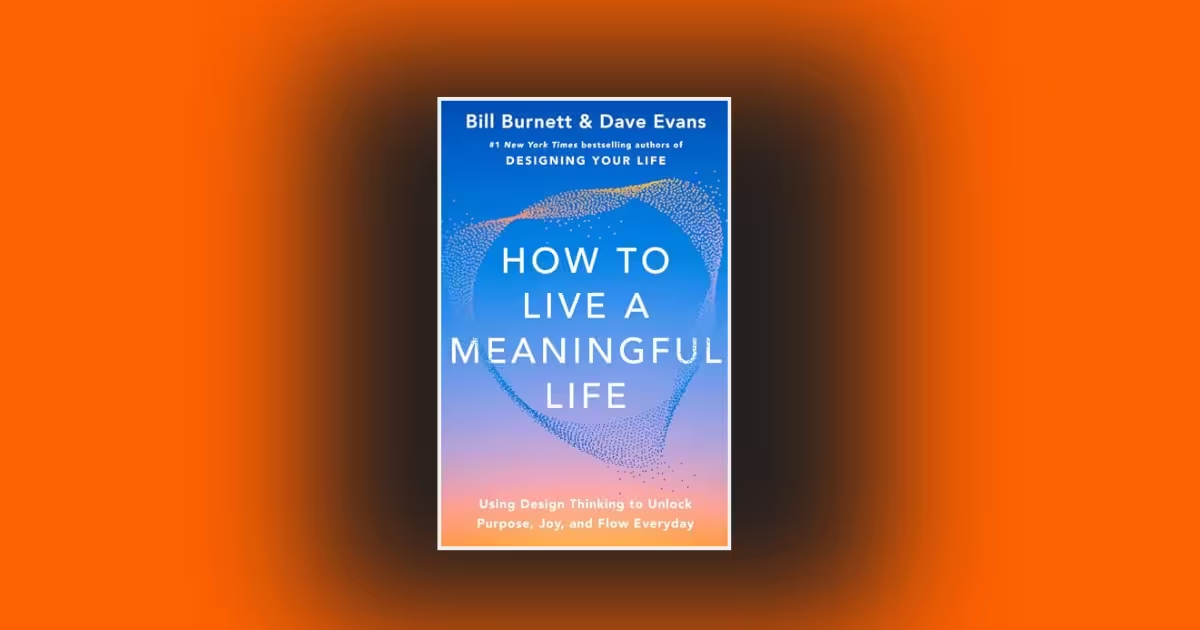

How do we bridge the gap between a life that looks good on paper and one that actually feels meaningful? Bill Burnett and Dave Evans, the Stanford design gurus behind the #1 New York Times bestseller Designing Your Life, are back with a profound manual for the soul: “How to Live a Meaningful Life: Using Design Thinking to Unlock Purpose, Joy, and Flow Every Day”.
This isn’t just a self-help book; it’s a design project for your existence.
How to Live a Meaningful Life is best for:
- The “Stuck”: People like “Allison,” who have a “perfectly fine” life but feel a deep, nagging dissatisfaction.
- High Achievers: Successful leaders who’ve reached the top only to find it uncomfortably hollow.
- Life Transitioners: Anyone facing a “wicked problem” like a career change, empty nest, or loss, looking for a way forward that isn’t just “burning it all down”.
Not For:
- Passive Readers: If you aren’t willing to “Try Stuff” and actually engage in the exercises, this book will just be another set of theories on your shelf.
- Certainty-Seekers: How to Live a Meaningful Life won’t give you a final “secret map”; it teaches you how to design moment-by-moment in a world with no single right answer.
Table of Contents
1. Introduction
Bill Burnett and Dave Evans are not just authors; they are the co-founders of the Stanford Life Design Lab, where they’ve spent decades applying the principles of Silicon Valley design thinking to the human experience.
Their central thesis is radical: Meaning is not something you find; it is something you design. Writing from their own “trenches” in 2025—after facing personal losses like the death of spouses and parents—they argue that a meaningful life is available “today, right now, in this exact moment,” regardless of your circumstances.
2. How to Live a Meaningful Life summary
Instead of focusing on grand, life-changing achievements, Burnett and Evans break meaning down into three core pillars: Impact, Fulfillment, and Particularity.
Key Arguments & Themes:
- The Impact Reframe: We often think meaning equals “making a huge difference” (Impact with a capital I). The authors argue that if impact is your only metric, you’re on a treadmill of “never enough”. Meaning is found in the granular, daily interactions—like how you treat a barista.
- The Fulfillment Fallacy: You cannot “be fulfilled” in a permanent sense. Fulfillment is a static state, whereas life is dynamic. Instead, the goal is to be “fully alive”.
- The Scandal of Particularity: This is the heart of the book. Meaning happens in specific, “scandalous” moments. It is “available right now, in the moment you are reading this”.
- Wicked Problems: Life’s biggest challenges (like career purpose or loneliness) are “wicked” because they have no single right answer. Designers approach these with curiosity and empathy rather than seeking a “hack”.
Highlighted Lessons & Chapters:
Bill Burnett and Dave Evans structure the book not as a linear path to a distant “meaning,” but as a cyclical design process for the “granular now.”
Here is exactly what happens in each chapter of How to Live a Meaningful Life.
Chapter 1: Meaning and Purpose Reframed
The Core Argument: The authors immediately dismantle the “dysfunctional beliefs” that keep us stuck. The biggest one? That meaning is a destination or a “significance” we must achieve.
The “Impact” Trap: We are obsessed with making a difference, but the authors warn that seeking meaning solely through impact is a recipe for misery because “no result or impact is big enough to supply a lifetime’s worth of meaning”. Impact is temporary; meaning must be sustainable .
The Myth of Fulfillment: They argue that “fulfillment is a dead end”. Why? Because you are “large” and “contain multitudes” (quoting Walt Whitman). You cannot possibly “fill up” or express every part of yourself in one lifetime. Instead of seeking full fulfillment (which is impossible), the goal is to be “fully alive”—present for the life you are actually living.
The Scandal of Particularity: This is the chapter’s “big idea.” We want universal truths (Love, Truth, Beauty), but we can only experience them in specific, tiny moments—a “particular” birthday cake, a specific conversation. “We can’t do utter beauty, but we can make a beautiful birthday cake”.
Embracing this “scandal”—that the ultimate can only be found in the small and particular—is the key to unlocking meaning.
Chapter 2: Think Like a Designer
Moment-Making: Design thinking isn’t just for products; it’s for experiences. The authors reframe the goal from “solving your life” to “moment-making”. Since you can’t hold onto a moment, meaning becomes a “never-ending prototype”.
The 5 Design Mindsets for Meaning:
- Wonder: Not just for poets, but a skill to notice the “mystery” in the ordinary.
- Availability: A state of “constant readiness for action”. It’s about posture—physically and mentally being open to what happens next.
- Radical Acceptance: The most powerful tool for getting unstuck. It means accepting reality as it is (even the bad parts, like a cancer diagnosis or a flight delay) so you can actually deal with it . “Acceptance of reality is the only choice that can result in making meaning”.
- Fully Engaged and Calmly Detached: A paradox where you care deeply about the activity but detach from the outcome, which you cannot control .
- Create Your World: You aren’t just a victim of circumstance; you are an “adaptive storyteller” creating your narrative in real-time.
Chapter 3: A Tale of Two Worlds
The Two Worlds Model: We live in two overlapping realities:
The Transactional World: The world of to-do lists, efficiency, and outcomes. It’s necessary for survival but “anathema to thriving” if it’s the only place you live .
The Flow World: The world of “immediate presence,” deep engagement, and “is-ness.” This is where meaning lives.
The Two Brains: This maps to our biology. The “Achieving Brain” handles transactions, while the “Awakened Brain” perceives connection and unity.
The Lesson: You don’t have to leave the Transactional World (you need to pay bills), but you must learn to “flip the switch” and visit the Flow World regularly, even during mundane tasks like a staff meeting .
Chapter 4: The Wonder Formula
The Equation: The authors provide a literal formula for generating meaning: Curiosity + Mystery = Wonder.
Curiosity as a Tool: We are born curious, but school and efficiency beat it out of us. Reclaiming “childlike curiosity” allows us to see the “mystery” in everyday objects .
Practical Exercise: The “Wonder Glasses” exercise involves looking at a mundane scene (like your living room) through three lenses: Normal (to-do lists), Curiosity (how was this made?), and Wonder (appreciating the life and history in the object).
Chapter 5: Living the Coherent Life
The Compass: To navigate meaning, you need a “Compass” that aligns three things: Who you are, What you do, and What you believe.
Coherency: When these three things align, you have “coherency.” You feel purposeful because your actions match your values.
Workview & Lifeview: The authors ask you to write out two manifestos. Your “Workview” (why do you work?) and your “Lifeview” (what is the meaning of life?). The goal is to find where they complement or clash.
Coherency Sightings: Instead of just a gratitude journal, keep a log of moments where you felt “coherent”—where your actions perfectly matched your values. This builds confidence in your “true north” .
Chapter 6: Finding Flow
Redefining Flow: We usually think of “Flow” as an elite state for Olympic athletes (“Peak Flow”). The authors argue this is too limiting. They introduce “Simple Flow”—accessible to anyone, anytime .
The Flow Channel Hack: Traditionally, flow requires high skill + high challenge. The authors show how to widen this channel using “Radical Acceptance” and “Availability” to find flow even in low-skill tasks like chopping onions or walking the dog.
The “Just This” Practice: By focusing intensely on a single, simple task (like slicing an onion) and refusing to let the Transactional World intrude, you can experience the “rapture of being alive” in your kitchen.
Chapter 7: Designing Formative Communities
Formative vs. Social: Most of our groups are for fun (social) or work (collaborative). A Formative Community is different: its sole purpose is to help members “become better” and grow into their authentic selves.
The E-R-S Practice: These communities thrive on a cycle of Engage (live your life), Reflect (think about it), and Storytell (share it with the group).
Focus Questions: Instead of just solving “presenting problems” (urgent crises), formative communities help you identify and live into a “Focus Question”—a deep inquiry about who you are becoming (e.g., “How do I want my career to contribute to who I will be at sixty?”).
Chapter 8: Ages and Stages
The Odyssey Years (18-28): A time for exploration. The goal here is to “curate curiosity” and build your initial Compass. Warning: Don’t lose your wonder to the pressure of “making it” .
The Midlife Shift: Moving from the “First Half” (building the ego/container) to the “Second Half” (self-transcendence). The crisis happens when you try to live the Second Half with First Half rules .
Elderhood: A time to embrace wisdom and “get more out of, not cram more into” life. It’s about mastering the Flow World .
Parenting as Flow: A massive reframe for parents—stop trying to “optimize” your kids for the Transactional World. Instead, join them in the Flow World (play), which is their natural habitat .
3. How to Live a Meaningful Life analysis
As a reader, what strikes me most is the authors’ humility. They don’t claim to have it all figured out. Dave Evans recounts losing his wife to cancer and turning seventy, admitting that the tools he used in his fifties no longer worked. This vulnerability makes their “Radical Acceptance” advice feel earned, not just academic.
The Guardian or The New Yorker might call this “applied stoicism for the modern age.” Unlike traditional philosophy, it provides a “Try Stuff” section in every chapter.
They effectively support their arguments with case studies—from 20-something tech workers like “Sonya” to 90-year-old artists like “Arne”—proving that the “Designer’s Way” is universal.
4. Strengths and Weaknesses
Strengths of How to Live a Meaningful Life
Practical Tools: The “Got To–Get To Reversal” and “Sudden Savoring” exercises are genius for parents and busy professionals.
Radical Acceptance: Their definition of acceptance as a “superpower mindset” that allows you to move forward from reality as it is (rather than how you wish it were) is life-changing.
Weaknesses of How to Live a Meaningful Life
Privilege Gap: While the authors acknowledge that it’s hard to think about meaning when you’re struggling to pay for groceries, some might find the “design your life” framework a luxury that requires a certain baseline of stability.
The “Design” Jargon: If you aren’t a fan of Silicon Valley “iteration” and “prototyping” language, the terminology might feel a bit clinical at first.
5. Comparison & Conclusion
Similar to Viktor Frankl’s Man’s Search for Meaning, How to Live a Meaningful Life emphasizes that meaning is an internal choice. However, it is more aligned with Atomic Habits in its focus on the “granular now”.
Final Verdict: You don’t need to quit your job and move to a farm in the San Juan Islands to find purpose (though Sonya did). You just need to look down. “Right here is where it starts”.
How to Live a Meaningful Life is a 5-star essential for anyone tired of “okay” and ready for “fully alive”.