
Last updated on April 30th, 2026 at 05:18 pm
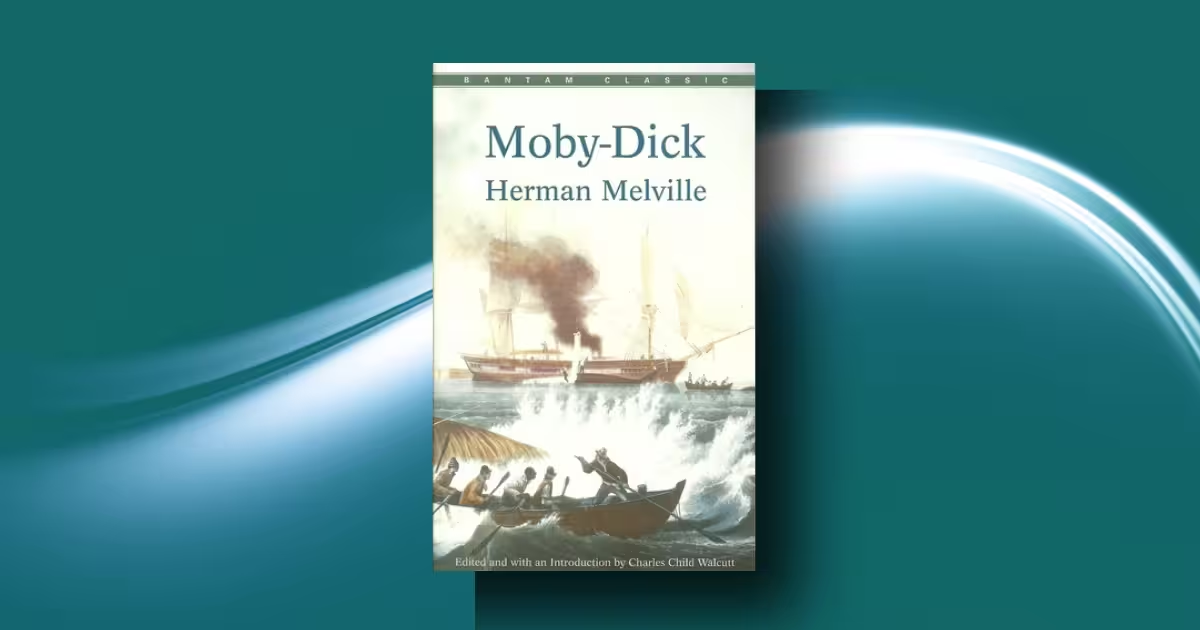
Did you ever wonder why one man would chase a whale across the ends of the earth—and lose everything in the process? Or how a single novel can mirror the madness, beauty, and terror of being human? Moby-Dick by Herman Melville is not just about a whale hunt—it’s a profound exploration of obsession, identity, and the terrifying vastness of existence.
Moby-Dick is a good read for readers who enjoy philosophical fiction, symbolic literature, maritime adventure, and deep psychological narratives.
Those seeking a fast-paced, plot-driven story without digressions or dense language.
Table of Contents
1. Introduction
Title: Moby-Dick; or, The Whale
Author: Herman Melville
Publication Year: 1851
When I first approached Moby-Dick, I expected a sea adventure—something straightforward, maybe even thrilling in a conventional way. Instead, I found myself submerged in a vast ocean of ideas, language, and existential dread. It’s not just a novel; it’s an experience that lingers long after the final page.
Melville himself described a whaleship as his “Yale College and Harvard,” and that raw experiential authority pulses through every page .
2. Background
Historical Context
Moby-Dick emerged during the height of the American Renaissance (1835–1855)—a literary explosion alongside writers like Emerson, Hawthorne, and Whitman. The novel reflects:
- The whaling industry, then central to the global economy (whale oil = “petroleum of its day” )
- Rising industrialization
- The looming American Civil War tensions
- Philosophical debates about God, fate, and human agency
Interestingly, the novel was inspired partly by the real-life sinking of the whaleship Essex in 1820.
Despite its brilliance, the book was a commercial failure upon release—a fact that feels almost ironic given its later recognition as one of the greatest novels in English.
3. Moby-Dick Summary
Opening: Ishmael’s Restlessness
The novel famously begins:
“Call me Ishmael.”
Ishmael introduces himself as a man plagued by a kind of spiritual melancholy—“a damp, drizzly November in my soul” . Instead of succumbing to despair, he turns to the sea as a remedy:
“Whenever I find myself growing grim about the mouth; whenever it is a damp, drizzly November in my soul; whenever I find myself involuntarily pausing before coffin warehouses, and bringing up the rear of every funeral I meet; and especially whenever my hypos get such an upper hand of me, that it requires a strong moral principle to prevent me from deliberately stepping into the street, and methodically knocking people’s hats off—then, I account it high time to get to sea as soon as I can.”.
This is not just travel—it’s existential escape
New Bedford & Queequeg
Ishmael travels to New Bedford and lodges at the Spouter-Inn, where he meets Queequeg, a tattooed Polynesian harpooner. Initially frightened, Ishmael soon forms a deep bond with him:
“Better sleep with a sober cannibal than a drunken Christian.”
This relationship becomes one of the novel’s emotional anchors—symbolizing tolerance, friendship, and the breakdown of prejudice.
Journey to Nantucket & Signing onto the Pequod
Together, Ishmael and Queequeg travel to Nantucket, the whaling capital. They sign onto the Pequod, a ship owned by Peleg and Bildad.
Here, we hear whispers of the ship’s mysterious captain—Ahab—who has not yet appeared.
Introduction of Captain Ahab
When Ahab finally emerges, he is already mythic:
- One leg replaced with a whale bone
- Scarred, imposing, and intensely focused
We soon learn the truth: Ahab is obsessed with a white whale—Moby Dick—who previously maimed him.
The Quest Revealed
In a dramatic speech, Ahab declares his purpose:
“I’ll chase him round Good Hope, and round the Horn, and round the Norway Maelstrom, and round perdition’s flames before I give him up. And this is what ye have shipped for, men! to chase that white whale on both sides of land, and over all sides of earth, till he spouts black blood and rolls fin out. What say ye, men, will
ye splice hands on it, now? I think ye do look brave.”
He nails a gold doubloon to the mast as a reward for the first sighting of the whale. The crew, swept by his charisma, joins his mission.
At this point, the voyage shifts from commercial whaling to a monomaniacal quest for revenge.
Philosophical Digressions & Whaling Lore
Melville pauses the narrative repeatedly to explore:
- Whale anatomy (Cetology)
- The whaling process
- Symbolism of whiteness
- The nature of perception and reality
One of the most striking reflections:
“Is it that by its indefiniteness it shadows forth the heartless voids and immensities of the universe?”
The whale becomes more than an animal—it becomes a cosmic symbol.
Life Aboard the Pequod
The crew is diverse:
- Starbuck (first mate, rational and moral)
- Stubb (carefree)
- Flask (practical)
- Fedallah (mysterious prophet-like figure)
Despite their differences, they fall under Ahab’s influence. The Pequod itself becomes a microcosm of humanity—diverse, conflicted, yet unified under a dangerous leader.
Foreshadowing Doom
Throughout the voyage, ominous signs appear:
- Prophecies about Ahab’s fate
- Encounters with other ships warning of Moby Dick
- Increasing tension between Ahab and Starbuck
Yet Ahab refuses to turn back. His obsession overrides reason, morality, and even survival.
The Final Phase: Signs, Madness, and Inevitability
As the Pequod sails deeper into the Pacific, the tone darkens into something almost apocalyptic. Ahab’s obsession intensifies into what Ishmael calls a kind of “monomania”—a total psychological takeover. Every encounter with other ships (called “gams”) becomes an opportunity to ask the same question: Have you seen the White Whale?
One haunting encounter is with the ship Rachel, whose captain begs Ahab to help search for his missing son lost at sea. Ahab refuses—coldly, absolutely. In that moment, we see the final erosion of his humanity. Revenge has replaced compassion.
“Talk not to me of blasphemy, man; I’d strike the sun if it insulted me.”
That line is not just defiance—it is metaphysical rebellion.
Prophecy Tightens Its Grip
Fedallah, Ahab’s shadowy confidant, delivers cryptic prophecies:
- Ahab will see two hearses on the sea
- Only hemp (rope) can kill him
- Fedallah will die before Ahab
At first, these seem impossible. But Melville constructs them with eerie precision, ensuring their eventual fulfillment.
The Chase: Three Days of Terror
Day 1
Moby Dick is sighted. The whale is vast, almost supernatural—described not merely as an animal but as a force.
The boats are lowered. Ahab leads the charge.
But Moby Dick retaliates violently—destroying boats, scattering men. The whale is not fleeing; it is fighting.
Day 2
The chase resumes. Tension escalates.
The whale appears again, smashing boats and injuring crew members. Ahab’s obsession only deepens. He is no longer pursuing the whale—he is locked in a fatal dance with it.
Starbuck pleads with him to stop. Ahab refuses.
Day 3 (Climax)
The final confrontation unfolds with terrifying inevitability.
- Moby Dick destroys the remaining boats
- The whale rams the Pequod itself
In a shocking moment, the prophecy begins to unfold:
- Fedallah is seen entangled in ropes—a “hearse” of the sea
- The sinking ship becomes the second hearse
Ahab, in one last act of defiance, hurls his harpoon:
“Towards thee I roll, thou all-destroying but unconquering whale; to the last I grapple with thee…”
But the rope of the harpoon coils around his neck—dragging him into the sea.
Hemp kills him. The prophecy is fulfilled.
The Destruction of the Pequod
The whale rams the ship again. The Pequod sinks into a massive whirlpool.
Everything—crew, ship, ambition—is swallowed.
Melville describes this annihilation not just physically, but cosmically: the ocean closes over the Pequod as if nothing ever existed.
Ishmael’s Survival (The Ending Explained)
Ishmael alone survives.
He clings to a strange object: Queequeg’s coffin, which had earlier been turned into a life buoy.
“The unharming sharks, they glided by as if with padlocks on their mouths; the savage sea-hawks sailed with sheathed beaks. On the second day, a sail drew near, nearer, and picked me up at last. It was the devious cruising Rachel, that in her retracing search after her missing children, only found another orphan.”
After drifting for days, he is rescued by the Rachel.
Meaning of the Ending
- The coffin becomes a symbol of life emerging from death
- Ishmael survives because he is detached from obsession
- Ahab dies because he cannot let go
The novel closes not with triumph—but with quiet, haunting survival.
4. Moby-Dick Analysis
4.1 Moby-Dick Characters
Ishmael (The Observer)
Ishmael evolves from a restless wanderer into a philosophical witness.
- Represents curiosity and openness
- Survives because he avoids absolutism
- Acts as both narrator and interpreter
Captain Ahab (The Obsessive Hero-Tragic Figure)
Ahab is one of literature’s most complex figures.
- Driven by revenge against Moby Dick
- Sees the whale as a symbol of all evil
“All visible objects… are but as pasteboard masks.”
He wants to “strike through the mask”—to destroy the hidden force behind reality itself.
Evaluation:
Ahab is not merely mad; he is intellectually dangerous. His charisma turns personal obsession into collective doom.
Queequeg (The Noble Other)
- A “cannibal” who proves more humane than “civilized” men
- Symbol of acceptance, friendship, and spiritual balance
His coffin ultimately saves Ishmael—an extraordinary narrative irony.
Starbuck (Moral Conscience)
- Represents reason, Christianity, restraint
- Opposes Ahab but lacks the will to stop him
His failure highlights a key theme: goodness without action is powerless.
Moby Dick (The Enigma)
The whale resists interpretation:
- Nature?
- God?
- Evil?
- Nothing at all?
Melville deliberately refuses a fixed meaning.
4.2 Themes and Symbolism
1. Obsession
Ahab’s fixation destroys everything.
Modern parallel: leaders or ideologies driven by singular visions often ignore human cost.
2. The Limits of Knowledge
Ishmael tries to classify whales scientifically—but fails.
The whale remains “unpainted to the last.”
Reality resists total understanding.
3. Whiteness as Terror
One of the most famous sections explores the meaning of whiteness:
- Purity
- Void
- Terror
“The palsied universe lies before us a leper.”
Whiteness becomes a symbol of existential emptiness.
4. Fate vs Free Will
Ahab believes he is choosing—but seems bound by destiny.
The prophecy fulfills itself through his own actions.
5. Nature vs Humanity
The whale is not evil—it simply exists.
The real danger lies in human interpretation and projection.
5. Evaluation
Moby-Dick is a staggering, unsettling, and profoundly human masterpiece that feels less like a novel and more like wrestling with existence itself.
5.1 Strengths
- Language: Shakespearean intensity blended with biblical rhythm
- Philosophical depth: Few novels attempt this scale
- Character complexity: Especially Ahab and Ishmael
- Symbolism: Rich but never fully reducible
5.2 Weaknesses
- Pacing issues: Long digressions on whaling
- Structural looseness: Narrative frequently disrupted
- Accessibility: Dense, demanding prose
Yet, these “weaknesses” are also part of its identity.
5.3 Impact
Personally, this book left me unsettled in a way few others have. It doesn’t comfort—it confronts.
It made me question:
- What obsessions drive us?
- What illusions do we chase?
- What truths are we unwilling to face?
5.4 Comparison with Similar Works
- Heart of Darkness → Similar descent into obsession and darkness
- The Old Man and the Sea → Man vs nature, but far simpler morally
- Paradise Lost → Ahab resembles a tragic, defiant Satan
5.5 Adaptations
Film Adaptations
- Moby Dick starring Gregory Peck
- Moby Dick
Comparison
- Films focus on adventure and Ahab
- The novel is far more philosophical and symbolic
Box Office (1956 Film)
- Moderate commercial success
- Mixed critical reception initially, later reassessed positively
6. Personal Insight
In today’s world, Moby-Dick feels less like a 19th-century novel and more like a warning.
Ahab’s obsession mirrors modern phenomena:
- Political extremism
- Corporate overreach
- Ideological echo chambers
According to global behavioral studies (e.g., rising polarization indexes and cognitive bias research), individuals increasingly gravitate toward single narratives, often ignoring contradictory evidence. Ahab embodies this cognitive trap—what psychologists today might call confirmation bias fused with identity fixation.
The Pequod becomes a floating metaphor for society: diverse individuals unified under a compelling but dangerous vision. No one stops Ahab—not because they agree fully, but because charisma overrides reason.
This is where the novel feels urgently contemporary.
We live in an age of:
- Algorithm-driven reinforcement
- Leadership cults
- Emotional over rational decision-making
And like Starbuck, many recognize the danger—but hesitate to act.
The most powerful lesson?
Survival may depend not on strength or certainty—but on intellectual humility.
Ishmael lives because he questions.
Ahab dies because he knows.
7. Moby-Dick Quotes
“Call me Ishmael.”
“Better sleep with a sober cannibal than a drunken Christian.”
“All visible objects, man, are but as pasteboard masks. But in each event—in the living act, the undoubted deed—there, some unknown but still reasoning thing puts forth the mouldings of its features from behind the unreasoning mask. If man will strike, strike through the mask!
”
“I’d strike the sun if it insulted me.”
“Towards thee I roll… thou all-destroying but unconquering whale…”
“The great flood-gates of the wonder-world swung open.”
8. Conclusion
Moby-Dick is not an easy book—but it is an essential one.
It demands patience, attention, and reflection. But in return, it offers something rare: a confrontation with the deepest parts of human nature.
Recommendation:
- Highly recommended for readers of philosophical fiction, classics, and literary analysis
- Not ideal for casual or purely entertainment-focused reading
Final Reflection:
Some books tell stories.
Moby-Dick is the storm.







