
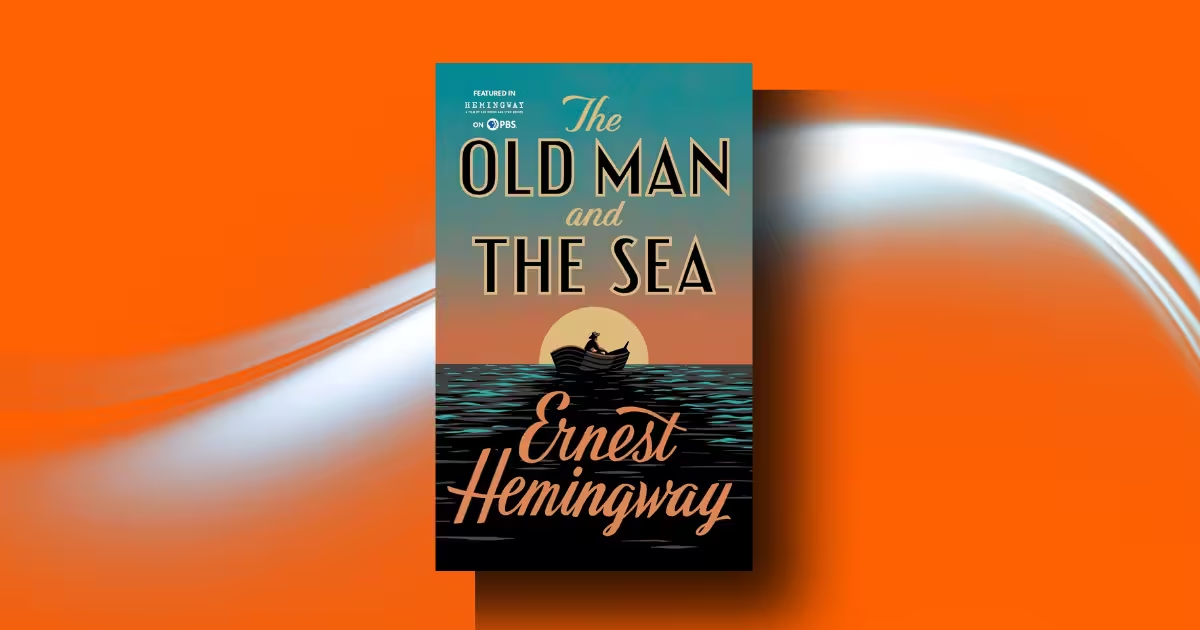
Did you ever wonder why some people continue to fight with quiet dignity, even when the entire universe seems to be stacked against them? It is a profound question of human existence that Ernest Hemingway tries to examine in The Old Man and the Sea, one that has occupied my mind for years, but no book answers it quite like Ernest Hemingway’s masterpiece.
The Old Man and the Sea is a true victory that lies in the unyielding courage and resilience of the human spirit, proving that an individual’s honor remains intact even in the face of inevitable, heartbreaking material loss.
The Old Man and the Sea is best for readers who appreciate philosophical, slow-burn narratives that focus deeply on human endurance, man’s relationship with nature, and raw, emotional storytelling.
Not for those seeking fast-paced, plot-driven action thrillers or highly complex, multi-character epics.
Table of Contents
1. Introduction
The Old Man and the Sea, a short novel written by the legendary Ernest Hemingway, is arguably one of the most significant works of 20th-century American literature. Published in 1952, it was the last major work of fiction published during his lifetime.
The book not only secured the Pulitzer Prize for Fiction but also played a monumental role in Hemingway being awarded the Nobel Prize in Literature in 1954.
2. Background
Set in the mid-20th century, the narrative takes place in a small fishing village in Cuba and out on the perilous waters of the Gulf Stream.
Hemingway, who himself lived in Cuba and was an avid deep-sea fisherman, dedicated the book to his publisher Charlie Scribner and his brilliant editor Max Perkins.
The novella embodies his famous “Iceberg Theory” of writing—where the surface story is simple and stripped of excessive prose, yet the underlying themes and emotional weight are extraordinarily deep.
3. The Old Man and the Sea Summary
To truly grasp the emotional weight of this book, we must dive deep into its plot. The story opens by introducing us to Santiago, a thin, gaunt old Cuban fisherman bearing the deep, permanent wrinkles of a hard life.
He has been fishing alone in his skiff in the Gulf Stream for an agonizing eighty-four days without catching a single fish. Initially, for the first forty days, a young boy named Manolin had been his apprentice and companion.
However, as the dry spell stretched on, the boy’s parents ordered him to join another, more successful boat, declaring that Santiago was now “definitely and finally salao,” which translates to the worst possible form of unlucky.
Despite this, Manolin’s love and devotion to the old man remain unshaken.
Every evening, the boy helps Santiago carry his heavy gear—the coiled lines, the gaff, the harpoon, and the sail patched with flour sacks that looks like “the flag of permanent defeat”. Everything about Santiago seems ancient and worn, except for his eyes, which remain “the same color as the sea and were cheerful and undefeated”.
Manolin continually cares for him, bringing him food, coffee, and fresh baits, while they engage in their favorite pastime: discussing American baseball, specifically Santiago’s idol, the “great DiMaggio” of the New York Yankees. Santiago views Joe DiMaggio—a man who plays perfectly despite a painful bone spur—as the ultimate symbol of enduring physical pain with grace.
On the eighty-fifth day, Santiago resolves to row out far beyond the other fishermen, into the deep waters of the Gulf Stream, hoping to break his cursed streak. Before dawn, he leaves the smell of the land behind and sets his lines with exacting precision.
Around noon, after picking up a small albacore, he feels a gentle, tentative pull on one of his deep lines, a hundred fathoms down. He knows immediately from the immense weight that it is a marlin of gargantuan proportions.
Santiago masterfully hooks the beast, but the fish does not panic; instead, it begins to tow the small skiff steadily toward the north-west. Thus begins an epic trial of endurance.
For two days and nights, the marlin pulls the boat.
Santiago bears the agonizing strain of the heavy line across his shoulders, sustaining himself on the raw albacore and later a dolphin fish he catches. The physical toll is immense: the line cuts his face and right hand, and his left hand seizes up in a severe, humiliating cramp, turning into a rigid claw.
Yet, isolated in the vast ocean, the old man refuses to yield. He speaks aloud to the birds, to his cramped hand, and to the great fish itself. He feels a profound connection to the marlin, calling it his brother, admiring its nobility, strength, and lack of panic. “Never have I seen a greater, or more beautiful, or a calmer or more noble thing than you, brother,” he whispers in reverence.
Finally, on the third day, the fish begins to tire and circle the skiff. When the marlin breaches the surface, Santiago is astounded; the fish is two feet longer than the skiff itself, colored in magnificent silver and purple.
Driven to the absolute edge of his physical limits—feeling faint, seeing black spots, and battling the burning pain in his hands and back—Santiago summons one final reserve of strength. As the massive fish passes the boat, he drives his harpoon deep into its side, straight into its heart. The marlin rises spectacularly into the air before crashing down dead, its blood clouding the blue water.
Because the fish is far too large to fit in the boat, Santiago lashes it alongside the skiff and sets his makeshift sail for home, calculating that a fish of over fifteen hundred pounds will bring a fortune at the market. But the victory is short-lived.
The scent of the marlin’s blood dispersing in the ocean attracts scavengers.
About an hour later, the first shark arrives—a massive Mako (dentuso) built for speed and killing. It takes a massive forty-pound bite out of the marlin before Santiago manages to kill it by driving his harpoon into its brain. But in the struggle, the shark sinks, taking Santiago’s only harpoon and rope with it.
Blood continues to leak from the mutilated marlin, laying a “highway through the sea” for other predators.
Over the rest of the day and into the night, packs of galanos (shovel-nosed sharks) relentlessly attack. Santiago fights them off with desperate, heroic ingenuity. He lashes his knife to the butt of an oar to stab them. When the knife snaps, he uses the short club of a broken oar handle. When that is lost, he uses the skiff’s tiller until it splinters. He fights blindly in the dark, driven by a raw refusal to give up, but the sharks are too many.
By midnight, they strip the marlin down to its bare, white skeleton.
Defeated and exhausted to the point of tasting blood in his mouth, Santiago sails into his home harbor in the dead of night. He unsteps his mast, shoulders it, and climbs the hill toward his shack, falling multiple times under its crushing weight. He falls into a deep, death-like sleep on his bed of old newspapers.
The next morning, the other fishermen marvel at the eighteen-foot skeleton lashed to the boat. A pair of ignorant tourists mistake the beautiful tail for that of a shark, completely misunderstanding the epic tragedy that took place. Manolin finds Santiago in his shack, sees his deeply scarred hands, and breaks down crying. When Santiago awakes, he humbly admits, “They beat me, Manolin… They truly beat me”.
But Manolin vehemently disagrees, declaring that the fish did not beat him, and insists they will fish together again regardless of what his parents say, for he has much to learn.
The novel ends with the old man falling back asleep, watched over by the boy, dreaming of lions playing on the long, golden beaches of Africa—a symbol of his enduring spirit and youth.
4. The Old Man and the Sea Analysis
4.1. Characters
Santiago: He is the ultimate Hemingway code hero—a man defined not by the success of his endeavors, but by the dignity, skill, and grace with which he endures suffering.
His humility is striking; he realizes he has attained it, knowing “it was not disgraceful and it carried no loss of true pride”. Though physically broken, his spirit remains entirely unbroken. His deep respect for the creatures of the sea elevate him from a mere fisherman to a tragic figure of natural philosophy.
Manolin: The boy represents love, compassion, and the continuation of legacy. He is the emotional anchor for Santiago. Their relationship flips traditional dynamics; the boy acts as the caretaker, ensuring the old man has food, coffee, and a blanket.
Manolin’s tears at the end of the novel solidify Santiago’s true victory: he has secured his legacy and the boy’s unwavering devotion.
The Marlin: The fish is not merely a prize, but Santiago’s equal. Hemingway uses the marlin to symbolize the ultimate, worthy opponent. Its calmness, lack of panic, and majestic death make it a mirror of Santiago’s own noble struggle.
4.2. The Old Man and the Sea Themes and Symbolism
Perseverance and Dignity in Defeat: The central theme of the novel is encapsulated in the immortal line: “A man can be destroyed but not defeated”.
The book argues that destruction is a physical inevitability—the sharks will always come for the prize—but defeat is a psychological choice. Santiago loses the meat of the fish, but he retains his honor because he fought to the absolute end.
Christian Symbolism: Hemingway masterfully weaves subtle religious iconography throughout. Santiago’s injured hands resemble the stigmata of Christ. When he returns home, carrying the heavy mast across his shoulders up the hill, falling under its weight, it is a direct parallel to Jesus carrying the cross to Calvary.
He finally collapses on his bed with his arms out straight and palms up, mirroring a crucifixion pose.
The Brotherhood of Nature: Unlike Western narratives of conquering nature, Santiago views the ocean (la mar) as a woman who gives or withholds favors. He calls the flying fish his friends and pities the great fish he must kill. This creates a profound ecological and spiritual interconnectedness.
5. 5 Life-changing lessons from The Old Man and the Sea
1. Courage is “Grace Under Pressure”
Santiago defines courage not through loud declarations, but through his silent endurance of physical and mental agony. Despite his back burning from the fishing line and his hands being sliced open by the marlin’s pull, he remains calm and methodical.
The Lesson: True bravery is the ability to maintain your composure and your “skill” even when you are at your absolute breaking point.
2. Destruction Does Not Equal Defeat
The most famous line in the book—”A man can be destroyed but not defeated”—is the ultimate thesis on courage. While the sharks physically destroy the prize Santiago worked so hard to win, they cannot take away the fact that he fought with everything he had.
The Lesson: External failure is inevitable in life, but internal defeat is a choice. You only lose if you stop fighting for what you believe in.
3. Resilience is a Skill, Not a Feeling
Santiago relies on his “tricks” and his vast experience to survive. When his left hand cramps into a useless claw, he doesn’t panic; he treats it as a technical problem to solve, eating raw fish to provide it with the strength to recover.
The Lesson: Courage often looks like preparation. When fear or pain strikes, relying on your discipline and your “gear” allows you to push through when your emotions want you to quit.
4. Honor Your Opposition
Santiago feels a deep “brotherhood” with the marlin, admiring its strength and nobility even as he works to kill it. He does not hate the fish; he respects it as a worthy opponent.
The Lesson: Great courage involves recognizing the dignity in the struggle itself. Respecting your challenges—rather than resenting them—transforms a struggle into a noble mission.
5. Find Your “Lions on the Beach”
Throughout his ordeal, Santiago dreams of the lions he saw on the beaches of Africa as a young man. These dreams provide him with a sense of peace and a connection to his strongest, youngest self.
The Lesson: To be brave, you need a mental sanctuary—a memory or a dream that reminds you of your inherent strength. When the world is dark and the sharks are circling, your “lions” are what keep your spirit alive.
6. Evaluation
The Old Man and the Sea is a groundbreaking, monumental work that absolutely shattered my heart while simultaneously rebuilding my faith in human resilience.
Strengths: The sensory precision of Hemingway’s prose is unmatched. When Santiago eats the raw tuna or when the first shark hits the marlin, the imagery is so visceral you can almost smell the salt and the blood. The emotional core between Santiago and Manolin is beautifully tender.
Weaknesses: Modern readers accustomed to high-paced storytelling might find the endless pages of a man alone in a boat battling a fish slightly repetitive or monotonic in its pacing.
Impact: It left a poignant, lingering ache in my chest. It fundamentally shifts how one views failure. It teaches you that the process, the struggle, and the respect you hold for your opponent are what define your character, not the material reward you bring back to shore.
7. Comparison and Adaptation
Comparison: The book is frequently compared to Herman Melville’s Moby-Dick. However, while Captain Ahab’s quest is driven by toxic vengeance, madness, and a desire to dominate nature, Santiago’s quest is driven by survival, deep respect, and a sense of brotherhood with the marlin.
Ahab’s battle is an act of defiance against God; Santiago’s is an act of communion with nature.
Adaptation & Box-Office: The novella has seen multiple adaptations, most notably the 1958 film starring Spencer Tracy.
Despite Hemingway’s direct involvement in trying to shoot real marlin footage off the coast of Peru (which failed), the film became a legendary box-office disappointment. Its budget heavily ballooned from $2 million to over $5 million, and Hemingway publicly mocked Tracy, saying he looked like a “fat old fisherman.”
Later, a 1990 television movie starring Anthony Quinn tackled the role, receiving mixed reviews but winning an Emmy for sound editing.
8. Contemporary Educational Relevance
When reading The Old Man and the Sea today, one cannot help but view it through the lens of modern ecological crises, specifically global overfishing and the depletion of marine ecosystems. Santiago’s struggle represents traditional, sustainable, artisanal fishing, where the fisherman is a part of the ecosystem, taking only what is needed with immense respect for the catch.
Today, this delicate balance has been annihilated by industrialized commercial fleets.
According to recent global statistics, such as the 2024 reports from the UN and the NOAA 2023 Status of Stocks, over one-third of the world’s assessed fisheries are pushed beyond their biological limits. The massive factory ships that trawl the oceans today have no concept of Santiago’s “brotherhood” with the fish; they view the ocean merely as an exploitable resource, leading to catastrophic bycatch and ecosystem collapse.
Educating readers on this contrast highlights how far humanity has strayed from a symbiotic relationship with nature. Santiago apologizes to the fish for going “too far out” and ruining them both. Humanity today has gone “too far out” technologically, ruining the oceans not for survival, but for corporate greed.
The novel stands as an educational touchstone, urging us to reclaim a philosophy of respect, limit, and reverence for the natural world before our oceans are stripped to nothing but bone.
9. The Old Man and the Sea Quotes
- “But man is not made for defeat. A man can be destroyed but not defeated.”
- “I am a strange old man.”
- “He is my brother. But I must kill him and keep strong to do it.”
- “No one should be alone in their old age, he thought. But it is unavoidable.”
- “Now is no time to think of what you do not have. Think of what you can do with what there is.”
10. Conclusion
The Old Man and the Sea is far more than a simple fable about a fisherman catching a big fish. It is an existential masterclass on how to suffer with grace and how to define victory on your own terms.
I strongly recommend this book for fans of classic literature, philosophical fiction, and anyone going through a period of personal defeat or hardship. It is a vital reminder that while life, the “sharks,” and time will eventually strip us of our prizes, they cannot touch our inner fortitude unless we let them.







