

Last updated on October 30th, 2026 at 10:21 am
Mughal-e-Azam is not a history lesson and it is not a fast film, but it is still the most complete argument Hindi cinema has made for itself. K. Asif’s 1960 epic follows the love affair between Prince Salim and the court dancer Anarkali, and it cost more than any Indian film before it. I think the real subject is not the lovers. It is a father who loves his son and rules an empire, and cannot do both at once.
Mughal-e-Azam at a Glance
- What it is: a 1960 Indian epic historical drama, produced and directed by K. Asif, starring Prithviraj Kapoor, Dilip Kumar, Madhubala and Durga Khote.
- Story in one line: Prince Salim loves the court dancer Anarkali, Emperor Akbar forbids it, and father and son go to war.
- Ending: Salim loses the war. Akbar secretly spares Anarkali, who is exiled, and Salim is not told.
- Why it matters: it held the title of highest-grossing Indian film for 15 years, and its 2004 colour re-release was a first for Hindi cinema.
- My rating: 4.5 out of 5.
Quick Verdict: An opulent, slow, deliberately theatrical tragedy that gets Akbar’s dilemma right even where it gets history wrong. Recommended for anyone who wants to see what Indian cinema looked like when it believed it could do anything.
Who should watch it: Viewers who enjoy period drama, classical music and big performances will love it. You will probably bounce if you want brisk pacing or historical accuracy.
It runs close to three hours, the dialogue is formal Urdu, and the plot is simple by design. Casual viewers can enjoy the music and the Sheesh Mahal sequence even if they drift during the war scenes. Cinephiles get the most out of it.
Introduction
Mughal-e-Azam (The Great Mughal) was released on 5 August 1960. Asif wrote and directed it. Shapoorji Pallonji Mistry produced it, Naushad composed the music, and R. D. Mathur shot it. Prithviraj Kapoor plays Emperor Akbar, Dilip Kumar plays Salim, and Madhubala plays Anarkali.
Background: How a Film Nearly Died Several Times
Imtiaz Ali Taj wrote a play about Salim and Anarkali in 1922, drawing on a 16th-century legend more than on fact. Asif read it in 1944. Four Urdu writers developed the screenplay and dialogue: Aman, Wajahat Mirza, Kamal Amrohi and Ehsan Rizvi. In 2010, The Times of India praised their mastery over Urdu’s poetic idiom.
The production was close to cursed. Shooting started in 1946 at Bombay Talkies with Chandra Mohan, D. K. Sapru and Nargis in the lead roles. Then Partition arrived, and communal rioting stalled the project. The financier Shiraz Ali migrated to Pakistan, and Chandra Mohan died of a heart attack in 1949. The businessman Shapoorji Pallonji agreed to finance the film in 1950 out of interest in Akbar’s history, and the film restarted with a new cast.
Casting is worth a pause. Asif first rejected Dilip Kumar for Salim, and Kumar was reluctant to do a period film. Nutan declined Anarkali, and Suraiya was considered. The role went to Madhubala, who had been longing for a significant part. She received an advance of ₹1 lakh, the highest for any actor at the time, and she shot the prison scenes despite congenital heart disease and skin abrasions.
Asif’s perfectionism shows up in the anecdotes. When he handed Naushad a briefcase of money and asked for memorable music, Naushad threw the notes out of the window. He took the job after the two men made peace. The painter G. Kamble needed paint for the posters, and Asif bought all available stocks of Winsor & Newton paint in India for ₹6 lakh.
Mughal-e-Azam Plot Summary
Akbar is a great emperor without an heir. The film opens with a voice-over, spoken over a map of India, saying “I am Hindustan”, and then tells the story in flashback. Akbar and his Rajput wife Jodha seek the blessing of the saint Salim Chishti.
A son is born and named Salim after the saint. A maid brings the emperor the news, and Akbar owes her a favour that she never claims. That maid is Anarkali’s mother, and the unspent favour returns at the end.
Salim grows up weak and pleasure-loving. Akbar, watching his son misbehave, says he will not see the empire become the toy of a rake prince. He hands Salim to Raja Man Singh to be raised in “the hot deserts of war,” telling him he is handing over the future of the Mughals.
Fourteen years later, Salim returns as a distinguished soldier.
In one scene Man Singh asks whether the wounds should be washed, and Salim waves his sword and calls the wounds flowers. Man Singh remarks that the humour of a man bathed in blood for 14 years has turned to poetry. The rake has become a romantic.
Salim receives a sculpture of a beautiful female slave from the sculptor and falls for the woman behind the stone.
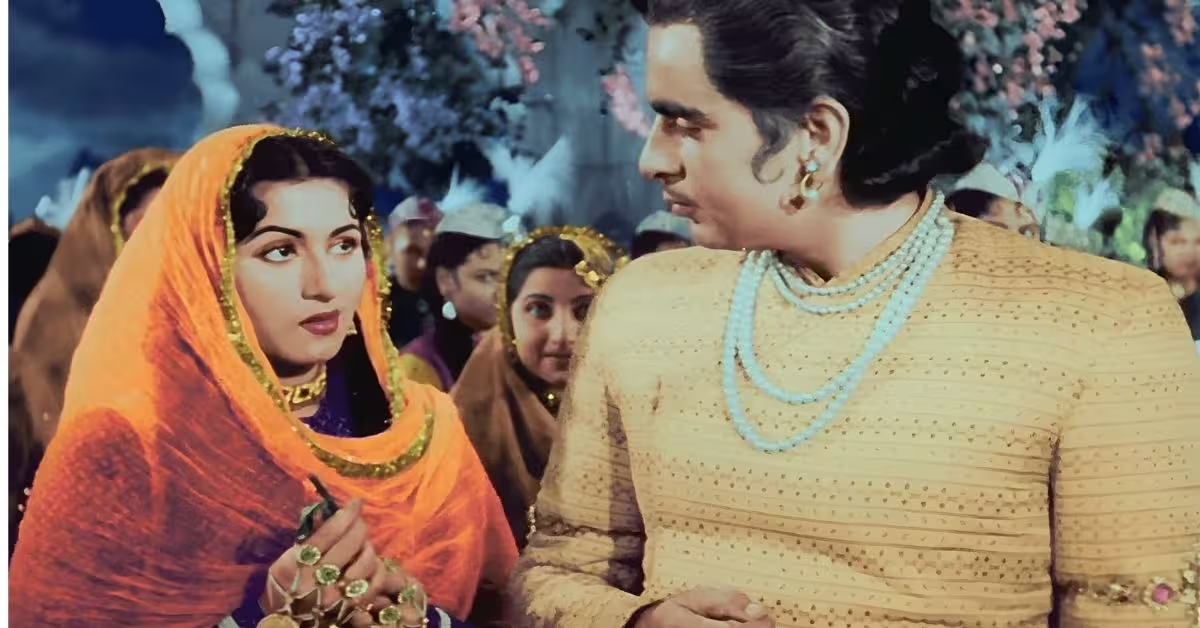
She is the court dancer Nadira, whom Akbar has renamed Anarkali, meaning pomegranate blossom. Bahar, an older and ambitious dancer, wants the throne beside Salim for herself. In one early scene her servant fears someone will see her wearing a crown, and Bahar answers that those who wear crowns do not fear.
The lovers meet in secret. Anarkali’s sister Suraiya brings her a letter from Salim and teases her when she hesitates. Anarkali finally takes it and reads it behind a bolted door. Later Salim finds her holding a candle. He lifts it to her face and says he wants to “demolish this wall of higher and lower.”
She begs him not to look, because her eyes hold only a servant’s grief. He asks her to forget that she is a servant. Hearing footsteps, she tells him she can bear separation from him but cannot bear his disgrace.
In another scene Salim strokes Anarkali’s face with a feather. Bahar is watching and rustles some leaves, and the couple is startled.
Salim summons whoever was watching, and Bahar comes to him in the palace. He hurls a dagger at her and misses. She picks up the dagger and hands it back, calling it disobedient and asking him to give it another chance.
Soon after, unsuccessful in winning Salim’s love, she exposes his forbidden relationship.
Akbar is furious. Salim pleads to marry Anarkali, but his father refuses and imprisons her. When Salim asks his father to treat him as a father and not a king, Akbar replies that he cannot ignore the duties of an emperor and cannot change the destiny of India for his son’s love.
Salim answers with the line that carries the whole film: times change, emperors change, destinies change, but when love grips a person, that person does not change. Akbar’s reply is only “Salim, you must change, you must!” Anarkali refuses to renounce Salim, even in the dungeon.
The film’s best-known sequence follows. Anarkali dances in the Sheesh Mahal and reaffirms her love in front of a livid Akbar. The song is “Pyar Kiya To Darna Kya,” roughly “what is fear when there is love.” Naushad built it on raga Darbari, and the sequence was shot in colour in a black-and-white film.
A slave is telling the emperor, at his own court, what she is not afraid of.
Salim offers to renounce his claim to the throne in exchange for Anarkali, and Jodha pleads with Akbar as well. Akbar refuses and sends Salim to the front to keep him away from the palace.
Then Akbar decides to settle the matter by other means. He rewards the sculptor and orders him to marry Anarkali. Bahar tells the sculptor he should be delighted.
He laughs and says there is “a short distance between the oppression and justice of kings.” He throws away the king’s award. The two of them look at his unfinished sculpture of the death sentence, and he says it may be completed with his blood. Later, in one of the film’s cries of defiance, he shouts “long live love.”
Akbar also orders Durjan Singh, his commander, to kill Anarkali, but Durjan had promised Salim to keep her safe. He hides her instead.
Salim learns what has happened.
He rebels and amasses an army to rescue Anarkali, and the film builds to a full battle between father and son. Salim loses and is sentenced to death. Akbar offers a way out: the sentence will be revoked if the hidden Anarkali is handed over to die in his place.
When word of Salim’s imminent execution reaches Durjan Singh, the commander is having his wounds bandaged. He says death will not come to the prince while his hands can still hold a sword, and he rushes out. He sees the statue of the goddess, cries “Jai Maa Kali!” and dies.
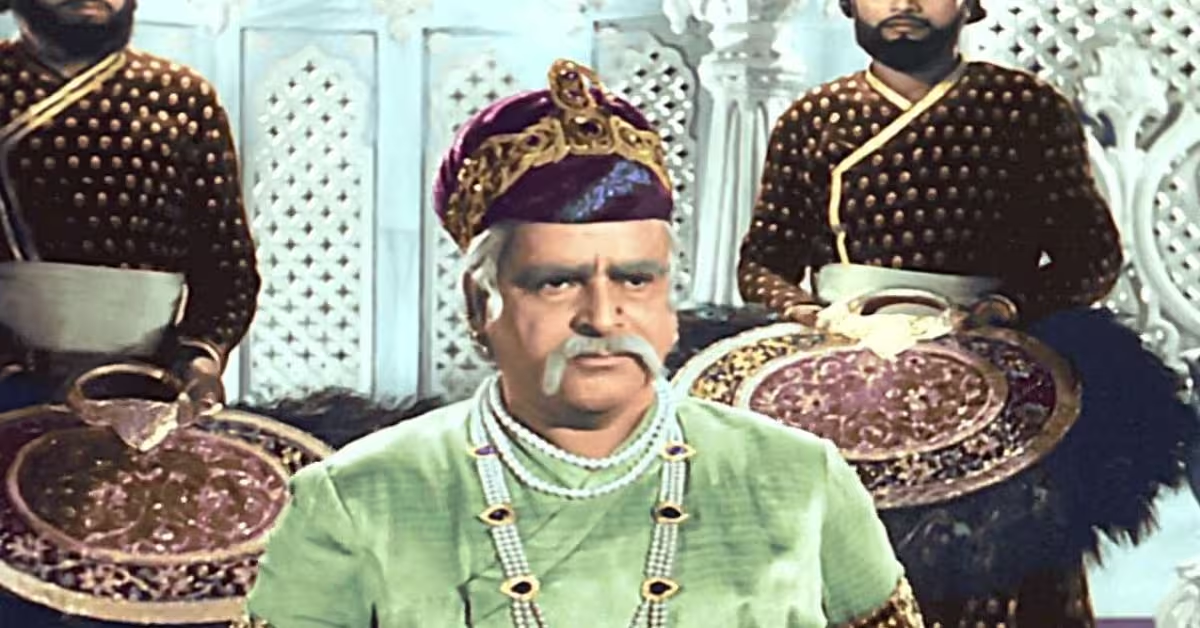
It is the film’s last act of loyalty before the ending.
Salim is led out to be executed by cannon. He asks his mother whether she sees any fear in her son’s face. Jodha answers that she does not, because she trusts her blood, and she says a true Rajput prince may even have death as his bride.
She places a garland from Bahar around his neck. Bahar’s face is wet with tears, so the rival has been moved by the lover’s courage.
Anarkali gives herself up.
She is led to be walled in. As she goes, she tells Akbar that in return for his majesty’s gifts, she forgives Jalaluddin Mohammed Akbar for her murder. As she is being walled up, Akbar is reminded that he still owes her mother a favour, the favour from the news of Salim’s birth. Her mother pleads for her daughter’s life.
Akbar wants to release Anarkali but cannot, because of his duty to his country. The sources agree on what he does: he spares her without Salim knowing, and she is exiled.
In one quoted line he tells her the plan must work, because if Salim learns she is alive, Akbar will not let her live and Salim will not let him die.
The film also includes a father-son exchange in which Salim asks whether Akbar has come to forgive a traitor. Akbar says he comes as an unfortunate father whom people called king, and swears he is not an enemy of love but a slave of his own principles. Salim answers that he too is a slave of his love.
The film gives the lovers no reunion. Salim lives and does not know why. Anarkali lives somewhere he cannot find her. Akbar keeps his law and loses his son’s trust.
Analysis and Criticism
I think the film is built on one idea: Akbar wins every argument and loses everything that matters. A University of Iowa note on the film observes that Akbar’s persecution of Anarkali contradicts what the audience knows about her, meaning her purity of heart and lack of ambition.
That contradiction is the point. We are asked to watch a great man be wrong for the right reasons.
The history, meanwhile, is loose. The film makes no claim that its story is real, unlike the 1952 Anarkali, which opened with a disclaimer, yet it takes many liberties.
The historian Alex von Tunzelmann notes that the real Salim led a rebellion against his father and had Akbar’s friend Abu al-Fazl murdered in 1602. The film blames both on his love for Anarkali, which is historically inaccurate.
The Sheesh Mahal was actually the queen’s royal bath, and the film turns it into a dancing hall. Thumri, a 19th-century form, appears in a 16th-century story. None of this wrecks the film, but you should know it.
The pace is the hardest thing to defend. Scenes are staged like theatre, with long pauses, formal speeches and tableaux. That works because the film wants to feel like myth. If you want realism, you will not enjoy it.
Acting Performances
Prithviraj Kapoor (Akbar). This is the performance everything leans on. Kapoor relied completely on the script and director, and by all accounts he suffered for the role: blisters from walking barefoot in the desert and trouble with heavy costumes. Lance Dane recalled one scene needing 19 takes.
Before make-up he would announce Prithviraj Kapoor ab jaa rahaa hai, and afterwards, “Akbar ab aa rahaa hai.” On screen the effort turns into weight.
Dilip Kumar (Salim). Kumar is quieter and more inward, and the contrast with Kapoor works. Asif trusted him to shape Salim himself, Kumar said, and he handled the Rajasthan heat and body armour during filming.
Madhubala (Anarkali). She is the film’s face, and she earned a Filmfare Best Actress nomination. The most important thing she does is hold still. Her best moments are not in the song, but in the dungeon scenes where she says almost nothing.
Supporting cast. Durga Khote as Jodha gives the film its warmth. Nigar Sultana plays Bahar with sharp, believable envy. Ajit as Durjan Singh gives the plot its moral hinge.
Themes and Messages
Duty against love. Akbar’s final act is the film’s thesis. He is allowed to feel mercy only in secret, because the state cannot see it.
Power and sentiment. The film asks whether a ruler can be a father. It answers no, at least not at the same moment.
Defiance through art. “Pyar Kiya To Darna Kya” turns a dance into a political act. The woman with no power uses the only stage she has.
Memory and legend. Because the Anarkali story is more legend than fact, the film is also about how a country decides which stories it keeps.
Comparison
The closest comparison is the film’s own family tree. Ardeshir Irani made a silent Anarkali in 1928 and remade it with sound in 1935, and Nandlal Jaswantlal’s Anarkali (1953), with Bina Rai and Pradeep Kumar, was the highest-grossing Hindi film of that year.
Kamal Amrohi, one of the writers, later planned his own film on the subject and agreed to shelve it after Asif confronted him. I have not rewatched the 1953 version for this piece. What sets Asif’s film apart is scale: it treats the legend as a state tragedy, not a romance.
Music
Naushad composed and Shakeel Badayuni wrote the lyrics. The film has 12 songs, which fill nearly a third of its running time.
The singers include Lata Mangeshkar, Mohammed Rafi, Shamshad Begum and the classical singer Bade Ghulam Ali Khan. “Bekas Pe Karam Keejiye” uses raga Kedar, and Naushad also used western orchestras and choruses for grandeur.
Audience Appeal, Reception and Awards
The film suits viewers who like grand, deliberate cinema, and it is better for cinephiles than for casual viewers. Filmfare’s review at release called it a tribute to the imagination, hard work and lavishness of its maker.
On awards, it won one National Film Award and three Filmfare Awards at the 8th Filmfare Awards. On box office, it broke records in India and held the highest-grossing title for 15 years.
Figures vary. One Wikipedia-derived copy lists a budget of about ₹10.5 million and box office of ₹55 million, while a retrospective blog gives about ₹1.5 crore as the final cost. I cannot reconcile these, so treat the numbers as estimates.
Colourisation: The Second Life
In 2004 the film became the first black-and-white Hindi film to be fully digitally coloured, and the first in any language to be given a theatrical re-release. The colour version came out on 12 November 2004 and did well commercially.
The work was enormous. The negatives were in poor condition and were cleaned of fungal growth, with damaged parts restored. Each of the 300,000 frames was scanned, and the restoration was done by Acris Lab in Chennai. The sound was cleaned at Chace Studio in the United States, and Naushad and Uttam Singh recreated the background score. The team spent 18 months developing colouring software called “Effects Plus”, then 10 more months on the colouring itself. When a costume was found in a warehouse, its colours matched the film’s closely.
The cost is disputed, with estimates from ₹20 million to ₹100 million.
Personal Insight: What a Restored Film Teaches Us About Keeping Stories Alive
I want to end the analysis on the angle that I think matters most today: how fragile the things we call classics really are.
Mughal-e-Azam nearly did not survive. The original negative had been damaged by extensive printing during its theatrical run, and it carried fungus. A film that held the box office record for 15 years could have faded into unwatchable prints. That is a small version of a bigger problem.
A cultural work is not safe because it is famous. It is safe because someone paid for the boring part: cleaning, scanning, storing, checking.
The story the film tells has the same shape. Akbar’s law survives, and the people it harms are quietly written out. Anarkali’s name survives as legend while the facts around her remain thin. The 2004 team faced the same question in miniature: how do you add something new without inventing it? Their answer was disciplined.
Their software accepted only colours whose hue matched the grey in the original frame, and they did research in museums and with historians, a design consultant and the actor Dilip Kumar himself.
Here are five lessons I take from this, and none of them is about cinema alone.
- Fame is not preservation. The film’s popularity did not protect its negative. Someone has to maintain what everyone loves.
- Restoration needs rules. Limiting the colouring software to matching hues kept the result honest. Any updating of old work needs a constraint like that.
- Duty can hide cruelty. Akbar uses the state as cover for private harm. When you hear “I have no choice,” ask who benefits from that sentence.
- Legends need an honest footnote. The film took liberties, and the historian’s corrections are public. Enjoy the story and keep the footnote.
- Craft takes patience nobody sees. Eighteen months of software work came before ten months of colouring. The visible part was the smaller part.
I did not find modern statistics on film preservation that I could verify for this section, so I have left them out rather than guess.
History or Legend?
The film is based on a legend, not history. Prince Salim did later become the emperor Jahangir and did rebel against his father, but there is no reliable historical evidence that Anarkali existed or that she was entombed.
The story became popular through later folklore and a 1922 Urdu play by Imtiaz Ali Taj. The film is best enjoyed as a romance set in history, not a history lesson.
Reception and Legacy
Mughal-e-Azam was a huge commercial success and won national awards in India, including the National Film Award for best Hindi feature. Its grand sets, costumes, dialogue and music influenced generations of filmmakers. For many in South Asia it remains the definitive costume epic.
Lessons in Love
- Love can demand courage, especially when it challenges power.
- Duty and desire are not easily reconciled, even for good people.
- Pride, in rulers and in lovers, can destroy what it means to protect.
- Sacrifice, as Anarkali shows, can be its own form of power.
Pros and Cons
| Pros | Cons |
|---|---|
| Kapoor’s Akbar carries real tragic weight | Slow, theatrical pacing across nearly three hours |
| Naushad’s music, with 12 songs, is a landmark | Historically inaccurate on Salim, the Sheesh Mahal and music styles |
| The Sheesh Mahal sequence still dazzles | Plot is simple, and the villain is mostly circumstance |
| Madhubala’s silences carry the dungeon scenes | Dense, formal Urdu may be hard for casual viewers |
| The colour restoration is a remarkable story in itself | Box office and cost figures are inconsistent across sources |
Conclusion
Mughal-e-Azam is not a perfect film, and it does not try to be an accurate one. It is a grand, slow, stubborn tragedy whose true subject is Akbar’s choice, and I keep thinking about that choice more than the romance.
I recommend it to lovers of period drama, classical music and big performances, and to anyone curious about how the Hindi film industry saw itself in 1960. If you want speed, skip it.
Rating: 4.5/5
Mughal-e-Azam

Director: K. Asif
Date Created: 1970-01-01 00:32
4.5
Pros
- Kapoor's Akbar carries real tragic weight
- Naushad's 12-song score is a landmark
- The Sheesh Mahal sequence still dazzles
Cons
- Slow, theatrical pacing
- Historically inaccurate in several places







