
Last updated on July 25th, 2026 at 10:43 pm
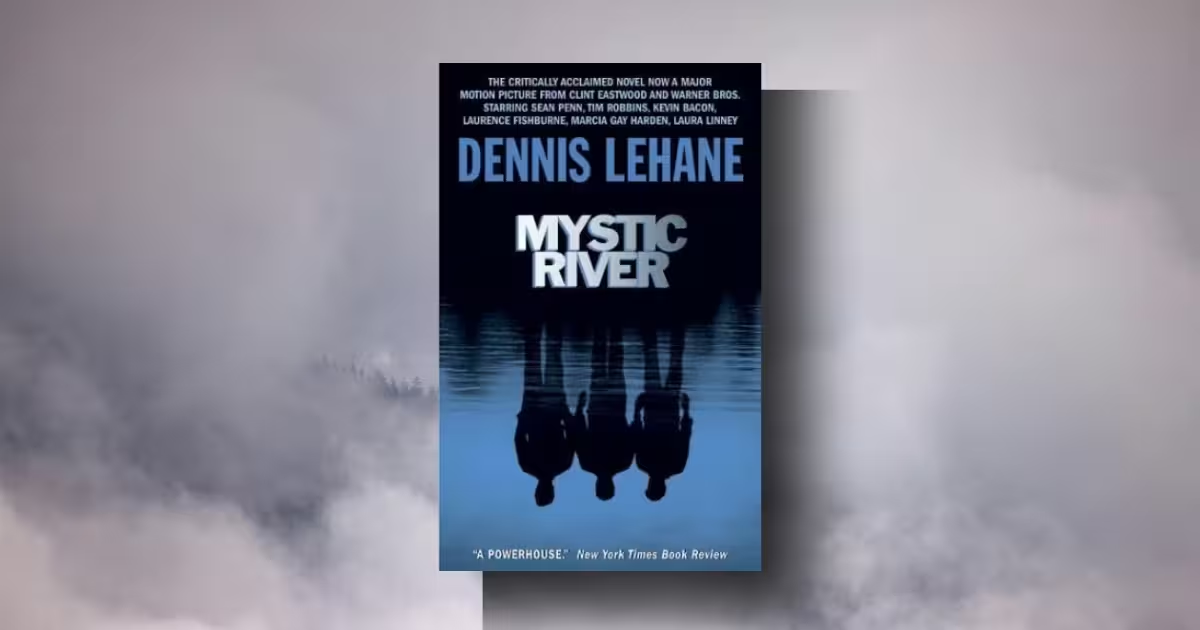
Did you ever wonder why you feel an unshakeable chill when a single childhood choice alters the entire course of three lives? Here is my personal appeal to you as a reader. Mystic River forces you to confront the darkest corners of human grief, making it a mandatory read for anyone who appreciates character-driven suspense.
Overview
Dennis Lehane’s Mystic River is a dark, psychological crime thriller set in a tight-knit, working-class Boston neighborhood.
The narrative follows three estranged childhood friends—Sean (a detective), Jimmy (an ex-con grieving father), and Dave (a trauma survivor)—whose lives brutally collide twenty-five years after a childhood abduction when Jimmy’s daughter is murdered.
Mystic River is suggested for readers who love gritty crime fiction and psychological tragedies where no character is truly innocent. But it is not a good read for those looking for a neat, happy resolution or readers sensitive to discussions of child abuse.
Table of Contents
1. Introduction
Mystic River by Dennis Lehane, published in 2001, is a towering achievement in modern crime fiction. Lehane sets the narrative in a fictionalized version of a working-class Boston neighborhood. It is a novel that operates as both a gripping police procedural and a profound meditation on the long shadow of trauma.
As someone constantly analyzing narrative structures for search-optimized literary content, I can tell you this book sets a gold standard for pacing and character development.
2. Background
The story is deeply rooted in the blue-collar, tribal culture of Boston in the late 20th century. This is a world divided by invisible lines of class and geography, specifically the people of the hill and the people of the flats.
The epigraph sets the haunting tone perfectly: “No existe la calle sin piedras mudas ni la casa sin ecos,” which translates to “There is no street without mute stones, nor house without echoes”.
This historical and cultural context is essential for grasping why the characters adhere to strict codes of silence, loyalty, and street justice.
3. Mystic River Summary
The Abduction (1975)
The narrative begins in East Buckingham, a neighborhood of tight-knit families and distinct social boundaries. Sean Devine and Jimmy Marcus grew up with fathers who worked at the Coleman candy factory, returning home smelling of hot chocolate.
Dave Boyle, a quiet boy from the flats, often tagged along. One Saturday, the three boys are playing in the street, writing their names in wet cement, when a dark brown car pulls up. Two men pretending to be police officers confront them.
The driver, a burly man, makes a gesture with his finger, moving it toward his chest until the boys are standing right in front of him. He questions them about fighting in the street and asks if they live nearby. Jimmy and Sean lie and say they do, but Dave admits he lives in the flats.
The man singles Dave out, telling him to get in the car. Jimmy and Sean watch helplessly as Dave is driven away. Sean notices a distinct, chilling detail about the vehicle. The car smelled like apples.
Dave is held captive and sexually abused by the two men in a cabin for four days before he manages to escape. He returns to his neighborhood in the back of a real police car, surrounded by cheering neighbors and flashing cameras, but the damage is done.
As Jimmy observes Dave waving from his window later that evening, he realizes Dave has become “mercancía dañada,” or damaged goods.
The Chasm of Adulthood
Twenty-five years pass. The childhood friendship has long since disintegrated. Sean Devine is a homicide detective for the Massachusetts State Police. His personal life is falling apart. His wife, Lauren, has left him, taking their young daughter, and she frequently calls him only to sit on the line in absolute silence.
Jimmy Marcus has a criminal past but has spent the last decade walking the straight and narrow. After serving time in prison, he opened a convenience store to provide for his family.
He has three daughters. His oldest, Katie, is nineteen years old and possesses an extraordinary beauty. She is secretly planning to run away to Las Vegas to marry her boyfriend, Brendan Harris.
Brendan loves Katie with a cinematic, overwhelming passion.
Dave Boyle is married to Celeste and has a young son named Michael. Dave is a shattered man, living a quiet, unassuming life but constantly battling the demons of his past. He still imagines the voices of his abusers, referring to them in his mind as the Big Wolf and the Greasy Wolf.
The Night of the Murder
The inciting incident of the adult timeline occurs on a Saturday night. Katie Marcus goes out with her friends to a local bar to celebrate her impending secret move. Dave Boyle is also out that night, having chosen to go to a bar to avoid a tarot card gathering his wife is hosting at their apartment.
Katie leaves the bar, and later that night, she is brutally murdered in the local park. Her car is found abandoned with blood inside. Around the same time, Dave Boyle returns home to his wife Celeste. He is covered in blood and deeply agitated.
He tells Celeste that he fought off a mugger in the parking lot of a bar, claiming he might have killed the man. Celeste, terrified but loyal, helps him clean up and disposes of his bloody clothes.
The Interlocking Investigations
The next morning, Katie’s car is discovered. Sean Devine and his partner, Whitey Powers, are assigned to the case. Sean is forced to return to his old neighborhood and interact with Jimmy. When Jimmy realizes his daughter is dead, his grief is volcanic. The scene where he is held back by police officers as he screams for his daughter is harrowing.
Sean and Whitey follow the evidence. They discover the gun used to shoot Katie belonged to “Just” Ray Harris, Brendan’s father, who disappeared years ago. This casts immediate suspicion on Brendan.
Meanwhile, Jimmy conducts his own parallel investigation. He enlists the help of the Savage brothers, ruthless local thugs who act as his enforcers. Jimmy has no faith in the police and is determined to exact street justice.
As the police investigate, Whitey Powers becomes increasingly suspicious of Dave Boyle. Dave’s erratic behavior, his bandaged hand, and his lack of a solid alibi draw the detectives’ attention. Celeste’s growing paranoia about her husband’s actions that night further complicates matters.
She eventually cracks under the pressure and confides in Jimmy, telling him that Dave came home covered in blood the night Katie died.
The Climax at the River
Armed with Celeste’s confession, Jimmy becomes completely convinced that Dave killed Katie. He arranges to meet Dave at a bar, getting him drunk and playing on their shared past. Jimmy and the Savage brothers then take Dave to the banks of the Mystic River.
Jimmy confronts Dave, demanding a confession. Dave desperately tries to explain what really happened that night. He confesses that he did not kill Katie. Instead, he admits that he beat a child molester to death. He had seen a man interacting inappropriately with a child, triggering a massive trauma response, and he lost control.
Jimmy refuses to believe him. He gives Dave a cruel ultimatum: confess to Katie’s murder, and Jimmy will let him live, allowing him to return to his wife and son. Terrified and wanting to survive for his family, Dave falsely confesses to killing Katie.
Tragically, Jimmy breaks his promise. He shoots Dave and dumps his body into the Mystic River, a place where the neighborhood has buried its secrets for generations.
The True Culprits and the Parade
The morning after Dave’s murder, Sean and Whitey finally crack the case. The murderers are not Dave, nor Brendan. The killers are Brendan’s mute younger brother, “Silent” Ray Harris, and his friend John O’Shea.
The two boys had found Just Ray’s old gun. They were playing with it when it accidentally went off, hitting Katie as she drove past. Panicked, they chased her into the park and beat her to death to silence her.
Sean goes to Jimmy’s house to deliver the news that they have caught Katie’s killers. During this conversation, Sean casually asks Jimmy about Dave Boyle’s whereabouts. Jimmy remains stoic and evades the question, but Sean, knowing Jimmy’s past and the rules of their neighborhood, pieces together exactly what Jimmy has done.
Despite knowing Jimmy murdered an innocent man, Sean makes a conscious decision not to arrest him. He lacks physical evidence, but more importantly, he is bound by the tribal loyalty that defines their community.
The novel ends with a local parade. Sean attends with his wife, who has finally spoken to him and returned home. Jimmy is there with his family.
Celeste Boyle is frantically searching the crowd for Dave, unaware that he is dead at the bottom of the river.
Jimmy and Sean exchange a silent glance across the street, acknowledging their shared complicity and the grim reality that the sins of the past will forever contaminate their future.
4. Mystic River Analysis
4.1 Characters
Jimmy Marcus: Jimmy is a tragic figure defined by rage and a distorted sense of control. His transition from a small-time criminal to a legitimate business owner is a facade that instantly shatters when his daughter is killed.
He represents the danger of taking the law into one’s own hands and the toxic nature of violent masculinity.
Dave Boyle: Dave is the ultimate victim. The trauma he endured in the car that smelled like apples stunted his emotional growth. He is a walking ghost, entirely consumed by the events of 1975. His false confession to Jimmy is a heartbreaking moment of a broken man trying to appease a bully, just as he had to appease his abusers.
Sean Devine: Sean acts as the moral center of the story, yet he is deeply compromised. He carries the survivor’s guilt of not getting into the car.
His final decision to let Jimmy go free highlights the corruption inherent in loyalty and tribalism.
4.2 Mystic River Themes and Symbolism
The Shadow of Trauma: The central theme is that time does not heal all wounds. The abduction in 1975 is the pebble dropped in the pond, and the murder in 2000 is the ripple. The trauma dictates the characters’ adult lives completely.
The River as a Symbol: The Mystic River symbolizes the burial of sins and secrets. It washes away the physical evidence but retains the moral decay of the community. It is a dark, indifferent force that consumes the weak, much like the neighborhood itself.
Justice vs. Revenge: The novel aggressively questions the nature of justice. The official police investigation is contrasted with Jimmy’s vigilante quest.
Ultimately, Jimmy’s brand of street justice results in the murder of an innocent man, proving that revenge is a blind and destructive force.
5. Mystic River Evaluation
My opinion on the book is clear: Mystic River is an outstanding, emotionally devastating masterpiece that transcends the traditional thriller genre.
Strengths: The primary strength lies in Lehane’s character work. He refuses to write caricatures. The dialogue is authentic, capturing the specific cadence of Boston’s working class. The pacing is meticulous, slowly tightening the noose around all three protagonists.
Weaknesses: Some readers might find the pacing in the middle act slightly slow, as Lehane spends considerable time detailing the mundane aspects of police procedural work and the domestic lives of the characters before escalating the tension.
Impact: Emotionally, Mystic River is a heavy burden. It leaves a lingering sense of despair regarding the cyclical nature of violence. It forces the reader to confront the reality that innocence, once lost, can never be reclaimed.
Comparison with similar Works: It sits comfortably on the top shelf alongside literary crime fiction like Richard Price’s Clockers or George Pelecanos’s The Night Gardener. It shares the same DNA as The Wire, focusing on the sociological breakdown of an urban environment.
Adaptation: The novel was adapted into a highly successful film directed by Clint Eastwood. Released in October 2003, it featured a phenomenal cast including Sean Penn, Tim Robbins, and Kevin Bacon.
The adaptation remained incredibly faithful to the book, earning Sean Penn and Tim Robbins Academy Awards for Best Actor and Best Supporting Actor, respectively.
6. Personal Insight with Contemporary Educational Relevance
The most important theme of Mystic River is the destructive nature of unchecked vigilante justice and the unreliability of assumed guilt, a topic that remains incredibly relevant in our current era of internet sleuthing and public shaming.
When systems fail or are perceived to be too slow, human nature often defaults to mob justice.
Jimmy’s fatal error is assuming he possesses all the facts, fueled by grief and a toxic community code. In today’s digital landscape, we frequently see this replicated on a massive scale; a snippet of video or a rumor goes viral, and the public demands immediate retribution, often destroying innocent lives before the truth can be established.
Here are 5 educational lessons we can draw from this angle:
Due Process is Imperative: The procedural steps of an investigation exist to prevent emotional, catastrophic mistakes. Bypassing them guarantees tragedy.
Trauma Warps Perception: Celeste’s interpretation of Dave’s actions was heavily skewed by her own fears. We must recognize how trauma and panic alter our objective reality.
The Danger of Echo Chambers: Jimmy surrounded himself with enforcers who never questioned his logic. Seeking absolute consensus is a recipe for fatal errors.
False Confessions Occur Under Duress: Dave’s confession to Jimmy perfectly illustrates why forced confessions are invalid. People will say anything to survive a localized threat.
Actions Leave Permanent Scars: You cannot undo a reactionary mistake. Jimmy has to live the rest of his life knowing he murdered his childhood friend for nothing.
7. Mystic River Quotes
- “There is no street without mute stones, nor house without echoes.”
- “We bury our sins here. We wash them clean.”
- “Sometimes, I think I got in that car too. And this is just a dream I’m having.”
- “The boys who escaped from the wolves.”
- “He was merchandise that was damaged.” (Translated from the text: “mercancía dañada”).
8. Conclusion
To summarize, Mystic River is a masterclass in psychological suspense and tragic storytelling. I highly recommend it to fans of literary fiction, psychological thrillers, and character studies.
It is a significant book because it refuses to offer easy answers, forcing readers to examine the terrifying fragility of a normal life and the devastating permanence of our choices.







