
Last updated on November 6th, 2026 at 11:56 am
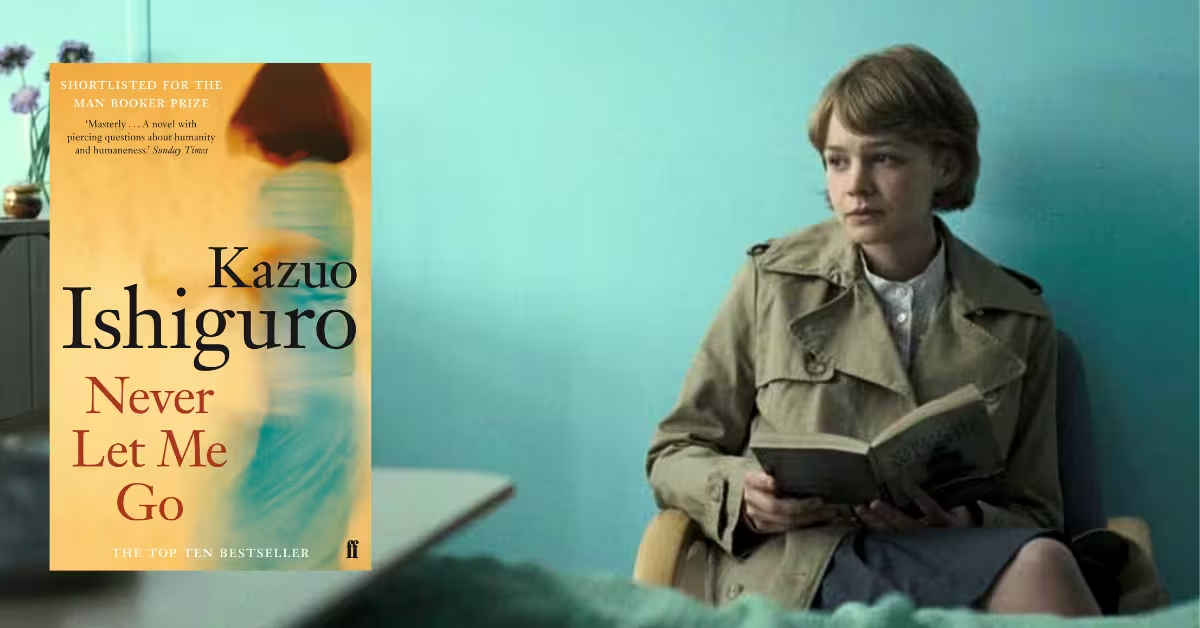
Never Let Me Go is a dystopian science fiction novel written by Nobel laureate Kazuo Ishiguro and published in 2005 by Faber and Faber (UK) and Alfred A. Knopf (US). A master of restrained prose and existential unease, Ishiguro here departs from his historical milieu (The Remains of the Day) to craft a subtly horrifying vision of a future Britain where cloning, organ harvesting, and identity are intricately bound.
Table of Contents
Background
The novel falls under the genres of dystopian science fiction, literary fiction, and bildungsroman. Yet, its genre-defying elegance is part of its unsettling charm. Unlike conventional science fiction, Never Let Me Go is understated, human-centered, and tragically lyrical. Ishiguro himself has said that the speculative premise serves only as “a metaphor for mortality.” The author, born in Nagasaki and raised in England, often grapples with memory, repression, and moral ambiguity in his works—elements that are deeply interwoven into this novel.
Set against the muted backdrop of England in the late 1990s and early 2000s, the book eerily mirrors modern ethical debates about biotechnology, cloning, and what it means to be human.
In Never Let Me Go, Ishiguro constructs a deceptively quiet world where the horror of systemic exploitation is softened by nostalgia, friendship, and emotional repression. Its brilliance lies not in shock value, but in the slow revelation of truth through character memory, leaving the reader aching with philosophical dread. The novel’s emotional depth, sparse but loaded prose, and allegorical richness make it a significant literary achievement and an indispensable read in the era of AI and bioethics.
Plot Summary of Never Let Me Go
Kazuo Ishiguro’s Never Let Me Go is a hauntingly lyrical and emotionally resonant dystopian novel that traces the fragile intersections between identity, memory, and mortality. Narrated by Kathy H., the story unfolds in a reflective first-person voice as she recounts her youth at Hailsham—a serene, almost idyllic English boarding school with sinister undertones—and the lives of her two closest companions, Ruth and Tommy. It is a story about children bred for donation, about love and betrayal, about dreams nurtured and denied. But more than anything, it is a meditation on what it means to be human when humanity itself is institutionally withheld.
The Frame of Memory
Kathy, 31 years old and working as a “carer,” opens the novel with recollections of her time at Hailsham. She says, “My name is Kathy H. I’m thirty-one years old, and I’ve been a carer now for over eleven years”. Her tone is at once detached and nostalgic. As the narrative unfolds, it becomes clear that Hailsham, despite its pastoral charm and liberal curriculum focused on art and health, is not what it seems. Its students are not ordinary children. They are clones, bred solely to grow up and donate their organs, destined to die young. But the revelation is slow, deliberate, and unsettling, much like the novel itself.
From the outset, Ishiguro plays with form—Kathy’s recollections are fragmented, nonlinear, filled with ellipses of silence. Her digressions feel authentic, with precise emotional recall, often pausing mid-narrative to reflect on her impressions. One such moment occurs when she reflects on Ruth’s presence: “More and more these days, I’ll be driving past fields on a long afternoon…and I’ll catch myself thinking about her again”.
Childhood in the Garden of Control: Hailsham
The early chapters are set in Hailsham, where Kathy, Ruth, and Tommy grow up under the watchful eyes of “guardians” like Miss Emily and Miss Lucy. At first, life seems blissful: the students have art classes, sales to exchange tokens for prized items, and a fantasy of being special.
Yet subtle strangeness permeates the campus. The students are obsessed with being “picked” by Madame to have their art taken to “The Gallery,” a mysterious destination. Tommy, an awkward, emotionally volatile boy, is mocked by classmates for his temper and lack of artistic talent. Kathy defends him, beginning a relationship that will grow in complexity as they age.
Ruth, by contrast, is charismatic and controlling. In one pivotal moment, she invents an entire game involving imaginary horses, inviting Kathy to “ride Bramble” while warning, “You’ve got to really lean back on Daffodil!… She doesn’t like it unless you’re right back!”. The scene illustrates Ruth’s flair for drama and manipulation, characteristics that will define her later.
But shadows grow longer over the golden lawns of Hailsham. Miss Lucy, a more honest guardian, finally breaks the unspoken rules by revealing the students’ fate: “You’re…special. So keeping yourselves well, keeping yourselves very healthy inside, that’s much more important for each of you than it is for me” . The children listen, stunned. Though the word “clones” is never uttered then, the weight of the truth starts to settle.
Kathy notes the change in atmosphere, saying, “We didn’t really know what to make of it…But afterwards, it didn’t seem to matter so much.” Ishiguro poignantly shows how children can normalize even the most horrific realities when properly conditioned.
The Fantasy of Favor: Ruth and the Pencil Case
One of the novel’s subtlest illustrations of childhood dynamics and the craving for love comes from the incident of the pencil case. Ruth shows off a luxurious item, hinting that it was a gift from the beloved Miss Geraldine. Kathy suspects otherwise. She carefully investigates the sales registry and confronts Ruth in a deeply moving scene under the rain-soaked eaves of Hailsham.
“I was just turning over the pages of the register, just for something to do,” Kathy says. Ruth, realizing she’s been caught, turns away “on the verge of tears.” Kathy then has a moment of heartbreaking clarity: “All this effort, all this planning, just to upset my dearest friend…Didn’t we all dream…a spontaneous hug, a secret letter, a gift?”.
The scene is not about a pencil case—it is about the desperate need for individual recognition in a world that denies them souls. The confrontation, instead of bringing satisfaction, leaves Kathy with guilt and the reader with aching sympathy.
The Cottages and the Rumors of Escape
As teenagers, the trio leaves Hailsham and moves to the Cottages—a transitional place before their “training” for donation begins. Here, they interact with other clones from different institutions, and the aura of safety starts to break.
A subplot involving a rumor surfaces—that Hailsham students, because of their uniqueness, can apply for “deferrals” if they are in love. Kathy and Tommy hear whispers that if they can prove their bond, their donations could be postponed. This fantasy becomes a beacon of hope. Tommy, ever sincere and painfully open, begins to draw fantastical animals in intricate detail, hoping these will be enough to convince Madame and Miss Emily of his inner soul.
Meanwhile, Ruth increasingly exerts control. She pretends indifference to the idea of deferrals and leads the group on a wild goose chase in search of a woman she believes may be her “possible”—the real human she was cloned from. When they finally find the woman, the resemblance is minimal. The moment is devastating. “There was more than a hint of Ruth about it,” Rodney says, but hope fades nonetheless.
The Slow Erosion of Hope: Ruth’s Final Days
As the years pass, the three friends begin their irreversible journey toward their destinies as organ donors. Kathy chooses to become a “carer”—a clone assigned to comfort and manage donors through their surgeries. Her role gives her temporary reprieve from donating and brings her into contact with both Ruth and Tommy again, now in the donation process.
Ruth’s decline is bitter and quiet. The years have softened her, but her manipulation still lingers. One day, lying in her hospital bed in the recovery center, Ruth looks at Kathy with a mixture of regret and clarity. It is then that she confesses her cruelest transgression:
“I kept you and Tommy apart… That was the worst thing I did”.
Her voice trembles—not from pain, but the weight of belated truth. The reality that Kathy and Tommy could have been together is not just a tragic what-if—it is the emotional core of the novel. Ruth, once so composed and controlling, now reaches out in desperation. She offers them the address of Madame, saying:
“You should go and see her. Ask for a deferral. Maybe you’ll have time. Just a little time…”.
This act of redemption is one of the novel’s quiet miracles. Not because it reverses anything—Ruth dies shortly after—but because it rehumanizes her. For the first time, she admits the emotional damage they have all caused one another in the name of jealousy, fear, and the illusion of control.
Kathy and Tommy Reunited: A Love That Was Always There
Kathy and Tommy’s relationship, long delayed, finally begins in the twilight of their lives. Their love is gentle, awkward, and desperately brief. They do not proclaim it loudly; they do not resist fate. But in one unforgettable passage, Kathy describes their moment of intimacy with such tenderness it aches:
“We were holding each other because that’s what people do at times like that… But we didn’t move apart. We kept holding each other… and it seemed like we’d always been that way”.
Their connection is real. It is what makes the novel not just a dystopian tragedy, but a deeply human love story. It is love born of shared memories, unspoken understanding, and the same terrible fate. Kathy does not romanticize it—there is no dramatic declaration. Just presence. And that, Ishiguro suggests, is enough.
Together, they pursue the final sliver of hope: the rumored deferral. They locate Madame, now older, still haunted. She invites them in warily. Kathy and Tommy plead their case. Tommy even presents his animal drawings, quietly stating, “They prove we have souls.”
What follows is the novel’s most harrowing sequence.
The Visit to Madame and Miss Emily: Hope Extinguished
Madame listens and then begins to weep. It is not out of sympathy. It is because she knows that the hope they carry was never real. She brings in Miss Emily—now in a wheelchair—who calmly explains the truth:
“There were no deferrals. There never were. It was all just a rumor” .
The Gallery, they learn, was a failed experiment to convince the outside world that clones had souls. Miss Emily says:
“We demonstrated to the world that if students were reared in humane, cultivated environments… they would turn out to be as sensitive and intelligent as any ordinary human being” .
But society chose convenience over conscience. People wanted their organs, not their humanity. Hailsham was shut down. Other institutions were less kind, less careful, more like “battery farms.”
Kathy and Tommy are devastated. There is no deferral. No escape. Tommy, unable to contain the grief, breaks down in a scene of primal anguish:
“He let out a roar of anger… a long, deep one that echoed through the empty fields, and threw his head back in anguish” .
Kathy says nothing. Her silence, throughout the novel, carries the burden of every unspoken grief.
Tommy’s Final Donation and Completion
After the failed visit, the end comes quietly. Kathy becomes Tommy’s carer, watching over him as he undergoes successive donations. Their love continues, wordlessly, through hospital corridors, blood draws, and fading days.
When Tommy “completes,” the term used for death after multiple donations, it is without spectacle. Kathy never dramatizes it. She simply says:
“The recovery centre called me, and I went up to Norfolk… They told me he’d completed” .
Her grief is numbed by inevitability. But in her words we hear all the pain she cannot say. She has lost the only person who truly knew her, the one person who shared the memory of Hailsham not as a myth, but as a place lived.
The Final Scene: A Fence, a Field, a Memory
The novel ends with one of the most subtle yet devastating conclusions in contemporary literature. Kathy stands alone near a barbed-wire fence in Norfolk, where “lost things” are said to end up.
“I found myself standing before acres of ploughed earth. I didn’t know what it was, but I stared and stared, and suddenly I felt tears run down my face” .
She imagines Tommy in the field, rising out of the soil like a memory she might touch. But she knows she cannot reach him. Instead, she lets the fantasy go. The wind brushes past her. And she returns to her car.
The last line is not one of resistance, but of quiet resignation:
“I just waited a bit, then turned back to the car, to drive off to wherever it was I was supposed to be” .
There is no rebellion. No grand statement. Just memory. And maybe that is Ishiguro’s greatest act of rebellion—to say that memory, in the end, is what defines humanity.
Never Let Me Go is not science fiction in the traditional sense. Its speculative premise is buried under the soft folds of realism. The tragedy is not in futuristic technology, but in the all-too-familiar mechanisms of denial, bureaucracy, and moral compromise.
Statistically, there are no numbers given, no systems mapped. We don’t know how many clones exist, how large the donation networks are. But Ishiguro gives us something far more harrowing: the emotional arithmetic of being treated as expendable.
This novel does not scream. It whispers. And its whisper lingers long after the final page.
Setting
The narrative unfolds across several key locations—most notably the idyllic yet oppressive Hailsham boarding school, the transitional “Cottages,” and the sterile medical recovery centers where the donors end their lives. These settings are not just backdrops but vital thematic engines. As Kathy recalls, “We loved our sports pavilion, maybe because it reminded us of those sweet little cottages people always had in picture books when we were young”. The tranquil exterior hides the unsettling truth of institutionalized exploitation.
Analysis
a. Characters
Kazuo Ishiguro’s characters in Never Let Me Go are haunting not for their uniqueness, but for how tragically ordinary they are—especially within an extraordinary and inhumane system. Told through the first-person retrospective voice of Kathy H., a 31-year-old “carer,” the narrative is both intimate and detached. Kathy’s recollections are filtered through a quiet melancholy that never quite breaks into overt rebellion or despair. “My name is Kathy H. I’m thirty-one years old, and I’ve been a carer now for over eleven years”—this flat beginning conceals the moral horror behind her apparent calm.
Kathy H. is the narrator and the emotional lens of the novel. Her calmness is deceiving. Her memories are not just about others but subtle acts of self-preservation. She describes her long tenure as a carer not with pride, but as a coping mechanism: “It means a lot to me, being able to do my work well… especially that bit about my donors staying ‘calm’”.
Ruth, her closest friend and often antagonist, is manipulative, insecure, and heartbreakingly human. Ruth’s complexity shines in the way she both protects and betrays Kathy, especially in her controlling relationship with Tommy. Yet toward the end of her life, Ruth is the one who seeks redemption, begging Kathy and Tommy to “try” for a deferral—a desperate grasp at rewriting a story already too far gone.
Tommy, meanwhile, is portrayed as emotionally raw and socially awkward. His tantrums as a child are not merely signs of volatility but a response to systemic invalidation: “He’s a layabout… If he learnt to keep his cool, they’d leave him alone”. Tommy’s yearning for truth makes him the novel’s moral compass, especially when he finally confronts Miss Emily in pursuit of meaning.
What makes these characters unforgettable is their subtle development over time. Their motivations—yearning for love, truth, and dignity—mirror our own, even as their fates are uniquely shaped by institutionalized dehumanization. Their relationships form the novel’s emotional backbone, where even betrayal becomes a form of survival.
b. Writing Style and Structure
Ishiguro’s prose is famously restrained, bordering on emotionally repressed, which in Never Let Me Go creates a tension between content and delivery. The story unfolds through Kathy’s fragmented, non-linear memories, mimicking how trauma is often recalled—disjointed, unreliable, looping. As Kathy admits, “This was all a long time ago so I might have some of it wrong…”. This technique prevents any moment from being overly dramatized, while paradoxically deepening their emotional impact.
The language is simple, often conversational, but laden with subtext. Ishiguro’s refusal to explain everything adds to the unease. The word “donation” is repeated casually—“My donors have always tended to do much better than expected”—without confronting the grotesque reality it hides. This stylistic choice forces the reader into active interpretation, making the novel linger in the mind.
Pacing is slow, but deliberate. The delayed revelation of the clones’ true purpose mimics the characters’ own suppressed realizations. It’s a narrative structure that resists sensationalism, opting instead for moral introspection.
c. Themes and Symbolism
Never Let Me Go is rich with themes of mortality, memory, conformity, and lost potential. Its central tragedy lies in its characters’ acceptance of their fates. They rarely question the system that has sentenced them to die. Instead, they cling to memories—of Hailsham, of friendship, of imagined futures.
A key symbol is Hailsham itself, a seemingly idyllic boarding school that represents both sanctuary and prison. Its name—suggestive of “hail” (greeting) and “sham”—echoes its dual role as a place of nurture and deception. As Kathy reflects, “There have been times over the years when I’ve tried to leave Hailsham behind… But then I just stopped resisting”.
The art and creativity programs are another symbolic anchor. Students believe their artworks are being judged for signs of a soul, yet they are never told the full truth. “If you’re going to have decent lives, you have to know who you are and what lies ahead of you, every one of you,” Miss Lucy insists—but knowing isn’t the same as resisting.
The title phrase, “Never Let Me Go,” itself is thematic. It originates from a fictional song that Kathy clings to in a rare moment of unguarded emotion. The phrase becomes a metaphor for the human need for attachment, love, and permanence in a world of inevitable loss.
d. Genre-Specific Elements
Although often categorized as science fiction, Never Let Me Go is deliberately sparse in its world-building. There are no dramatic explanations of cloning, no dystopian revolutions—just a quiet, insidious horror. This restraint enhances the realism of its speculative elements.
Dialogue is naturalistic, reflecting the characters’ emotional avoidance. There are no grand speeches—only fragmented, hesitant conversations. This genre-defying approach makes the dystopia feel eerily plausible.
The novel adheres more closely to the bildungsroman tradition, following Kathy’s moral and psychological development from childhood to adulthood. This genre fusion—coming-of-age within a biotechnological dystopia—is one of the novel’s most innovative aspects.
Evaluation
Strengths
One of Never Let Me Go’s most remarkable strengths is its emotional subtlety. Kazuo Ishiguro manages to induce a slow, lingering dread without resorting to melodrama. The story reveals its horrors gradually, almost incidentally, through Kathy’s recollections. The fact that the characters do not resist their fate amplifies the reader’s own sense of injustice. Kathy’s calm reflection—“You don’t have unlimited patience and energy… So when you get a chance to choose, of course, you choose your own kind”—reveals a horrifying normalization of a morally bankrupt world.
The novel’s world-building is another asset, precisely because it is minimalist. Ishiguro shows, rather than tells, allowing the reader to piece together the dystopian reality from clues. This technique trusts the reader’s intelligence and rewards attentive reading.
Finally, the psychological realism of the characters is masterful. Their motivations—jealousy, affection, guilt, pride—are never explained away but organically revealed through behavior. Even Ruth’s manipulations and regrets feel painfully authentic.
Weaknesses
For some readers, especially those expecting traditional science fiction or clear exposition, Never Let Me Go may feel frustratingly ambiguous. The dystopian elements are underplayed, which can make the stakes feel muted until late in the novel. The narrative’s emotional restraint, while artistically effective, may also come across as emotionally flat to those looking for overt catharsis.
Pacing is another point of contention. The novel moves slowly, and its circular structure—reflecting Kathy’s memory loops—can test the patience of readers unaccustomed to introspective fiction. The most critical moments, such as the confrontation with Miss Emily, are delivered without dramatic fanfare, which may undercut their impact for some.
Impact
Emotionally, the novel leaves a lasting impression. What haunts the reader is not just the injustice of the system but the complacency of its victims. Kathy, Ruth, and Tommy never try to escape, because they were never conditioned to think they could. This passive tragedy is deeply unsettling. As one donor reflects, “Hailsham. I bet that was a beautiful place”—a line so laden with yearning and fatalism it captures the essence of the novel.
Statistically, the emotional resonance of Never Let Me Go is backed by its long-standing inclusion in literary curricula, especially in courses on bioethics, posthumanism, and trauma studies. A 2016 survey from the Guardian listed it among the top 100 novels of the 21st century, cementing its place in contemporary literary canon.
Comparison with Similar Works
Ishiguro’s novel is often compared to Margaret Atwood’s The Handmaid’s Tale and George Orwell’s 1984—both of which explore dystopias built on systemic subjugation. However, Never Let Me Go differs in tone. It lacks open rebellion, focusing instead on intimate sorrow and quiet fatalism. Where Orwell exposes totalitarian control and Atwood dramatizes gender oppression, Ishiguro renders the banality of ethical collapse—how entire systems can function immorally without protest.
It also resonates with Aldous Huxley’s Brave New World, particularly in its portrayal of humans engineered for utility and satisfaction within their caste. But again, Ishiguro’s approach is more psychological than political, more elegiac than didactic.
Reception and Criticism
Upon its release, Never Let Me Go was met with widespread acclaim. The New York Times hailed it as “a novel that won’t leave the reader’s consciousness,” and it was shortlisted for the 2005 Booker Prize. Literary critic James Wood praised Ishiguro’s “mastery of restraint,” noting how “the horror is that no one sees the horror.”
Some criticisms, however, focus on the novel’s emotional coldness. Critics from The Telegraph noted its “clinical sadness,” arguing that the novel may fail to fully engage readers emotionally due to its detached tone. Others defended this detachment as integral to the novel’s critique of social engineering and ethical numbness.
Adaptation
In 2010, Never Let Me Go was adapted into a critically acclaimed film directed by Mark Romanek, with a screenplay by Alex Garland, and starring Carey Mulligan, Keira Knightley, and Andrew Garfield. The film retains much of the novel’s melancholic tone and visual aesthetic. It received praise for its performances and atmospheric tension, though some argued it couldn’t fully capture the psychological nuance of the book. Still, it serves as a faithful companion piece rather than a substitute.
Valuable and Notable Insights
The novel provides subtle yet profound commentary on how society can normalize atrocity. The characters’ failure to resist mirrors our real-world moral apathy toward injustices that don’t directly affect us—be it in bioethics, labor exploitation, or institutionalized inequality. Kathy’s passive voice and lack of anger are not just character choices but literary strategies that force readers to reflect on their own passivity.
Furthermore, Never Let Me Go becomes even more chilling when considered in light of modern genetic engineering and organ harvesting ethics. With the rise of AI, CRISPR, and predictive genomics, the questions Ishiguro posed in 2005 are no longer speculative—they’re pressing.
Personal Insight with Contemporary Educational Relevance
Reading Never Let Me Go in today’s rapidly evolving world is an unnerving experience. As someone engaged in both technological and humanistic education, I found the novel disturbingly relevant—almost prophetic. What moved me most was not the bleak dystopia it presents, but how eerily plausible and contemporary its ethical dilemmas feel.
In classrooms where bioethics, literature, and technology intersect, this novel deserves renewed attention. Ishiguro doesn’t use scientific jargon to critique cloning; instead, he creates a world where students—clones raised for organ harvesting—are educated, cultured, even loved, but ultimately denied freedom or a future. “You’ve been told and not told,” Miss Lucy admits—a line that eerily mirrors the ambiguous way we often teach ethics: outlining possibilities without confronting real consequences.
From an educational perspective, the book challenges the romanticization of innocent childhood. Hailsham is a school like any other—art competitions, gossip, friendship, discipline—but its purpose is fundamentally sinister. “We were encouraged to value each other’s work,” Kathy recalls, reflecting the subtle manipulation at play. Students are groomed not just for conformity, but for complicity. That realization felt like a gut-punch.
This becomes especially pertinent when considering how students today are taught to optimize for systems that may not serve them—standardized testing, algorithmic job placement, surveillance-driven learning analytics. Never Let Me Go becomes a mirror, forcing us to ask: Are we cultivating genuine critical thought, or preparing students to fit neatly into pre-designed roles?
Emotionally, the book hit hard in its portrayal of friendships warped by subtle coercion. The scene where Kathy quietly watches Tommy being excluded from a football match—and doesn’t intervene—reminded me of countless moments when silence felt safer than solidarity. In educational environments, this unspoken calculus is familiar: speak up, and risk being punished or othered; stay quiet, and suffer guilt.
In terms of curriculum design, Never Let Me Go fits powerfully in courses on:
- Bioethics and Philosophy (for debates on cloning, identity, consent)
- Posthuman Literature (exploring the boundary between human and synthetic lives)
- Social Studies/Education Policy (questioning institutional complicity and the illusion of choice)
- English Literature (as an example of unreliable narration and non-linear structure)
What makes the book profoundly educational is that it does not moralize. It presents Kathy’s story with painful neutrality, leaving students (and readers) to wrestle with what should have been done. It forces the most uncomfortable question of all: Would I have behaved differently?
Today, in an era where algorithms can predict illness, where gene-editing is no longer science fiction, and where systemic inequality is algorithmically replicated, Ishiguro’s cautionary tale demands more than admiration—it demands action.
Conclusion
Reading Never Let Me Go by Kazuo Ishiguro is not a conventional literary experience—it’s an awakening. It doesn’t shout, doesn’t accuse, and doesn’t even explicitly warn. Instead, it whispers through memory, through silence, and through absence. And that’s what makes it unforgettable.
Ishiguro’s decision to filter the horror through Kathy’s soft-spoken narration intensifies, rather than dulls, the ethical weight of the story. The characters do not resist because they have been taught not to. And in that sense, Never Let Me Go becomes more than a dystopian novel—it becomes a meditation on moral blindness, institutional design, and the fragility of personal autonomy.
For readers seeking a novel that provokes emotional introspection, Never Let Me Go is a perfect choice. It’s especially recommended for fans of introspective fiction like Ian McEwan’s Atonement or Atwood’s The Handmaid’s Tale, where trauma is psychological rather than sensational.
Educators, too, will find it a powerful tool for fostering debate about bioethics, conformity, memory, and systemic morality. This novel has a place in classrooms, book clubs, and ethical roundtables alike. It forces you to slow down and reflect. Not just on what the characters endured—but on what we, as a society, tolerate without question.
Why is Never Let Me Go worth reading? Because in a world driven by innovation, it makes us ask: What if progress costs us our soul?
As Tommy once weeps beneath the stars, beating his fists against a world that gave him no say, the novel offers no answers. But it insists we ask the right questions.







