

Did you know that in 1995, fewer than 40 million people used the Internet? By 2009, that number had exploded to about 1.5 billion. Today, over 5 billion of us are connected. But here’s the question that keeps me up at night: are we shaping these networks, or are they shaping us?
Manuel Castells answered that question more than two decades ago in The Rise of the Network Society, and his predictions have proven eerily accurate. This isn’t just another academic book. It’s a roadmap to understanding why you feel overwhelmed by information, why your job feels less secure than your parents’ did, and why global events halfway across the world can crash your local economy overnight.
Overview
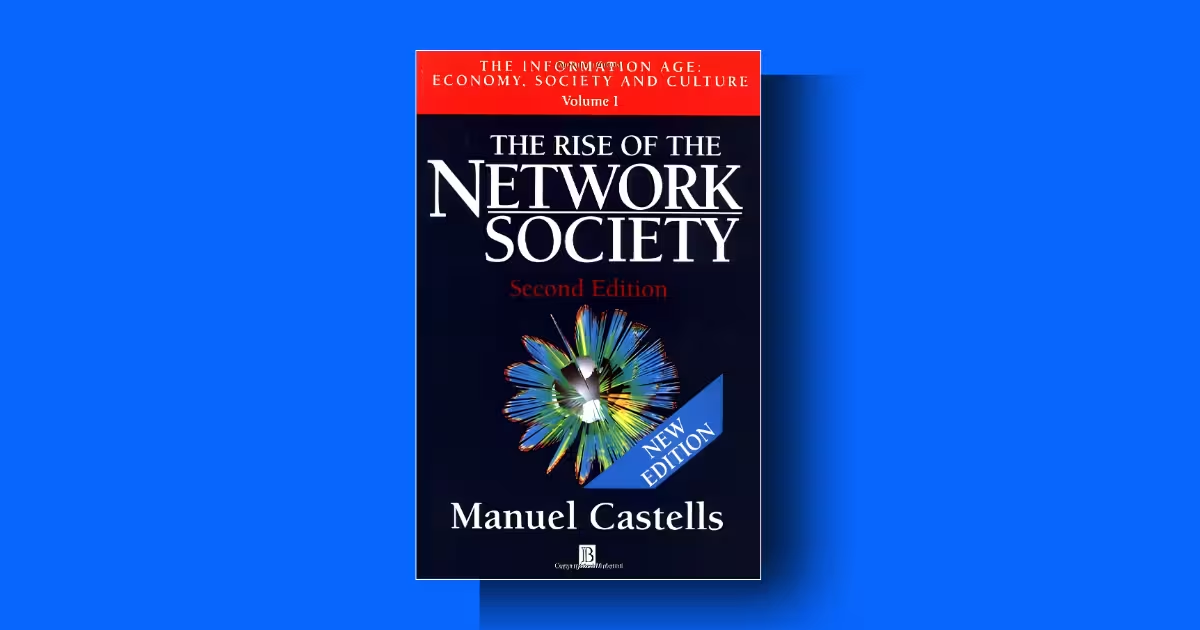
The Rise of the Network Society is the first volume of Manuel Castells’ groundbreaking three-part trilogy, The Information Age: Economy, Society, and Culture. First published in 1996, with a second edition in 2000 and a new preface in 2010, this book isn’t about technology for technology’s sake.
It’s about how networks, of capital, information, images, and power, have become the dominant organizational logic of our time.
Castells argues that we’ve moved beyond the industrial age into something fundamentally different: a network society where productivity and competitiveness depend on the capacity to generate and process knowledge-based information. The book spans nearly 600 pages and draws on research from the USA, Asia, Latin America, and Europe. It’s dense, sometimes daunting, but ultimately rewarding.
What you’ll learn:
- Why the global economy now works as a unit in real time
- How financial markets have become a “global casino” disconnected from actual production
- Why your work is increasingly flexible, temporary, and individualized
- How media and politics have fused into a single spectacle
- Why identity, religious, ethnic, national, has become the primary source of meaning in a world of flows
Reader Recommendation for The Rise of the Network Society
Who will actually love it:
- Sociology and media studies students, this is foundational reading that will shape your understanding of contemporary society
- Tech professionals and entrepreneurs, want to understand why Silicon Valley works the way it does? Castells explains the logic behind the networks you’re building
- Policy makers and urban planners, the book offers a framework for understanding globalization, inequality, and the spatial dynamics of the 21st century
- Anyone frustrated by modern life, if you’ve ever wondered why politics feels like entertainment, why your job feels precarious, or why global events feel so disconnected from local reality, this book offers answers
- Fans of Yuval Noah Harari, Shoshana Zuboff, or Naomi Klein, Castells provides the theoretical foundation many popular writers build upon
Who should probably skip it:
- Casual readers looking for light entertainment, this is academic work, and it shows
- Readers who prefer anecdote over data, Castells is rigorous, sometimes to a fault
- Anyone hoping for simple solutions, the book diagnoses problems brilliantly but offers few prescriptions
- Readers with limited time, at nearly 600 pages, this is a commitment
Table of Contents
1. Introduction
Title: The Rise of the Network Society (The Information Age: Economy, Society, and Culture, Volume I)
Author: Manuel Castells
Publication Details:
- First edition: 1996 (Blackwell Publishers)
- Second edition: 2000 (Blackwell Publishers)
- Second edition with new preface: 2010 (Wiley-Blackwell)
- ISBN: 9781405196864 (paperback)
Context of The Rise of the Network Society
This book is the first volume of a trilogy that includes The Power of Identity (Volume II) and End of Millennium (Volume III). Together, they represent one of the most ambitious sociological projects of the late 20th century, a systematic attempt to understand how information technology was restructuring economy, society, and culture on a global scale.
Manuel Castells was born in Hellín, Spain, in 1942. He studied economics and law before shifting to sociology. He taught at the University of Paris for 12 years before being appointed Professor of Sociology and of City and Regional Planning at the University of California, Berkeley, in 1979.
By the time he wrote this book, he had already established himself as one of the world’s preeminent social scientists through works like The Urban Question (1977) and The City and the Grassroots (1983).
Purpose of The Rise of the Network Society
The central argument of The Rise of the Network Society is straightforward yet profound: networks have become the new social morphology of our societies. As Castells writes:
“Networks constitute the new social morphology of our societies, and the diffusion of networking logic substantially modifies the operation and outcomes in processes of production, experience, power, and culture.”
The book aims to formulate a systematic theory of the information society that accounts for the fundamental effects of information technology on the contemporary world. Castells isn’t predicting the future, he explicitly distances himself from futurology. Instead, he’s identifying trends that were already observable in the 1980s and 1990s and making sense of their meaning.
2. Background
To understand why The Rise of the Network Society matters, you need to understand the intellectual context in which it emerged.
In the 1970s and 1980s, thinkers like Daniel Bell were writing about “post-industrial society”, the idea that advanced economies were shifting from manufacturing to services, and that knowledge would become the key resource. But Castells saw something deeper happening.
The 1970s weren’t just another economic downturn. They were a structural crisis of industrial capitalism. The old model, mass production, mass consumption, the welfare state, organized labor, was breaking down. Something new was emerging, but nobody quite knew what to call it.
Castells proposed a distinction between modes of production (capitalism vs. statism) and modes of development (industrialism vs. informationalism). This wasn’t just academic hair-splitting. It allowed him to argue that while capitalism was surviving, it was being fundamentally transformed by a new technological paradigm.
The information technology revolution wasn’t simply a new set of tools. It was a new way of organizing production, distribution, and consumption, one based on the generation and processing of knowledge. And this new “informational” mode of development was giving rise to a new social structure: the network society.
3. The Rise of the Network Society Summary
Let me walk you through what I learned from this book. I’ll try to be comprehensive because, honestly, the summary is where the real value lies.
The Information Technology Revolution
Castells begins by establishing that we’re living through a technological revolution comparable to the industrial revolution of the 18th century. But he’s careful to avoid technological determinism. As he puts it:
“Technology does not determine society: it embodies it. But neither does society determine technological innovation: it uses it.”
The revolution clustered in the 1970s, mostly in the United States, and especially in California. Key developments included:
- The microprocessor (Intel, 1971)
- The microcomputer (Apple II, 1977)
- The Internet (ARPANET, 1969; TCP/IP protocol, 1973)
- Genetic engineering (gene-cloning, 1973)
What makes this revolution different from previous ones? Information becomes the raw material. Previous technological revolutions acted on matter or energy. This one acts on information itself. And because information is integral to all human activity, the effects are pervasive.
Castells also notes the networking logic of the new technologies. Networks are flexible, adaptable, and can grow exponentially, the value of a network increases as the square of the number of nodes.
The New Economy
This is where things get really interesting. Castells argues that a fundamentally new economy emerged in the last quarter of the 20th century, one that is informational, global, and networked.
Informational because productivity and competitiveness depend on the capacity to generate and process knowledge-based information.
Global because the core activities of production, consumption, and circulation are organized on a global scale.
Networked because productivity is generated through global networks of interaction between business networks.
One of the most striking sections deals with the productivity paradox. In the 1970s and 1980s, despite massive investment in information technology, productivity growth actually slowed down. Castells offers several explanations:
First, there’s a time lag. The industrial revolution didn’t show up in productivity statistics for decades. The same thing was happening with information technology.
Second, measurement problems. How do you measure productivity in services? How do you account for quality improvements? Traditional statistics simply weren’t capturing what was happening.
Third, organizational change matters. Firms that simply grafted new technologies onto old structures saw little benefit. Those that reorganized their entire operations saw dramatic gains.
By the late 1990s, the productivity payoff finally arrived. Between 1995 and 1999, US productivity growth climbed to an annual rate of 2.6 percent, with the third quarter of 1999 posting an annualized rate of 4.2 percent.
Global Financial Markets
Castells devotes considerable attention to the globalization of finance, and for good reason. As he argues, financial markets are the backbone of the new global economy.
The numbers are staggering. By the late 1990s, the daily turnover of currency markets reached 1.5 trillion US dollars. Cross-border transactions in bonds and equities increased from less than 10 percent of GDP in 1980 to over 100 percent by the mid-1990s.
What made this possible? Three factors:
- Deregulation of financial markets
- New information technologies that allowed real-time global trading
- New financial products like derivatives that linked markets together
But there’s a dark side. These global financial networks are highly volatile. They can crash economies in days, as happened in Mexico (1994), Asia (1997), Russia (1998), and Brazil (1999). And because they operate in real time, they’ve escaped the control of any government or regulatory agency.
The Network Enterprise
Castells argues that the traditional, vertically integrated corporation is dying. In its place, we’re seeing the rise of the network enterprise, a form of organization that’s flexible, adaptable, and based on networks of autonomous units.
He identifies several organizational trends:
- From mass production to flexible production
- From vertical integration to networks of firms
- From management hierarchy to teamwork and worker autonomy
- From “just in case” to “just in time” inventory management
One of the most compelling examples is Cisco Systems. In the late 1990s, Cisco was handling over 80 percent of its orders over the web. It had cut its own manufacturing to the bone, most of its production was done by a network of suppliers who received orders directly from customers. Cisco’s business model wasn’t about making things. It was about managing the network.
This isn’t just about technology. It’s about a fundamental shift in how value is created. As Castells writes, the network enterprise is “that specific form of enterprise whose system of means is constituted by the intersection of segments of autonomous systems of goals”.
The Transformation of Work and Employment
This chapter was particularly eye-opening for me. Castells shows that while technology doesn’t directly cause unemployment, it does fundamentally transform the nature of work.
The key trend is individualization. Work is becoming more flexible, more temporary, and more individualized. The traditional model, a full-time job, with benefits and a career path, at a single company, is declining.
The numbers tell the story. Between 1983 and 1998, part-time work increased significantly in most OECD countries. Temporary employment grew in all countries analyzed. Self-employment increased in most countries. By the late 1990s, between one-quarter and one-half of the employed population in major industrialized countries did not follow the classic pattern of a full-time job with a regular working schedule.
But here’s the twist: this isn’t necessarily bad for everyone. High-skilled professionals often benefit from flexibility. They can work from anywhere, set their own schedules, and command premium salaries. The problem is the polarization between high-skilled “networkers” and low-skilled “generic labor”.
Castells introduces a useful typology of workers in the informational economy:
- Commanders, strategic decision-makers
- Researchers, innovators in products and processes
- Designers, who adapt and target innovation
- Integrators, who manage relationships between decisions and execution
- Operators, who execute tasks with initiative
- The “operated” , who execute preprogrammed tasks
This isn’t just about job titles. It’s about power. Those who control information and networks are increasingly separate from those who simply execute instructions.
The Culture of Real Virtuality
This chapter explores how electronic communication is transforming culture. Castells argues that we’re seeing the emergence of a new communication system, one that integrates all media into an interactive network.
The key shift is from mass media to mass self-communication. In the old model, a few centralized senders broadcast messages to millions of passive receivers. In the new model, anyone can produce content, distribute it globally, and interact with audiences.
The numbers are staggering. In 1999, the Internet connected about 63 million computer hosts and was used by 179 million people. By 2009, the number of Internet users had grown to about 1.5 billion.
But there’s a paradox. While the Internet enables unprecedented diversity and autonomy, it also creates new forms of control. Those who control the networks, the infrastructure, the platforms, the algorithms, exercise enormous power. As Castells puts it, “The power of flows takes precedence over the flows of power”.
The result is what he calls the culture of real virtuality. In this culture, reality itself is captured, fully immersed in virtual image settings. The boundaries between real and virtual blur. Murphy Brown’s fictional pregnancy becomes a real political issue. The distinction between information and entertainment collapses.
The Space of Flows
This is perhaps the most original concept in the book. Castells argues that space, the material support of social practices, has been fundamentally transformed.
In the industrial age, space was organized around places, cities, regions, nations, with clear boundaries and physical contiguity. In the network society, the dominant logic is the space of flows, the material support of simultaneous social practices communicated at a distance.
The space of flows has three layers:
- Electronic exchanges, the technological infrastructure (telecommunications, computer networks, information systems)
- Nodes and hubs, specific places that function as points of connection in global networks (global cities like New York, London, Tokyo)
- Elite spaces, the spatial organization of the dominant managerial elites who exercise directional functions
The key insight is that networks connect some places while disconnecting others. Global cities like New York, London, and Tokyo become nodes in global networks, attracting capital, talent, and power. But many other places, entire regions, countries, and communities, are switched off, becoming irrelevant from the perspective of the system’s logic.
This creates a fundamental tension. As Castells writes, “in a world constructed around the logic of the space of flows, people make their living in the space of places”. The contradiction between global networks and local identities is one of the defining features of our time.
Timeless Time
Time, like space, is being transformed. Castells argues that we’re seeing the emergence of timeless time, a form of temporality that mixes tenses and eliminates sequence.
This manifests in several ways:
- Financial markets operate in real time, with transactions measured in fractions of seconds
- Flex-time work blurs the boundaries between working time and personal time
- The life-cycle is being deconstructed, people have children later, work longer, and live longer
- Death is increasingly denied, pushed back by medical technology and hidden from view
- Wars are compressed into instant events, conducted remotely with smart bombs
- Media culture mixes past, present, and future in a single hypertext
The result is a world where time is no longer a predictable sequence. As Castells writes, timeless time is “the kind of time that occurs when in a given context, such as the network society, there is systemic perturbation in the sequential order of the social practices performed in this context”.
But not everyone experiences timeless time. Most people still live by clock time, the mechanical time of industrial work, the biological time of daily life. The tension between timeless time and clock time is another dimension of the fundamental split between the space of flows and the space of places.
4. The Rise of the Network Society Analysis
Reading The Rise of the Network Society felt like someone had turned on the lights in a room I’d been stumbling through in the dark. Castells doesn’t just describe what’s happening, he explains why it’s happening and how all the pieces fit together.
The book is remarkable for its scope. Castells draws on research from multiple countries, multiple disciplines, and multiple decades. He synthesizes economics, sociology, political science, and communication studies into a coherent framework. Few scholars could pull this off. Fewer still could do it without losing the reader.
But the book is also remarkable for its accuracy. Castells wasn’t predicting the future. He was identifying trends that were already visible in the 1980s and 1990s and projecting their logical consequences. More than 25 years later, those projections have largely been verified. The global financial crisis of 2008? Castells anticipated the structural instability of global financial networks. The rise of social media?
He foresaw the shift from mass media to mass self-communication. The resurgence of identity politics? He identified the tension between global networks and local identities as a defining feature of our time.
Does He Support His Arguments?
Yes, but the evidence can be overwhelming. Castells packs the book with statistics, case studies, and references. Sometimes the sheer volume of data makes it hard to see the forest for the trees. But the arguments are well-supported, and the logic is generally sound.
One weakness is the density of the prose. Castells writes in the style of academic sociology, precise, systematic, and sometimes impenetrable. The book rewards careful reading, but it’s not a quick read.
Another weakness is the tone. Castells is passionate about his subject, but he maintains a professional distance. The book doesn’t have the emotional resonance of, say, Naomi Klein’s The Shock Doctrine or the narrative drive of Yuval Noah Harari’s Sapiens. It’s analysis, not storytelling.
Does It Fulfill Its Purpose?
Yes. Castells set out to formulate a systematic theory of the information society, and he succeeded. The book provides a framework for understanding the economic, social, and cultural transformations of our time that is both comprehensive and coherent.
It’s not the final word, Castells himself acknowledges that his theory is exploratory, but it’s an essential starting point for anyone trying to make sense of the contemporary world.
5. Strengths and Weaknesses
What I Found Compelling
The conceptual framework. The distinction between modes of production and modes of development. The space of flows vs. the space of places. Timeless time. These concepts have become essential tools for understanding the contemporary world.
The global scope. Castells doesn’t just focus on the United States or Western Europe. He draws on research from Asia, Latin America, and Eastern Europe. The result is a truly global analysis.
The empirical grounding. This isn’t abstract theorizing. Castells backs up his arguments with data, lots of it. The book includes dozens of tables and figures documenting everything from productivity growth to Internet penetration.
The integration of technology and society. Castells avoids both technological determinism and social constructivism. He shows how technology and society co-evolve, each shaping the other.
The prophetic accuracy. It’s striking how many of Castells’ observations from the 1990s remain relevant today. He identified trends that have only intensified in the past quarter-century.
What I Found Frustrating
The length. Nearly 600 pages of dense academic prose is a lot to ask of any reader. Some sections could have been trimmed.
The prose style. Castells writes like an academic, which he is. The sentences are long, the vocabulary is specialized, and the arguments are complex. This isn’t a book you can skim.
The lack of prescriptions. Castells is brilliant at diagnosing problems but offers few solutions. He describes the network society but doesn’t tell us how to make it more just or humane.
The neglect of agency. The book focuses on structures and trends, not on the people who create and resist them. Social movements are discussed in later volumes, but they’re largely absent from this one.
The dated examples. Some of the case studies, particularly those about specific companies or technologies, feel dated. The book would benefit from updating, though the conceptual framework remains solid.
6. Comparison with Similar Works
The Third Wave by Alvin Toffler (1980)
Toffler’s book was one of the first to describe the shift from an industrial to an “information” society. But where Toffler is journalistic and speculative, Castells is scholarly and empirical. The Third Wave is more readable; The Rise of the Network Society is more rigorous.
The Coming of Post-Industrial Society by Daniel Bell (1973)
Bell’s classic anticipated many of the themes Castells addresses, the rise of services, the importance of knowledge, the role of technology. But Bell was writing in the 1970s, before the Internet and globalization had fully emerged. Castells builds on Bell’s insights while updating them for a new era.
The Wealth of Networks by Yochai Benkler (2006)
Benkler focuses on how networked information economies enable new forms of production and cooperation. He’s more optimistic than Castells, emphasizing the democratizing potential of networks. Castells is more balanced, acknowledging both the opportunities and the risks.
The Culture of the New Capitalism by Richard Sennett (2006)
Sennett explores similar themes, the transformation of work, the decline of stable careers, the rise of flexibility. But where Sennett focuses on the human experience of these changes, Castells focuses on the structural logic. They complement each other well.
The Power of Identity by Manuel Castells (1997)
This is the second volume of Castells’ trilogy. While The Rise of the Network Society focuses on the economic and technological dimensions of the network society, The Power of Identity focuses on the social and political responses, social movements, religious fundamentalism, nationalism, and the crisis of the nation-state.
End of Millennium by Manuel Castells (1998)
The third volume examines the collapse of the Soviet Union, the rise of the Fourth World (zones of social exclusion), the global criminal economy, and the economic crisis in Asia. Together, the three volumes provide a comprehensive picture of the network society.
7. Conclusion
So, after all of this, what’s my final verdict?
The Rise of the Network Society is an essential book for anyone trying to understand the contemporary world. It’s not an easy read, the length, the density, and the academic prose will test your patience. But the reward is worth the effort.
Castells provides a framework for making sense of a world that often feels chaotic and incomprehensible. He shows how seemingly disconnected phenomena, the globalization of finance, the transformation of work, the rise of identity politics, the evolution of media, are all expressions of a single underlying shift: the emergence of a new social structure organized around networks.
The book has its limitations. It’s stronger on diagnosis than prescription. It focuses on structures rather than agency. And some of the examples feel dated. But the core argument remains as relevant today as it was when the book was first published in 1996.
A Final Thought
Castells ends the book with a powerful observation. We’ve entered a new stage in human history, one where culture refers to culture, having superseded nature to the point that nature is artificially preserved as a cultural form. This isn’t the end of history. It’s the beginning of a new kind of history, one where we’re alone in our human world, looking at ourselves in the mirror of historical reality.
The question is whether we’ll like what we see.
Related Books/Films/Articles:
- The Power of Identity by Manuel Castells
- End of Millennium by Manuel Castells
- The Wealth of Networks by Yochai Benkler
- The Culture of the New Capitalism by Richard Sennett
- The Coming of Post-Industrial Society by Daniel Bell
- The Third Wave by Alvin Toffler
- The Social Construction of Technological Systems (edited by Bijker, Hughes, Pinch)
- “Materials for an exploratory theory of the network society” by Manuel Castells
This review is based on the 2010 second edition of The Rise of the Network Society, published by Wiley-Blackwell.