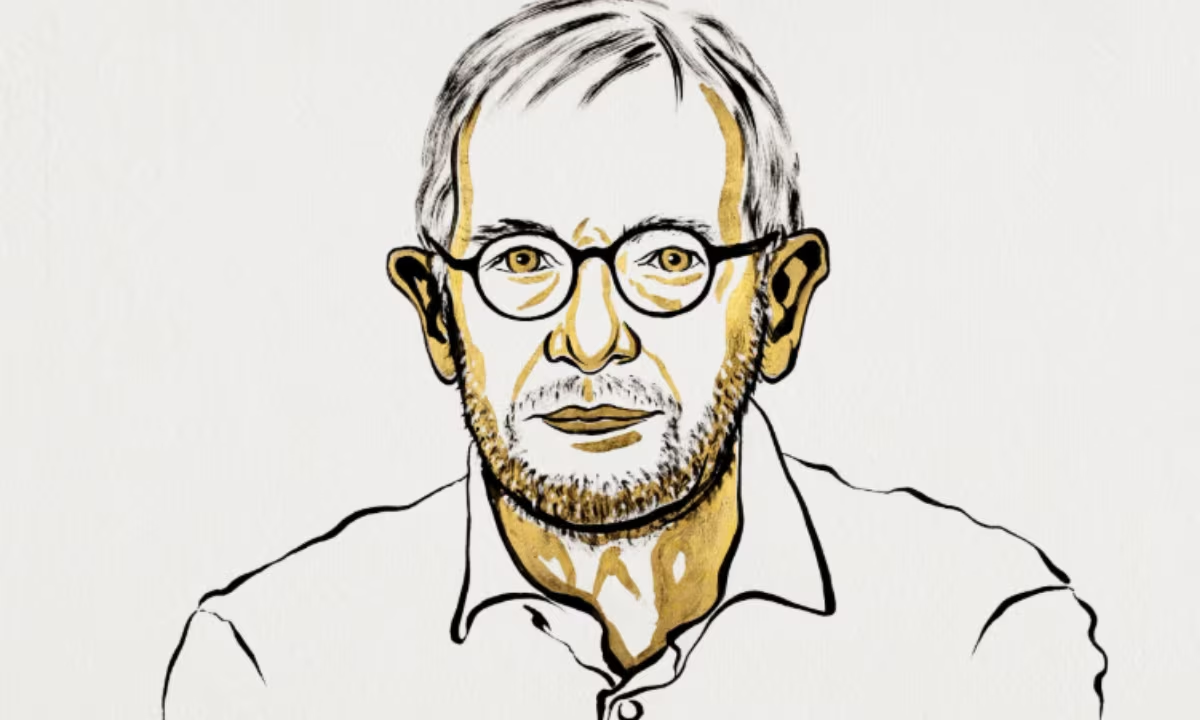

Stockholm, October 6, 2026. The Royal Swedish Academy of Sciences has awarded the Nobel Prize in Physics 2026 to Francis Halzen, the Belgian-born physicist at the University of Wisconsin–Madison who spent nearly four decades building a particle detector inside the ice sheet at the South Pole.
The Academy honoured Halzen “for decisive contributions to the IceCube Neutrino Observatory and the discovery of high-energy neutrinos of astrophysical origin.” He receives the full prize of 12 million Swedish kronor, roughly $1.2 million, along with a medal and diploma.
Table of Contents
Nobel Prize in Physics 2026
Winner: Francis Halzen, 82, University of Wisconsin–Madison
Why: Leading the IceCube Neutrino Observatory and the first detection of high-energy neutrinos from beyond our solar system
Prize: 12 million Swedish kronor, not shared
Notable: Halzen is the first sole winner of the physics prize since Georges Charpak in 1992
Ceremony: December 10, 2026, in Stockholm
A Surprise Call in Italy
Halzen took the committee’s call by phone while in Italy. Speaking to the Associated Press, he said, “It was a great surprise and I obviously didn’t expect it,” adding that the news left him feeling strange.
Mark Pearce, chair of the Nobel Committee for Physics, credited Halzen’s persistence, saying his work “paved the way for a new kind of astronomy.”
What Are Neutrinos, and Why Are They So Hard to Catch?
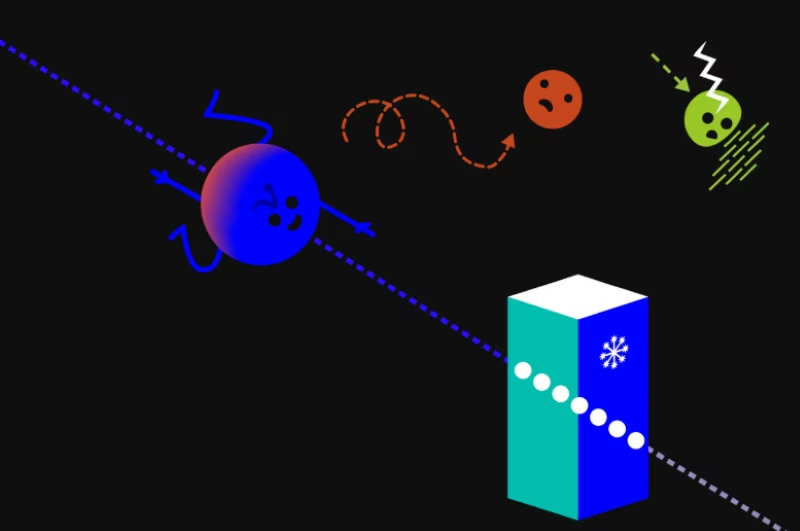
Neutrinos are nearly massless particles with no electric charge. They interact with ordinary matter so rarely that tens of billions of them, most from the Sun, stream through every square centimetre of your body each second without leaving a trace.
That same quality makes them valuable to astronomers. Light can be absorbed by dust, and charged cosmic rays get bent by magnetic fields on their way to Earth, so neither points cleanly back to its source. A neutrino travels in a straight line from wherever it was born, carrying information out of the most violent places in the universe, including the regions around supermassive black holes.
The catch is that you need an enormous detector to see even a handful of them.
A Cubic Kilometre of Ice
Halzen first proposed using Antarctic ice as a neutrino detector in 1988. The idea was simple on paper. When a neutrino occasionally strikes an atomic nucleus in the ice, it produces charged particles that give off a faint blue flash. Ice deep below the surface is clear enough for light sensors to record that flash and reconstruct the neutrino’s direction and energy.
Turning that idea into hardware took decades:
- Late 1980s to 1990s: Halzen served as principal investigator of AMANDA, a smaller prototype array that tested whether the polar ice could work as a detector.
- 2005 to 2010: Crews drilled 86 holes into the ice with hot water and lowered strings of sensors between 1,450 and 2,450 metres below the surface. Construction was completed in December 2010.
- The finished instrument: 5,160 digital optical modules spread through a cubic kilometre of ice, at a total project cost of about $279 million.
IceCube is operated by the University of Wisconsin–Madison with support from the U.S. National Science Foundation and funding agencies in Sweden, Belgium, Germany and other countries. The collaboration now includes more than 450 people from 58 institutions in 14 countries.
What IceCube Found
The detector delivered the result the Nobel committee singled out. In 2013, the IceCube team reported 28 neutrinos with energies far too high to have come from Earth’s atmosphere or the Sun. Two of them, nicknamed “Bert” and “Ernie” after the Sesame Street characters, each carried about one petaelectronvolt, or 1,000 trillion electronvolts. It was the first solid evidence of high-energy neutrinos arriving from deep space.
Later findings built on that discovery:
2018: IceCube traced a neutrino detected in September 2017 to a blazar called TXS 0506+056, a galaxy with an active black hole billions of light-years away. It was the first time a neutrino detector helped identify a specific cosmic source.
2022: The collaboration reported neutrino emission from the active galaxy NGC 1068 (Messier 77).
2023: IceCube produced the first neutrino “image” of our own Milky Way, detecting emission from the galactic plane.
Together, these results turned neutrinos into a working tool for astronomy, alongside light and gravitational waves.
Who Is Francis Halzen?
Halzen was born in Tienen, Belgium, in 1944. He earned his master’s degree (1966) and doctorate (1969) in physics at the University of Louvain, then worked as a scientific associate at CERN before joining UW–Madison in 1972. He has stayed there for more than 50 years and holds a named Gregory Breit professorship.
Before the Nobel, his honours included the Balzan Prize (2015), the Bruno Pontecorvo Prize (2018), election to the U.S. National Academy of Sciences (2024), and the American Physical Society’s 2026 Medal for Exceptional Achievement in Research.
Why This Prize Stands Out
Recent physics prizes have usually been split among two or three researchers. Last year’s award went jointly to John Clarke, Michel Devoret and John Martinis for experiments showing quantum effects in electrical circuits. A solo award is rare, and this one recognises a career-long bet on a project that many considered impractical when Halzen first pitched it.
The prize also honours the kind of science that depends on large teams and long timelines. IceCube is an instrument, not a single experiment, and the committee’s citation names both the detector and the discovery it made possible.
What Happens Next
Halzen will receive the prize at the Nobel ceremony in Stockholm on December 10, the anniversary of Alfred Nobel’s death. Meanwhile, IceCube continues to collect data, and the collaboration has proposed a much larger successor, IceCube-Gen2, to detect rarer and more energetic neutrinos.
For readers interested in how other physicists have shaped our view of the cosmos, see our pieces on Stephen Hawking on God and the universe and Oppenheimer (2023). For another recent Nobel story, read our review of The Infinity Machine, on Nobel chemistry laureate Demis Hassabis.