

Do you ever wonder why some people emerge from the worst conditions with their humanity intact while others are destroyed by the same experience? Dostoevsky’s Notes from a Dead House answers that question with brutal honesty.
Overview
A semi-autobiographical account of Dostoevsky’s four years in a Siberian labor camp (1850–1854), framed through the fictional narrator Alexander Petrovich Goryanchikov. The book documents prison life, the psychology of convicts, and the author’s own transformation from aristocratic prejudice to a profound understanding of human dignity.
Notes from a Dead House is best for readers of classic Russian literature, fans of psychological depth, those interested in prison narratives, and anyone curious about Dostoevsky’s development as a writer.
Notes from a Dead House is not for readers seeking a fast-paced plot or light entertainment—this is a slow, immersive, and often bleak exploration of prison life.
Table of Contents
1. Introduction
Notes from a Dead House (also published as The House of the Dead) was written by Fyodor Dostoevsky and first published serially between 1860 and 1862.
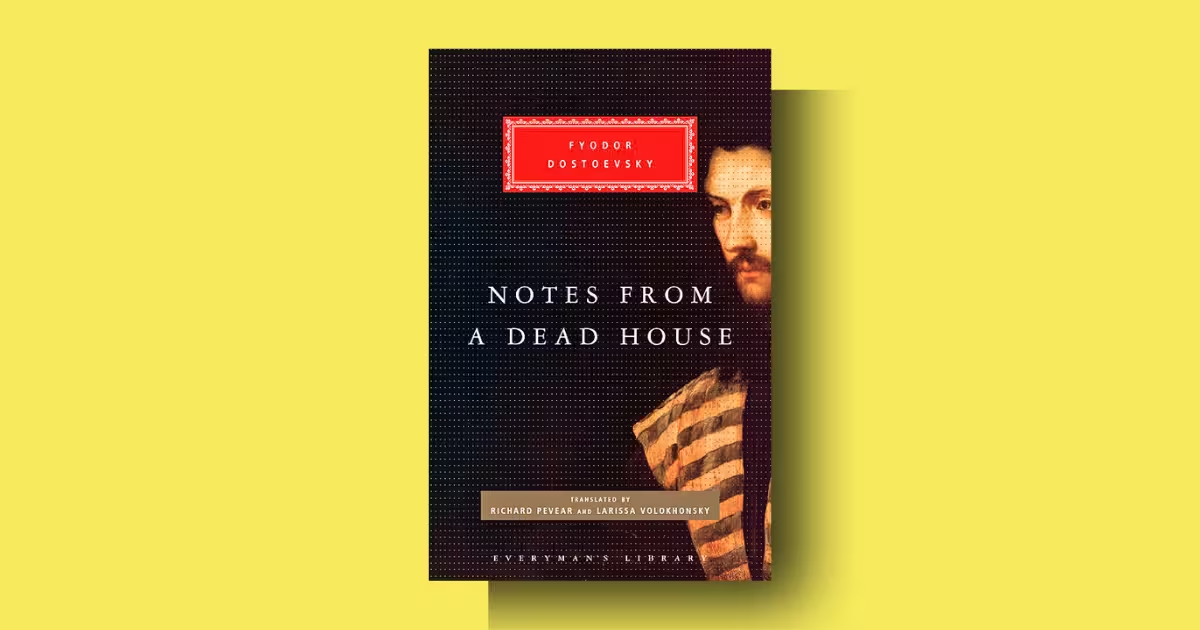
The edition I read is the 2015 translation by Richard Pevear and Larissa Volokhonsky, published by Alfred A. Knopf. It runs approximately 368 pages and is classified as a semi-autobiographical novel.
2. Background
Dostoevsky was arrested on April 23, 1849, for his involvement in the Petrashevsky Circle, a group of intellectuals who discussed utopian socialism.
He was 28 years old when he entered prison on January 23, 1850. After a mock execution, a psychological torture orchestrated by Tsar Nicholas I, his death sentence was commuted to four years of hard labor in Omsk, Siberia, followed by four years of military service.
The journey from St. Petersburg to Omsk covered more than 2,000 miles. The prison held about 250 inmates at any given time. Dostoevsky was forbidden to write while incarcerated, but he managed to make notes during hospital visits and later reconstructed the material from memory.
3. Notes from a Dead House Summary
The Framing Device
The book opens with an unnamed editor discovering the notes of Alexander Petrovich Goryanchikov, a former nobleman who served ten years in a Siberian prison for murdering his wife. Goryanchikov lived as a recluse after his release and died in obscurity. The editor presents these notes to the public, noting their “totally new world, unknown till then”.
Entering the Dead House
Goryanchikov describes the prison as “an alive dead house, a life like nowhere else”. The compound is surrounded by a high stockade with sharpened posts. Inside, about 250 prisoners live in cramped barracks, sleep on wooden bunks, and wear fetters that clank with every step. The prisoners are divided into categories based on the severity of their crimes and sentence lengths.
The narrator’s first impressions are marked by disgust and disbelief. He notes the “ceaseless gossip and scandal-mongering” and observes that “vanity and appearances took the foreground”. Most prisoners show no sign of repentance. They consider themselves justified in their crimes.
First Impressions and Early Days
Goryanchikov struggles to adapt. He is shunned by the other prisoners because of his noble status. The convicts “took a dark and unfavorable view of former noblemen”. He is mocked for his weakness at work and his inability to perform manual labor.
He describes the prison’s internal economy: money is smuggled in, vodka is traded, and prisoners work at crafts to earn kopecks. He observes the “maidan” (card games), the smuggling of vodka in bull’s guts, and the brutal punishment of those caught.
Christmas and the Theater
The Christmas holidays bring a brief respite. The prisoners receive alms from the town, eat better food, and organize a theater performance. The performance is a highlight, prisoners act in plays like Filatka and Miroshka and Kedril the Glutton. The audience, including Circassians and Tatars, is captivated. Goryanchikov notes the “childlike joy” on the prisoners’ faces during the performance.
The Hospital
Goryanchikov falls ill and is sent to the military hospital. Here he witnesses the aftermath of corporal punishment—men with lacerated backs, some dying from their wounds.
He observes the prisoners’ stoicism and the strange hierarchy among them. He sees one man, Mikhailov, die of consumption while still wearing fetters. The fetters, he reflects, are “a dishonor, a shame and a burden, physical and moral”, not a practical prevention against escape.
Akulka’s Husband
One night in the hospital, Goryanchikov overhears a story told by Shishkov, a young prisoner. Shishkov recounts how he married Akulka, a girl dishonored by another man. He beat her mercilessly, grew jealous, and eventually tried to kill her by slashing her throat. She survived the attack but died later.
The story reveals the cycle of violence, jealousy, and poverty that pervades the prisoners’ past lives.
Summertime and the Grievance
Spring brings renewed longing for freedom. The prisoners work harder—making bricks, carrying loads, shoveling snow. A grievance over food leads to a confrontation with the major.
The prisoners line up to protest, but Goryanchikov is told to stay out of it. The major quickly suppresses the protest, but the incident reveals the deep divisions between nobles and commoners.
The Prison Animals
A chapter on the prison’s animals—dogs, geese, a goat, and an eagle—offers a brief respite from the grimness. The goat, Vaska, becomes a beloved pet until the major orders it slaughtered. The eagle, wounded and captive, is released by the prisoners. Goryanchikov reflects: “He’s a free, tough bird, he’s not used to prison.”
The Escape
Kulikov and A—v, two prisoners, attempt to escape with the help of a guard, Koller. They are captured after eight days. The prisoners’ reaction shifts from admiration to mockery when the escape fails. Kulikov is given 1,500 strokes; A—v receives 500. The failed escape underscores the near-impossibility of freedom.
Leaving Prison
In the final chapter, Goryanchikov is released. He walks through the prison for the last time, saying goodbye to his fellow inmates. He reflects: “These people are extraordinary people.
They are perhaps the most gifted, the strongest of all our people. But their mighty strength perishes for nothing, perishes abnormally, unlawfully, irretrievably.” The fetters are removed, and he steps into freedom.
4. Notes from a Dead House Analysis
4.1 Notes from a Dead House Characters
Alexander Petrovich Goryanchikov (The Narrator)
Goryanchikov is Dostoevsky’s fictional alter ego. He is a former nobleman who killed his wife out of jealousy. Throughout the book, he evolves from a prejudiced aristocrat to a man who sees the humanity in even the most hardened criminals. He notes: “The prisoner himself knows that he is a prisoner, an outcast … but no brands, no fetters will make him forget that he is a human being”.
Petrov
A prisoner in the “special section,” Petrov is described as “the most resolute, the most fearless of all the convicts.” He is capable of murder but also shows moments of kindness. He steals from Goryanchikov but later confesses without remorse. He represents the unpredictable nature of human morality.
Alei
A young Tatar prisoner, Alei is innocent and kind-hearted. Goryanchikov teaches him to read and write. Alei’s transformation from illiterate boy to literate man is one of the book’s few hopeful arcs. He represents the potential for goodness even in the worst circumstances.
Akim Akimych
A former sub-lieutenant, Akim Akimych is pedantic, honest, and utterly indifferent to his surroundings. He accepts prison life with stoic resignation. He represents the type of person who can adapt to anything through sheer rigidity.
The Major (“Eight-eyes”)
The prison’s cruel commander, the major embodies arbitrary authority. He is hated by the prisoners and feared for his unpredictability. After his dismissal, he becomes a pathetic figure, revealing how power defines a man’s identity.
Isai Fomich Bumstein
A Jewish prisoner and jeweler, Isai Fomich is comical, boastful, and resilient. He celebrates the Sabbath in prison and endures mockery with good humor. He represents the persistence of cultural identity under oppression.
4.2 Notes from a Dead House Themes and Symbolism
The Dehumanization of Prison
The prison strips away individuality. Prisoners are shaved, branded, and forced into uniforms. Even “the most distinct, most original personalities … tried to fall into the general tone”. The fetters are not merely physical—they are symbolic of a permanent loss of freedom.
The Inequality of Punishment
Goryanchikov obsesses over the fact that the same punishment is applied to vastly different crimes. One man kills for pleasure; another kills in self-defense. Yet both receive the same sentence. He writes: “For each character there is a variation” of the crime, but the law fails to account for this.
The Duality of Human Nature
Dostoevsky shows that prisoners are neither purely evil nor purely good. Some murderers are gentle; some thieves are honest. The book challenges the reader to see beyond labels.
The Role of Work
Forced labor is not productive but punitive. Goryanchikov observes that if work were truly meaningless—like pouring water from one tub to another—prisoners would go mad. Meaningful work, even under duress, preserves sanity.
Freedom as an Illusion
The prisoners dream of freedom, but their dreams are often unrealistic. Even after release, they remain marked by their experience. The book suggests that true freedom is internal, not external.
5. Notes from a Dead House Evaluation
5.1 Strengths
Psychological Depth
Dostoevsky’s ability to enter the minds of criminals and outcasts is unparalleled. He shows their humanity without excusing their crimes.
Vivid Descriptions
The bathhouse scene, the hospital ward, and the theater performance are rendered with extraordinary detail. You can almost smell the prison.
Honest Portrayal
Dostoevsky does not romanticize prison life. He shows the filth, the cruelty, and the despair, but also the moments of kindness and humor.
Structural Innovation
The fragmented, episodic structure mirrors the monotony of prison life. As one reviewer noted, it can be “repetitive … by design to affect the quotidian tedium of prison life”.
5.2 Weaknesses
Pacing Issues
Some chapters feel like a slog. The book is not plot-driven, and readers expecting a conventional narrative may be frustrated.
Disjointed Tone
The book shifts between memoir, observation, and fiction. This can be disorienting.
Prejudice
Dostoevsky’s descriptions of some prisoners reflect the prejudices of his time. The Jewish character, Isai Fomich, is portrayed with affection but also with stereotypes.
5.3 Impact
The book had a profound effect on Russian society. It is credited with influencing Tsar Alexander II’s penal reforms. Tolstoy called it Dostoevsky’s finest work. It also initiated the genre of the prison memoir in Russian literature.
5.4 Comparison with Similar Works
| Work | Author | Similarities | Differences |
|---|---|---|---|
| The Gulag Archipelago | Aleksandr Solzhenitsyn | Prison narrative, moral reflection | Non-fiction, Soviet context |
| Crime and Punishment | Dostoevsky | Psychological depth, crime | Fictional plot, not autobiographical |
| One Day in the Life of Ivan Denisovich | Solzhenitsyn | Daily prison life | Shorter time frame, more focused |
6. Personal Insight with Contemporary Educational Relevance
Why This Book Matters Now
Prison reform remains a pressing global issue. According to the UK’s Prison Reform Trust, nearly 47,000 people were sent to prison in England and Wales in the year to June 2025. Reoffending costs an estimated £18 billion annually. In some countries, recidivism rates exceed 80%.
Dostoevsky’s central argument—that punishment alone does not reform—is supported by modern data. A 2025 report from Nigeria showed that rehabilitation programs reduced recidivism from 11,616 to 1,382 repeat offenders in two years. In Malaysia, only 1 in 800 program participants returned to crime.
The book teaches us that prisoners are not a separate species. They are human beings shaped by circumstance. Goryanchikov’s transformation—from hatred to understanding—is a blueprint for how society might view those behind bars.
5 Lessons from Notes from a Dead House
- Human dignity survives even in the worst conditions. The prisoners maintain their sense of self, despite being branded and fettered.
- Punishment without purpose is cruel and ineffective. Dostoevsky shows that forced labor without meaning destroys the soul.
- Compassion can bridge the deepest divides. Goryanchikov’s friendship with Alei crosses class, culture, and religion.
- Hope is essential for survival. Even the most hopeless prisoners cling to dreams of freedom.
- Society is judged by how it treats its outcasts. The book challenges readers to look beyond the crime and see the person.
7. Notes from a Dead House Quotes
Here are some of the most powerful passages from the book:
“Man is a creature who gets used to everything, and that, I think, is the best definition of him.”
“The prisoner himself knows that he is a prisoner, an outcast … but no brands, no fetters will make him forget that he is a human being.”
“These people are extraordinary people. They are perhaps the most gifted, the strongest of all our people. But their mighty strength perishes for nothing, perishes abnormally, unlawfully, irretrievably.”
“I must say it all: these people are extraordinary people.”
“I remember perfectly that in the first place this life astonished me by the very fact that it offered nothing particular, nothing extraordinary, or to express myself better, nothing unexpected.”
8. Conclusion
Notes from a Dead House is not an easy read. It is bleak, repetitive, and often harrowing. But it is also one of the most honest and compassionate books ever written about prison life. Dostoevsky does not excuse the crimes of his fellow inmates, but he refuses to see them as monsters. He shows us their humanity, their suffering, and their resilience.
This book is essential reading for anyone interested in Dostoevsky’s development as a writer, the history of Russian penal systems, or the psychology of incarceration. It is a testament to the power of empathy and the endurance of the human spirit.
Recommendation: If you are new to Dostoevsky, start with Crime and Punishment. But if you are ready for something deeper and more personal, Notes from a Dead House will stay with you long after you close the book.